If you are truly present and know how to take care of the present moment as best you can, you are doing your best for your future. The same is true about the past. The teaching and the practice of mindfulness do not forbid looking deeply into the past. But if we allow ourselves to drown in regret and sorrow concerning the past, that’s not mindfulness – Thich Nhat Hanh
Category Archives: Uncategorized
If you are trul…
Pain – Let it pass through
I am just reading a fascinating book by Michael A. Singer “The Untethered Soul”. He goes much into why we get stuck in pain by the things that hurt us. Here is a quote that I would like to share:
“If life does something that causes a disturbance inside of you, instead of pulling away, let it pass through you like the wind. After all, things happen every day that cause inner disturbance… If you want to be free, you have to learn to stop fighting those human feelings. When you feel pain simply view it as energy.
This goes much in line with the yin-yang philosophy which teaches us to accept that we live in a world of polarity. There will always be good and there will always be bad. There will always be moments of happiness and moments of sadness.
In practising Taiji we learn to stay grounded and aligned by never confronting the force that comes at us with the same energy. If you resist you will lose your balance. If you soften your body if a hard force comes at you, you will win the battle.
Singer writes that every time you relax and release a pain inside your heart and actually dare to face it, it will pass. It will be released and open up your heart and emotional body to new and more powerful energy…
More on yin and yang: https://reinoblog.wordpress.com/yield-and-overcome/
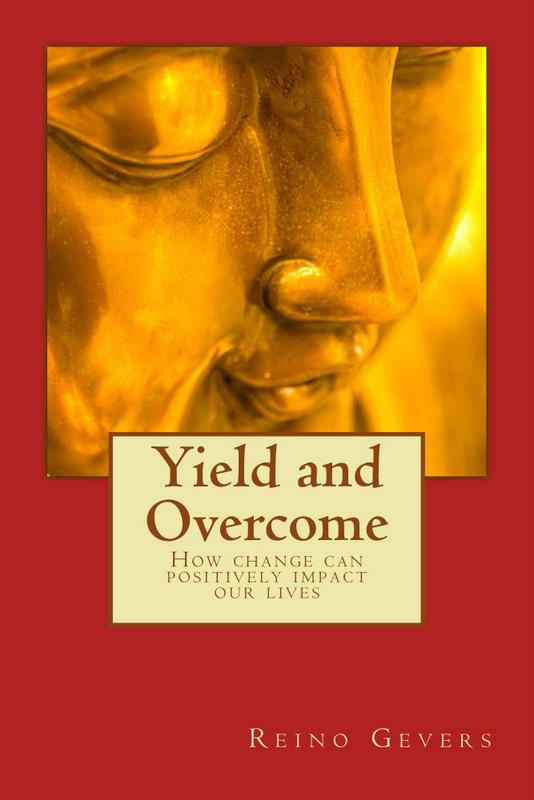
My book “Yield and Overcome”: http://goo.gl/TXSgw0
Filed under Uncategorized
Finding peace with the polarity of yin and yang
Our western culture finds itself in an extreme state of imbalance. We are buying too many things we don’t really need, eat too much unhealthy food and allowing our mind to be captured by a cacophony of so many voices that we can barely be alone in total silence for more than a few minutes.
We have become sidetracked. There is much we can learn from ancient eastern culture to regain our bearings. According to the ancient Daoist principle the universe is constantly striving toward a balance between the polarity of yin and yang.
We can understand the principle of yin and yang best by looking at the yin and yang symbol.

Within the dark yin is also yang and in the lightened yang is also yin. Day turns to night and night turns to day. The entire universe is based on this polarity which is constantly in flow and in movement. Without the polarity of the male and female there would be no life. Like this universal principle the body will always try to restore balance between these energies and set the stage for the next growth cycle.
Illness, imbalance or destruction proceeds where there is too much yin or too much yang. The advertising world is indoctrinating us 24-7 on what we need to buy or do to live a happy life. In most cases we don’t even notice how subtle these influences are. These mostly “external needs” can never be met. We live a hollow life of what we perceive to be unfulfilled personal needs and wants. Our western culture feeds on us comparing ourselves with Joe next door who has “a big house and can afford to buy a sports car.”
A couple of years ago I visited Malawi, a small south eastern African country and one of the world’s poorest countries with a gross national income per capita of 870 dollars (or personal income per person annually) compared to 27,000 in the United States. I have never seen so many happy and smiling people around me than in Malawi. It is a subjective view, but still set me thinking why people in the wealthy countries look a lot more glum. This is not to be misunderstood that you need to be poor to be happy. I presume however, that the people in the mainly agrarian culture of Malawi know that they are dependent on each other and feel a much greater sense of being part of a caring family and community.
In the Book of Wisdom, the I Ging, one of the central themes is finding the right moment to withdraw into yin or to become pro-active by going into yang. The Daoist and other wise women and men teach us that we need to let go of attachment and that this is one of the main reasons for misery and unhappiness. Unhappy and sad moments in our lives are just as transient as the happy moments. Thus the happy person is the one who has found peace in himself or herself that everything is impermanent, in a constant cycle like the seasons going through birth, growth, death and rebirth. Sadly much of organised Christian in the West focuses too much on the crucifixion and pain aspect. It is my personal view that the deeper meaning of the Christ is that we constantly go through cycles of birth, crucifixion and resurrection. After walking painfully over the path of hot coals lies growth and light.

Filed under Uncategorized
A walk through Switzerland – a different Camino
All across western Europe a network of ancient trails used by pilgrims for centuries are being re-discovered as a growing number of people are realising that taking a long walk is one of the best ways to get your stress level down.
During the Middle Ages it was common practise for at least one member of the family to walk by foot to Santiago de Compostela in Spain to pay homage to what is believed to be the burial place of St. James – one of the Apostles of Jesus. Many did not survive the hazards of disease, bandit attacks and other accidents.
Following a series of recent best-selling books on the Camino including “The Pilgrimage” by Paulo Coelho and “I’m Off Then: Losing and Finding Myself on the Camino de Santiago” by the German entertainer Harpe Kerkeling, tens of thousands of people are again walking the Camino every year.
The main route, the Camino Frances, from Roncesvalles to Santiago is 737 kilometres long and will take the hiker several weeks to complete. The route is well signposted and the “peregrino” or hiker will find a pilgrims hostel in almost every village on the way where he/she can stay at a cheap price overnight. It is a far cry to the hazardous route from the days of yore.
After taking my first “small” 120 kilometre walk from Saria to Santiago several years ago I have literally become hooked to these ancient paths. Since then I have understood why many a wise teacher has pronounced that getting back into sync with nature “is your best healer”. Walking helps you find your natural rhythm, relaxes your breathing and has many other positive health effects.
On one of my longest trails lasting more than four weeks, which I walked with my good friend Tom, we took the more rugged Camino del Norte along the coast from Urquera to Santiago. It was an exhilarating experience, off the main route frequented by most other peregrinos. The landscape is spectacular with mountains, a rugged coastline and remote villages.
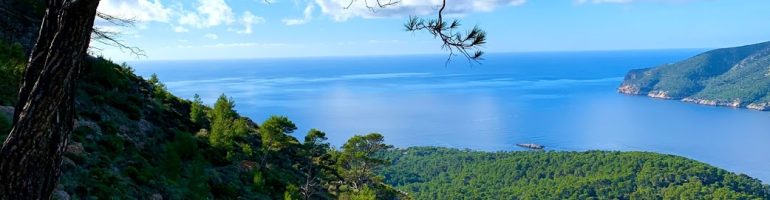
This year my wife Alyce, our Dalmatian dog Klara and I did a short stretch from St. Gallen to Einsiedeln in Switzerland. During the Middle Ages most pilgrims from northern Europe walked the same route, gathering at the famous monastery in Einsiedeln before commencing on the long route through France and Spain. Walking slowly by foot through a country makes you see so many things you would never see when travelling by car, bus, train or even bicycle.
After a long afternoon walk up an Alpine hill during summer temperatures of well over 30 degrees Celsius we found a hut next to the road and a fridge filled with cold drinks and ice cream. You merely put into a bottle the money for the drinks you consumed. I couldn’t help but wonder what such a gesture of trust in one’s fellow man would have meant in my home country South Africa with its spiralling crime rate. Camping sites in the Swiss Alps are spotlessly clean and equipped with all the necessary utensils with obviously no danger of theft and vandalism. People had warned us not to take a dog on the walk but we were positively surprised how accommodating and dog-friendly the Swiss really are.
True, Switzerland also has its problems, but somehow the Swiss for centuries have managed to stay on track with a grass roots democracy based on mutual tolerance for different religious, language and cultural affiliations with a broad consensus on this common value system. A general scepticism in big government is deeply embedded with the cantons or regions having wide legislative freedoms. The result: A healthy and vibrantly affluent society.
Filed under Uncategorized
Genes versus lifestyle
Are we victims of our genes or can we largely influence our health?
The debate has been raging all the more since the 38-year-old actress Angelina Jolie went public earlier this year by revealing that she underwent a double masectomy after discovering she had inherited a cancer gene that killed her mother, grandmother and great-grandmother.
While it remains a very personal and painful decision to undergo such a radical step, one side of the medical profession is lauding Jolie while others are questioning whether this was really necessary.
For the past decade most research has concluded that genes play a major role on whether we are obese, die of a heart attack or cancer. But this appears to be only half the truth. A new field of research called epigenetics tells us that the choices we make in our daily living and in what environment we live can actually alter our health at the molecular level, even if we are born with genes that give us a predisposition of contracting certain types of disease.
The good news here is that we have the choice. We have the freedom to decide how healthy our lives are going to be. The amount of exercise we get, the food we eat, the water we drink and the air we breathe has a huge effect on our health.
According to the research, exercise may well alter the expression of our genes in a positive way, preventing a variety of disease such as Alzheimer, heart and circulatory problems.
Certain types of stem cells appear to determine their direction at an early stage, depending on how well we exercise and what food we eat. Using treadmill-conditioned mice, a team of researchers from McMaster University, United States, led by the Department of Kinesiology’s Gianni Parise has shown that exercise triggers those cells to become bone more often than fat. In sedentary mice, the same stem cells were more likely to become fat, impairing blood production in the marrow cavities of bones.
“The interesting thing was that a modest exercise program was able to significantly increase blood cells in the marrow and in circulation. What we are suggesting is that exercise is a potent stimulus, enough of a stimulus to actually trigger a switch in these mesenchymal stem cells,” according to Parise
The research appeared in a paper published by the Journal of the Federation of American Societies for Experimental Biology.
Filed under Uncategorized
Cold facts of staying in denial when it comes to your personal health
Most of us human beings see ourselves at the top of the evolutionary ladder endowed with enormous intelligence with the capacity to reflect on our own patterns of behaviour. At the same time we are extremely rigid in our ways, unable to change a lifestyle that we know is doing us great harm.
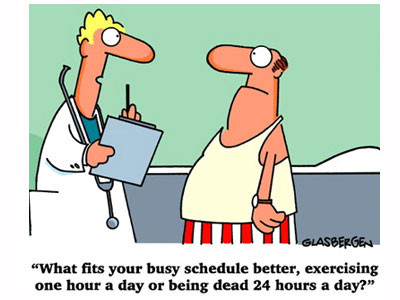
If you ask people what is important for their happiness, most will reply that it is their loved ones, good health, friends or a good job. If you add another question: “What are you actually doing to stay healthy?” there is a long pause or an excuse like: “I don’t have any time to fit a physical exercise programme into my busy schedule.”
Ask any seriously ill person what her/his greatest wish is, it certainly won’t be a win in the national lottery. When the body no longer functions as it should be, a lot of it has to do with what kind of lifestyle you have led for the past years or decades. Most of our modern diseases like diabetes, heart circulatory ailments, cancer, skeletal and bone problems and many mental illnesses can be directly attributed to the kind of lifestyle we lead. Only a small percentage is actually hereditary and some health experts are even questioning the “cancer gene” theory, arguing that there might be some risk of dying from a heart attack like your grandfather and brother but that this need not be inevitable . There is much you can do to compensate for an inherited body weakness.
In 2011, five major causes of death (heart disease, cancer, chronic lower respiratory diseases, stroke, and accidents) accounted for 62 per cent of all deaths in the United States. http://goo.gl/a5rdR
The figures would be much the same in other western countries. Life expectancy is increasing but how many people over the age of even 55 or 60 can really still say of themselves that they are fit and healthy.
Until the late 1950s most people in the western world had jobs demanding some kind of physical activity. Mortality rates were mostly as a result of respiratory diseases. Diabetes and obesity were rare by today’s standards. To put it bluntly: We are poisoning our bodies with the wrong foods and not getting enough exercise to stimulate our body metabolism. The amount of sugars, fats and salts we eat daily actually requires a good 20 kilometre run a day to get rid of all those excess toxins. The sad truth is that in Germany for instance the average person has less than 20 minutes of active exercise per week! Television, computer and other electronic consumption is more than four hours per day.

There are many ways you can motivate yourself to do more for your health. The reward comes in a much improved feeling of well being both physically and mentally. Watch this blog for more details. Maybe you would also like to have a look at my book.
Filed under Uncategorized
Work as Flow
“Work not only transforms the environment by building bridges across rivers and cultivating barren plains; it also transforms the worker from an animal guided by instincts into a conscious, goal-directed, skillful person.” – Mihaly Csikszentmihalyi-
Boosting your stress resilience
Feeling burned out by all the stress in your life? There are several ways to boost your mental and physical resources during times of great change and stress. With just a little effort you can be in a much better position to “ride the storm” and to make the right decision with a calm mind.
- Body movement: Are you feeling fatigued from long sessions in the office or in conference rooms? The first reaction is often a workout out in the gym or a ten kilometre run. Initially you might feel good by all those “happy hormones” or endorphins being emitted by the body. But at the same time you are flooding your body with a stress hormone called cortisol of which you already might have more than enough. The more cortisol in your system, the more your adrenal glands on the kidneys become fatigued. Try body arts that relax you both mentally and physically and bring your entire body metabolism into balance. Yoga, taiji, qi gong, pilates and meditation are ancient proven methods that work. But even a gentle walk in nature and jogging at a gentle pace (with pauses inbetween) will help bring down your stress level.
- What food do you eat? Too much sugar and salts in processed foods is wreaking havoc on our bodies. White sugars rob the body of phosphates which are vitally important in almost every intracellular reaction. Too much salt interferes with the natural absorption of water in our body, causing constipation, accumulation of toxins and higher blood pressure. You can’t go wrong with a good mixture of fresh seasonal vegetables and fruit. The supplement spirulina is loaded with beta carotene, iron, magnesium and other trace materials which your body really needs during times of stress.
- Healing rituals: When everything around us appears to be in disarray or collapse a ritual can restore balance and sense of belonging and connection. It could be a religious prayer, the lighting of a candle, a meditation or any other regularly performed daily action at a certain time or place of the day. Rituals have been part of human life and social interaction since the dawn of mankind but we seem to have forgotten the significance of them in the rat-race of modern times.
- Friends and family: A typical symptom of burnout caused by stress is the withdrawal from social interaction. We are social animals and need to talk and interact with our fellow human beings, who give us important feedback, empathy, sense of meaning and comfort. Sharing and volunteering your help for a non-profit organisation, church, neighborhood initiative or any other group that serves a higher purpose often brings you “back to earth”.
- If you can learn to ride the storm, change can positively enrich your life in many ways. The challenge lies in dealing with those defining moments of transition from a position of strength and power.
More information in my book: “Yield and Overcome” http://goo.gl/iry4y
Filed under Uncategorized