Category Archives: spirituality

Embracing Self-Love on the Camino de Santiago

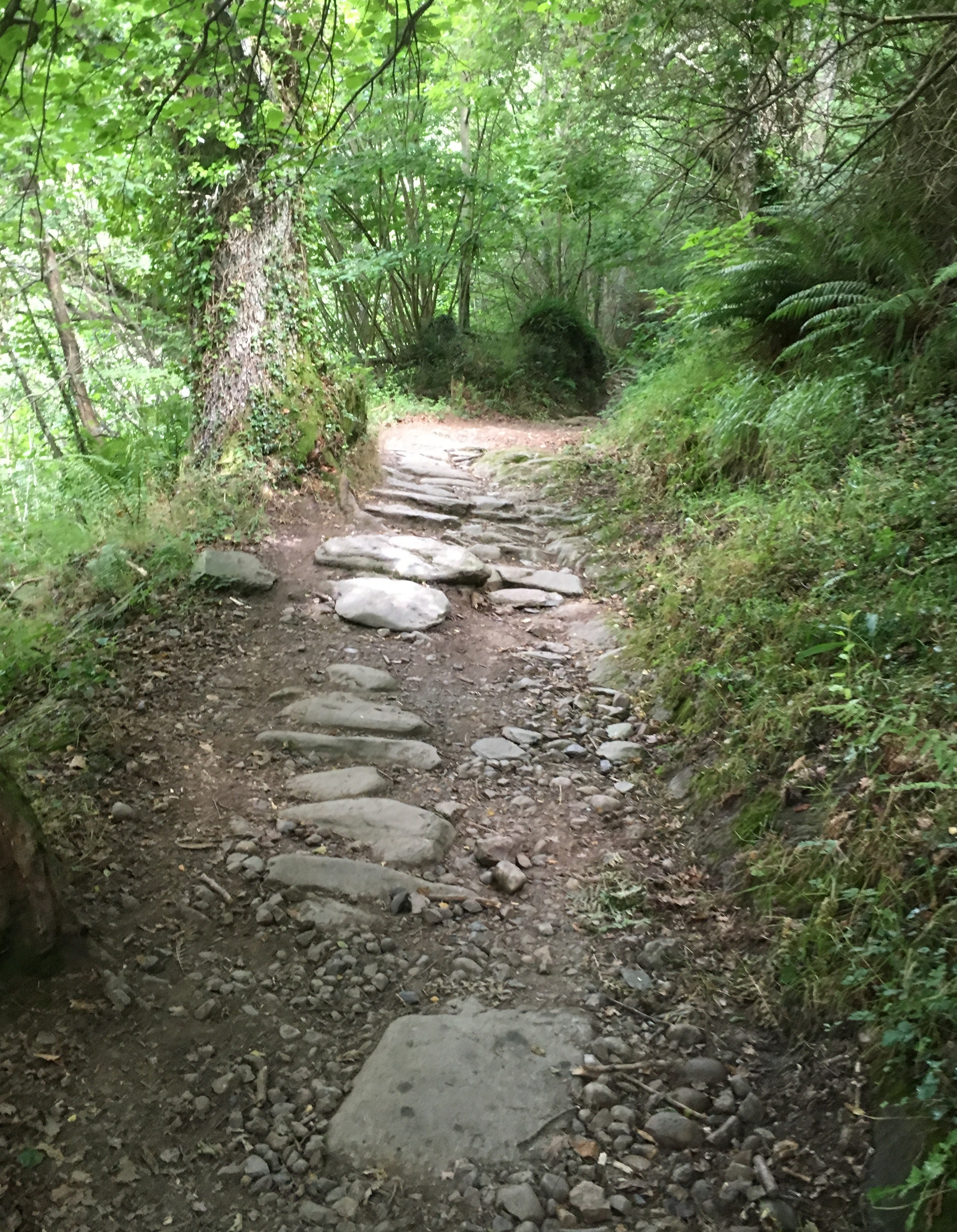
While walking the Camino de Santiago, I sometimes encountered pilgrims who seemed to confuse pilgrimage with an act of self-punishment. Despite their bodies sending unmistakable signals—painful blisters, swollen joints, and deep exhaustion—that it was time to rest, they would continue pushing forward. Determined to conquer the path at all costs, they ignored their physical limits until, inevitably, they were forced to abandon their journey altogether.

There is a saying I learned from another pilgrim on the way. “If you don’t learn to approach the path with humility, it will teach you humility.”

Others approached the Camino very differently. I remember older pilgrims, some well into their eighties, who walked slowly and with intention. They moved at their own pace, stopping occasionally to admire the landscape, sitting quietly in contemplation, or choosing to walk only half a stage in a day. Rather than measuring success by distance covered, they seemed to delight in the journey itself. Remarkably, many of these pilgrims completed the entire 800-kilometre route to Santiago. Even more striking was the vitality they radiated. They appeared youthful, not because of physical strength alone, but because they had learned the wisdom of walking in harmony with themselves.

Pilgrimage offers many lessons about life, but one of its most important teachings is the often misunderstood art of self-love.

Modern psychology increasingly confirms what many spiritual traditions have taught for centuries: self-love is not a luxury but a necessity for human flourishing. Research on self-compassion, pioneered by psychologist Dr Kristin Neff, shows that people who treat themselves with kindness during times of difficulty tend to be more resilient, emotionally balanced, and motivated than those who constantly criticise themselves.

Contrary to popular belief, harsh self-judgment, especially negative self-talk, does not produce stronger or more successful people. Instead, it often leads to anxiety, burnout, perfectionism, and emotional exhaustion.

Self-love, in psychological terms, means relating to oneself with the same care and understanding that one would naturally offer a good friend. It involves recognising one’s limitations without shame and acknowledging one’s worth without needing constant external validation. Such an attitude fosters emotional well-being and enables people to respond more constructively to life’s inevitable challenges.

These findings resonate deeply with the teachings of the 13th-century mystic Meister Eckhart. Eckhart believed that what turns human beings into compulsive graspers—unable to let go of possessions, status, relationships, or beliefs—is ultimately a lack of trust. Beneath our attachments lies a profound insecurity, a fear that we are somehow incomplete or unworthy.

For Eckhart, self-love and trust in the divine are inseparable. Compassion arises from confidence in the goodness that lies at the heart of existence, while compulsive striving grows from the belief that we are fundamentally lacking or flawed. The person who learns to “let be” and at the same time allows themselves to be is expressing a deep confidence in the creative source of life.

Eckhart writes: If you do not know how to love yourself, how is it possible that you will love God? There can be no love of neighbour without love of self.” To love oneself, in his understanding, is not an obstacle to spiritual growth but one of its essential foundations.

Such ideas were controversial in Eckhart’s time. Many theologians were preoccupied with sin, moral regulation, and the strict enforcement of doctrine. God was often portrayed as an authoritarian ruler who rewarded obedience and punished transgression. Shame and guilt became powerful tools of religious instruction—a dynamic that continues to influence some religious traditions today.

The divine potential in every person

Yet Eckhart offered a radically different vision. Rather than beginning with fear, he began with trust. Rather than emphasising human depravity, he pointed toward the divine potential present within every person.

This brings us to an important distinction: self-love is not the same as ego.

The ego seeks validation, superiority, and control. It constantly compares itself with others and measures its worth through achievement, status, or recognition. Ego asks, “How can I become more important?” Self-love asks, “How can I become more fully myself?”

The ego is rooted in insecurity and therefore always needs more. Self-love arises from a deeper acceptance and therefore has nothing to prove. The ego separates; self-love connects. The ego grasps; self-love releases. The ego seeks to protect an image; self-love nurtures a living reality.

Far from encouraging selfishness, genuine self-love often leads to greater compassion. People who are at peace with themselves generally have a greater capacity to listen, empathise, forgive, and care for others. They are not depleted by the endless struggle to earn their own worth.

The spiritual path, whether on the Camino or in everyday life, invites you to confront your fears, loosen your attachments, and ultimately learn the difficult art of letting go. This includes letting go of the false stories you tell yourself about who you should be.

At the heart of Eckhart’s teaching is a beautiful image. The essence of the divine, he says, is “birthing”—a continual process of creation and emergence. Life is not a static state to be achieved but an ongoing unfolding into what we are meant to become. We are not passive observers of this process but active participants in it.

Perhaps this is one of the Camino’s greatest lessons. The journey is not won by those who push themselves the hardest. It is completed by those who learn to walk with wisdom, humility, and kindness toward themselves. In learning to love yourself, you discover that you are not separate from the sacred journey but part of its unfolding.

Reino Gevers – Host of the LivingToBe podcast

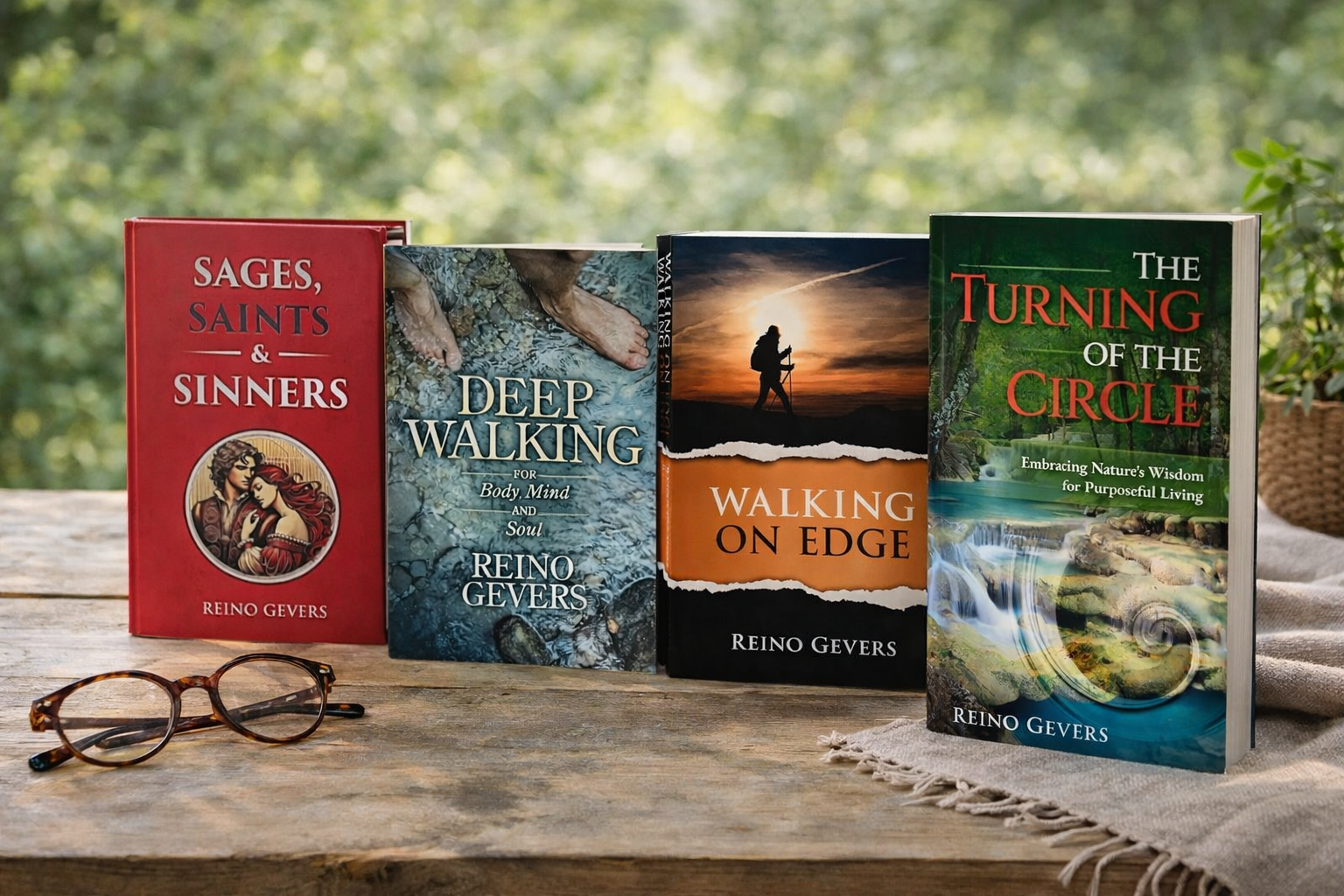
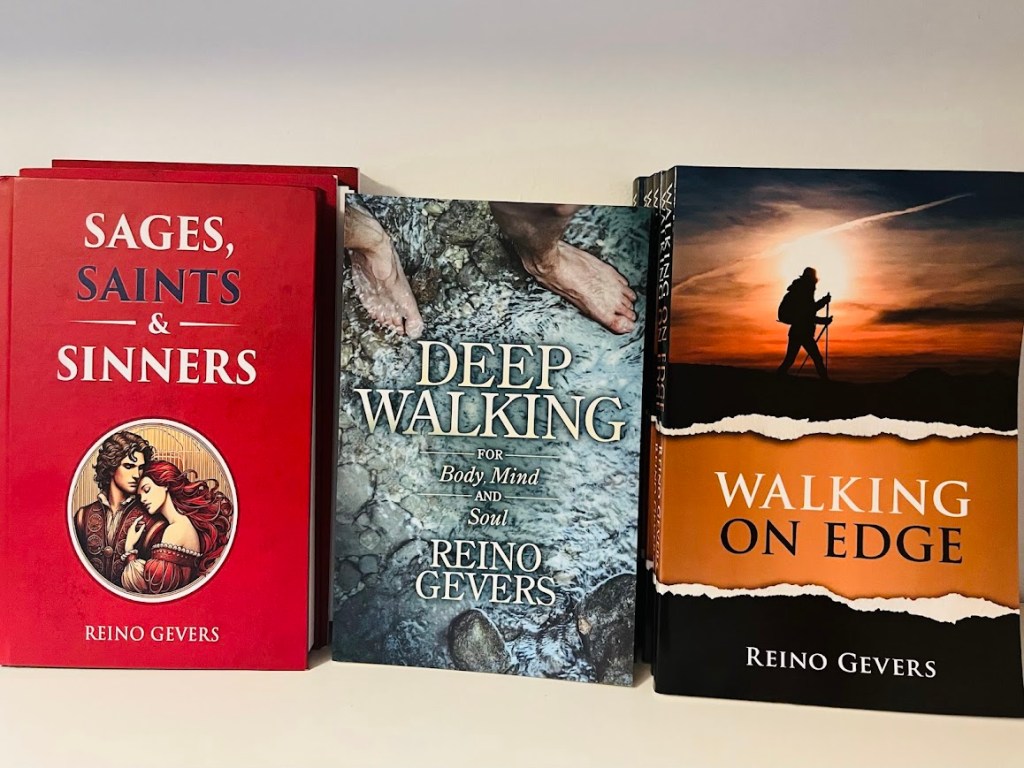
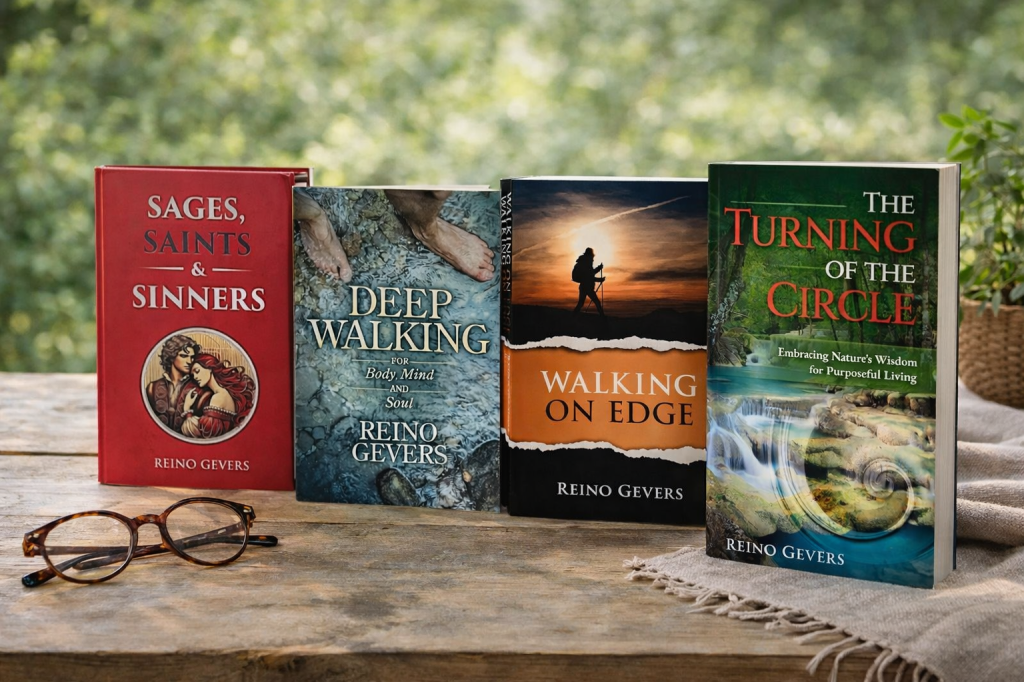
P.S. Over the years, my own Camino journeys have inspired two books exploring the deeper inner dimension of pilgrimage and transformational walking: Deep Walking for Body, Mind and Soul and the newly revised edition of Walking on Edge. Both reflect on the Camino not merely as a physical journey, but as a path of inner change, reflection, and rediscovery.

Leave a comment

Filed under Camino de Santiago, psychology, spirituality

The Lost Art of Stillness: Awakening Your Inner Self

In an age shaped by scrolling screens and shrinking attention spans, something profound is happening beneath the surface. Recent studies suggest that nearly two-thirds of young people struggle to remain engaged with content lasting longer than a minute. Yet, paradoxically, this same generation is searching intensely for meaning, transcendence, and spiritual grounding. The hunger for depth has not disappeared. If anything, it has become more urgent.

The difficulty is that our modern world is designed for speed rather than contemplation. We are conditioned to expect instant answers, simplified narratives, and constant stimulation. But the deepest truths of existence cannot be reduced to sound bites or algorithms. Mystery does not reveal itself in haste.

The ancient mystics understood this well. They approached the human soul with reverence, knowing that the divine cannot be encountered amid endless distraction and noise. The sacred unfolds quietly. Only in silence, solitude, and contemplation does the veil begin to lift, allowing fleeting glimpses of a reality greater than yourself.

As the 14th-century mystic Meister Eckhart wrote:

Nothing in all creation is so like God as stillness.”

Those words may be more relevant now than ever before.

You did not arrive here by accident. Your very existence is astonishingly improbable. Consider how different your life might have been had you been born in another country, another culture, another language, another body, or another century. None of those things were within your control. And yet, within the boundaries of circumstance, you have been given the extraordinary freedom to choose how you respond to life.

Your external conditions shape you, but they do not define the deepest essence of who you are.

It is by fully entering the depth of life’s journey that you awaken to purpose, resilience, and meaning. But this awakening becomes difficult when the mind is continually fragmented by external distraction. Much of the anxiety and emotional exhaustion of modern life emerges from this loss of alignment — a growing disconnect between the soul and its deeper calling.

We lose ourselves when we settle for the illusion of safety in mediocrity, silencing the inner voice that calls toward courage, creativity, and transformation. In doing so, there is a drift away from the very source of vitality.

Nature has always offered a path back.

The silence of mountains, forests, rivers, and open skies reveals something ancient and expansive. Birdsong, wind through trees, flowing water — all of it speaks of an intricate web of interconnectedness that modern life often obscures. In nature, you are reminded that you belong to something far greater than your schedules, anxieties, and ambitions.

It is no coincidence that many of humanity’s sacred places are found in forests, caves, deserts, and mountain summits. Nature slows our breathing, quiets stress, restores attention, and gently reconnects you to the rhythm of being itself.

Perhaps this is why time spent in nature often feels less like escape and more like remembrance.

To live well is not merely to chase future goals or external validation. It is to recover the lost art of presence — to live not only to achieve, but Living to BE.

And perhaps, in the stillness that you so often avoid, you may rediscover the deeper purpose for which you were born.

Reino Gevers – Host of the LivingToBe podcast

P.S: If you enjoyed this article you might be interested in reading: Sages, Saints and Sinners Get it today on Amazon, Barnes & Noble and where all good books are sold.

Leave a comment

Filed under meditation, psychology, spirituality

Lessons from the 14th Century Plague

There are places where history feels very present and where the emotional residue of another age still clings to stone and air. Puig de Maria, rising above the town of Pollença, on the Mediterranean island of Mallorca is one such place. It is not simply an old monastery, but built as a human answer to a dark time.

In 1348, as the Black Death swept across Europe. Suffocating fear was everywhere. Death arrived without logic or mercy, dismantling the illusion of control that underpinned medieval life. It is in this context that Puig de Maria was conceived: not as an architectural ambition, but as a cry to the divine.

The decision to build a sanctuary on a mountain summit high above the town was not accidental. It carried symbolic weight. To ascend is to separate—from contagion, from chaos, from the unbearable proximity of suffering. But it is also to draw nearer to God, to meaning, to the possibility that fear can be held within something larger than itself.

In Sages, Saints and Sinners, I return to a question that refuses to stay buried: what becomes of us when certainty collapses? When the structures we trusted—faith, order, meaning—no longer hold, who do we become? Set against the desolation of the 14th-century plague, a time when vast stretches of Europe fell silent and entire communities vanished, the novel steps into that rupture. It is not only a story of loss, but of what emerges in its wake—of the fragile, defiant ways human beings rediscover courage, meaning, and even love when everything familiar has been stripped away.

Some retreat into despair. Others are in denial. But there is a third path, rarer and more demanding—the transmutation of fear into courage, and anxiety into love.

Puig de Maria stands as a physical manifestation of that third path.

The people who built it were not free of fear. They were defined by it. And yet, instead of allowing fear to contract their world, they expanded it vertically. They climbed. They carried stone up a mountain in the midst of plague, and in doing so, enacted a radical defiance: fear would not have the final word.

There is a discipline in the refusal to be mentally captured by catastrophe.

The monastery that emerged—first a chapel, then a place of ongoing devotion—became more than a sanctuary. It became a container. Within its walls, fear was transformed. Ritual, prayer, and community gave structure to what would otherwise have been overwhelming. The unknown was met not with paralysis, but with presence.

This is the essence of transmutation. Not the removal of darkness, but its reworking into something that can sustain life.

Walking up to Puig de Maria today, the path winds in steady, deliberate curves. It is not a punishing climb, but it demands attention. There is a rhythm to it—step, breath, step—that mirrors something older than the path itself. Pilgrimage is never only about arrival. It is about what is shed along the way.

Halfway up, the town below begins to recede. Perspective shifts. What felt immediate loosens its grip. By the time you reach the summit, something subtle but unmistakable has occurred: distance has been created, not just physically, but internally.

This is the overlooked power of sacred geography. It externalises an inner movement.

At the top, the monastery remains austere. A tower and thick walls. A chapel that holds silence rather than spectacle. There is no excess here, no attempt to impress. It was never meant for comfort in the modern sense. It was meant for clarity.

And clarity, in times of crisis, is everything.

In our own age, fear has taken on different forms, but its structure remains familiar. Uncertainty, fragmentation, and a sense that the ground is less stable than we were led to believe. The temptation is the same as it was in the 14th century: to collapse inward, to narrow, to protect.

But Puig de Maria offers another template.

Climb.

Not away from reality, but toward a broader vantage point. Build—not necessarily in stone, but in practice—structures that can hold anxiety without being defined by it. Create spaces, inner and outer, where fear can be acknowledged, but not enthroned.

The plague did not end because a monastery was built. Suffering was not avoided. But meaning was forged in the midst of it.

And meaning is what allows endurance to become transformation.

In Sages, Saints and Sinners, the figures who endure are not those who escape fear, but those who metabolise it. They refuse its finality. They insist, against all evidence, that love and courage remain alive.

Puig de Maria asks a question that is as relevant now as it was then:

When fear rises, will you descend into it—or will you climb?

Reino Gevers – Host of the LivingToBe podcast

P.S: If you enjoyed this article you might be interested in reading: Sages, Saints and Sinners Get it today on Amazon, Barnes & Noble and where all good books are sold.

Leave a comment

Filed under Pilgrimage, psychology, spirituality

The Cross: A Symbol of Resurrection and New Beginnings

Wishing you a peaceful Easter. I’m sharing this extract from my book: Deep Walking for Body, Mind and Soul as a reflection for the season — on the Cross, on suffering, and on the possibility of new beginnings.

“It is easy to bond with people on the Camino. You share daily experiences, memories and the highs and lows that come with a pilgrimage walk.

Then comes the time to say goodbye, which can be a painful process if you have spent days and weeks walking with someone. It is like saying goodbye to an old friend when you know it will be some time before you will see each other again.

Ray was a veteran pilgrim, walking the Camino for the last time. He had undergone surgery for colon cancer some weeks before, and was taking his walk slowly and with great mindfulness.

It was from the awareness that every moment that he still had to live was precious. “I’ve been on this same path many times,” he confided, “but this time I am seeing so many things I did not see before.”

“It is like reading a good book, and then you read it a second time and a third time, discovering each time something new from a different state of awareness,” he said.

Talking with Ray led to the realization that life itself is meaning and the purpose of each individual is moving to a higher state of consciousness during a lifetime whose end we cannot predict.

Ray decided to take a few days’ rest near the town of Sarria, wanting to walk the last 100 kilometers (62 miles) to Santiago in his own time.

On saying goodbye, Ray gave me a Christian cross that he had lovingly carved out of wood from an olive tree.

While I was touched by his gift that came from the heart, I had mixed feelings about the cross that also symbolized the “corporate identity” of the church with which I had a long-troubled relationship.

I was unaware at the time that my pilgrim friend had given me an astounding gift. I hung it around my neck, its mystery opening to me with every step to Santiago and healing the old wound.

In the Christian tradition the cross is the symbol of Christ’s pain and suffering. It resonated with the people in the Middle Ages who themselves went through a dark time of humanity. But in the modern era?

The tragedy is that the fixation on this symbol of suffering misses the essence of Jesus’ teachings—that of transmuting suffering and death in resurrection.

This might sound blasphemous for some but we have a religion focused on life being an endless endurance of pain and suffering with the salvation only coming in the hereafter.

This was very much the thinking during the Middle Ages. Christians paid tithes to the church to “buy” their way into heaven. With disease, war and childbirth being a constant daily reminder that life on earth could be a short sojourn, the church fed into the fears of what comes in the afterlife. If certain beliefs, habits and rules were not followed, you ended up in the eternal flames of hell.

Life on earth at the time must surely have been hell for many people, struggling to eke out a living in the overcrowded towns and cities infested with rodents and human excrement. Living in the rural areas was no better, as every freak weather condition could mean a failed harvest and famine.

The devil was blamed for bad luck, accidents, immoral behavior, theft, illness and death. He was frequently depicted in places of worship, paintings and manuscripts of the time. Hell was a dark underground world ruled by Satan and full of demons, monstrosity and deformity. The horrors could not be worse if you turned your back against God and the church.

At the same time Christ was the savior in the sky above. Depictions of heaven and Christ could frequently be found on high ceilings and on top of the altar. God’s mercy and the reward in the afterlife came after leading a life following rules and beliefs.

There are many depictions of the world of darkness and the world of light in the old cathedrals, chapels and churches on the Camino, such as in Jaca, Lugo and Oviedo, giving an inkling of the mindset of the time.

The dividing lines between good and evil could not be more vivid.

In contrast, the Cathedral of Santiago is an expression of joy. It probably stems from the joy many pilgrims felt in finally reaching their destination after months of arduous walking. The Monte de Gozo, or Mountain of Joy, is situated on a hilltop from where the pilgrims had a beautiful view of the ancient city of Santiago.

The Portal of Glory in the cathedral features over 200 Romanesque sculptures, featuring angels, saints and prophets. Angels carry and lead the soul to paradise. The angels play instruments in concert to the glory of God.

Built in the form of a cruciform, the cathedral is almost austere coming from the entrance but opens up to a magnificent organ and choir with illuminated chapels on either side.

Even today pilgrims are overwhelmed when entering the cathedral for the first time.

If he or she has walked on the northern route, he/she will have passed by numerous crosses along the wayside, depicting the crucified Christ in many shapes and forms of gruesome suffering.

No wonder the first Vikings visiting England went back to their homeland telling their people that the Anglo-Saxons were easy prey because they were worshipping a dead God.

The cross is in fact an old symbol pre-dating Christian times and deeply embedded in pagan and Celtic tradition.

In many of the churches and chapels on the Camino the “Goddess,” the Virgin Mary, is the central figure on the altar. Especially in Galicia the ancient stone crosses depict Jesus on the one side and the Mother Mary on the other, which on a symbolic level unites the male and the female aspect.

One of the sad aspects of the Protestant movement was the banishment of the Madonna, the female aspect, from the altar, replacing it with the crucifix.

Many priceless artifacts were burned and destroyed in the fanatic 30-year religious war between Catholicism and Protestantism that ravaged central Europe in the 15th century.

While the Roman Cross has a long central vertical line, the Celtic cross has both the vertical and horizontal lines in equal length, with a circle around it.

The horizontal lines symbolize the past and the future, with the mind locked in one of these two thoughts on a daily basis. The vertical line, however, represents the alignment with the above and the below, the awakened state of the present “heart moment” in the center where the cross meets.

We thus find many an ancient painting depicting a heart or a mandala in the center of the cross.

As we say the old Celtic powerful prayer of protection, we visualize the Goddess, the Mother, Mary, the Madonna:

She is as above me as below, to the left and to the right, before me and behind me as well as within me.”

Reino Gevers – Host of the LivingToBe podcast

P.S: If you enjoyed this article you might be interested in reading more in “Deep Walking for Body, Mind and Soul” published by Morgan James, New York. Get it today on Amazon, Barnes & Noble and where all good books are sold.

Leave a comment

Filed under Camino de Santiago, humanity, spirituality

Karma and Grace: How Your Actions Shape Reality Beyond Fate

Karma, much like forgiveness, is one of the most misunderstood concepts in the spiritual world. It is often reduced to a simplistic notion of fate, something predetermined, inevitable, and beyond your control. But this interpretation strips it of its real power and your divine purpose.

In a recent conversation on my LivingToBe podcast with Buddhist teacher and author Ann Tashi Slater, we explored a deeper and far more empowering understanding. In the Buddhist tradition, karma is not destiny. It is taking intentional action, and the ripple effects those actions create over time.

This shifts everything.

Rather than seeing life as something that “happens to you,” karma invites you to recognize that we are constantly participating in the shaping of our own reality. Every thought, every word, every action plants a seed. And those seeds, given time and conditions, bear fruit.

This is where agency enters.

If karma were fixed, we would be trapped in a script already written. But karma is dynamic. It unfolds in the present moment. And that means the present moment is always a point of power.

You are not just living out past causes; you are inevitably generating new ones.

A Christian Mystical Parallel

Interestingly, this understanding is not foreign to the Christian mystical tradition. While the word karma is not used, the principle of cause and effect appears in several profound ways.

Meister Eckhart spoke about the inner orientation of the soul as the determining factor of one’s experience of God and reality. It is not external circumstances, but your state of being that shapes what unfolds.

Similarly, St. John of the Cross emphasized that choices do matter. Purification and transformation come through conscious participation—through surrender but also through intentional alignment with divine love, kindness, and compassion.

In the New Testament, the principle is stated with striking clarity: “As you sow, so shall you reap” (Galatians 6:7). This is, in essence, a karmic law, not to be seen as punishment, but as a reflection of the deep coherence of creation.

From this perspective, karma or what is often misunderstood in Christian terms as sin, is not a cosmic bookkeeping system of reward and punishment. It is a spiritual practise and the evolving of consciousness.

From Victimhood to Participation

The misunderstanding of karma as fate often leads to passivity, shame, or even quiet despair:


“This is just my karma.”
“This is how things are meant to be.”

But a more accurate understanding empowers, restores responsibility, and possibility.

If your present circumstances are influenced by past causes, then your present actions are shaping your future experience.

This does not mean everything is controllable. Life is inevitably unpredictable, with waymarkers of loss, sadness, happiness, bliss, and mystery. But it does mean that how you respond is never predetermined.

And that response is itself karmically potent.

This is where karma and forgiveness meet.

Forgiveness interrupts cycles. It dissolves patterns that would otherwise continue repeating. In karmic terms, it is the conscious decision not to perpetuate a particular chain of cause and effect.

It is an act of profound spiritual authorship.

The Transformative Shift

To understand karma in this way is to move from a passive to an active relationship with life.

You are no longer merely the result of what has been.
You are a participant in what is becoming.

Each moment becomes an invitation:
What am I creating now?
What seeds am I planting?

Even the smallest shift in awareness can spark a new choice.
And a single new choice can begin to reshape your entire life.

You are not here to be carried by circumstance and fate. You are here to participate, to create, to transform.

Pause. Notice. Choose consciously.

The life you are living tomorrow begins with the action you take today.

Reino Gevers – Host of the LivingToBe podcast

P.S: If you enjoyed this article you might be interested in reading: Sages, Saints and Sinners Get it today on Amazon, Barnes & Noble and where all good books are sold.

Leave a comment

Filed under gratitude, happiness research, spirituality

Does God Punish Humanity? Lessons from the Black Death and Modern Pandemics

When disaster strikes on a massive scale, people instinctively ask the same ancient question:

Is this God’s judgment?

It is a question that has echoed throughout human history.

In the 14th century, as the Black Death swept across Europe, entire populations believed they were witnessing divine punishment. Churches filled with desperate prayers. Some people turned toward deeper faith. Others lost their faith entirely.

Centuries later, during the COVID-19 pandemic, that same question quietly resurfaced.

What happens to faith when the world believes God’s judgment has arrived?

Fear, Faith, and the Flagellants

During the Black Death, fear spread as quickly as the disease itself. Many believed the plague was a punishment for humanity’s sins.

Across Europe, bands of penitents known as flagellants marched from town to town, whipping themselves in public acts of penance. They believed that if humanity suffered enough, God might show mercy.

Crowds gathered to watch them.

Some saw them as holy reformers.

Others saw them as dangerous fanatics.

It was faith under extreme pressure.

The Quiet Courage of Compassion

Yet there was another response to the plague.

While many fled cities in terror, others stayed behind to care for the sick and dying. Monks, nuns, and priests often remained when everyone else ran.

Historians estimate that in some regions nearly half the clergy died while caring for plague victims.

For these people, faith did not mean explaining suffering.

Faith meant standing beside those who suffered.

When Catastrophe Shakes Belief

But the plague also shook belief at its foundations.

People began asking difficult questions:

  • Why would a loving God allow such devastation?
  • Why did the devout die alongside the corrupt?
  • Why did prayers not stop the disease?

These questions gradually reshaped Europe’s intellectual landscape, eventually contributing to major religious transformations, including the Protestant Reformation.

Faith did not disappear.

But it began to evolve.

How Faith Responds to Crisis

History shows that when a catastrophe strikes, faith often moves in three different directions.

Some people become more rigid and fearful, searching for certainty in times of chaos.

Others lose faith entirely, unable to reconcile suffering with belief in a loving God.

And some discover a deeper, quieter faith—one rooted not in easy answers, but in compassion, humility, and solidarity with others.

What Did Jesus Say About Suffering?

In the teachings of Jesus Christ, suffering is rarely presented as punishment directed at specific individuals.

Instead, suffering often becomes an invitation to reflect on how we live and how we treat one another.

The focus shifts away from blame and toward compassion, mercy, and moral transformation.

The Inspiration Behind Sages, Saints and Sinners

These were the questions that fascinated me when I began writing my historical novel Sages, Saints and Sinners.

I wanted to explore what happens to ordinary people when the world around them collapses and they believe that God’s judgment has arrived.

In many ways, the questions raised during the recent pandemic helped inspire that exploration.

Set during the Black Death, Sages, Saints and Sinners explores love, faith, and spiritual conflict in the midst of an existential crisis.

What do people hold onto when everything begins to collapse?

The novel tells a story of faith, doubt, and forbidden love in a time when many believed the end of the world had come.

If these questions intrigue you, you may enjoy the novel that grew out of them.

Sages, Saints and Sinners is available on Amazon, and all good bookshops.

What Pandemics Reveal About Us

History reminds us that pandemics do more than challenge our health.

They challenge our beliefs.
They challenge our assumptions.
And they challenge our understanding of God.

Perhaps the deepest question is not whether suffering is punishment.

Perhaps the real question is this:

Do moments of crisis invite us to rediscover compassion, courage, and faith?

Reino Gevers – Author – Mentor –Speaker

P.S: If you enjoyed this article you might be interested in reading: Sages, Saints and Sinners Get it today on Amazon, Barnes & Noble and where all good books are sold.

Leave a comment

Filed under purpose, religion, spirituality

Does God Punish Humanity? Lessons from the Black Death and Modern Pandemics

When disaster strikes on a massive scale, people instinctively ask the same ancient question:

Is this God’s judgment?

It is a question that has echoed throughout human history.

In the 14th century, as the Black Death swept across Europe, entire populations believed they were witnessing divine punishment. Churches filled with desperate prayers. Some people turned toward deeper faith. Others lost their faith entirely.

Centuries later, during the COVID-19 pandemic, that same question quietly resurfaced.

What happens to faith when the world believes God’s judgment has arrived?

Fear, Faith, and the Flagellants

During the Black Death, fear spread as quickly as the disease itself. Many believed the plague was a punishment for humanity’s sins.

Across Europe, bands of penitents known as flagellants marched from town to town, whipping themselves in public acts of penance. They believed that if humanity suffered enough, God might show mercy.

Crowds gathered to watch them.

Some saw them as holy reformers.

Others saw them as dangerous fanatics.

It was faith under extreme pressure.

The Quiet Courage of Compassion

Yet there was another response to the plague.

While many fled cities in terror, others stayed behind to care for the sick and dying. Monks, nuns, and priests often remained when everyone else ran.

Historians estimate that in some regions nearly half the clergy died while caring for plague victims.

For these people, faith did not mean explaining suffering.

Faith meant standing beside those who suffered.

When Catastrophe Shakes Belief

But the plague also shook belief at its foundations.

People began asking difficult questions:

  • Why would a loving God allow such devastation?
  • Why did the devout die alongside the corrupt?
  • Why did prayers not stop the disease?

These questions gradually reshaped Europe’s intellectual landscape, eventually contributing to major religious transformations, including the Protestant Reformation.

Faith did not disappear.

But it began to evolve.

How Faith Responds to Crisis

History shows that when a catastrophe strikes, faith often moves in three different directions.

Some people become more rigid and fearful, searching for certainty in times of chaos.

Others lose faith entirely, unable to reconcile suffering with belief in a loving God.

And some discover a deeper, quieter faith—one rooted not in easy answers, but in compassion, humility, and solidarity with others.

What Did Jesus Say About Suffering?

In the teachings of Jesus Christ, suffering is rarely presented as punishment directed at specific individuals.

Instead, suffering often becomes an invitation to reflect on how we live and how we treat one another.

The focus shifts away from blame and toward compassion, mercy, and moral transformation.

The Inspiration Behind Sages, Saints and Sinners

These were the questions that fascinated me when I began writing my historical novel Sages, Saints and Sinners.

I wanted to explore what happens to ordinary people when the world around them collapses and they believe that God’s judgment has arrived.

In many ways, the questions raised during the recent pandemic helped inspire that exploration.

Set during the Black Death, Sages, Saints and Sinners explores love, faith, and spiritual conflict in the midst of an existential crisis.

What do people hold onto when everything begins to collapse?

The novel tells a story of faith, doubt, and forbidden love in a time when many believed the end of the world had come.

If these questions intrigue you, you may enjoy the novel that grew out of them.

Sages, Saints and Sinners is available on Amazon, and all good bookshops.

What Pandemics Reveal About Us

History reminds us that pandemics do more than challenge our health.

They challenge our beliefs.
They challenge our assumptions.
And they challenge our understanding of God.

Perhaps the deepest question is not whether suffering is punishment.

Perhaps the real question is this:

Do moments of crisis invite us to rediscover compassion, courage, and faith?

Reino Gevers – Author – Mentor –Speaker

P.S: If you enjoyed this article you might be interested in reading: Sages, Saints and Sinners Get it today on Amazon, Barnes & Noble and where all good books are sold.

Leave a comment

Filed under purpose, religion, spirituality

From Struggle to Awe: A Pilgrimage of Transformation

“Be willing to be a beginner every single morning.” — Meister Eckhart

There was a time in my life when I believed I had to hold everything together by sheer work and effort. If I paused, I feared I would disappear. Only later did I begin to understand that disappearing was not the danger I imagined. It was, in fact, the return.

Life is something like a ripple on the ocean, momentarily appearing, briefly defined, then gently dissolving back into the vastness from which it came. The ripple feels separate while it lasts, yet it has never been anything other than the ocean. This simple image has accompanied me through many seasons of exhaustion, loss, and quiet awakening.

The mystics gave language to what I was slowly learning through experience. The 13th-century Mystic Meister Eckhart puts it into words: “The eye with which I see God is the same eye with which God sees me.” If this is true, then separation is not the final truth of a lifetime.

When Separation Feels Real

For many years, separation felt very real to me. I lived on the surface—busy, capable, outwardly functional—while something deeper waited patiently. I now recognize how easily we mistake movement and activity for meaning. Eckhart’s warning feels almost tender in hindsight: “As long as you are seeking God, you are not yet aware that you have found Him.” I was always seeking, rarely resting.

The poet-mystic Rumi names this restlessness with compassion: “Why are you so busy with this or that or good or bad; pay attention to how things blend.” When you allow things to blend, you surrender to strength, vulnerability, certainty, and doubt, faith and the unknowing.

The Descent That Saved Me

My own turning point came not through achievement, but through fatigue. I had reached a place where distraction no longer worked. What emerged instead was a quiet invitation to walk—both literally and inwardly. An annual pilgrimage became my way of consenting to descent.

One day, on the Camino Primitivo in northwestern Spain, I found myself struggling up a steep mountain path amid darkness and driving rain. Each step felt heavy. The trail seemed endless, and my inner landscape matched the weather—tight, effortful, and discouraged.

Then, without warning, the heavens opened. The rain softened, the clouds lifted, and beneath me appeared a vast sea of clouds stretching all the way to the horizon. The shift was almost instantaneous. Within seconds, my mood changed completely. Where there had been struggle, there was awe. Where there had been resistance, there was gratitude.

I stood there, soaked and breathless, perceiving not only the incredible beauty of that moment, but the beauty of life itself. I felt truly blessed—not because anything had been solved, but because something had been revealed. I had crossed a threshold without even realizing it.

The Christian mystics speak of this movement without sentimentality. John of the Cross calls it “the dark night,” a phrase that once frightened me. Now I hear it differently: as a stripping away of the onion layers of what no longer carries life. What felt like loss was actually a clearing.

Living Lightly on the Surface

It is so easy to confuse your ripple with your worth. There is a deep need to be seen, to be heard, and to be validated. But it can create much pressure. Accept who you are with loving kindness, and the old burden of control is no longer that important. Meister Eckhart’s invitation is simply: “Let go of yourself and you will find yourself.” This letting go is a daily practice rather than a single event.

To live as a ripple is to accept impermanence without fear. To rest as the ocean is to trust belonging without proof. Somewhere between the two, a quieter wisdom emerges.

A Gentle Invitation

A Pilgrimage to New Beginnings grew out of this lived knowing. It is not about fixing what is broken, but about remembering what has never been lost. If these reflections echo something in your own life, you are warmly welcome to join.

The reservation window remains open for ten more days—not as an urgency, but as an invitation to step across a threshold.

The ripple does not need to earn its place in the ocean.

Reino Gevers – Host of the LivingToBe podcast

P.S. For those who feel drawn to explore this in-between season more intentionally, I am offering a six-week online course, Pilgrimage into New Beginnings. It is a quiet, reflective journey for times of transition, starting March 4th.

Leave a comment

Filed under deep walking, gratitude, happiness, meditation, self-development, spirituality

A world in transition: The in-between season

Times of transition, like those we are living through now, are often marked by chaos, uncertainty, and the unraveling of certainties that no longer hold. These in-between seasons can be deeply unsettling, yet they are also profoundly formative. More than ever, such times call for clarity of purpose and a conscious alignment with our core values and guiding principles.

During such seasons, the new has not yet taken shape. The ancient Chinese I Ching, or the Book of Change, offers timeless guidance for such moments. It does not promise quick solutions or firm ground. Instead, it teaches us how to live wisely while the ground is moving beneath our feet.

The new struggling to be born

At the heart of the I Ching is a simple truth: change is not an interruption of life. Chaos is not a mistake. It is often the sign that something new is struggling to be born.

In times of transition, the I Ching counsels restraint rather than force. The outer world feels increasingly unstable, with the individual feeling helpless amid external circumstances that cannot be controlled. Yet the I Ching invites us to turn toward inner alignment. Before you act, you are asked to listen. Before you decide, you are asked to become still enough to discern what truly matters.

Waiting is not passive resignation

These in-between seasons call for patience. The I Ching reminds us that timing is sacred. Action taken too soon can distort what is forming; action taken too late can miss the moment entirely. As the book puts it:

“Waiting. If you are sincere,
You have light and success.”

I Ching, Hexagram 5

This waiting is not passive resignation. It is an active, attentive presence—a way of staying faithful to the process even when the outcome is not yet visible.

Discovering what genuinely sustains you

Integrity becomes the anchor in such times. When familiar supports fall away, you discover what genuinely sustains you. The I Ching repeatedly emphasizes that inner truth—not certainty, control, or speed—is what carries us through periods of upheaval. To remain faithful to what is essential within you is, in itself, a spiritual practice.

The book also teaches adaptability without self-betrayal. Like water, we are encouraged to yield without losing our depth, to respond without hardening, to move with change rather than against it. True transformation, it suggests, begins quietly, often invisibly, long before it takes form in the outer world.

Perhaps most importantly, the I Ching directs our attention away from grand solutions and back toward the small and the near:

  • The words we choose to speak
  • Listening with mindfulness
  • Caring for one another
  • Paying attention to the inner life and consciousness.

In times of uncertainty, it is these humble acts that carry the future.

The in-between is not a void. It is a threshold.

When we stop trying to escape it, fix it, or rush through it, we begin to sense its hidden gift. Something is loosening. Something is aligning. Something is quietly taking shape.

And the invitation is simple, though not easy: to become still enough to hear what this season of change is asking of you.

Reino Gevers – Host of the LivingToBe podcast

P.S. For those who feel drawn to explore this in-between season more intentionally, I am offering a six-week online course, Pilgrimage into New Beginnings. It is a quiet, reflective journey for times of transition, starting February 4th.

Leave a comment

Filed under meditation, mental health, psychology, raised consciousness, spirituality

Many languages. One human story.

In an age when narratives of division, exclusion, and separation grow louder, a quiet truth comes into view when we examine the origins of language and culture.

Diversity is not accidental. It is a divine principle of growth, evolution, and color. From the earliest words to the languages we speak today, we have always been—and will always be— one humanity, expressing ourselves in many voices and song. 

Languages and cultures did not arise in isolation. 

They grew as people moved, met, traded, worshipped, struggled, and learned from one another. English carries Germanic bones, Latin learning, French refinement, Norse pragmatism, and words from every corner of the globe. 

German shares ancient roots with English, shaped by regional sound shifts and centuries of cultural exchange with Slavic and Norse peoples.

Spanish is Latin at heart, enriched by Celtic echoes, Visigothic rule, and nearly eight centuries of Arabic wisdom. 

Chinese developed along a different path, yet with the same human impulse—to name the world, preserve meaning, and pass wisdom across generations—using a writing system that unites many voices into one shared tradition.

At their deepest level, all languages serve the same purpose: to connect human beings.

Whether through inflected verbs or tones, alphabets or characters, each language reflects the same universal needs—belonging, memory, meaning, and hope. 

Even where linguistic families differ, the patterns repeat: shared ancestors, adaptation through contact, and continuity through storytelling and faith.

No language is “pure.” Each is a living record of encounter. Every word carries footprints of those who came before—migrants, traders, teachers, farmers, poets, seekers. What appears as difference is, in truth, relationship written into sound. 

 Language reminds us that humanity has always been interwoven. Our histories overlap, our words borrow freely, and our voices echo one another across time and geography.

We are formed in relationship and sustained by exchange. When we build walls, and retreat into tribalism, we harden ourselves behind artificial boundaries. We diminish and extinguish divine purpose. What refuses connection withers; what remains open continues the work of creation. 

As the 13th century Mystic Meister Eckart reminds us: „The eye with which I see God is the same eye with which God sees me.”

English: Germanic (Angles, Saxons, Jutes), Latin, Old Norse (Viking), Norman French, Greek 

German: Latin, French, Latin, Greek, Sanskrit, Slavic 

Spanish: Iberian, Celtic, Basque, Latin, Germanic 

Chinese: Mandarin, Cantonese, Wu, Min, Hakka, etc.

Reino Gevers – Host of the LivingToBe podcast

P.S.: If you enjoyed this article, you might be interested in my latest book, Sages, Saints, and Sinners. Get it today on Amazon, Barnes & Noble, and wherever good books are sold.

Leave a comment

Filed under humanity, psychology, purpose, spirituality, Uncategorized