A lost ritual once firmly embedded in medieval Europe has found new life among modern burned-out souls and those disillusioned with institutional religion. Walking the same ancient paths travelled by pilgrims centuries ago has become, for hundreds of thousands of people, a modern route to purpose, silence, healing, and experiential spirituality.
During the Middle Ages, a vast network of pilgrimage routes stretched across Europe — from Warsaw in Poland, Oslo in Norway, and Walsingham in England to Einsiedeln in Switzerland, Cologne in Germany, Rome and Assisi in Italy, and the Via Tolosana, or Arles Route, in France. These paths eventually converged toward some of Christianity’s most revered destinations, especially Santiago de Compostela in Spain and Rome in Italy.
For medieval pilgrims, it was common to leave directly from one’s doorstep and walk for months across mountains, forests, and foreign territories. The journey was often undertaken as an act of penance, spiritual devotion, or thanksgiving. In some cases, one member of a family would walk on behalf of the entire household.
Pilgrimage was never easy. Even in medieval times, it required considerable resources, endurance, and courage. Pilgrims faced illness, disease, hunger, harsh weather, and the constant danger of robbery. Many never returned home. Yet despite the risks, historians estimate that by the late Middle Ages, millions of people had travelled these sacred routes, making pilgrimage one of the defining spiritual practices of medieval Europe.
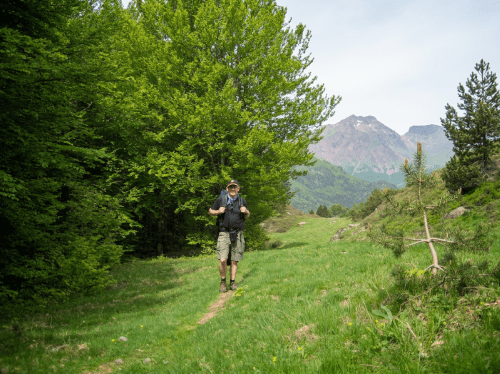
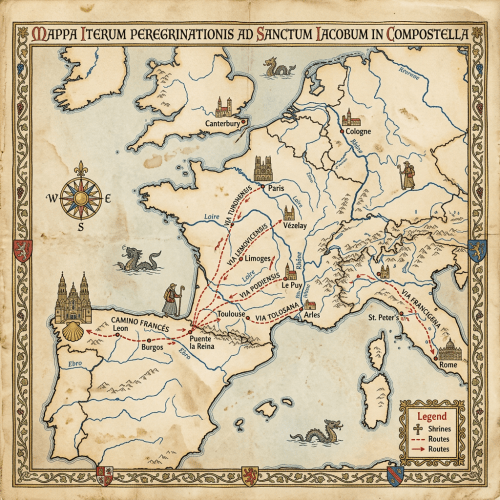
Historic routes highlighting key pilgrimage paths across Europe to Santiago de Compostela
Pilgrimage also became deeply woven into the economic and cultural fabric of the continent. Pilgrims needed food, shelter, clothing, medical care, and transport. Inns, monasteries, bridges, hospitals, and marketplaces flourished along the routes. Wealthier travellers journeying on horseback or in carriages relied on blacksmiths and craftsmen for repairs and supplies.
But the pilgrimage routes were far more than economic arteries. They became channels for the exchange of ideas, languages, customs, art, and knowledge. Along these roads, Europe slowly developed a shared cultural consciousness.
One important spiritual centre on the Camino route was the monastery of San Juan de la Peña near Jaca in northern Spain. According to medieval tradition, the monastery housed the Holy Grail for several centuries — the cup believed to have been used by Jesus at the Last Supper. Beyond its religious significance, San Juan de la Peña also became an important centre of scholarship and monastic learning during the Middle Ages.
By the 18th century, however, much of the great pilgrimage tradition had declined. The Protestant Reformation, the suppression of monasteries, political upheaval, changing religious attitudes, and centuries of war dramatically reduced pilgrimage across Europe. In England, King Henry VIII dissolved the monasteries between 1536 and 1541 and effectively outlawed many traditional pilgrimage practices.
Then, in the late 20th century, something remarkable happened.
In the early 1980s, the Spanish priest Father Elías Valiña Sampedro became convinced that the ancient Camino de Santiago could live again. Armed with cans of yellow paint and driving his small Citroën 2CV through rural northern Spain, he began marking forgotten sections of the route with the now-famous yellow arrows that guide pilgrims to this day.
Father Elías was far more than a parish priest. He was a respected scholar who had completed a doctoral thesis on the Camino de Santiago in the 1960s, long before the modern revival began. At the time, very few people could have imagined that the Camino would once again attract pilgrims from across the world.
When I first walked the Camino in 2006, around 100,000 pilgrims received the Compostela certificate in Santiago annually. Most were students, retirees, or spiritual seekers with the time to undertake such a journey. Since then, the numbers have grown dramatically. In 2024, more than 446,000 pilgrims officially received the Compostela in Santiago de Compostela, and the real number of walkers is believed to be substantially higher, since many people complete sections of the Camino without registering officially.
Over the years I have walked more than a dozen Camino routes through Germany, Switzerland, France, Italy, and Spain, speaking to hundreds of pilgrims along the way. My overwhelming impression is that many people walking these ancient paths are searching for something they are no longer finding within institutional religion alone.
Pilgrims come from every imaginable background, age group, profession, and nationality. Many are standing at a crossroads in life. Some are grieving the death of a loved one. Others are recovering from divorce, burnout, illness, or emotional exhaustion. Some arrive carrying deep spiritual questions they can no longer ignore.
Few people return home unchanged.
Stepping away from the noise and acceleration of modern life for several weeks affects body, mind, and soul in profound ways. Long days of walking create space for reflection rarely possible in ordinary life. Many pilgrims return home and change careers, relationships, priorities, or even countries after realizing that a life centred on Being feels fundamentally different from a life driven primarily by external achievement and accumulation.
What we are witnessing may be more than the revival of an ancient tradition. It may reflect a broader transformation in humanity’s understanding of spirituality itself.
Increasingly, people are questioning whether spiritual meaning can be mediated exclusively through institutions, doctrines, or systems of belief. The modern pilgrimage speaks to a growing hunger for direct experience — for silence, mystery, transcendence, and inner transformation.
Experiential spirituality cannot simply be inherited intellectually. It must be encountered.
And perhaps that is why so many people are becoming pilgrims again.
Reino Gevers – Host of the LivingToBe podcast
P.S. Over the years, my own Camino journeys have inspired two books exploring the deeper inner dimension of pilgrimage and transformational walking: Deep Walking for Body, Mind and Soul and the newly revised edition of Walking on Edge. Both reflect on the Camino not merely as a physical journey, but as a path of inner change, reflection, and rediscovery.


