Monthly Archives: April 2026

Awareness Over Calm: Redefining Emotional Mastery

On one of my earliest pilgrimage walks, I began to recognise something I had long resisted: the very emotions I was trying hardest to suppress—pain, anger, and fear—were not obstacles, but the raw materials of transformation.

Along the spiritual path, there is a subtle temptation to numb or transcend these feelings prematurely. I knew that tendency well: the quiet disappointment of relationships that had unravelled, the lingering anger of unmet expectations, and the helplessness of facing forces beyond my control.

But what if anger and fear are not barriers to a higher life… but thresholds?

Anger is rarely mere volatility; more often, it is power without direction.

Fear is not simply weakness; it is awareness, contracted and constrained.

Both carry energy. And energy, when understood, can be redirected—into clarity, into creativity, into new beginnings.

Anger tends to arise where a boundary has been crossed, a value violated, or an expectation left unmet. Fear emerges at the intersection of uncertainty and attachment. In both cases, something within is signalling: pay attention—this matters.

To elevate consciousness, you do not bypass these signals. You learn to read them, to work with them, and ultimately, to transform them.

Consciousness Is Not Calmness—It Is Awareness

Elevated consciousness is often confused with a calm mind. But true elevation is not the absence of disturbance; it is the ability to accept and remain aware within it.

When anger flares, the unconscious mind reacts by blaming, defending or attacking. But the conscious mind takes five steps back and observes:

What exactly am I protecting? Where is this reaction coming from? Is this moment echoing an older wound?

This shift—from reaction to observation—is the first act of transmutation.

Awareness creates space. And in that space, energy begins to reorganise itself.

The Alchemy of Emotional Energy

Transmutation is not suppression but transformation through understanding and intentional redirection. And, here is how it works in practise:

  • The moment you feel anger or fear rising, resist the urge to respond immediately. Let the emotion fully surface without feeling shame or labeling it as “bad.”
  • How does the energy feel in your body physically? Do you feel their grip in your throat, gut or chest?
  • Ask yourself the question: What is this emotion trying to teach me? The anger may be totally unrelated to the incident and come from a deeper, buried space. Fear may reveal the path to go, but you are still stuck in your comfort zone and finding it safer to stay in a place you know.
  • Redirecting the energy is the inner alchemy that turns the emotion into conscious power

Abundance Begins Internally

Abundance is often misunderstood as the accumulation of things and material status. But externally driven abundance is fragile because it is often driven by the fear of scarcity.

Unprocessed anger creates conflict, and unresolved fear creates procrastination. The mind is locked in fear, flight and freeze mode preventing creative flow of ideas, relationships and opportunities that come from the prefrontal cortex of the brain in a relaxed mindset. You make decisions from clarity rather than insecurity with internal coherence naturally attacting external expansion. Abundance is not chased but comes naturally as a result of flow energy.

Happiness as a Byproduct, Not a Goal

Happiness is often pursued directly, which paradoxically keeps it out of reach. But happiness can really only be appreciated if we have experienced the pain, the loss and the disappointment. Happiness is not the absence of difficult emotions but the acceptance and integration of them. If you are no longer controlled by fear and anger, you will feel empowered.

Inner Mastery

Mastering your emotional life is not a single breakthrough—it is a discipline, forged through consistent inner work. Anger, fear, and pain do not disappear; they remain part of the human condition. What changes is their authority. They no longer govern you.

With time, you develop the capacity to recognise these signals early and to redirect their energy with intention rather than reaction.

You will still feel anger. You will still feel fear. But you are no longer ruled by them. Instead, you cultivate the ability to transmute: fear into courage, anger into clarity and grounded compassion, pain into recovery—and, ultimately, renewal.

In that space between stimulus and response lies everything: the depth of your awareness, the breadth of your capacity for abundance, and the quality of the life you create.

Reino Gevers – Host of the LivingToBe podcast

P.S: If you enjoyed this article you might be interested in reading more in “Deep Walking for Body, Mind and Soul” published by Morgan James, New York. Get it today on Amazon, Barnes & Noble and where all good books are sold.

Leave a comment

Filed under happiness, mental-health, psychology

When the Crowd Roars: Why Independent Thinking Matters

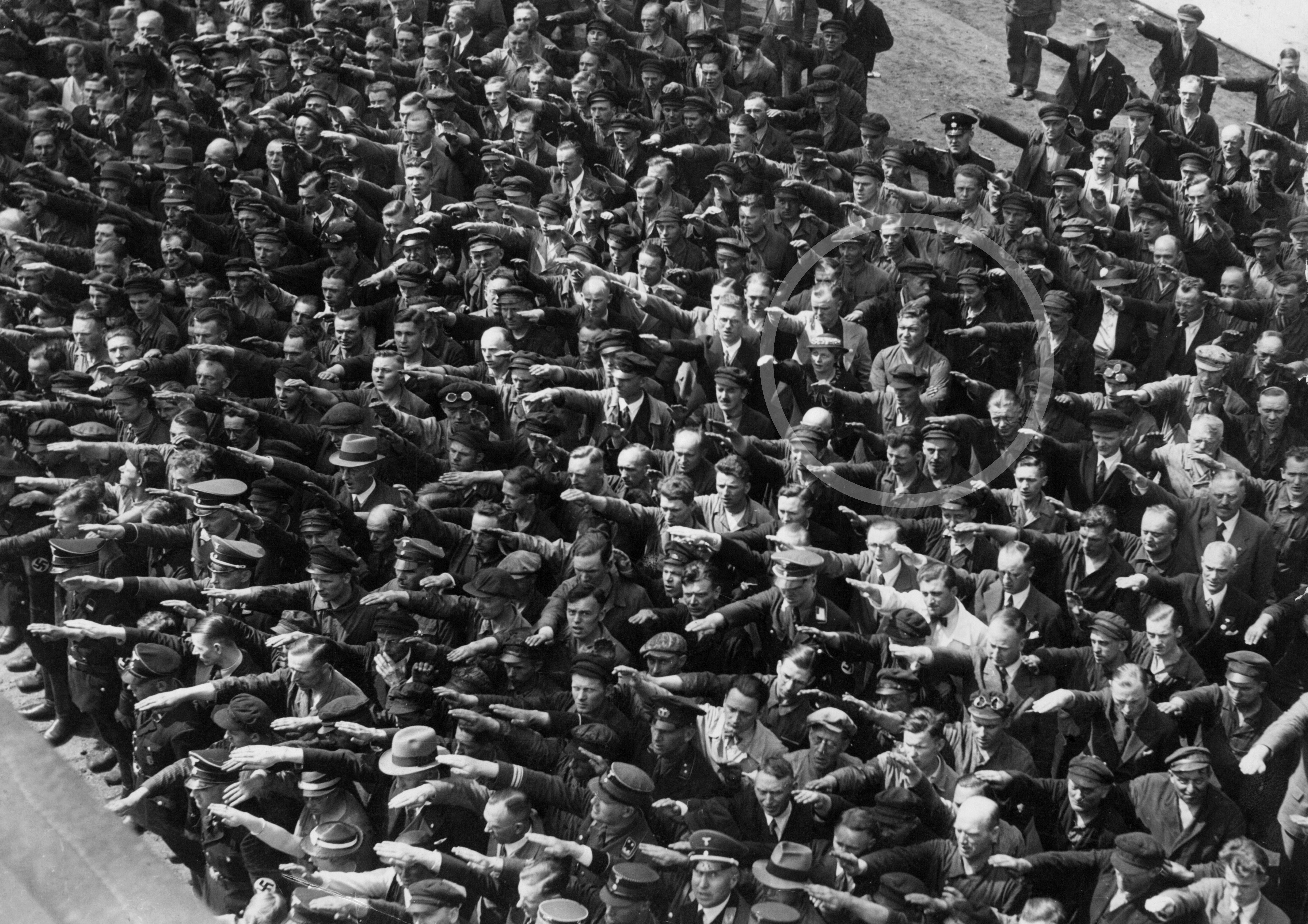
There is a single man standing with his arms crossed in defiance while surrounded by a sea of German dockworkers raising their arms in the Nazi salute. The image was taken on 13 June 1936 in the port of Hamburg and rediscovered decades later, in 1991, when it quickly spread around the world.

The man was later identified as August Landmesser.

The occasion was the launch of a naval training vessel attended by Adolf Hitler—a ceremony designed to project unity, obedience, and ideological conformity. Against this backdrop, Landmesser’s refusal to salute stands out as an act of rare moral clarity. It was a small gesture, almost understated, yet it carried immense personal risk—and ultimately, tragic consequences.

The individual who stood against the crowd

Landmesser’s story is not one of abstract heroism but of lived contradiction. He had joined the Nazi Party in 1931, reportedly to secure employment. Yet his life took a decisive turn when he fell in love with Irma Eckler, a Jewish woman.

Under the racial laws of the regime, their relationship was forbidden. He was expelled from the party. Still, they remained together and had a daughter in 1935. Their refusal to separate led to their arrest in 1938. Landmesser was imprisoned, later conscripted into a penal military unit, and is believed to have died in action. Eckler was deported and murdered in the Ravensbrück concentration camp in 1942.

Seen in this light, the photograph is no longer simply symbolic—it is deeply personal. Landmesser’s defiance was not ideological theatre. It was the visible expression of a man whose life had already been shattered by the system he refused to endorse.

The individual mind versus the herd mind

The image endures because it captures a perennial tension: the individual conscience set against the force of the collective.

Crowds possess psychological gravity. Individuals who, in isolation, might act with restraint and judgment can become unrecognizable when absorbed into a mass. We have seen modern echoes of this dynamic in events such as the January 6 United States Capitol attack, where ordinary citizens were swept into a collective surge that overrode personal responsibility.

Western societies place a high value on individual freedom and self-expression. Yet beneath this, there often lies a spiritual disconnect that makes the pull of belonging all the more powerful. Identification with political movements, brands, cultural tribes, or even sports teams can take on a “religious” intensity. The need to belong can, under certain conditions, eclipse the capacity to think.

When consciousness gives way to the collective

The Swiss psychiatrist Carl Gustav Jung, who studied the psychological undercurrents of totalitarianism, drew a sharp distinction between the individuated mind and what he termed the collective unconscious.

He warned that as groups enlarge, consciousness tends to diminish. The ethical and reflective capacities of the individual are diluted, replaced by something more primitive, more reactive. In his words, the psychology of large crowds tends to descend to a more instinctual, even “animal” level. What emerges is not an elevation of shared wisdom, but often a regression into emotional contagion.

This is not merely a historical observation. It is a recurring human pattern.

The modern amplification of the herd

We are living through a period of accelerated change where vigilance and discernment are no longer optional—they are essential.

The digital ecosystem has intensified the dynamics Jung described. Large segments of mass media and social platforms no longer function primarily as vehicles of information, but as engines of emotional activation. Content is optimized not for truth, but for engagement—often by triggering fear, outrage, or tribal loyalty.

Distortion, simplification, and conspiracy narratives thrive in such environments. The line between information and manipulation has become increasingly blurred.

There are early indications that major platforms are beginning to acknowledge their role in this landscape. But structural incentives remain largely unchanged.

A practical line of resistance

Landmesser’s gesture invites a question that is as relevant now as it was then: what does it take to remain inwardly independent in the face of collective pressure?

A useful starting point is deceptively simple:

When you encounter a piece of information that provokes an immediate emotional reaction—pause.

Ask yourself:

  • What is the source of this reaction?
  • What intention might the communicator be pursuing?
  • Does this information serve clarity—or does it seek to agitate?

These questions create a small but decisive space between stimulus and response. In that space, the individual mind can reassert itself.
Sometimes it simply takes courage to refuse to roar like the crowd, to stand still, and refuse to follow.

Reino Gevers – Host of the LivingToBe podcast

P.S: If you enjoyed this article you might be interested in reading more in “Deep Walking for Body, Mind and Soul” published by Morgan James, New York. Get it today on Amazon, Barnes & Noble and where all good books are sold.
Leave a comment

Filed under psychology, purpose, religion

The Cross: A Symbol of Resurrection and New Beginnings

Wishing you a peaceful Easter. I’m sharing this extract from my book: Deep Walking for Body, Mind and Soul as a reflection for the season — on the Cross, on suffering, and on the possibility of new beginnings.

“It is easy to bond with people on the Camino. You share daily experiences, memories and the highs and lows that come with a pilgrimage walk.

Then comes the time to say goodbye, which can be a painful process if you have spent days and weeks walking with someone. It is like saying goodbye to an old friend when you know it will be some time before you will see each other again.

Ray was a veteran pilgrim, walking the Camino for the last time. He had undergone surgery for colon cancer some weeks before, and was taking his walk slowly and with great mindfulness.

It was from the awareness that every moment that he still had to live was precious. “I’ve been on this same path many times,” he confided, “but this time I am seeing so many things I did not see before.”

“It is like reading a good book, and then you read it a second time and a third time, discovering each time something new from a different state of awareness,” he said.

Talking with Ray led to the realization that life itself is meaning and the purpose of each individual is moving to a higher state of consciousness during a lifetime whose end we cannot predict.

Ray decided to take a few days’ rest near the town of Sarria, wanting to walk the last 100 kilometers (62 miles) to Santiago in his own time.

On saying goodbye, Ray gave me a Christian cross that he had lovingly carved out of wood from an olive tree.

While I was touched by his gift that came from the heart, I had mixed feelings about the cross that also symbolized the “corporate identity” of the church with which I had a long-troubled relationship.

I was unaware at the time that my pilgrim friend had given me an astounding gift. I hung it around my neck, its mystery opening to me with every step to Santiago and healing the old wound.

In the Christian tradition the cross is the symbol of Christ’s pain and suffering. It resonated with the people in the Middle Ages who themselves went through a dark time of humanity. But in the modern era?

The tragedy is that the fixation on this symbol of suffering misses the essence of Jesus’ teachings—that of transmuting suffering and death in resurrection.

This might sound blasphemous for some but we have a religion focused on life being an endless endurance of pain and suffering with the salvation only coming in the hereafter.

This was very much the thinking during the Middle Ages. Christians paid tithes to the church to “buy” their way into heaven. With disease, war and childbirth being a constant daily reminder that life on earth could be a short sojourn, the church fed into the fears of what comes in the afterlife. If certain beliefs, habits and rules were not followed, you ended up in the eternal flames of hell.

Life on earth at the time must surely have been hell for many people, struggling to eke out a living in the overcrowded towns and cities infested with rodents and human excrement. Living in the rural areas was no better, as every freak weather condition could mean a failed harvest and famine.

The devil was blamed for bad luck, accidents, immoral behavior, theft, illness and death. He was frequently depicted in places of worship, paintings and manuscripts of the time. Hell was a dark underground world ruled by Satan and full of demons, monstrosity and deformity. The horrors could not be worse if you turned your back against God and the church.

At the same time Christ was the savior in the sky above. Depictions of heaven and Christ could frequently be found on high ceilings and on top of the altar. God’s mercy and the reward in the afterlife came after leading a life following rules and beliefs.

There are many depictions of the world of darkness and the world of light in the old cathedrals, chapels and churches on the Camino, such as in Jaca, Lugo and Oviedo, giving an inkling of the mindset of the time.

The dividing lines between good and evil could not be more vivid.

In contrast, the Cathedral of Santiago is an expression of joy. It probably stems from the joy many pilgrims felt in finally reaching their destination after months of arduous walking. The Monte de Gozo, or Mountain of Joy, is situated on a hilltop from where the pilgrims had a beautiful view of the ancient city of Santiago.

The Portal of Glory in the cathedral features over 200 Romanesque sculptures, featuring angels, saints and prophets. Angels carry and lead the soul to paradise. The angels play instruments in concert to the glory of God.

Built in the form of a cruciform, the cathedral is almost austere coming from the entrance but opens up to a magnificent organ and choir with illuminated chapels on either side.

Even today pilgrims are overwhelmed when entering the cathedral for the first time.

If he or she has walked on the northern route, he/she will have passed by numerous crosses along the wayside, depicting the crucified Christ in many shapes and forms of gruesome suffering.

No wonder the first Vikings visiting England went back to their homeland telling their people that the Anglo-Saxons were easy prey because they were worshipping a dead God.

The cross is in fact an old symbol pre-dating Christian times and deeply embedded in pagan and Celtic tradition.

In many of the churches and chapels on the Camino the “Goddess,” the Virgin Mary, is the central figure on the altar. Especially in Galicia the ancient stone crosses depict Jesus on the one side and the Mother Mary on the other, which on a symbolic level unites the male and the female aspect.

One of the sad aspects of the Protestant movement was the banishment of the Madonna, the female aspect, from the altar, replacing it with the crucifix.

Many priceless artifacts were burned and destroyed in the fanatic 30-year religious war between Catholicism and Protestantism that ravaged central Europe in the 15th century.

While the Roman Cross has a long central vertical line, the Celtic cross has both the vertical and horizontal lines in equal length, with a circle around it.

The horizontal lines symbolize the past and the future, with the mind locked in one of these two thoughts on a daily basis. The vertical line, however, represents the alignment with the above and the below, the awakened state of the present “heart moment” in the center where the cross meets.

We thus find many an ancient painting depicting a heart or a mandala in the center of the cross.

As we say the old Celtic powerful prayer of protection, we visualize the Goddess, the Mother, Mary, the Madonna:

She is as above me as below, to the left and to the right, before me and behind me as well as within me.”

Reino Gevers – Host of the LivingToBe podcast

P.S: If you enjoyed this article you might be interested in reading more in “Deep Walking for Body, Mind and Soul” published by Morgan James, New York. Get it today on Amazon, Barnes & Noble and where all good books are sold.

Leave a comment

Filed under Camino de Santiago, humanity, spirituality