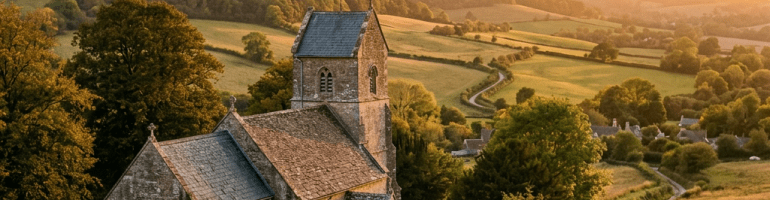
Last week, we reflected on what is lost when people leave their village, their small town, and the familiar rhythms of communal life. Across the modern world, millions have moved toward cities in search of opportunity, freedom, and economic survival. Yet in the process, something profound has often been left behind.
Life in cities can be exciting and liberating, but it is also frequently anonymous. One can live among millions and still feel unseen. Modern urban life often disconnects people from land, ancestry, ritual, and the shared memory of community. Relationships become fragmented and transactional. The old structures that once held human life together slowly weaken.
In villages and rural communities, identity was traditionally formed through belonging. A person was known not only by occupation, but by family, neighbourliness, participation, and place. There were rhythms to life: births, marriages, funerals, feast days, seasons of mourning, prayer at certain hours, bells ringing across a valley at dusk. Human beings lived within a larger story.
Research into the so-called Blue Zones — regions of the world where people consistently live longer and healthier lives — reveals something deeply important. Longevity is not simply linked to diet or exercise. It is also connected to a healthy social network, purpose, ritual, intergenerational connection, and spiritual belonging. In many of these communities, faith and communal life remain deeply intertwined.
Historically, the church stood at the center of this communal structure. Whatever its failures — and history certainly contains many — churches often provided sanctuary during times of grief, illness, uncertainty, and poverty. Sacred spaces gave language to suffering and meaning to mortality. The repetition of prayer, liturgy, candle-lighting, silence, chanting, kneeling, and ritual anchored people psychologically and spiritually.
Today, in much of the Western world, institutional religion has lost moral authority for millions of people. Financial scandals, abuse, political entanglement, shaming, and rigid dogmatism have left deep wounds. Many have walked away from organized religion altogether.
Yet the deeper human hunger has not disappeared.
People continue searching for meaning, transcendence, stillness, and connection. Even those who no longer identify as religious are often drawn toward pilgrimage routes, monasteries, ancient cathedrals, contemplative prayer, meditation, sacred music, or moments of silence in old churches. Something within the human spirit still longs for an encounter with the mystery of the divine.
The medieval Christian mystic Meister Eckhart once wrote:
“The soul grows by subtraction, not by addition.”
It is a remarkable insight for our age of endless stimulation and accumulation. Modern life constantly tells us to consume more information, more possessions, more experiences, more noise. Yet many people remain inwardly exhausted and spiritually empty.
Ritual and contemplative practice offer another path.
When prayer is repeated daily at a particular hour, in a sacred place, with intention and rhythm, it slowly becomes embedded in consciousness. Over time, the body itself begins to remember stillness. Ritual becomes less about performance and more about orientation. It provides structure when life feels chaotic and uncertain.
Modern neuroscience increasingly confirms what ancient spiritual traditions long understood intuitively: repetition calms the nervous system. Sacred ritual regulates emotional states. Silence and contemplative practice can reduce anxiety and restore psychological balance. The body responds to rhythm, breath, chant, and sacred attention.
But perhaps the deeper issue is existential rather than merely psychological.
A life disconnected from spiritual depth can begin to feel strangely hollow. Human beings do not live by productivity and consumption alone. Usually in moments of crisis or solitude, deeper questions emerge.
What happens when life ends?
What is the soul?
What gives suffering meaning?
What remains when certainty collapses?
These questions often arrive quietly — at three in the morning, during illness, after loss, while sitting beside a hospital bed, or in the strange silence that accompanies aging. Technology cannot answer them. Wealth cannot remove them. Distraction only postpones them.
Perhaps this is why sacred places, like walking ancient pilgrimage routes, still matter.
Even now, many people instinctively lower their voices when entering an ancient church or monastery. Something within us recognizes sacred space before the intellect has framed it. In the lighting of a candle, the sound of distant bells, or the quiet repetition of prayer, we remember something modern life easily forgets:
You are not just an economic creature.
You are also a spiritual being searching for meaning, belonging, and connection to something greater than yourself.
Reino Gevers – Host of the LivingToBe podcast
P.S: If you enjoyed this article you might be interested in reading: Sages, Saints and Sinners Get it today on Amazon, Barnes & Noble and where all good books are sold.


 ReinosBlog