Tag Archives: faith

Embracing Self-Love on the Camino de Santiago

While walking the Camino de Santiago, I sometimes encountered pilgrims who seemed to confuse pilgrimage with an act of self-punishment. Despite their bodies sending unmistakable signals—painful blisters, swollen joints, and deep exhaustion—that it was time to rest, they would continue pushing forward. Determined to conquer the path at all costs, they ignored their physical limits until, inevitably, they were forced to abandon their journey altogether.

There is a saying I learned from another pilgrim on the way. “If you don’t learn to approach the path with humility, it will teach you humility.”

Others approached the Camino very differently. I remember older pilgrims, some well into their eighties, who walked slowly and with intention. They moved at their own pace, stopping occasionally to admire the landscape, sitting quietly in contemplation, or choosing to walk only half a stage in a day. Rather than measuring success by distance covered, they seemed to delight in the journey itself. Remarkably, many of these pilgrims completed the entire 800-kilometre route to Santiago. Even more striking was the vitality they radiated. They appeared youthful, not because of physical strength alone, but because they had learned the wisdom of walking in harmony with themselves.

Pilgrimage offers many lessons about life, but one of its most important teachings is the often misunderstood art of self-love.

Modern psychology increasingly confirms what many spiritual traditions have taught for centuries: self-love is not a luxury but a necessity for human flourishing. Research on self-compassion, pioneered by psychologist Dr Kristin Neff, shows that people who treat themselves with kindness during times of difficulty tend to be more resilient, emotionally balanced, and motivated than those who constantly criticise themselves.

Contrary to popular belief, harsh self-judgment, especially negative self-talk, does not produce stronger or more successful people. Instead, it often leads to anxiety, burnout, perfectionism, and emotional exhaustion.

Self-love, in psychological terms, means relating to oneself with the same care and understanding that one would naturally offer a good friend. It involves recognising one’s limitations without shame and acknowledging one’s worth without needing constant external validation. Such an attitude fosters emotional well-being and enables people to respond more constructively to life’s inevitable challenges.

These findings resonate deeply with the teachings of the 13th-century mystic Meister Eckhart. Eckhart believed that what turns human beings into compulsive graspers—unable to let go of possessions, status, relationships, or beliefs—is ultimately a lack of trust. Beneath our attachments lies a profound insecurity, a fear that we are somehow incomplete or unworthy.

For Eckhart, self-love and trust in the divine are inseparable. Compassion arises from confidence in the goodness that lies at the heart of existence, while compulsive striving grows from the belief that we are fundamentally lacking or flawed. The person who learns to “let be” and at the same time allows themselves to be is expressing a deep confidence in the creative source of life.

Eckhart writes: If you do not know how to love yourself, how is it possible that you will love God? There can be no love of neighbour without love of self.” To love oneself, in his understanding, is not an obstacle to spiritual growth but one of its essential foundations.

Such ideas were controversial in Eckhart’s time. Many theologians were preoccupied with sin, moral regulation, and the strict enforcement of doctrine. God was often portrayed as an authoritarian ruler who rewarded obedience and punished transgression. Shame and guilt became powerful tools of religious instruction—a dynamic that continues to influence some religious traditions today.

The divine potential in every person

Yet Eckhart offered a radically different vision. Rather than beginning with fear, he began with trust. Rather than emphasising human depravity, he pointed toward the divine potential present within every person.

This brings us to an important distinction: self-love is not the same as ego.

The ego seeks validation, superiority, and control. It constantly compares itself with others and measures its worth through achievement, status, or recognition. Ego asks, “How can I become more important?” Self-love asks, “How can I become more fully myself?”

The ego is rooted in insecurity and therefore always needs more. Self-love arises from a deeper acceptance and therefore has nothing to prove. The ego separates; self-love connects. The ego grasps; self-love releases. The ego seeks to protect an image; self-love nurtures a living reality.

Far from encouraging selfishness, genuine self-love often leads to greater compassion. People who are at peace with themselves generally have a greater capacity to listen, empathise, forgive, and care for others. They are not depleted by the endless struggle to earn their own worth.

The spiritual path, whether on the Camino or in everyday life, invites you to confront your fears, loosen your attachments, and ultimately learn the difficult art of letting go. This includes letting go of the false stories you tell yourself about who you should be.

At the heart of Eckhart’s teaching is a beautiful image. The essence of the divine, he says, is “birthing”—a continual process of creation and emergence. Life is not a static state to be achieved but an ongoing unfolding into what we are meant to become. We are not passive observers of this process but active participants in it.

Perhaps this is one of the Camino’s greatest lessons. The journey is not won by those who push themselves the hardest. It is completed by those who learn to walk with wisdom, humility, and kindness toward themselves. In learning to love yourself, you discover that you are not separate from the sacred journey but part of its unfolding.

Reino Gevers – Host of the LivingToBe podcast

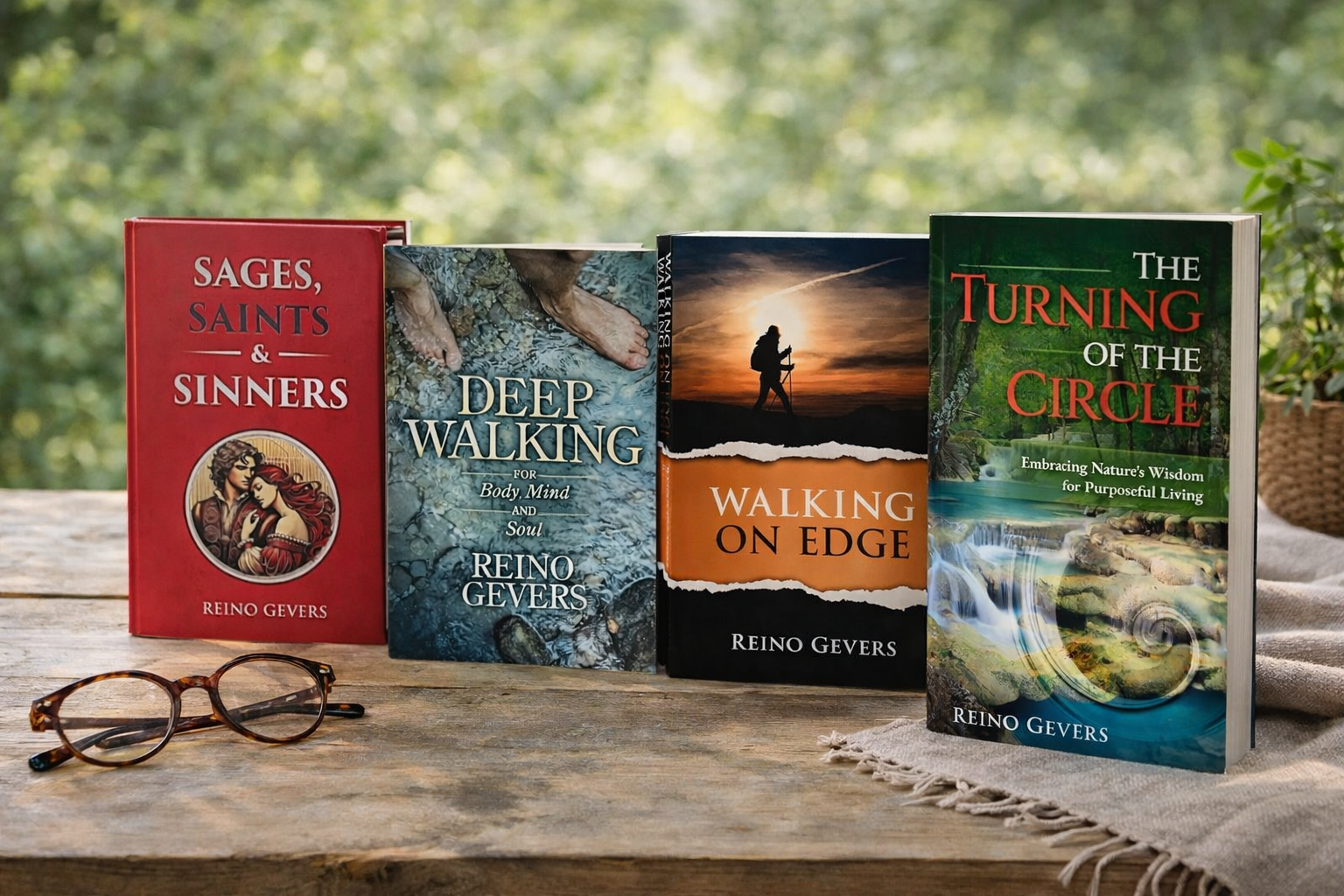
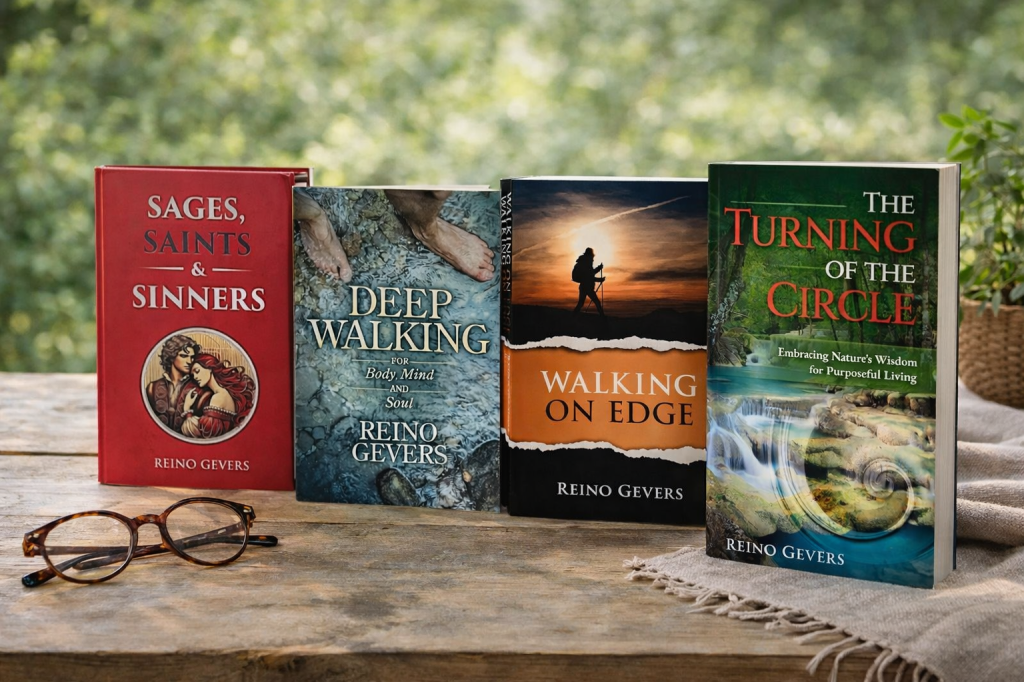
P.S. Over the years, my own Camino journeys have inspired two books exploring the deeper inner dimension of pilgrimage and transformational walking: Deep Walking for Body, Mind and Soul and the newly revised edition of Walking on Edge. Both reflect on the Camino not merely as a physical journey, but as a path of inner change, reflection, and rediscovery.

Leave a comment

Filed under Camino de Santiago, psychology, spirituality

Finding Spiritual Connection in Modern Society

Last week, we reflected on what is lost when people leave their village, their small town, and the familiar rhythms of communal life. Across the modern world, millions have moved toward cities in search of opportunity, freedom, and economic survival. Yet in the process, something profound has often been left behind.

Life in cities can be exciting and liberating, but it is also frequently anonymous. One can live among millions and still feel unseen. Modern urban life often disconnects people from land, ancestry, ritual, and the shared memory of community. Relationships become fragmented and transactional. The old structures that once held human life together slowly weaken.

In villages and rural communities, identity was traditionally formed through belonging. A person was known not only by occupation, but by family, neighbourliness, participation, and place. There were rhythms to life: births, marriages, funerals, feast days, seasons of mourning, prayer at certain hours, bells ringing across a valley at dusk. Human beings lived within a larger story.

Research into the so-called Blue Zones — regions of the world where people consistently live longer and healthier lives — reveals something deeply important. Longevity is not simply linked to diet or exercise. It is also connected to a healthy social network, purpose, ritual, intergenerational connection, and spiritual belonging. In many of these communities, faith and communal life remain deeply intertwined.

Historically, the church stood at the center of this communal structure. Whatever its failures — and history certainly contains many — churches often provided sanctuary during times of grief, illness, uncertainty, and poverty. Sacred spaces gave language to suffering and meaning to mortality. The repetition of prayer, liturgy, candle-lighting, silence, chanting, kneeling, and ritual anchored people psychologically and spiritually.

Today, in much of the Western world, institutional religion has lost moral authority for millions of people. Financial scandals, abuse, political entanglement, shaming, and rigid dogmatism have left deep wounds. Many have walked away from organized religion altogether.

Yet the deeper human hunger has not disappeared.

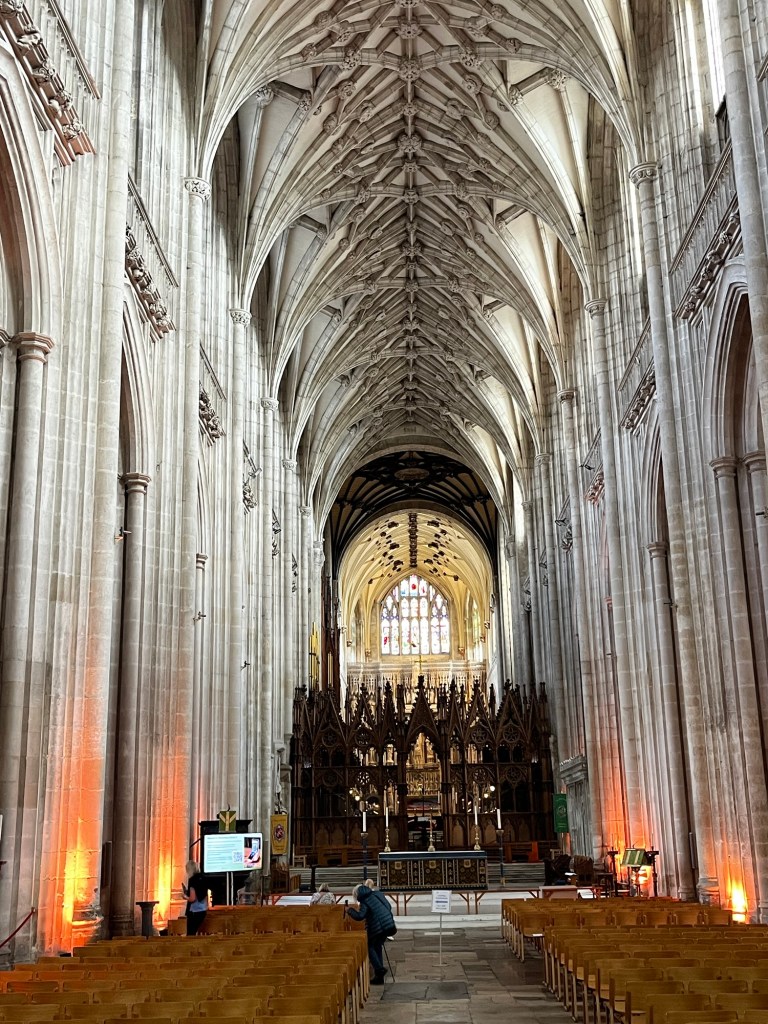
People continue searching for meaning, transcendence, stillness, and connection. Even those who no longer identify as religious are often drawn toward pilgrimage routes, monasteries, ancient cathedrals, contemplative prayer, meditation, sacred music, or moments of silence in old churches. Something within the human spirit still longs for an encounter with the mystery of the divine.

The medieval Christian mystic Meister Eckhart once wrote:

“The soul grows by subtraction, not by addition.”

It is a remarkable insight for our age of endless stimulation and accumulation. Modern life constantly tells us to consume more information, more possessions, more experiences, more noise. Yet many people remain inwardly exhausted and spiritually empty.

Ritual and contemplative practice offer another path.

When prayer is repeated daily at a particular hour, in a sacred place, with intention and rhythm, it slowly becomes embedded in consciousness. Over time, the body itself begins to remember stillness. Ritual becomes less about performance and more about orientation. It provides structure when life feels chaotic and uncertain.

Modern neuroscience increasingly confirms what ancient spiritual traditions long understood intuitively: repetition calms the nervous system. Sacred ritual regulates emotional states. Silence and contemplative practice can reduce anxiety and restore psychological balance. The body responds to rhythm, breath, chant, and sacred attention.

But perhaps the deeper issue is existential rather than merely psychological.

A life disconnected from spiritual depth can begin to feel strangely hollow. Human beings do not live by productivity and consumption alone. Usually in moments of crisis or solitude, deeper questions emerge.

What happens when life ends?

What is the soul?

What gives suffering meaning?

What remains when certainty collapses?

These questions often arrive quietly — at three in the morning, during illness, after loss, while sitting beside a hospital bed, or in the strange silence that accompanies aging. Technology cannot answer them. Wealth cannot remove them. Distraction only postpones them.

Perhaps this is why sacred places, like walking ancient pilgrimage routes, still matter.

Even now, many people instinctively lower their voices when entering an ancient church or monastery. Something within us recognizes sacred space before the intellect has framed it. In the lighting of a candle, the sound of distant bells, or the quiet repetition of prayer, we remember something modern life easily forgets:

You are not just an economic creature.

You are also a spiritual being searching for meaning, belonging, and connection to something greater than yourself.

Reino Gevers – Host of the LivingToBe podcast

P.S: If you enjoyed this article you might be interested in reading: Sages, Saints and Sinners Get it today on Amazon, Barnes & Noble and where all good books are sold.
Leave a comment

Filed under Uncategorized

Does God Punish Humanity? Lessons from the Black Death and Modern Pandemics

When disaster strikes on a massive scale, people instinctively ask the same ancient question:

Is this God’s judgment?

It is a question that has echoed throughout human history.

In the 14th century, as the Black Death swept across Europe, entire populations believed they were witnessing divine punishment. Churches filled with desperate prayers. Some people turned toward deeper faith. Others lost their faith entirely.

Centuries later, during the COVID-19 pandemic, that same question quietly resurfaced.

What happens to faith when the world believes God’s judgment has arrived?

Fear, Faith, and the Flagellants

During the Black Death, fear spread as quickly as the disease itself. Many believed the plague was a punishment for humanity’s sins.

Across Europe, bands of penitents known as flagellants marched from town to town, whipping themselves in public acts of penance. They believed that if humanity suffered enough, God might show mercy.

Crowds gathered to watch them.

Some saw them as holy reformers.

Others saw them as dangerous fanatics.

It was faith under extreme pressure.

The Quiet Courage of Compassion

Yet there was another response to the plague.

While many fled cities in terror, others stayed behind to care for the sick and dying. Monks, nuns, and priests often remained when everyone else ran.

Historians estimate that in some regions nearly half the clergy died while caring for plague victims.

For these people, faith did not mean explaining suffering.

Faith meant standing beside those who suffered.

When Catastrophe Shakes Belief

But the plague also shook belief at its foundations.

People began asking difficult questions:

  • Why would a loving God allow such devastation?
  • Why did the devout die alongside the corrupt?
  • Why did prayers not stop the disease?

These questions gradually reshaped Europe’s intellectual landscape, eventually contributing to major religious transformations, including the Protestant Reformation.

Faith did not disappear.

But it began to evolve.

How Faith Responds to Crisis

History shows that when a catastrophe strikes, faith often moves in three different directions.

Some people become more rigid and fearful, searching for certainty in times of chaos.

Others lose faith entirely, unable to reconcile suffering with belief in a loving God.

And some discover a deeper, quieter faith—one rooted not in easy answers, but in compassion, humility, and solidarity with others.

What Did Jesus Say About Suffering?

In the teachings of Jesus Christ, suffering is rarely presented as punishment directed at specific individuals.

Instead, suffering often becomes an invitation to reflect on how we live and how we treat one another.

The focus shifts away from blame and toward compassion, mercy, and moral transformation.

The Inspiration Behind Sages, Saints and Sinners

These were the questions that fascinated me when I began writing my historical novel Sages, Saints and Sinners.

I wanted to explore what happens to ordinary people when the world around them collapses and they believe that God’s judgment has arrived.

In many ways, the questions raised during the recent pandemic helped inspire that exploration.

Set during the Black Death, Sages, Saints and Sinners explores love, faith, and spiritual conflict in the midst of an existential crisis.

What do people hold onto when everything begins to collapse?

The novel tells a story of faith, doubt, and forbidden love in a time when many believed the end of the world had come.

If these questions intrigue you, you may enjoy the novel that grew out of them.

Sages, Saints and Sinners is available on Amazon, and all good bookshops.

What Pandemics Reveal About Us

History reminds us that pandemics do more than challenge our health.

They challenge our beliefs.
They challenge our assumptions.
And they challenge our understanding of God.

Perhaps the deepest question is not whether suffering is punishment.

Perhaps the real question is this:

Do moments of crisis invite us to rediscover compassion, courage, and faith?

Reino Gevers – Author – Mentor –Speaker

P.S: If you enjoyed this article you might be interested in reading: Sages, Saints and Sinners Get it today on Amazon, Barnes & Noble and where all good books are sold.

Leave a comment

Filed under purpose, religion, spirituality

The Dark Side of Christian Nationalism

Having grown up in apartheid South Africa, I witnessed firsthand how religion can be distorted to justify some of the gravest human rights abuses. History offers chilling parallels: in Nazi Germany, the swastika found its way into church ceremonies, with clergy openly swearing allegiance to a dictator.

Today, a similar shadow—rooted in comparable theological distortions—is emerging within the Christian Nationalist movement in the United States.

Theology and religion are human constructions that often claim divine authority. Yet when they are used to sanctify power, exclusion, or domination, they stand in stark contradiction to the core teachings of early Christianity and the mystical tradition, which consistently point toward humility, compassion, and the radical dignity of every human being.

The Christian Nationalist movement operates with a social-Darwinist logic: power is taken as proof of truth, strength as legitimacy to rule, and survival as confirmation of human worth. The ideologues of apartheid followed the same reasoning. Racial domination was justified through a distorted theology that claimed the ruling white Afrikaner population had been chosen by God, much like ancient Israel, while other races were destined to serve the so-called “chosen people.”

Such an ideology devastates the very tenets of a caring, humane society. It dehumanizes not only its victims but, ultimately, also the perpetrators and those who wield power. Essential human qualities—empathy, love, and compassion—are sacrificed. Overarching foundational values and ethics are eroded. There is extreme polarization between “us” and “them,” sowing the seeds of a conflict-ridden society that can last generations.

For Christian mystics, however, God is never encountered at the top of a hierarchy. God is found in descent—into poverty of spirit, vulnerability, empathy, and the surrender of control and power.

The 13th-century mystic Meister Eckhart goes so far as to say that God can only enter the soul when it becomes nothing. This is the precise opposite of evolutionary ascent and nationalist thinking built on “us over them,” where identity precedes ethics. In early Christian ethics, election is always for the sake and service of others, never against them.

The apostle Paul shatters tribal and hierarchical thinking when he writes:

“There is neither Jew nor Greek, slave nor free, male nor female.”

The mystics radicalize this even further. God is encountered beyond all description and distinction. Ultimately, the soul is eternal and has no nationality.

Julian of Norwich’s famous vision—“All shall be well”—embraces all of creation, not a purified remnant.

Social Darwinism interprets weakness and poverty as failure. Jesus’ teachings, however, were taken literally by early Christians:

  • Blessed are the poor
  • Blessed are the meek
  • Blessed are the persecuted

These were not metaphors. Early Christians were often minorities without political power—socially marginalized and frequently persecuted. The Cross was not an abstract symbol but a mirror of their own suffering, where pain and challenge were understood as moments of revelation. To this day, many churches recognize care for the sick, the feeding of the poor, and the protection of the weak as faith made visible.

The mystics take this even further by turning inward, welcoming the soul’s own shadow. God is found where the ego loses its boundaries. Isaac of Nineveh writes:

“A heart that has learned compassion burns for the whole creation.”

This vision is anti-Darwinian and anti-predestination to its core.

The social-Darwinist logic of the state claims that violence preserves order and advances God’s evolutionary plan by eliminating the weak. Early Christians and martyrs exposed the lie of violence. They refused to cooperate with its false claims, rejected armed revolt, and resisted the sacralization of force.

Christian Nationalism imagines history moving upward through domination. Mystical Christianity understands history as being transformed from within, through the elevation of consciousness. The Kingdom of God is invisible, non-coercive, and never aligned with empire or government.

Truth does not require dominance. Love—not survival—is the measure of divine destiny.

Where social Darwinism asks, “Who deserves to live?”
Christianity asks, “Who is already loved?”

Reino Gevers – Host of the LivingToBe podcast

P.S. For those who feel drawn to explore this in-between season more intentionally, I am offering a six-week online course, Pilgrimage into New Beginnings. It is a quiet, reflective journey for times of transition, starting March 4th.

Leave a comment

Filed under gratitude, happiness, Uncategorized

From Struggle to Awe: A Pilgrimage of Transformation

“Be willing to be a beginner every single morning.” — Meister Eckhart

There was a time in my life when I believed I had to hold everything together by sheer work and effort. If I paused, I feared I would disappear. Only later did I begin to understand that disappearing was not the danger I imagined. It was, in fact, the return.

Life is something like a ripple on the ocean, momentarily appearing, briefly defined, then gently dissolving back into the vastness from which it came. The ripple feels separate while it lasts, yet it has never been anything other than the ocean. This simple image has accompanied me through many seasons of exhaustion, loss, and quiet awakening.

The mystics gave language to what I was slowly learning through experience. The 13th-century Mystic Meister Eckhart puts it into words: “The eye with which I see God is the same eye with which God sees me.” If this is true, then separation is not the final truth of a lifetime.

When Separation Feels Real

For many years, separation felt very real to me. I lived on the surface—busy, capable, outwardly functional—while something deeper waited patiently. I now recognize how easily we mistake movement and activity for meaning. Eckhart’s warning feels almost tender in hindsight: “As long as you are seeking God, you are not yet aware that you have found Him.” I was always seeking, rarely resting.

The poet-mystic Rumi names this restlessness with compassion: “Why are you so busy with this or that or good or bad; pay attention to how things blend.” When you allow things to blend, you surrender to strength, vulnerability, certainty, and doubt, faith and the unknowing.

The Descent That Saved Me

My own turning point came not through achievement, but through fatigue. I had reached a place where distraction no longer worked. What emerged instead was a quiet invitation to walk—both literally and inwardly. An annual pilgrimage became my way of consenting to descent.

One day, on the Camino Primitivo in northwestern Spain, I found myself struggling up a steep mountain path amid darkness and driving rain. Each step felt heavy. The trail seemed endless, and my inner landscape matched the weather—tight, effortful, and discouraged.

Then, without warning, the heavens opened. The rain softened, the clouds lifted, and beneath me appeared a vast sea of clouds stretching all the way to the horizon. The shift was almost instantaneous. Within seconds, my mood changed completely. Where there had been struggle, there was awe. Where there had been resistance, there was gratitude.

I stood there, soaked and breathless, perceiving not only the incredible beauty of that moment, but the beauty of life itself. I felt truly blessed—not because anything had been solved, but because something had been revealed. I had crossed a threshold without even realizing it.

The Christian mystics speak of this movement without sentimentality. John of the Cross calls it “the dark night,” a phrase that once frightened me. Now I hear it differently: as a stripping away of the onion layers of what no longer carries life. What felt like loss was actually a clearing.

Living Lightly on the Surface

It is so easy to confuse your ripple with your worth. There is a deep need to be seen, to be heard, and to be validated. But it can create much pressure. Accept who you are with loving kindness, and the old burden of control is no longer that important. Meister Eckhart’s invitation is simply: “Let go of yourself and you will find yourself.” This letting go is a daily practice rather than a single event.

To live as a ripple is to accept impermanence without fear. To rest as the ocean is to trust belonging without proof. Somewhere between the two, a quieter wisdom emerges.

A Gentle Invitation

A Pilgrimage to New Beginnings grew out of this lived knowing. It is not about fixing what is broken, but about remembering what has never been lost. If these reflections echo something in your own life, you are warmly welcome to join.

The reservation window remains open for ten more days—not as an urgency, but as an invitation to step across a threshold.

The ripple does not need to earn its place in the ocean.

Reino Gevers – Host of the LivingToBe podcast

P.S. For those who feel drawn to explore this in-between season more intentionally, I am offering a six-week online course, Pilgrimage into New Beginnings. It is a quiet, reflective journey for times of transition, starting March 4th.

Leave a comment

Filed under deep walking, gratitude, happiness, meditation, self-development, spirituality

Transforming Pain: Cultivating True Gratitude

You may find yourself in the midst of one of life’s more challenging chapters marked by grief, uncertainty, or loss. Then, as if on cue, a well-meaning friend offers the familiar advice: “Just be grateful.” In that moment, you might feel an angry urge to say: “You don’t understand.” And the weight grows heavier when you begin comparing your life to those who seem happier, wealthier, healthier, or younger, as if their brightness somehow dims your own.

But here’s the deeper truth: you cannot silence authentic emotions such as sadness, despair, or fear by layering them with forced gratitude. Emotional honesty is not weakness; it’s the foundation of healing. Gratitude only becomes meaningful when it arises from a place of full acceptance and when you allow yourself to feel everything that is part of you without self-judgment.

“I am feeling sad. I am disappointed. I am angry. And still, there are things I can be grateful for.”

This is where healing begins. When you make a habit of connecting the dots between past experiences and present growth, you start to see a deeper pattern.

There comes that quiet reassurance that the universe has always had your back. Even the darkest moments often conceal unexpected blessings, pushing you to tap into inner reserves of strength and begin anew.

I’ve lived through many moments of profound despair, and I suspect you have too. Relationship breakdowns, the untimely loss of loved ones, financial setbacks, and health scares. Yet in hindsight, these painful milestones have often marked the beginning of something transformative.

Technologically, humanity has made extraordinary progress in recent decades. But this advancement has come at a steep personal and environmental cost. Our lives today are faster, more connected, and paradoxically more stressed. We have more time than any generation before us, and yet time has become our most precious, elusive commodity.

This revolution forces us to confront an ancient question:

What truly makes you content and fulfilled?

The thrill of a shiny new object fades quickly. What endures is meaning and purpose.

Every extreme carries within it the seed of renewal. The technological age has amplified our left-brain — analytical, data-driven, “spreadsheet” thinking — while the right-brain, our intuitive, creative, and spiritual side, remains undernourished. Yet it is this neglected dimension that holds the key to balance.

We are not just rational beings. We are playful, imaginative, soulful creatures. Reclaiming that part of the self — and integrating both hemispheres of the mind — is the challenge of our time. Just because you are going through a dark chapter, doesn’t mean you cannot have a beautiful life. Peace comes from going all in on accepting yourself and building on the habits and tools that elevate healing and growth.

How can I do a reset?

Begin with small, intentional rituals that reconnect you to gratitude — not as a forced emotion, but as a recognition and acceptance of life’s complexity and beauty. Here are three daily practices to help you cultivate authentic gratitude:

Morning Reflection

Before reaching for your phone, take three minutes to sit quietly and ask: What is one thing I’m grateful for today — even if it’s small? It could be the warmth of a comfortable bed, the sound of birds, or simply waking up and still being alive, perhaps thanking God, or the universe for a new day.

Gratitude Journal

Each evening, write down three things that brought you comfort, joy, or insight — even if the day was difficult. Over time, this builds a reservoir of perspective and emotional resilience.

Sharing Gratitude

Make it a daily practice to express appreciation — whether through a heartfelt compliment, a sincere thank-you, or a simple kind word. When you share in someone else’s joy or gratitude, you amplify it. Gratitude shared is gratitude multiplied, and it deepens the bonds that connect us.

These rituals aren’t about denying pain or pretending everything is fine. They’re about honouring the full spectrum of your experience while gently creating space for light to return. Gratitude, when rooted in truth, becomes a quiet but potent force for healing, resilience, and renewal.

If the only prayer you ever say in your entire life is ‘thank you,’ it will be enough.”
— Meister Eckhart

This simple yet profound reminder by the great 13th-century Mystic invites you to see gratitude as a way of being and a sacred thread that weaves through joy and sorrow alike, anchoring you in the beauty of presence and opening to grace.

Reino Gevers – Host of the LivingToBe podcast

P.S.: If you enjoyed this article, you might be interested in my latest book, Sages, Saints, and Sinners. Get it today on Amazon, Barnes & Noble, and wherever good books are sold.

Leave a comment

Filed under gratitude, happiness, spirituality, Thanksgiving

The Gift of Money: Spiritual Perspectives

Since the earliest days of organized religion, money has played a pivotal role. It has been used to “spread the word” and to entrench religious power, sometimes abused for exploitation, but also put to good use. It has funded countless schools, hospitals, and welfare that shaped much of our society today.

The Roman Catholic Church, for centuries, built its power on a system of tithes. People were taught that by giving money, they could buy tickets out of purgatory and into heaven.

My own family’s story is intertwined with the Lutheran tradition. My grandparents were hardworking farmers who managed to build some wealth through self-sufficiency and discipline. But extravagance was frowned upon. Any money not reinvested in the farm usually went to the church. Holidays, luxury clothing, and even the small consumer comforts that many middle-class families enjoy today were considered wasteful. The unspoken rule was simple: every cent could be put to “better use.”

Is money the root of all evil?

I often heard the phrase: “Money is the root of all evil.” It shaped me more than I realized. Wealth, if earned at all, had to come through sweat, toil, and tears. Quick fortunes, whether through inheritance or the stock market, were regarded with suspicion. For years, I carried this heavy view of money as something dangerous, almost shameful.

But over time, I began to see that this idea rested on a mistranslation. Paul actually wrote: “The love of money is a root of all kinds of evil” (1 Timothy 6:10). Not money itself, but the love of it, the obsession, the addiction, the false security it promises. That realization was freeing. Money is not moral or immoral; it is neutral. It simply amplifies what is already in us.

Money amplifies character

I have seen this truth play out in my own circle. Friends who were always kind and generous only became more so when entrusted with wealth. They gave freely, they created opportunities, they lifted others up. But those who were by nature fearful, self-centered or controlling became even more so once money entered their lives.

I also found new meaning in the parables I had heard as a child. The Parable of the Talents (Matthew 25:14–30) used to feel like a simple lesson about money and responsibility, but as an adult it spoke to me on a deeper level. In the story, a master entrusts his servants with sums of money before leaving on a journey. Two of them take risks, invest, and return with more than they were given. The third buries his portion in the ground, paralyzed by fear of losing it. When the master returns, he praises the first two as faithful and trustworthy, but calls the last one lazy and casts him out.

For me, this is no longer a story about coins or wealth. It is a metaphor for life itself. Each of us is entrusted with something: gifts, time, energy, relationships, and resources. To bury those gifts, to let fear dictate our choices, is to betray the trust of the One who gave them to us in the first place.

The ultimate sin, I have come to realize, is not failure: It is waste. It is letting your unique talents go unused, your light hidden behind a veil, your voice silenced. From the moment of birth, we are called to grow into the fullness of who we are meant to be. Ignoring that inner calling is not just a missed opportunity. It is, in a sense, a treachery against the soul itself.

Burying your talent, your voice, or even your capacity for love is just as wasteful as burying a coin in the dirt. We are meant to risk, to create, to step out in faith, even if it means stumbling along the way. For it is only in using our gifts, be it wealth, wisdom, or creativity that you truly live in alignment with our calling.

Another great example from scripture is the widow in the temple (Mark 12:41–44). She gave two small coins, all she had, while others gave out of their abundance. Jesus noticed her, not for the amount, but for the spirit of trust with which she gave. That story has always humbled me. It reminds me that generosity has nothing to do with size, but with the heart.

Money is a form of energy

Through these reflections, I began to form a new relationship with money. I no longer see it as shameful or corrupting, but as a form of energy. It can be something that can be directed toward building, healing, and serving. If invested ethically, money can create jobs, sustain communities, and bring hope. Used rightly, it becomes spiritual because it reflects love in action.

I hold onto these mantras now:

  • Money creates freedom of choice.
  • Money provides the means to be generous.
  • Money provides comfort and joy.
  • Money removes anxiety and fear.

When money is a gift, not a god, it can truly serve. As Proverbs 11:25 says: “A generous person will prosper; whoever refreshes others will be refreshed.”

That decision to quit a safe job set me on an entirely new path into writing, podcasting, giving workshops, and exploring the realms of self-realization and spirituality. At first, it felt like stepping into a void, but slowly I discovered that the void was full. Every time I shared my journey, someone would come forward and say, “I needed to hear that.” Every time I gave a workshop, I realized that the experiences and lessons I had once considered private struggles could become bridges of connection.

And strangely, once I began to live into that calling, resources began to align with my purpose. Opportunities opened, doors I couldn’t have forced began to swing wide, and money itself flowed differently, less as something to chase, more as something that supported the work I was meant to do. It was as though life itself was saying: finally, you are using what I gave you.

But the inward and outward journey has shown me a different truth. Money, like talent, is a gift. It is neither evil nor good on its own, but it becomes holy when it is placed in service of something greater. It is energy waiting to be directed. To hoard it, or to bury our gifts in fear, is to shrink from the life we are called to live.

Jesus praised both the servants who multiplied their talents and the widow who gave her last two coins. The size of the gift never matters. What matters is the courage to release it, to trust that God can do more with it than we can ever imagine.

That is the lesson I carry forward: when money is a gift, not a god, it can be a force for freedom, generosity, and joy. And when talents are used, not buried, life opens in unimaginable ways and miracles.

I no longer see money as the root of all evil, nor do I see security as the highest goal. My prayer is simpler now: to be a faithful steward of what I have, to invest in love, to risk my gifts, and to walk each path with trust, knowing that even the detours are part of the journey.

Reino Gevers – Host of the LivingToBe podcast

P.S.: If you enjoyed this article, you might be interested in my latest book, Sages, Saints, and Sinners. Get it today on Amazon, Barnes & Noble, and wherever good books are sold.

2 Comments

Filed under religion, spirituality

Reclaiming Democracy: A Call for Moral Action

Authoritarian movements are not historical accidents. They are the outcome of a long, steady erosion of the moral and spiritual foundations that once underpinned Western societies. The Judaic-Christian values that emphasized community, compassion, and responsibility have weakened, leaving a vacuum filled by grievance culture and divisive tribalism.

A growing number of people feel frustrated, aggrieved, and desperate as societies fracture between the privileged and the left-behind. Rapid technological disruption and sweeping social changes have upended long-held certainties. Entire communities have been dislocated, and the Covid-19 pandemic only deepened the sense of instability and loss.

Traditional institutions in education, religion, media, and politics have not addressed the alienation felt by millions. Students of history will recognize these conditions. Today’s authoritarian movements bear an uncanny resemblance to the turmoil and mass manipulation of the late 1920s and 1930s.

In A Preface to Morals (1929), Walter Lippmann foresaw the dangers of moral relativism and cultural drift:

“When men can no longer be the slaves of tradition, they must be the slaves of reason. If they will not be slaves of reason, they must be the slaves of their passions… And if each man is to judge for himself what is true and false, right and wrong, then we are already at the end of civilization.”

Authoritarian movements offer the illusion of safety and belonging. But instead, they further tear apart the fabric of civil society. Families, communities, and congregations fracture into warring factions, each loyal to its own tribe, and its own version of truth.

The Role of Media

Traditional media once acted as a civic compass, a watchdog of power. But in the digital age, social media algorithms amplify the most extreme, emotional, and divisive content. Outrage sells; nuance does not. Facts struggle to compete with feelings. In this climate, truth is no longer a shared destination but a weapon of personal or political gain.

The Sacrifice of Traditional Values

This is fertile ground for demagogues who distort Judaic-Christian values beyond recognition. Empathy is rebranded as a fatal flaw. Power is idolized; the weak and vulnerable are mocked as “parasites.” Even the medieval theology of ordo amoris—originally a call to rightly ordered love—is weaponized to justify a hierarchy of compassion: prioritize citizens over foreigners, neighbors over strangers. In this logic, cutting humanitarian aid for millions of people becomes not just acceptable, but righteous.

Yet most theologians, including Pope Francis, have challenged this interpretation. He reminds us that unconditional love lies at the heart of the Christian faith, and that true morality cannot be confined to borders or tribal interests. The parable of the Good Samaritan teaches that love recognizes no boundary.

As former U.S. President Jimmy Carter once put it:

“It is the weak nation that must behave with bluster, boasting, rashness, and other signs of insecurity.”
Strong societies practice humility. They uphold compassion, generosity, and justice—especially toward the most vulnerable.

The Choice Before Us

With traditional norms under siege and authoritarianism corroding democratic institutions, the burden of responsibility falls on we the people, every one of us. Troubled times, however grim, present a profound opportunity for reflection and moral clarity. There will come the realization that there is no hero coming and no savior on the horizon.

Change begins within—when individuals reclaim their agency, resist distraction, and choose courage over comfort. But it cannot end there. Lasting transformation happens when people come together, organize with purpose, and hold power to account.

For democracy to endure, it must do more than preserve procedures. It must recover its soul and the shared commitment to truth, moral responsibility, and compassion.

A democracy worthy of its name serves all people, not just the powerful elite. It confronts inequality, ensures access to healthcare, housing, and education, and defends the dignity of every human being. It protects the environment not as an afterthought, but as a sacred trust, recognizing that the future of life itself depends on how we care for the Earth today.

Democracy ultimately is not merely a system of governance. It is an expression of our collective values. And its survival depends on whether we are willing to live them.

Reino Gevers – Author – Mentor –Speaker

P.S: If you enjoyed this article you might be interested in my very latest book: Sages, Saints and Sinners Get it today on Amazon, Barnes & Noble and where all good books are sold.

Leave a comment

Filed under happiness, psychology, religion, social media, trump presidency

The peril of rigid belief

Throughout history, one of the most potent catalysts of conflict and war has been humanity’s deep-seated addiction to rigid concepts and beliefs, particularly those rooted in religion, ideology, and political affiliation. These mental fixations often block the path to growth, empathy, and the elevation of consciousness.

While society rightly highlights the dangers of substance addictions like alcohol and drugs, we often overlook an equally destructive force: the psychological and emotional dependence on fixed worldviews. This addiction becomes especially visible during periods of rapid social upheaval and crisis. In such times, people often cling even more tightly to their beliefs, seeking certainty in a world that feels uncertain.

At the heart of these belief systems lies a refusal to entertain alternative perspectives. Even when faced with overwhelming evidence or scientific data, those entrenched in ideological thinking will often reject reason itself. For many, admitting they might be wrong is more terrifying than death. They become prisoners of their own convictions.

Scapegoating and misinformation

The COVID-19 pandemic offered a sobering modern example. As the virus swept across the globe, so too did a parallel wave of conspiracy theories, scapegoating, and misinformation. Rational discourse was drowned out by fanaticism. In many places, especially the United States, this led to deepening political polarization and extremism. Civil debate between differing political camps has become virtually impossible.

During the lockdown, I delved into the social consequences of previous pandemics. One of the most harrowing was the Black Plague of the 14th century, which devastated Europe and left cities and countrysides empty for decades. Faced with unimaginable death, people sought easy answers. In Strasbourg, a vicious rumor claimed Jews had poisoned the water wells, leading to the massacre of the city’s Jewish population. Those who were different—whether in religion, race, or opinion—were blamed.

In my latest book, Sages, Saints and Sinners, I explore how two central characters respond to such a crisis. While some individuals rise to the occasion with compassion and courage, others descend into violence and hatred. This story, rooted in historical truth, offers a mirror to our turbulent times. I encourage you to read it as a call to self-reflection.

Just like substance addiction, ideological addiction often stems from unresolved trauma and fear. In times of economic uncertainty or personal crisis, people gravitate toward simple answers to complex problems. This is the moment when deceivers step in, offering an easy scapegoat: You are not the problem—it’s “them.” The others. The outsiders. Those who think, look, or believe differently from you.

This narrative is tragically familiar. It has fueled genocides, invasions, land thefts, torture, witch hunts, and pogroms. History is littered with the consequences of belief systems weaponized against fellow human beings.

Healing begins within

Ideological fixation poisons the mind. The path to healing begins with honest inner reflection. We must each ask:


What lies beneath my anger, my sadness, my resentment?
How can I transmute these emotions into love, compassion, and understanding?

The responsibility rests with each of us. Our highest calling and our divine purpose is to cultivate and spread love. Love that transcends division. Love that sees the humanity in all beings. Love that embraces life in its fullness.

This is the true revolution. And it begins within.

Reino Gevers – Author – Mentor –Speaker

P.S: If you enjoyed this article you might be interested in my very latest book: Sages, Saints and Sinners Get it today on Amazon, Barnes & Noble and where all good books are sold.

Leave a comment

Filed under psychology, religion, self-development, spirituality

Finding Peace Through Contemplative Prayer

In times of crisis, prayer can become a sacred act of surrender and spiritual growth. When we release the need to control, prayer opens a quiet space where the soul can rest, realign, and remember its connection to the greater Oneness.

Regardless of religious background, contemplative prayer can serve as a lifeline, anchoring the soul in resilience and peace. By turning inward and detaching from external distractions, we remember who we truly are.

The great 13th-century Mystic Meister Eckart describes his concept of prayer as one of “Gebet aus ledigem Gemüt”, which translates from the German as a prayer detached from the conceptual mind – a turning inward to the heart-mind.

The two eyes of the soul

Eckart describes the soul as having two eyes. The soul’s inner eye is that which sees into being, and derives its being without any mediation from God.

The soul’s outer eye is turned toward all creatures, observing them as images and through the ‘powers.’

“Any man who is turned in on himself, so as to know God by His own taste and in His own ground, that man is made free of all created things, and is enclosed in himself in a very castle of truth.

As I once said, our Lord came to his disciples on Easter day behind closed doors.

So it is with this man who is freed from all otherness and all createdness: God does not come into this man – He is essentially within him.” (Meister Eckhart, The Complete Works of Meister Eckhart, Sermon 66, Page 336)

For Eckhart, prayer “aus ledigem Gemüt” was a contemplative state of inner stillness with the soul liberated from all egoic desire and becoming receptive to the Divine presence, driven not by need but by love and union.

What we ask for may not serve our highest good

According to Meister Eckhart, God cannot always grant our requests, for we may still be in a state of unpreparedness. What we ask for may not serve our highest good, or it may simply not be the right time.

Like the soil that must first be tilled, the soul requires a practiced detachment. A receptiveness to divine gifts can only come by letting go of ego and desires. When we are prepared we receive not only what we ask for, but perceive the miracles of the very presence of God within all things. Without such preparation, we risk spoiling both the gift and the giver.

Reino Gevers – Author – Mentor –Speaker

If you enjoyed this article you might be interested in my latest book: Sages, Saints and Sinners

Leave a comment

Filed under gratitude, happiness, psychology, spirituality