
Tag Archives: life

The Wisdom of Silence

There is something I have been thinking about lately: how much of what we say actually needs to be said in a world that demands continuous expression and reaction.

We comment. We react. We post. We answer. We defend ourselves. We tell people what we think. We respond to something before we have even had time to understand why it has stirred something within.

More than at any other time in history, we have the technology to make our reactions instantly public. But ancient wisdom offers a very different possibility.

In Pirkei Avot, or Ethics of the Fathers, a collection of Jewish ethical teachings dating back almost two thousand years, there is a remarkable emphasis on the discipline of speech.

One teaching says:

“I have found nothing better for the body than silence.”

At first, that may sound strange. For why would silence be described as something so beneficial?

I don’t think the rabbis were simply talking about keeping quiet. They were pointing toward something deeper: the space between what you feel and what you express. And it is this space that can become enormously important.

Because not every thought needs to become a word, and not every emotion needs to become an immediate accusation or provocation that requires response. And not every disagreement needs to turn into a heated argument.

The pause before the word

Think about what happens when someone says something that wounds or angers you. Your first impulse may be to respond immediately and to defend yourself. You want to be right and want them to know that. You might even want to hurt them back. Yet, if you crate even a small pause between the impulse and the response, something shifts.

You can ask yourself:

Is this worth saying?

What is motivating me to say it?

Am I trying to clarify something—or simply trying to win an argument?

Will these words bring something into the world that I actually want to create?

That pause is not weakness but can turn into inner freedom.

Silence isn’t passivity

There is a danger, of course, in romanticizing silence and it can become avoidance.

There are moments when you need to speak out, to defend someone, to confront injustice, to establish a boundary, and to tell the truth.

The wisdom of silence isn’t that you should never speak. It is becoming aware of why you are speaking.

There is a profound difference between speaking because something needs to be said and speaking because you cannot tolerate the discomfort of remaining silent. And perhaps that is one of the great challenges of our time. We have become extraordinarily good at expressing ourselves.

But are we equally good at listening?

What happens when you don’t pause?

Words have consequences. A careless sentence can remain in another person’s memory for decades. A harsh word spoken in anger can change or destroy a relationship. Gossip can damage someone’s reputation who isn’t even present to defend themselves. Words now don’t simply disappear into the air. They remain a permanent record online.

The ancient rabbis obviously could not have imagined social media, smartphones or the speed with which words now travel across the world. Yet their concern was remarkably similar.

What happens when human beings fail to discipline their speech?

Silence creates a space for something deeper

For me, this connects with something much larger than communication. Silence creates space. And in that space we sometimes encounter something beneath the constant noise of the head mind. You actually start noticing what is happening within.

Perhaps there is fear beneath the anger. Beneath the need to be right might be insecurity. When you stop reacting, you might discover that there is not urgent need to respond at all. Silence then becomes a spiritual practise.

Before you speak

The next time you feel the impulse to respond immediately, wait. Take a deep breath. Inhale and exhale.

Notice what is happening inside you.

Then ask yourself:

Does this need to be said?

And if it does:

Can I say it without adding unnecessary harm?

Maybe that is what the ancient wisdom is pointing toward.

Not silence for its own sake.

But conscious speech.

Words chosen rather than words discharged.

Words that emerge from reflection rather than reaction.

Because ultimately, the quality of your life is shaped not only by what you believe or what you think. It is shaped by what you do with that which arises from within.

Sometimes the wisest thing you can do with a thought, an emotion or an angry impulse is simply to let it pass and to remain silent.

And in that space, perhaps, you discover a little more freedom, a little more compassion and a little more wisdom.

Reino Gevers – Host of the LivingToBe podcast

P.S: If you enjoyed this article, you might be interested in reading one of my four books, available where all good books are sold.

Leave a comment

Filed under spirituality

When Fear Turns Good People Dark

All my life I have grappled with a question that has never allowed me much peace: How can ordinary, seemingly good people turn almost overnight against their fellow human beings and participate in acts of terrible cruelty?

History gives us countless examples. Perhaps among the most shocking are the genocidal conflicts in Rwanda, where people who had lived alongside one another for generations suddenly turned on their neighbours, friends and even family members in a frenzy of violence.

In Nazi Germany, ordinary citizens looked away as Jewish neighbours were arrested and deported. Some went further, informing the authorities where those who were hiding could be found.

These events are difficult to comprehend because they challenge one of our most comforting assumptions: that good people and evil people are fundamentally different kinds of human beings.

During my years as a journalist, I came to question that assumption.

A few months into my first job as a junior reporter, an elderly colleague took me aside one day. He had been watching me, he said, and there was something I needed to understand about the profession.

“You really need to stop being so naïve.”

At the time, I thought he was talking about journalism. Over the years, I came to understand that he was talking about something much larger: human nature.

Each of us carries within us the capacity for both compassion and cruelty, courage and cowardice, generosity and selfishness. The fact that we may currently live peaceful, decent lives does not make us immune to the darker possibilities within ourselves.

Sometimes the greatest good and the greatest evil can even exist within the same person.

This is one of the most uncomfortable truths of being human.

The great thirteenth-century mystic Meister Eckhart understood suffering not simply as punishment or divine cruelty, but as something that could chisel us into beings capable of carrying light.

St. Augustine, too, understood evil not as an independent force competing with God, but as a form of absence — a turning away from the source of being and love.

These ideas have stayed with me because they suggest that darkness is not something we overcome simply by declaring ourselves to be good. It has to be seen.

And this is where the idea of the shadow becomes important.

The shadow is everything within us that we would rather not acknowledge: our fear, envy, resentment, shame, aggression, insecurity, grief and woundedness. It contains the parts of ourselves that we have pushed out of conscious awareness because they do not fit the image we have constructed of who we are.

But what we refuse to see does not necessarily disappear.

It can operate from the darkness. You can project it onto others. You can turn unresolved fear into suspicion. Or humiliation into hatred. Pain into aggression and insecurity into the need to control. The sense of powerlessness turns into the desire to find someone weaker to blame.

This may help explain one of the great paradoxes of human history: why people who have themselves suffered persecution can sometimes become persecutors.

Afrikaners who carried the historical memory of British colonial oppression later participated in a political system that subjected Black South Africans to systematic discrimination and humiliation.

I witnessed another contradiction in my own childhood.

Members of my church congregation could receive communion on a Sunday, be loving husbands and fathers, generous to their fellow parishioners and apparently sincere in their Christian faith — and yet treat their Black farmworkers with extraordinary cruelty. They could compartmentalize their lives so completely that compassion existed in one part of their world while dehumanization existed in another.

And history continues to remind us that liberation from one form of oppression does not automatically free us from the impulses that created it. Some people who once fought apartheid have themselves later been accused of corruption and abuse of power.

The lesson, for me, is not that one political group or another is inherently good or evil. It is that no human being, movement or community is automatically protected from the shadow.

We remain incomplete beings.

Nobody is immune to temptation. Nobody is entirely free from fear. And nobody can honestly claim that darkness belongs only to someone else.

This is why I have become increasingly convinced that one of the most important tasks of a human life is to transmute fear and integrate the shadow.

By transmutation, I don’t mean suppressing fear or pretending that it isn’t there. Nor do I mean excusing harmful behaviour because someone has been wounded.

You have to become conscious of what moves within you. You have to be willing to sit with your fear long enough to understand what lies beneath it. What are you protecting? What are you afraid of losing? Where did the fear begin? What old wound does it touch? What story about yourself or other people has grown around it?

When fear remains unconscious, it easily becomes a justification.

It tells us that they are the problem.

They are dangerous.

They are taking something from us.

They don’t belong.

They must be controlled.

And once another human being has been reduced to they, compassion becomes much easier to abandon. There is separation between them and us and the seeds of tribalism are sown.

It can become xenophobia. Racism. Religious hatred. Political extremism. Nationalism stripped of compassion. The search for scapegoats. Fear narrows the field of perception until the other person is no longer experienced as a human being with a story, a family, wounds and hopes of their own.

Love, by contrast, reconnects.

This does not mean that fear is always irrational. Fear has an important biological function. It protects us from genuine danger. The problem begins when old fear, inherited fear or unprocessed trauma becomes the lens through which the present is interpreted.

Trauma can travel through families and communities. Historical grievances can become part of collective identity. Stories of humiliation and victimhood can be passed from one generation to another until they become almost indistinguishable from truth itself.

Unless someone interrupts the pattern through consciousness.

It requires the courage to look inward and ask not only, What have they done to us? but also, What is happening inside me because of what has happened to us?

This, I believe, is where genuine transformation begins.

To transmute the shadow is to bring what has been unconscious into consciousness and, rather than acting it out, allow it to be understood.

Fear can become discernment.

Anger can become a recognition of injustice without becoming hatred.

Grief can become compassion.

Shame can become humility.

Pain can become wisdom.

The darkness does not necessarily have to be destroyed. It has to be brought into the light.

Perhaps this is what Eckhart meant by being chiselled into someone capable of carrying light. The work is not to become a person who has no darkness. It is to become a person who knows their darkness well enough not to be ruled by it.

This is also why I have become wary of the temptation to divide humanity into the good and the bad, the enlightened and the unenlightened, the victims and the perpetrators.

Those distinctions may sometimes be necessary when confronting injustice. Responsibility must never disappear into spiritual abstraction. People must be held accountable for what they do.

But accountability and shadow work are not opposites.

The more honestly we recognize our own capacity for darkness, the less easily we can project that darkness onto others.

Perhaps the real work of becoming human is not to prove that we are good.

It is to become conscious enough to choose goodness when fear gives us another option.

Because the shadow will always be there.

The question is whether we remain unconscious of it — allowing it to shape our thoughts, our relationships and our societies from beneath the surface — or whether we have the courage to turn towards it, understand it and gradually transform its energy into something life-giving.

That, for me, is the deeper meaning of inner work.

You cannot create a less divided world simply by changing other people. You can only begin by becoming conscious of what lies within that divides.

And perhaps the most important spiritual journey of all is the journey from fear back into connection — from separation back into wholeness, and from the unconscious shadow into the light.

Reino Gevers – Host of the LivingToBe podcast

P.S: If you enjoyed this article, you might be interested in reading one of my four books, available where all good books are sold.

Leave a comment

Filed under spirituality

Living As If You Will Never Die

The Dalai Lama once said that what surprised him most about the human condition was that “Man sacrifices his health in order to make money. Then he sacrifices money to recuperate his health. And then he is so anxious about the future that he does not enjoy the present; the result being that he does not live in the present or the future; he lives as if he is never going to die, and then dies having never really lived.”

The German mystic Meister Eckhart, writing seven centuries earlier, arrived at something similar from the opposite direction. For Eckhart, death was not an event waiting for us at the end of life but a practice for the whole of it: “If you want the kernel, you must break the shell.” He meant that the self we cling to — our roles, our possessions, our five-year plans — is the shell. Only by letting it crack, again and again, do we get near the kernel, which he called the ground of the soul. A person who has never rehearsed that letting-go meets death, when it finally comes, as a stranger.

Confronting our mortality is anathema in Western culture. We don’t talk about it, and when a loved one dies, we’re expected to “get over it” and function again as soon as possible. Cultural icons are expected to stay forever young. The dying are outsourced to hospitals and hospices, and the dead are buried in well-manicured cemeteries far off the beaten track.

I had an intense conversation with Catherine Duncan, author and hospice chaplain, on the LivingToBe podcast this week. She has guided hundreds of people during the last moments of their journey on earth. What stands out is the same pattern that repeats itself over and over again. What was deemed as important in life such as money, status and possessions falls away. What remains is only peace, love and forgiveness. Death can teach us what is important in life such as those magical moments that we often do not recognize in the business of life.

Confronting mortality head-on

One of the reasons behind our mental health crisis and addiction epidemic is that we don’t confront our mortality head-on. Instead we compare ourselves to the Joneses next door and wait for the “happy” life to arrive — when we retire, when we get rich, when we find the perfect partner, when we have that luxury car or that beautiful home.

Eckhart had a word for this waiting: he called it living for the sake of a reward rather than living itself. He preached that people who work only “in order to get” something — heaven, wealth, peace of mind — never actually arrive, because their attention stays fixed on the getting. The people of Bhutan seem to have found the alternative he was pointing to.

There’s a reason the people of the small southeast Asian country of Bhutan are regarded as among the happiest and most contented in the world. As in the world of our ancestors, death is part of everyday reality there.

The Buddhist country encourages its people to think about death for a few minutes each day. Paintings, artwork, and house decorations often feature death. Funerals are elaborate three-week events, with the body kept in the home before being slowly cremated over fragrant juniper wood in front of hundreds of friends and relatives.

In Bhutan, death is seen simply as a transition to another dimension. The spiritual disconnect in Western culture has left no place for death, or for the rituals that once surrounded it. I’ve lost a good share of family and friends over the past five years — each loss has jolted me back to the age-old question: what am I doing with the days I have left?

Because death is the elephant in the room, we lurch into collective grief when a well-known figure suddenly dies. The University of Oxford Centre for Suicide Research found that the overall suicide rate in England and Wales rose by 17 percent in the four weeks after Princess Diana’s funeral in September 1997, compared with the average for that period over the four previous years.

A review of these cases suggested that Diana’s death worked largely through “amplification of personal losses and exacerbation of existing distress” — grief for a stranger unlocking grief that was already there, unaddressed.

History shows that when catastrophe strikes, faith tends to move in one of three directions. Some people become more rigid and fearful, reaching for certainty in the middle of chaos. Others lose faith entirely, unable to reconcile suffering with belief in a loving God. And some find a deeper faith — one rooted not in easy answers, but in compassion, humility, and solidarity with others. Which direction we take often depends on whether we’ve already done the work of facing mortality, or whether death arrives as an ambush.

Talking about the human condition

We need to talk about the human condition — about death, our mortality, and the fact that life as we know it ends. My work is helping people reclaim enough vitality and energy to live the life they’re meant to live, rather than the one they’ve settled for.

Eckhart’s shell-and-kernel image is useful here, because he wasn’t just talking about the moment of dying. He meant it as daily practice: letting go of the version of yourself built from job title, bank balance, and other people’s opinions, so that something truer underneath has room to breathe. “The eye with which I see God,” he wrote, “is the same eye with which God sees me.” Strip away enough of the shell, he’s saying, and the distance between the seer and the seen collapses. That’s a hard sentence to sit with, but it’s also a way of saying: stop postponing yourself.

Are you living the life you’re destined to live?

Are you merely existing, or living the life you’re destined to live? Are you stuck in a job or relationship that drains most of your energy? Are you waiting for the day you can finally start living?

Procrastination and fear are the biggest obstacles to raising consciousness and growing spiritually. When you’re doing what’s in alignment with your soul’s purpose, you will — to quote Rumi — feel a river moving in you with joy.

If these questions stay with you, you might find their sharpest form in my novel Sages, Saints and Sinners, set during the Black Death — a time when an entire society was forced to confront mortality on a mass scale, with no hospitals or hospices to look away to. It follows what happens to people, faith, and community when death can no longer be outsourced or postponed.

Reino Gevers – Host of the LivingToBe podcast

Leave a comment

Filed under happiness, humanity, spirituality

The Age of Everything—and the Hunger for Meaning

We live in an age saturated with ideologies.

Whether political, cultural, religious, or social, ideology is always trying to tell you who you should be and how you should behave. It defines identity by drawing boundaries between those who belong and those who do not. In a world that feels fragmented, uncertain, and complex, ideology offers certainty—but usually at the cost of curiosity, nuance, and human connection.

Almost every ideology shares another trait: it idealises the past.

The drumbeat is that there was once a golden age when people were happier, communities were stronger, society was safer, and life was somehow better. History tells a different story.

As I write this from London on a beautiful summer day, the sky is blue, the air is fresh, and birds are singing in the park outside my window. It is easy to forget that only fifty years ago, many of Europe’s great cities were shrouded in traffic fumes and industrial smog.

Go back further, and the contrast becomes starker still. Few of us would choose to live in the Middle Ages, when life expectancy was dramatically lower, disease was widespread, famine was common, and countless women died in childbirth while men perished in wars or from illnesses that are now treatable.

By many measurable standards, humanity is living through an era of extraordinary progress. Millions have been lifted out of poverty. Freedom has expanded across much of the world. Medical science stands on the threshold of breakthroughs that may one day conquer diseases such as cancer.

And yet something seems deeply unsettled.

Why does grievance feel so widespread? Why do anxiety, loneliness, and depression continue to rise? Why do so many people feel disconnected in the most interconnected age in history?

Perhaps because meaning cannot be manufactured by prosperity alone.

A healthy life is not one without difficulty. It is the capacity to navigate life’s inevitable cycles of gain and loss, joy and sorrow, certainty and doubt. Yet the world around us constantly sends a different message—that happiness depends on external validation, social approval, achievement, possessions, or carefully curated identities.

At the same time, many of the institutions that once offered a framework for meaning have lost credibility or struggle to speak in ways that resonate with contemporary life.

Deeper questions surface as a result:

  • Where have I come from?
  • Where am I going with the years I have left?
  • Who am I beyond my career, income, gender, age, or social status?
  • What remains when the labels fall away?

These questions have come up repeatedly in my podcast conversations, workshops, and personal encounters over recent months. Beneath the noise of current events, I sense a growing hunger—not for more information, but for wisdom. Not for certainty, but for deeper understanding.

Reino Gevers – Host of the LivingToBe podcast

P.S. In the coming weeks, I’ll share more about Letters from the Threshold, a Sunday letter where I explore many of these themes in greater depth. For those who find value in thoughtful reflection and deeper inquiry, there will soon be an opportunity to subscribe.

Leave a comment

Filed under ideology, life vision, psychology, Uncategorized

The Thin Line Between Character and Choice

A few days ago, I had a fascinating conversation on the LivingToBe podcast with Eric Robinson.

What makes Eric’s story remarkable is not simply that he spent twenty-four years as an FBI agent investigating terrorism, violent crime, and some of the darkest corners of human behavior. Before all of that, he was a church minister. At first glance, those two worlds seem miles apart.

One is associated with compassion, spiritual guidance, and the care of souls. The other is with criminal investigations, threats, violence, and the pursuit of justice.

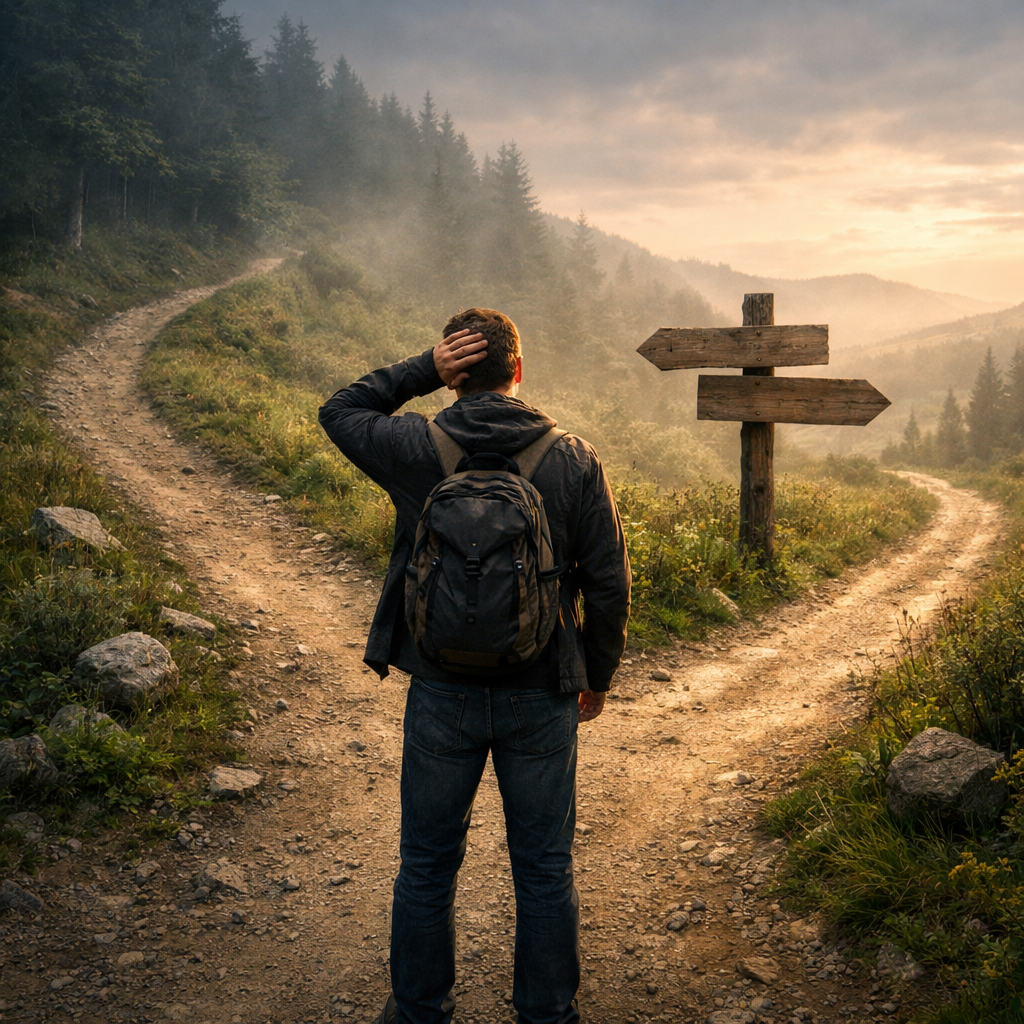
Yet as Eric shared his journey, I became increasingly aware that both vocations revolve around the same essential question:

What makes people choose the paths they do?

In ministry, he encountered people struggling to become better versions of themselves. People wrestling with their weaknesses, failures, fears, and doubts. People attempting, however imperfectly, to live according to values, principles, and moral commitments larger than themselves.

In the FBI, he encountered a very different reality. Not simply people who made mistakes. But individuals who consciously and deliberately chose destructive paths.

This distinction has stayed with me.

Much of modern culture encourages us to explain away human behavior as entirely determined by circumstances. We speak of trauma, environment, social conditions, and psychological influences. These factors matter. But there is another reality we sometimes hesitate to acknowledge. Human beings have the power of choice.

Every day, most people are trying, however imperfectly, to align themselves with values that create trust, cooperation, and human flourishing. They seek to improve their relationships, contribute to their communities, and become more patient, generous, wise, and compassionate.

The majority of people, I would argue, are engaged in this work of character formation.

Yet there are others who move in the opposite direction with purpose and intent.

History repeatedly reminds us that human beings are capable of organizing themselves around hatred, violence, and destructive ideologies with the same commitment that others devote to goodness and service.

That reality is uncomfortable because it challenges simplistic narratives.

We often prefer to divide the world neatly into good people and bad people.

But reality is more complicated. The potential for both creation and destruction exists within every human heart. Character is not a destination we arrive at once and for all. It is a series of choices repeated over time.

The people Eric investigated were not a different species. They were human beings whose decisions, beliefs, resentments, ambitions, and justifications gradually shaped them into who they became.

The same process operates in all of us. The difference is direction. Some people intentionally cultivate wisdom, integrity, and responsibility. Others intentionally cultivate grievance, resentment, domination, or self-interest.

The consequences eventually become visible. One of the most important lessons I took away from my conversation with Eric is that understanding human behavior requires us to hold two truths simultaneously.

We must have compassion for the forces that shape people. But we must also recognize personal responsibility for the choices people make. Without compassion, we become judgmental. Without accountability, we become naïve. Wisdom requires both.

Perhaps this is why so many people today are hungry for deeper conversations.

We are surrounded by commentary but longing for understanding. Surrounded by information but searching for wisdom. Surrounded by certainty but yearning for perspective. The questions that matter most rarely have simple answers.

Why do some people become more compassionate after suffering, while others become more bitter? Why do some use power to serve while others use it to control? What enables a person to remain anchored in values when confronted with fear, temptation, or adversity? These are not merely social or political questions.

They are deeply personal ones. Every day, you are participating in the ongoing formation of your own character.

Every day, you are in the process of becoming who you really are by remaining curious enough to keep asking better questions and courageous enough to examine the choices that shape your life.

Ultimately, every future is built not by what happens to you, but by the values you choose to live by.

Reino Gevers – Host of the LivingToBe podcast
P.S. Over the coming weeks, I’ll share more about the online community I am creating and what membership will look like in practice, and why I believe it can become a meaningful space for deeper reflection.

Leave a comment

Filed under Uncategorized

Embracing Self-Love on the Camino de Santiago

While walking the Camino de Santiago, I sometimes encountered pilgrims who seemed to confuse pilgrimage with an act of self-punishment. Despite their bodies sending unmistakable signals—painful blisters, swollen joints, and deep exhaustion—that it was time to rest, they would continue pushing forward. Determined to conquer the path at all costs, they ignored their physical limits until, inevitably, they were forced to abandon their journey altogether.

There is a saying I learned from another pilgrim on the way. “If you don’t learn to approach the path with humility, it will teach you humility.”

Others approached the Camino very differently. I remember older pilgrims, some well into their eighties, who walked slowly and with intention. They moved at their own pace, stopping occasionally to admire the landscape, sitting quietly in contemplation, or choosing to walk only half a stage in a day. Rather than measuring success by distance covered, they seemed to delight in the journey itself. Remarkably, many of these pilgrims completed the entire 800-kilometre route to Santiago. Even more striking was the vitality they radiated. They appeared youthful, not because of physical strength alone, but because they had learned the wisdom of walking in harmony with themselves.

Pilgrimage offers many lessons about life, but one of its most important teachings is the often misunderstood art of self-love.

Modern psychology increasingly confirms what many spiritual traditions have taught for centuries: self-love is not a luxury but a necessity for human flourishing. Research on self-compassion, pioneered by psychologist Dr Kristin Neff, shows that people who treat themselves with kindness during times of difficulty tend to be more resilient, emotionally balanced, and motivated than those who constantly criticise themselves.

Contrary to popular belief, harsh self-judgment, especially negative self-talk, does not produce stronger or more successful people. Instead, it often leads to anxiety, burnout, perfectionism, and emotional exhaustion.

Self-love, in psychological terms, means relating to oneself with the same care and understanding that one would naturally offer a good friend. It involves recognising one’s limitations without shame and acknowledging one’s worth without needing constant external validation. Such an attitude fosters emotional well-being and enables people to respond more constructively to life’s inevitable challenges.

These findings resonate deeply with the teachings of the 13th-century mystic Meister Eckhart. Eckhart believed that what turns human beings into compulsive graspers—unable to let go of possessions, status, relationships, or beliefs—is ultimately a lack of trust. Beneath our attachments lies a profound insecurity, a fear that we are somehow incomplete or unworthy.

For Eckhart, self-love and trust in the divine are inseparable. Compassion arises from confidence in the goodness that lies at the heart of existence, while compulsive striving grows from the belief that we are fundamentally lacking or flawed. The person who learns to “let be” and at the same time allows themselves to be is expressing a deep confidence in the creative source of life.

Eckhart writes: “If you do not know how to love yourself, how is it possible that you will love God? There can be no love of neighbour without love of self.” To love oneself, in his understanding, is not an obstacle to spiritual growth but one of its essential foundations.

Such ideas were controversial in Eckhart’s time. Many theologians were preoccupied with sin, moral regulation, and the strict enforcement of doctrine. God was often portrayed as an authoritarian ruler who rewarded obedience and punished transgression. Shame and guilt became powerful tools of religious instruction—a dynamic that continues to influence some religious traditions today.

The divine potential in every person

Yet Eckhart offered a radically different vision. Rather than beginning with fear, he began with trust. Rather than emphasising human depravity, he pointed toward the divine potential present within every person.

This brings us to an important distinction: self-love is not the same as ego.

The ego seeks validation, superiority, and control. It constantly compares itself with others and measures its worth through achievement, status, or recognition. Ego asks, “How can I become more important?” Self-love asks, “How can I become more fully myself?”

The ego is rooted in insecurity and therefore always needs more. Self-love arises from a deeper acceptance and therefore has nothing to prove. The ego separates; self-love connects. The ego grasps; self-love releases. The ego seeks to protect an image; self-love nurtures a living reality.

Far from encouraging selfishness, genuine self-love often leads to greater compassion. People who are at peace with themselves generally have a greater capacity to listen, empathise, forgive, and care for others. They are not depleted by the endless struggle to earn their own worth.

The spiritual path, whether on the Camino or in everyday life, invites you to confront your fears, loosen your attachments, and ultimately learn the difficult art of letting go. This includes letting go of the false stories you tell yourself about who you should be.

At the heart of Eckhart’s teaching is a beautiful image. The essence of the divine, he says, is “birthing”—a continual process of creation and emergence. Life is not a static state to be achieved but an ongoing unfolding into what we are meant to become. We are not passive observers of this process but active participants in it.

Perhaps this is one of the Camino’s greatest lessons. The journey is not won by those who push themselves the hardest. It is completed by those who learn to walk with wisdom, humility, and kindness toward themselves. In learning to love yourself, you discover that you are not separate from the sacred journey but part of its unfolding.

Reino Gevers – Host of the LivingToBe podcast

P.S. Over the years, my own Camino journeys have inspired two books exploring the deeper inner dimension of pilgrimage and transformational walking: Deep Walking for Body, Mind and Soul and the newly revised edition of Walking on Edge. Both reflect on the Camino not merely as a physical journey, but as a path of inner change, reflection, and rediscovery.

Leave a comment

Filed under Camino de Santiago, psychology, spirituality

Finding Wisdom Through Complexity

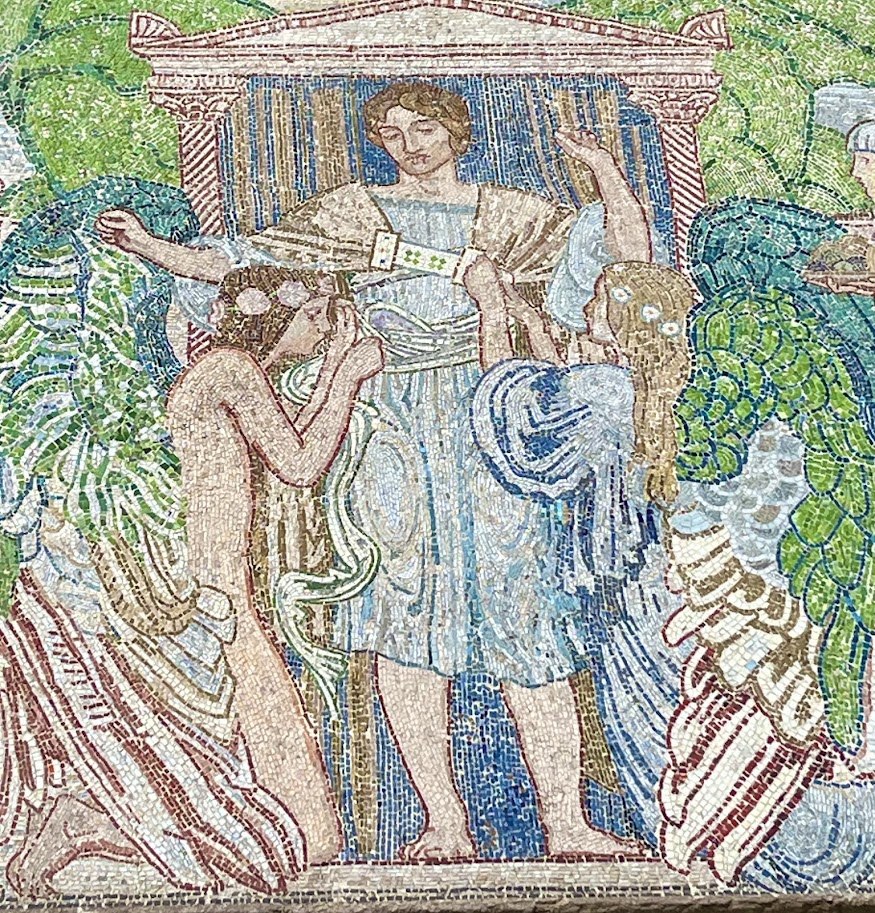
On a recent visit to the Horniman Museum and Gardens in London, I found myself pausing at the entrance. Set into the façade is a compelling mosaic, almost easy to overlook. Created by Robert Anning Bell at the turn of the twentieth century, it feels less like decoration and more like a question posed across time. Its message lands with particular force in a world where volume substitutes for depth, where opinions harden into slogans, and identities calcify into positions that leave little room for movement.

In Humanity in the House of Circumstance, a central figure—Humanity —is gently attended by Love and Hope. Standing before it, I was struck by how quietly subversive this image is. It does not present us as self-made or self-sufficient, but as shaped—formed in relationship, in dependence, in the interplay between our inner lives and the limits that surround us.

And yet, the instinct is to simplify and to reach for fixed categories. What feels unfamiliar, unsettling, or threatening is quickly reduced, flattened into binaries: for or against, right or wrong, aligned or opposed. In doing so, something essential is lost.

Nuance in such a climate is perceived as weakness and the inability to “take a stand.” Yet, in truth, nuance is a deeper form of strength and wisdom.

To hold nuance is to allow multiple perspectives to coexist within the mind without rushing to premature judgment. It is the discipline of pausing before concluding, of listening not just to respond but to understand. Where dogmatism seeks closure, nuance remains open—curious, attentive, and alive to the subtleties of reality.

Humanity tended by Love and Hope

Rigid thinking serves psychological needs:

  • Certainty offers comfort. The world feels unpredictable and filled with contradictions. Dogmatic beliefs simplify this chaos into something manageable. They provide a sense of control, even when that control is illusory.
  • Identity and Ego play a powerful role. Beliefs are often tied to who you believe yourself to be, rooted in culture, community, or personal history. To question those beliefs can feel like questioning who you are. Dogmatism becomes a form of self-protection.
  • There is a social reward. Strong, uncompromising opinions are amplified on social media. Nuanced thinking, by contrast, appears hesitant or indecisive and doesn’t translate into viral soundbites.

Something essential is lost when we abandon nuance.

To think with nuance is not to drift aimlessly between opinions. It is an active, often demanding process. It requires intellectual humility and the recognition that your understanding is always a partial perspective. No matter how informed you are, there will always be an angle you have not considered.

When you allow conflicting ideas into your awareness, you may feel tension, even discomfort. Dogmatism relieves that tension quickly by choosing a side. Nuance asks you to stay with it longer, to let the mind stretch rather than snap into certainty.

It also requires empathy. To truly weigh different perspectives, you must enter into the worldview of others. This does not mean agreement. It means understanding the logic, the fears, and the hopes that shape another position.

Nuance as a Path to Wisdom

Wisdom is not the accumulation of facts alone, but the ability to discern, to contextualize, and to integrate. Nuance is its foundation.

Consider any complex issue—whether personal, political, or spiritual. Beneath the surface, there are layers: historical context, emotional undercurrents, competing values, and unintended consequences. Dogmatic thinking tends to isolate one layer and elevate it above all others. Nuance, by contrast, seeks to see the whole.

This does not lead to paralysis. On the contrary, decisions made with nuance are often more grounded and enduring. They are less reactive, less driven by fear or tribal loyalty, and more aligned with a deeper understanding of reality.

The Courage to Resist Simplicity

It requires courage in resisting the pull of simplicity. It is easier to adopt a ready-made belief than to wrestle with complexity. Easier to echo the consensus of one’s group than to risk standing in a more ambiguous space.

In a world that grows louder and more polarized, the practice of nuance becomes not just a personal virtue, but a social necessity. It creates space for dialogue where there would otherwise be division. It invites curiosity where there might be judgment. It allows us to meet one another not as adversaries, but as participants in a shared search for understanding.

Returning to a Deeper Way of Seeing

At its heart, nuance is an act of respect for complexity, for truth, and for the dignity of perspectives that differ from your own. It requires you to slow down when the world urges you to run, to listen when you are tempted to react, and to think with care rather than certainty.

Standing before Humanity in the House of Circumstance at the Horniman Museum and Gardens, this feels less like an abstract ideal and more like an invitation. The mosaic does not resolve the tensions of life; it holds them. It is a powerful reminder that we are shaped not only by what we believe, but by how we remain open to Love, to Hope, and to the limits within which we live.

Reino Gevers – Host of the LivingToBe podcast
P.S: If you enjoyed this article you might be interested in reading: Sages, Saints and Sinners Get it today on Amazon, Barnes & Noble and where all good books are sold.

Leave a comment

Filed under happiness, mental health, psychology

Embracing Change: Pain and Growth

“Be willing to let go of who you are, for who you are becoming.” – Meister Eckhart (13th-Century Mystic)

There are moments in life when moving forward feels impossible. The way ahead seems blocked, not by one clear obstacle, but by a quiet accumulation of losses, disappointments, and unanswered questions. Something has ended. Something hurts in a way that cannot be easily fixed. And in those moments, it can feel as though nothing is happening at all.

Yet beneath the surface, something is quietly stirring. What looks like stillness is often a deep, unseen movement and a reordering that cannot be rushed or explained. This is not stagnation, but a subtle turning of the soul.

We are quick to judge these seasons as failures or weaknesses. We tell ourselves we should be coping better, moving faster, knowing more. But what if pain and failure are not signs that we have lost our way? What if they are threshold moments—gentle, demanding invitations into a new beginning, or into a deeper way of seeing and being?

Henry James, often regarded as a founding voice in American philosophy, spoke to this hidden depth when he wrote that life is “always more divine than it seems, and hence we can survive degradations and despairs which otherwise must engulf us.”

The Threshold Moment

A threshold is not a destination. It is not even a clear path. It is a space between: between what has been and what is becoming. It is coming out of a dark, cold winter with the seeds of spring waiting to sprout.

In threshold moments, the old story—the one that once made sense, gave structure, identity, or safety—begins to loosen its grip. It no longer fits. Yet the new story has not arrived fully formed. There are no clear instructions, and there is primarily uncertainty.

This in-between space can feel deeply uncomfortable. It often comes with grief, fatigue, confusion, or a quiet panic that whispers, “I should be further along by now.”

But thresholds are not failures of progress.
They are pauses of transformation.

When Pain Is Asking for Attention, Not Erasure

Pain has a bad reputation. There is a tendency to push it away, a rush to numb it with distractions, and explain it away. Yet pain often carries a message that can’t be accessed in any other way. It forces you to dig deep into your inner resources. It is asking you to slow down and pay attention to what is happening.

Failure, too, has a voice. It may be saying: This path has run its course. Or: This version of you has served its purpose.

Letting the Old Story End

Endings rarely announce themselves cleanly. More often, they fray at the edges. Motivation fades. Joy drains away. What once felt purposeful now feels heavy or hollow. It could be anything from a job, a location, a home, or even a long-term relationship. This should not be seen as betrayal or weakness, but something new unfolding slowly.

The courage of a threshold moment lies not in forcing clarity, but in allowing uncertainty to do its work in trusting that not knowing is sometimes the most honest spiritual posture.

You don’t need to rush to define the next chapter. You only need to be present enough to notice what is loosening—and what is quietly insisting on staying alive.

A Gentle Practice for the Threshold

Rather than trying to solve or transcend this moment, you might sit with it. Breathe with it. Let it speak. Found more moments of solitude so that the voice within can be perceived.

Ask yourself, without urgency or judgment:

  • What am I being asked to release?
    A role? An expectation? A belief or particular self-sabotaging talk?
  • What feels unfinished, yet still alive?
    A longing? A truth you haven’t yet honored? A call that has been whispering rather than shouting?

Staying with the Becoming

Thresholds are sacred precisely because they are uncomfortable. They strip away certainty and invite you into a deeper honesty. They teach you that meaning is not only found in arrival, but in the courage to stay present while becoming. They force you to look more closely in the darkness.

If you find yourself here—tired, unsure, grieving something you can’t quite name—know this:
You are not broken. You are not behind. You are standing at a doorway.

And sometimes, the most honest thing you can do is wait with open hands until the new story is ready to unfold.

If you find yourself standing in such a threshold—sensing that something has ended, but not yet knowing what comes next—you don’t have to walk this terrain alone. A Pilgrimage to New Beginnings is a gentle online journey created by me for moments just like this: a spacious, reflective path for those navigating endings, listening for what wants to be born, and learning to trust the wisdom of the in-between. If this speaks to where you are, you are warmly invited to join us on March 4th and take the next few steps—slowly, honestly, and in your own time.

Reino Gevers – Host of the LivingToBe podcast
Leave a comment

Filed under meditation, mental health, psychology, self-development

Finding Meaning in a Nihilistic World

Nihilism is the despair that comes when all higher meaning collapses and life is reduced to emptiness

  – Sören Kierkegaard­ –

The world sometimes feels as if it is unraveling before our eyes. Truth is no longer truth, values are mocked, and meaning itself is up for debate. Kierkegaard warned of this kind of despair and the disease that spreads when a higher purpose is abandoned. In this hollow space, populist narratives rush in, manipulating with outrage, stripping away nuance, and discarding the responsibility for a common humanity.

University of Virginia sociologist James Davison Hunter warns that a new common culture is emerging that is chillingly nihilistic. He defines this culture with the drive to destroy, observing how fear, demonization, and rigid divisions dominate political life, leaving many unable or unwilling to negotiate, compromise, or even recognize shared humanity.

“A nihilistic culture is defined by the drive to destroy, by the will to power. And that definition now describes the American nation,” Hunter writes.

Hunter points out that a politicized identity “is formed and sustained by way of negation. Its emergence as well as its persistence depend on an active and hostile enemy. What naturally follows is rage, hatred, and a thirst for “a capable and wide revenge” that, in a twisted way, becomes a source of meaning—a raison d’être—for those who see themselves as victims.”

In the same vein, Noam Chomsky emphasizes that meaning in life is built through lived experience and collective responsibility. Acts that reduce suffering, preserve dignity, or advance freedom create meaning in a world that can otherwise feel void. For Chomsky, moral clarity stems from recognizing our shared humanity and universal ethical standards, while moral responsibility entails choosing to act on them. Nihilism, despair, or relativism, in his view, are excuses that allow people to avoid this work.

He has also criticized postmodernism for being obscure, relativistic, and politically disengaged—warning that societies risk moral collapse if they lose sight of truth and responsibility.

Modern life compounds these challenges. Constant information, endless obligations, and persistent anxieties can erode spirit and energy. The solution isn’t hustling harder; it’s pausing, reflecting, and breathing deeply. It’s grounding yourself in love and acceptance, trusting that you are guided and protected by reconnecting with your spiritual self.

Recently, the words of American monk and author Brother David Steindl-Rast came to mind. He doesn’t argue against nihilism like philosophers do; he simply invites us to notice this: “It is not joy that makes us grateful; it is gratitude that makes us joyful.” Gratitude, he reminds us, doesn’t depend on joy—it creates it.

In his book Gratefulness: The Heart of Prayer, Steindl-Rast describes gratefulness as “the inner gesture of giving meaning to our life by receiving life as a gift.” It begins with simple surprise—a rainbow, a warm smile, the sound of a bird—opening the door to joy. Being thankful awakens us to the blessings around us and becomes the linchpin of a life animated by faith, lifted by hope, and nurtured by love.

In an age dominated by nihilism, gratitude is an act of resistance. It stitches meaning back into life.

Here’s a simple, actionable antidote to nihilism:

Each morning or evening, pause and reflect on three things from the past 24 hours for which you are truly grateful. Feel the gratitude fully. Notice what shifts in your heart and mind. Watch how even small moments of appreciation counteract negativity, restore meaning, and reconnect you to the life that surrounds you.

Gratitude is more than a practice—it’s a rebellion against emptiness, a return to purpose, and a daily homecoming for the soul.

Reino Gevers – Host of the LivingToBe podcast

P.S.: If you enjoyed this article, you might be interested in my latest book, Sages, Saints, and Sinners. Get it today on Amazon, Barnes & Noble, and wherever good books are sold.

Leave a comment

Filed under happiness, psychology, purpose, religion

Beyond Noise: Rilke’s Invitation to Stillness

I’ve been contemplating one of Rilke’s poems lately. It has stayed with me because it speaks so directly to our world today, where noise and distractions pull from all directions. Rilke envisions a silence so profound that all the noise, chatter, busyness of the senses, and endless distractions simply fall away.

And, in that stillness, he says, we might finally glimpse the divine with full clarity.

If only it would be, just once, completely quiet…
If only it would be, just once, completely quiet.
If the random, and the approximate
went mute, and the neighbors’ laughter,
if the noise that my senses make
wouldn’t so stubbornly keep me from waking–
Then I could, in a thousandfold
thought, think you right to the edge of you
and have you (just a smile long),
to give to all life as a gift
like a thank-you.

Reading this, I couldn’t help but notice how often we treat noise, chatter, and distraction as normal. Yet maybe our constant talking, scrolling, and background hum are really a way of avoiding something scarier: just sitting with the stillness within.

Stillness can feel so unsettling because it invites us to hear the inner voice we’ve been ignoring, the voice of authenticity, of truth, of God. Rilke reminds me that silence isn’t empty at all. It’s a threshold. If we dare to step into it, we may discover presence, gratitude, and a deeper connection with life than all our distractions could ever offer.

You could also take a walk in nature, opening the senses to natural sounds that are different from noise. Birdsong, the waters of a creek, the rustling of leaves in the trees—all of it forms a beautiful symphony. In those moments, you can feel yourself connected to a larger whole and begin to perceive the subtle whispers of the universe.

So here’s a simple practice: find just five minutes today to sit in stillness. Turn off the phone, close your eyes, and notice the quiet beneath the noise. At first it may feel uncomfortable, but stay with it. Listen for that subtle inner voice—the one that whispers rather than shouts. You may find, as Rilke did, that in the stillness something sacred begins to stir.

Reino Gevers – Host of the LivingToBe podcast

P.S.: If you enjoyed this article, you might be interested in my latest book, Sages, Saints, and Sinners. Get it today on Amazon, Barnes & Noble, and wherever good books are sold.

Leave a comment

Filed under happiness, meditation, mental health, psychology, purpose, Uncategorized