
Monthly Archives: August 2026

Living As If You Will Never Die

The Dalai Lama once said that what surprised him most about the human condition was that “Man sacrifices his health in order to make money. Then he sacrifices money to recuperate his health. And then he is so anxious about the future that he does not enjoy the present; the result being that he does not live in the present or the future; he lives as if he is never going to die, and then dies having never really lived.”

The German mystic Meister Eckhart, writing seven centuries earlier, arrived at something similar from the opposite direction. For Eckhart, death was not an event waiting for us at the end of life but a practice for the whole of it: “If you want the kernel, you must break the shell.” He meant that the self we cling to — our roles, our possessions, our five-year plans — is the shell. Only by letting it crack, again and again, do we get near the kernel, which he called the ground of the soul. A person who has never rehearsed that letting-go meets death, when it finally comes, as a stranger.

Confronting our mortality is anathema in Western culture. We don’t talk about it, and when a loved one dies, we’re expected to “get over it” and function again as soon as possible. Cultural icons are expected to stay forever young. The dying are outsourced to hospitals and hospices, and the dead are buried in well-manicured cemeteries far off the beaten track.

I had an intense conversation with Catherine Duncan, author and hospice chaplain, on the LivingToBe podcast this week. She has guided hundreds of people during the last moments of their journey on earth. What stands out is the same pattern that repeats itself over and over again. What was deemed as important in life such as money, status and possessions falls away. What remains is only peace, love and forgiveness. Death can teach us what is important in life such as those magical moments that we often do not recognize in the business of life.

Confronting mortality head-on

One of the reasons behind our mental health crisis and addiction epidemic is that we don’t confront our mortality head-on. Instead we compare ourselves to the Joneses next door and wait for the “happy” life to arrive — when we retire, when we get rich, when we find the perfect partner, when we have that luxury car or that beautiful home.

Eckhart had a word for this waiting: he called it living for the sake of a reward rather than living itself. He preached that people who work only “in order to get” something — heaven, wealth, peace of mind — never actually arrive, because their attention stays fixed on the getting. The people of Bhutan seem to have found the alternative he was pointing to.

There’s a reason the people of the small southeast Asian country of Bhutan are regarded as among the happiest and most contented in the world. As in the world of our ancestors, death is part of everyday reality there.

The Buddhist country encourages its people to think about death for a few minutes each day. Paintings, artwork, and house decorations often feature death. Funerals are elaborate three-week events, with the body kept in the home before being slowly cremated over fragrant juniper wood in front of hundreds of friends and relatives.

In Bhutan, death is seen simply as a transition to another dimension. The spiritual disconnect in Western culture has left no place for death, or for the rituals that once surrounded it. I’ve lost a good share of family and friends over the past five years — each loss has jolted me back to the age-old question: what am I doing with the days I have left?

Because death is the elephant in the room, we lurch into collective grief when a well-known figure suddenly dies. The University of Oxford Centre for Suicide Research found that the overall suicide rate in England and Wales rose by 17 percent in the four weeks after Princess Diana’s funeral in September 1997, compared with the average for that period over the four previous years.

A review of these cases suggested that Diana’s death worked largely through “amplification of personal losses and exacerbation of existing distress” — grief for a stranger unlocking grief that was already there, unaddressed.

History shows that when catastrophe strikes, faith tends to move in one of three directions. Some people become more rigid and fearful, reaching for certainty in the middle of chaos. Others lose faith entirely, unable to reconcile suffering with belief in a loving God. And some find a deeper faith — one rooted not in easy answers, but in compassion, humility, and solidarity with others. Which direction we take often depends on whether we’ve already done the work of facing mortality, or whether death arrives as an ambush.

Talking about the human condition

We need to talk about the human condition — about death, our mortality, and the fact that life as we know it ends. My work is helping people reclaim enough vitality and energy to live the life they’re meant to live, rather than the one they’ve settled for.

Eckhart’s shell-and-kernel image is useful here, because he wasn’t just talking about the moment of dying. He meant it as daily practice: letting go of the version of yourself built from job title, bank balance, and other people’s opinions, so that something truer underneath has room to breathe. “The eye with which I see God,” he wrote, “is the same eye with which God sees me.” Strip away enough of the shell, he’s saying, and the distance between the seer and the seen collapses. That’s a hard sentence to sit with, but it’s also a way of saying: stop postponing yourself.

Are you living the life you’re destined to live?

Are you merely existing, or living the life you’re destined to live? Are you stuck in a job or relationship that drains most of your energy? Are you waiting for the day you can finally start living?

Procrastination and fear are the biggest obstacles to raising consciousness and growing spiritually. When you’re doing what’s in alignment with your soul’s purpose, you will — to quote Rumi — feel a river moving in you with joy.

If these questions stay with you, you might find their sharpest form in my novel Sages, Saints and Sinners, set during the Black Death — a time when an entire society was forced to confront mortality on a mass scale, with no hospitals or hospices to look away to. It follows what happens to people, faith, and community when death can no longer be outsourced or postponed.

Reino Gevers – Host of the LivingToBe podcast

Leave a comment

Filed under spirituality, humanity, happiness

How Language Shapes  Mind, Body and Soul

The other day, I came across a wonderful initiative that gives children something far more valuable than a toy: books and the opportunity to discover the power of words from an early age.

Through Dolly Parton’s Imagination Library, registered children receive a free, age-appropriate book every month from birth until their fifth birthday. It is a simple but powerful idea—helping children develop a love of reading while giving them access to a richer world of language, imagination, and ideas.

It also made me reflect on something we often underestimate: The words we hear, read, speak and repeat influence how we think, how we feel, how we relate to others, and, increasingly, research suggests, how our bodies respond to stress and emotion.

From the first stories we hear as children to the language that surrounds us as adults, the words we live with help shape our lives.

When leaders normalise belittling, insulting, humiliating or threatening language, they give their followers permission to do the same. We can see the consequences particularly clearly on social media, where emotionally charged discussions can deteriorate rapidly into personal attacks, contempt and hostility. A disagreement about an idea becomes an attack on the person.

This matters because language is not psychologically neutral. The words we repeatedly encounter and use influence attention, interpretation, and emotional responses. 

Stress, anger, and hostility can activate physiological systems involved in the body’s stress response, while positive emotions, social connection, and a sense of meaning can support psychological resilience.

Repetition of negative language

Repeated exposure to words and messages associated with anger, fear and hostility can reinforce particular patterns of attention and interpretation. Over time, this may contribute to a more threatening or pessimistic perception of the world.

There is an important distinction, however: words do not automatically cause disease, and the science is more nuanced than the popular claim that simply hearing a negative word raises cortisol or damages the body. What matters is the broader psychological response—particularly when threatening or hostile language becomes persistent, personally meaningful and part of a chronic environment of stress.

A landmark 2015 study published in Psychological Science analysed millions of Twitter messages from 1,347 U.S. counties. Researchers found that county-level use of language expressing anger, anxiety, negative relationships and disengagement was associated with higher rates of atherosclerotic heart-disease mortality, while positive-emotion and engagement language showed protective associations. The researchers reported that their language-based model predicted cardiovascular mortality better than a model combining ten conventional demographic, socioeconomic and health variables.

These findings were striking—but they should not be interpreted as proof that negative words themselves cause heart disease. The study was observational and conducted at the community level, and subsequent methodological criticism has questioned how robust and generalisable the associations are. What the research does support is a fascinating possibility: the emotional language circulating within a community may act as a window into its collective psychological climate.

Other research provides a more direct connection between stress and language. Experimental studies have found that people experiencing greater physiological stress—including higher cortisol and heart-rate responses—tend to produce less cognitively complex speech. More recent research is also exploring whether characteristics of speech can themselves be used as indicators of stress.

The potential of positive language

The opposite is also worth cultivating. Kindness, gratitude, appreciation, compassion and encouragement can change the quality of our interactions and strengthen social bonds. And strong social relationships are among the most important resources we have for psychological resilience and wellbeing.

Research on self-affirmation offers an interesting insight into how constructive language can work. In laboratory studies, reflecting on personally important values activated brain regions involved in self-related processing and positive valuation. In one study, these neural responses were subsequently associated with changes in sedentary behaviour.

This does not mean that repeating positive words is a magical cure. Nor does it mean that we should suppress difficult emotions or pretend that everything is wonderful. Healthy language can acknowledge suffering while still leaving room for possibility:

I am struggling—but I can seek help.

I disagree with you—but I can still respect you.

This is difficult—but it is not necessarily hopeless.

Such language does something important: it creates psychological space. Instead of narrowing our attention around threat, blame and fear, it can help us recognise choices, relationships and possibilities.

Words, mantras and prayer

This may help explain why human beings across cultures have used mantras, prayers, chants and contemplative phrases for thousands of years.

The benefit may not lie simply in the meaning of the words. Repetition slows attention, reduces distraction and can be accompanied by rhythmic breathing. Studies of contemplative practices have found associations with changes in autonomic regulation, including heart-rate variability, although the evidence varies considerably according to the practice and study design.

Research into music and prayer has also suggested that slow rhythmic structures can influence cardiovascular rhythms. Work examining musical tempo and autonomic responses has highlighted the role of slow breathing and rhythm in producing calming physiological effects.

This offers a more scientifically cautious way of understanding the experience many people report when listening to or singing something such as Ave Maria, whether in the settings of Schubert, Gounod or other classical arrangements. The combination of familiar words, melody, repetition, breath, memory and spiritual meaning can create a profound sense of calm and emotional safety.

For a person of faith, there is an additional dimension that science cannot easily measure: prayer can provide a sense of relationship, trust, meaning and transcendence. These subjective experiences may themselves be important sources of psychological resilience.

Read good words

There is another simple way of nourishing our inner vocabulary: read books.

In an age dominated by short posts, headlines, notifications and rapidly changing fragments of information, sustained reading offers something very different. A book asks you to remain with an idea, follow an argument, inhabit another person’s experience and encounter words in context.

Reading also exercises language itself. It exposes you to a richer vocabulary, more complex sentence structures, metaphors, stories and unfamiliar perspectives. This matters not only intellectually but potentially for healthy ageing.

A 14-year longitudinal study found that older adults who reported reading at least weekly were less likely to experience cognitive decline over six, ten and fourteen years than those who read less frequently. The association remained after adjustment for relevant covariates.

A separate 2024 study of older Japanese adults found an association between childhood availability of books and cognitive function later in life, particularly among participants with lower educational attainment. The researchers also identified an association involving the volume of the left superior temporal cortex, an area important for language and related cognitive functions. Because this was an observational study, it cannot establish that books themselves caused the difference—but it adds to the growing evidence that a life rich in reading and language may be beneficial for cognitive ageing.

Perhaps, then, we should think of vocabulary as a kind of mental landscape.

If your daily diet consists largely of words such as threat, enemy, stupid, hate, crisis, failure and fear, you are repeatedly exposing your attention to a narrow emotional vocabulary.

But if you also make room for words such as curiosity, courage, gratitude, wonder, forgiveness, possibility, beauty, compassion, stillness, love and hope, you give the mind more possibilities with which to interpret experience.

The goal is not to eliminate negative words. Anger can alert to injustice. Fear can protect from danger. Grief gives expression to loss. Difficult words have their rightful place.

The deeper question is:

What kind of language do you want to live with within?

And perhaps an equally important for everyone is:

What kind of emotional climate are your words creating for the people around you?

Words are small things. But repeated millions of times, they can become attitudes, attitudes can become behaviours, and behaviours can become culture.

Choose them carefully.

Reino Gevers – Host of the LivingToBe podcast

P.S: If you enjoyed this article, you might be interested in reading one of my four books, available where all good books are sold.

Leave a comment

Filed under cortisol, meditation, mental health

When Faith Stops Working: Are You Listening?

This summer, as Europe swelters under yet another wave of extraordinary heat, I find myself thinking about an old story I heard many years ago. It is a simple story, almost a joke. But sometimes the simplest stories contain truths we would rather avoid.

There was an old man named Angelo who lived in a small Italian village. One day, his neighbour came running to his door.

“There is a flood warning,” he told him. “The river is rising. Everyone has been told to leave the village within 24 hours.”

Angelo listened calmly.

“I will be fine,” he replied. “I trust in the Lord.”

His neighbour pleaded with him, but Angelo refused to leave.

A little later, a fire engine came through the village, its loudspeaker warning everyone to evacuate immediately.

Angelo heard it.

But he stayed.

Then the river began to rise. Water flooded the houses closest to the river, and people started fleeing for higher ground. A rescue worker came to Angelo’s door.

“You have to leave now!”

But Angelo shook his head.

“I trust in the Lord.”

Eventually, the water reached the upper floor of his house. Angelo climbed onto the roof.

Then a helicopter appeared.

A rescue worker lowered a ladder.

“Come on, Angelo! We can get you out!”

But once again Angelo refused.

“I trust in the Lord.”

The helicopter eventually disappeared.

Angelo drowned.

When he arrived at the gates of heaven, he was furious.

“I trusted you,” he said to God. “I believed you would save me. And you didn’t.”

God looked at him with sadness.

“Angelo, I sent you your neighbour. I sent you the fire engine. I sent you the rescue worker. And finally, I sent you a helicopter. What more did you expect me to do?”

Perhaps the warnings are the message

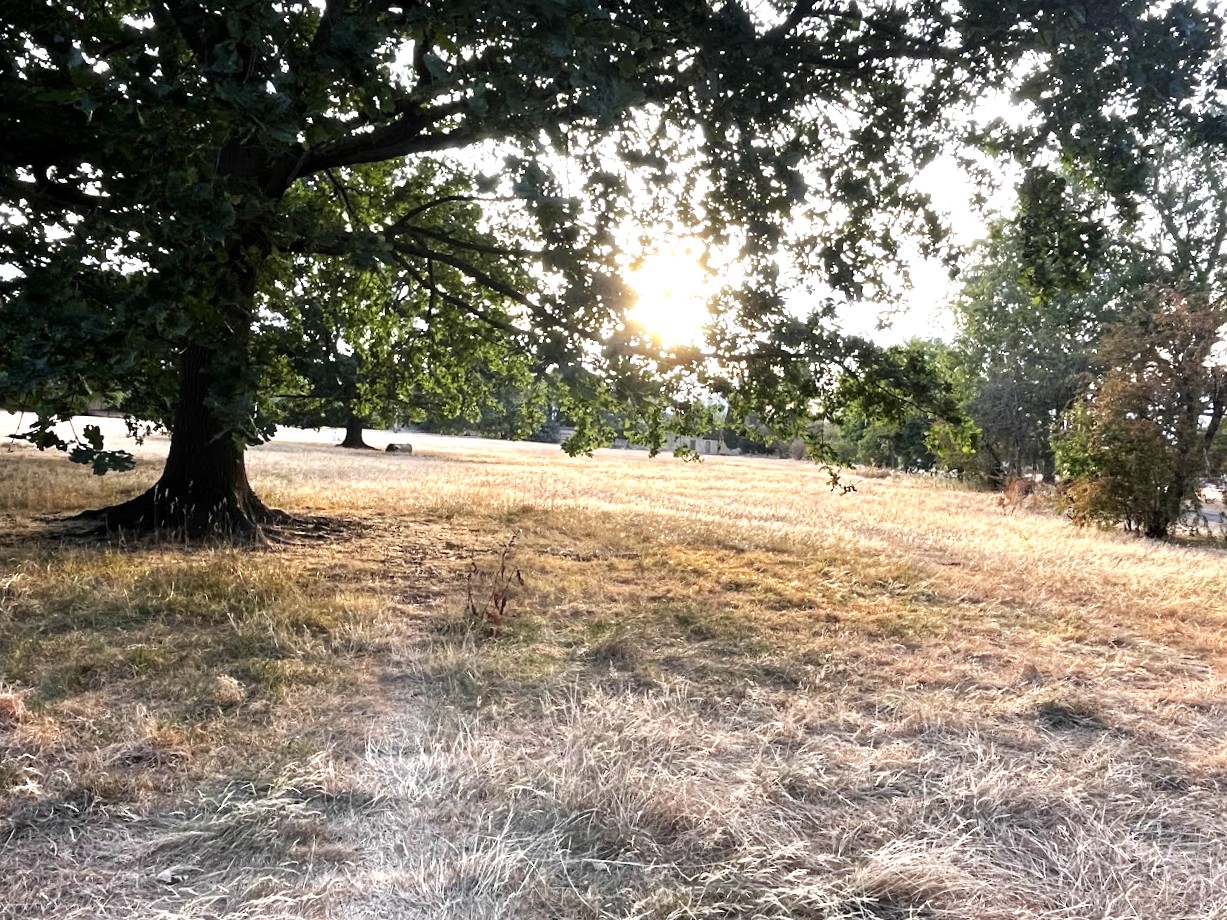
I thought about Angelo recently while walking through Wandsworth Common. Walking has become a way for me to make sense of the world. When I walk, I notice things I might otherwise miss.

This time, I noticed the grass. I noticed the bumblebee dying and the pigeon spreading its wings, trying to stay cool.

The grass should have been green. Instead, it was dry and yellow, brittle beneath my feet. Trees and shrubs were showing the strain of weeks without sufficient rain. Nature seemed tired. There was something strangely unsettling about it. Perhaps because I have lived long enough to remember summers when rain in central Europe was something we complained about rather than something we worried about.

I know that one hot summer does not prove climate change. Nor does a dry lawn. But when an isolated event becomes part of a pattern, perhaps the wise response is not to explain it away, but to ask questions, pay attention, and to listen.

And that is what keeps returning to me from the story of Angelo.

I attended one of the early United Nations climate conferences as a journalist many years ago. The scientists were warning us about the consequences of pumping ever greater quantities of carbon dioxide into the atmosphere. At the time, the future seemed comfortably distant. Climate change belonged to another generation. It would have to deal with it

What if the warnings are already the message?

But perhaps that is one of the great illusions of human beings: our tendency to imagine that the consequences of what we do will always arrive somewhere else, sometime later, and affect somebody else. Now the future has become the present. The heat, the droughts, the record-breaking summer temperatures, the fires, and the floods simply cannot be denied anymore. And yet, like Angelo, we seem strangely reluctant to leave the comfort zone of our house.

When faith becomes a way of not seeing

This is where the story touches something much deeper for me than climate change. It touches the question of faith itself. For much of my life, I have wrestled with what it means to believe.

I have become suspicious of a faith that gives us easy answers to difficult questions. A faith that tells us everything will be all right if only we trust enough. Because sometimes everything tells us that something is just not right. The river really is rising. The diagnosis is serious. A relationship is really over. The world is changing rapidly beneath our feet. The certainties we have built our lives around simply have stopped working.

Perhaps that is one of the most frightening experiences in life: discovering that the beliefs that once gave us security no longer help us make sense of what is happening. But perhaps it is also an invitation. When faith stops working, something else may be asking to emerge. It is perhaps a deeper faith that does not require you to know how everything will turn out. It is a faith that allows you to say:

I don’t know.

I am afraid.

I may have been wrong.

But I am willing to look.

Listening to what is in front of you

I am increasingly convinced that wisdom has less to do with having answers than with learning how to listen. It is listening to your body, to other people, your intuition, and to that voice that you perceive only in silence, above all in nature.

Nature does not speak to you in words. It speaks through patterns, seasons, heat, drought, rain, abundance and scarcity. Our ancestors knew very well how to interpret these signs. Their survival depended on it. But in the disconnect from the natural world, we seem to have lost that ability.

We can choose to ignore these whispers from the universe. But ignoring them does not make them disappear. That is what Angelo misunderstood. He believed that faith meant waiting for God to intervene. Perhaps the deeper truth is that God had already intervened. The neighbour was the intervention. The fire engine was the intervention. The rescue worker was the intervention. The helicopter was the intervention. Angelo simply didn’t recognise them as such.

And I wonder how often we do the same.

How many times in your life has something tried to get your attention?

A relationship that no longer feels right. A body telling you to slow down. A restlessness that cannot be explained. A recurring dream and a difficult conversation that you keep avoiding.

A landscape that no longer looks the way it once did. A world that is changing before our eyes. Perhaps these are not interruptions to our lives. Perhaps they are our lives speaking to us.

The helicopter is still there

I don’t know what the world will look like ten or fifteen years from now. I don’t know whether we will succeed in changing course quickly enough. And I certainly don’t believe that fear and denial is going to save us.

But I do believe we still have choices. That may be the most hopeful part of the story. Angelo was not a victim until the very end.

He had choices. And so do you. We are not powerless in the face of a changing world. We can change how we live. We can demand that those who govern us take reality seriously. We can consume less, waste less, protect what remains and support those working to restore what has been damaged.

But perhaps the first step is simpler.

We need to listen. To put down our certainties for a moment. To look out of the window.

To walk through a park. To notice the colour of the grass. To feel the heat and rescue the bumblebee looking for water.

To see the trees struggling.

And then to ask yourself honestly:

What is life trying to tell me?

Faith does not mean believing that someone will come and save you.

Perhaps faith means trusting yourself enough to recognise the helicopter when it arrives. And having the courage to climb aboard.

Reino Gevers – Host of the LivingToBe podcast
P.S: If you enjoyed this article, you might be interested in reading one of my four books, available where all good books are sold.

Leave a comment

Filed under climate, climate change, healing nature, spirituality

Finding Meaning Beyond Success: A Personal Journey

Are you one of those people living with this sense that your work somehow contradicts the deeper yearning of the soul? Outwardly you may appear successful, yet inwardly something remains unsettled.

Each person is born as a unique individual with gifts, talents, and a particular path to walk. Yet one of life’s great tragedies is that many people discover too late that they have spent decades climbing a ladder only to find it was leaning against the wrong wall.

Our culture encourages us to pursue success, influence, recognition, and wealth. There is nothing inherently wrong with these aspirations. The problem arises when we mistake them for the destination of a meaningful life. Once the goal has been achieved, the excitement gradually fades. What once felt extraordinary becomes ordinary. Habit replaces wonder. Achievement is followed by an unexpected emptiness.

I experienced something similar after walking my first pilgrimage to Santiago de Compostela.

Reaching the cathedral filled me with joy and a profound sense of accomplishment. For weeks I had overcome blisters, fatigue, uncertainty, and changing weather. Every step had carried meaning because it demanded something of me.

Yet it was only after returning home to the old routine that I found that work needed to be done on the real pilgrimage. I was still stuck in an unfulfilling job and a marriage that was slowly falling apart.

On the Camino Primitivo

The Camino had changed me within, but my external world was still the same.

The real work was not completing the journey. It was allowing the journey to transform the way I lived afterwards.

That insight has stayed with me ever since.

The deepest satisfaction is seldom found at the destination. It is found in the daily struggle, the uncertainty, the conversations with strangers, the physical exhaustion, the moments of silence, and the countless small challenges along the way.

Perhaps this explains why people who seem to have every comfort deliberately seek difficult experiences. They climb mountains, run ultramarathons, walk across continents or venture into remote wilderness. They are not searching for suffering. They are searching for aliveness.

Growth rarely happens in perfect comfort.

Psychologists have long observed that human beings thrive when they are stretched, but not overwhelmed. Challenges activate creativity, resilience, and learning. When every obstacle is removed, our development often stalls. Muscles strengthen through resistance. Character is shaped through adversity. Wisdom is born from experience rather than convenience.

The workplace is no exception.

Many people see workplace difficulties as something to escape. Difficult colleagues, demanding projects, changing technology or increasing responsibilities can easily become sources of frustration. Yet these very challenges often become the training ground where patience, courage, emotional intelligence and leadership are formed.

This does not mean that toxic work environments should be tolerated. Persistent bullying, exploitation or unhealthy organisational cultures damage both individuals and organisations. But in a healthy workplace, challenge itself is not the enemy. Constructive difficulty invites you to grow beyond who you were yesterday.

The German philosopher Arthur Schopenhauer captured this paradox with remarkable clarity:

“If all wishes were fulfilled as soon as they arose, how would men occupy their lives? What would they do with their time? If the world were a paradise of luxury and ease… men would either die of boredom or hang themselves.”

His words may sound severe, but they point to an enduring truth. Human beings need something meaningful to strive for. We are not designed merely for comfort; we are designed for growth.

Over the years, I have facilitated hundreds of workshops on corporate health and wellbeing. One pattern has repeatedly emerged.

Many employees spend years counting the days until retirement, convinced that happiness lies just beyond their final working day. Yet when retirement finally arrives, many discover that the absence of work also means the loss of structure, identity, community and purpose. Without a compelling reason to get up in the morning, freedom can unexpectedly become emptiness.

Work is about far more than earning a living.

People often realise this only after a prolonged illness, unemployment or an extended absence from the workplace. Beyond the salary, meaningful work offers connection, contribution and the opportunity to develop our abilities. It gives us occasions to solve problems, collaborate with others and become more than we were yesterday.

Considering that we spend such a large portion of our lives at work, perhaps the better question is not, “How can I escape the workplace?” but rather, “How can I transform my work into part of my own inner journey?”

Whether you remain in your current profession or eventually choose another path, every challenge can become part of your formation. Every difficult conversation can teach compassion. Every setback can deepen resilience. Every obstacle can reveal strengths you never knew you possessed.

The goal, after all, is not simply to arrive at retirement, promotion or financial security.

The goal is to become the person you were always meant to be.

As I look back on my own life, I rarely remember the periods when everything was easy. It was the pilgrimages, the professional setbacks, the unexpected detours, the relationships that tested me, and the moments when I had to make difficult choices that shaped who I have become.

Perhaps the same is true for you.

Rather than asking, “How can I avoid life’s obstacles?” perhaps a better question is, “What is this challenge trying to teach me?”

The obstacle may not be standing in your way.

It may be showing you the way.

So let me leave you with this question:

When you look back on your own journey, did your greatest growth come from the seasons of comfort—or from the challenges you once wished would disappear?

Reino Gevers – Host of the LivingToBe podcast

P.S: If you enjoyed this article, you might be interested in reading one of my four books, available where all good books are sold.

Leave a comment

Filed under Camino de Santiago, Pilgrimage, self-development, spirituality, Uncategorized