This summer, as Europe swelters under yet another wave of extraordinary heat, I find myself thinking about an old story I heard many years ago. It is a simple story, almost a joke. But sometimes the simplest stories contain truths we would rather avoid.
There was an old man named Angelo who lived in a small Italian village. One day, his neighbour came running to his door.
“There is a flood warning,” he told him. “The river is rising. Everyone has been told to leave the village within 24 hours.”
Angelo listened calmly.
“I will be fine,” he replied. “I trust in the Lord.”
His neighbour pleaded with him, but Angelo refused to leave.
A little later, a fire engine came through the village, its loudspeaker warning everyone to evacuate immediately.
Angelo heard it.
But he stayed.
Then the river began to rise. Water flooded the houses closest to the river, and people started fleeing for higher ground. A rescue worker came to Angelo’s door.
“You have to leave now!”
But Angelo shook his head.
“I trust in the Lord.”
Eventually, the water reached the upper floor of his house. Angelo climbed onto the roof.
Then a helicopter appeared.
A rescue worker lowered a ladder.
“Come on, Angelo! We can get you out!”
But once again Angelo refused.
“I trust in the Lord.”
The helicopter eventually disappeared.
Angelo drowned.
When he arrived at the gates of heaven, he was furious.
“I trusted you,” he said to God. “I believed you would save me. And you didn’t.”
God looked at him with sadness.
“Angelo, I sent you your neighbour. I sent you the fire engine. I sent you the rescue worker. And finally, I sent you a helicopter. What more did you expect me to do?”
Perhaps the warnings are the message
I thought about Angelo recently while walking through Wandsworth Common. Walking has become a way for me to make sense of the world. When I walk, I notice things I might otherwise miss.
This time, I noticed the grass. I noticed the bumblebee dying and the pigeon spreading its wings, trying to stay cool.
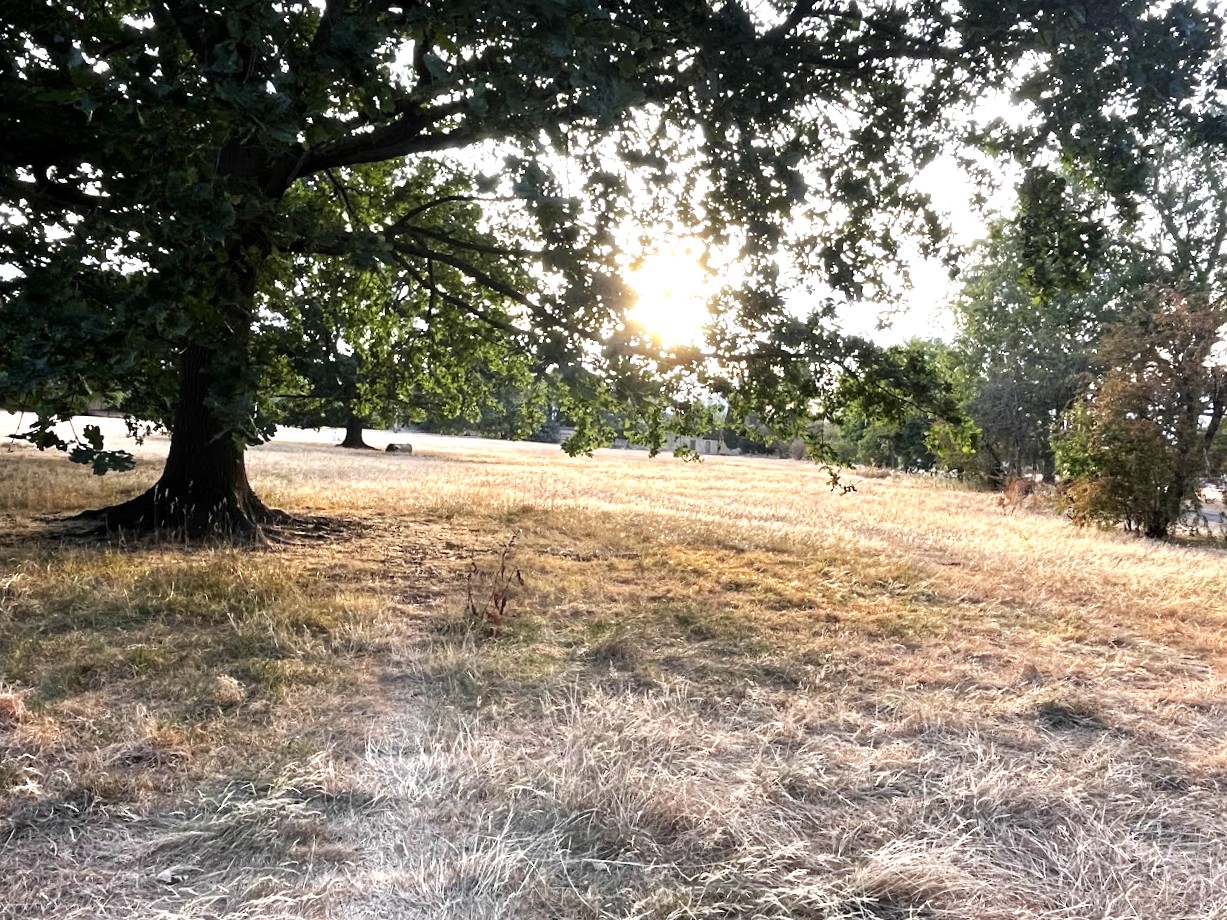
The grass should have been green. Instead, it was dry and yellow, brittle beneath my feet. Trees and shrubs were showing the strain of weeks without sufficient rain. Nature seemed tired. There was something strangely unsettling about it. Perhaps because I have lived long enough to remember summers when rain in central Europe was something we complained about rather than something we worried about.
I know that one hot summer does not prove climate change. Nor does a dry lawn. But when an isolated event becomes part of a pattern, perhaps the wise response is not to explain it away, but to ask questions, pay attention, and to listen.
And that is what keeps returning to me from the story of Angelo.
I attended one of the early United Nations climate conferences as a journalist many years ago. The scientists were warning us about the consequences of pumping ever greater quantities of carbon dioxide into the atmosphere. At the time, the future seemed comfortably distant. Climate change belonged to another generation. It would have to deal with it
What if the warnings are already the message?
But perhaps that is one of the great illusions of human beings: our tendency to imagine that the consequences of what we do will always arrive somewhere else, sometime later, and affect somebody else. Now the future has become the present. The heat, the droughts, the record-breaking summer temperatures, the fires, and the floods simply cannot be denied anymore. And yet, like Angelo, we seem strangely reluctant to leave the comfort zone of our house.
When faith becomes a way of not seeing
This is where the story touches something much deeper for me than climate change. It touches the question of faith itself. For much of my life, I have wrestled with what it means to believe.
I have become suspicious of a faith that gives us easy answers to difficult questions. A faith that tells us everything will be all right if only we trust enough. Because sometimes everything tells us that something is just not right. The river really is rising. The diagnosis is serious. A relationship is really over. The world is changing rapidly beneath our feet. The certainties we have built our lives around simply have stopped working.
Perhaps that is one of the most frightening experiences in life: discovering that the beliefs that once gave us security no longer help us make sense of what is happening. But perhaps it is also an invitation. When faith stops working, something else may be asking to emerge. It is perhaps a deeper faith that does not require you to know how everything will turn out. It is a faith that allows you to say:
I don’t know.
I am afraid.
I may have been wrong.
But I am willing to look.
Listening to what is in front of you
I am increasingly convinced that wisdom has less to do with having answers than with learning how to listen. It is listening to your body, to other people, your intuition, and to that voice that you perceive only in silence, above all in nature.
Nature does not speak to you in words. It speaks through patterns, seasons, heat, drought, rain, abundance and scarcity. Our ancestors knew very well how to interpret these signs. Their survival depended on it. But in the disconnect from the natural world, we seem to have lost that ability.
We can choose to ignore these whispers from the universe. But ignoring them does not make them disappear. That is what Angelo misunderstood. He believed that faith meant waiting for God to intervene. Perhaps the deeper truth is that God had already intervened. The neighbour was the intervention. The fire engine was the intervention. The rescue worker was the intervention. The helicopter was the intervention. Angelo simply didn’t recognise them as such.
And I wonder how often we do the same.
How many times in your life has something tried to get your attention?
A relationship that no longer feels right. A body telling you to slow down. A restlessness that cannot be explained. A recurring dream and a difficult conversation that you keep avoiding.
A landscape that no longer looks the way it once did. A world that is changing before our eyes. Perhaps these are not interruptions to our lives. Perhaps they are our lives speaking to us.
The helicopter is still there
I don’t know what the world will look like ten or fifteen years from now. I don’t know whether we will succeed in changing course quickly enough. And I certainly don’t believe that fear and denial is going to save us.
But I do believe we still have choices. That may be the most hopeful part of the story. Angelo was not a victim until the very end.
He had choices. And so do you. We are not powerless in the face of a changing world. We can change how we live. We can demand that those who govern us take reality seriously. We can consume less, waste less, protect what remains and support those working to restore what has been damaged.
But perhaps the first step is simpler.
We need to listen. To put down our certainties for a moment. To look out of the window.
To walk through a park. To notice the colour of the grass. To feel the heat and rescue the bumblebee looking for water.
To see the trees struggling.
And then to ask yourself honestly:
What is life trying to tell me?
Faith does not mean believing that someone will come and save you.
Perhaps faith means trusting yourself enough to recognise the helicopter when it arrives. And having the courage to climb aboard.
Reino Gevers – Host of the LivingToBe podcast
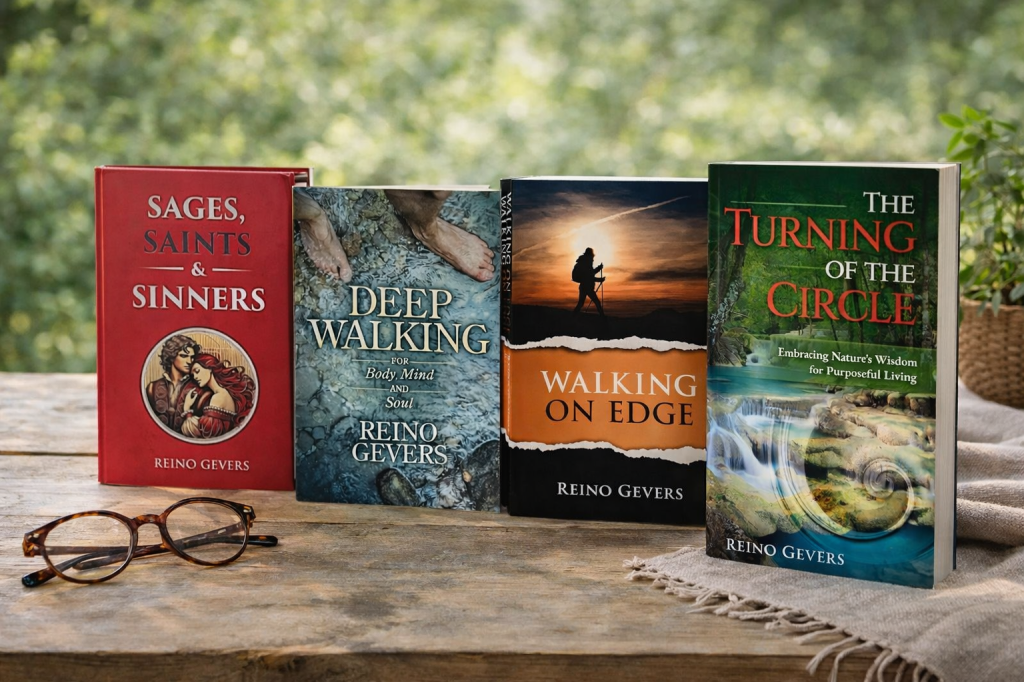
P.S: If you enjoyed this article, you might be interested in reading one of my four books, available where all good books are sold.