Category Archives: Uncategorized

The Marketplace of Meaning

For most of human history, meaning was inherited. People were born into a family, a culture, a faith tradition, and a set of expectations. Whether one agreed with them or not, there was a framework.

Today, meaning has become a marketplace where thousands of voices compete for your attention. Coaches, influencers, therapists, spiritual teachers, political commentators, podcasters, and self-help experts all offer explanations for why you might feel lost and promises for how to find your way.

Many provide genuine value. Some are insightful guides. But the sheer volume of competing narratives creates a new problem: paralysis. When everyone claims to possess the answer, how do you know whom to trust?

The Seduction of Certainty

Human beings have always been uncomfortable with uncertainty in times of rapid social change, economic instability, political division, and technological disruption; certainty becomes a highly desirable product. But the individuals who gain the largest audiences are often not those who ask the best questions but those who provide the simplest answers.

Complexity rarely goes viral. Certainty does. Yet history repeatedly demonstrates that simplistic explanations rarely survive contact with reality. The world is too nuanced, human beings too contradictory, and life too unpredictable to fit neatly into slogans and soundbites. Discernment and depth require patience.

The Difference Between Guidance and Dependency

There is nothing wrong with seeking wisdom from teachers, mentors, therapists, or spiritual guides. The problem arises when guidance turns into dependence. A good teacher helps people think for themselves. A dangerous teacher trains people to stop thinking altogether and to blindly follow.

One of the quiet tragedies of modern life is watching intelligent, capable people gradually surrender their own judgment. Every decision must be approved by the guru. Every life choice must be interpreted through the framework of the therapist. Every uncertainty requires external validation. The result is often a dangerous form of mind captivity.

The same pattern can often be observed in dysfunctional relationships, where one partner gradually surrenders their independence and begins to define their identity entirely through the other. Decisions, values, and even self-worth become filtered through the relationship. What may initially appear as devotion can ultimately become a loss of self, replacing personal agency with emotional dependence

Outsourcing the Work of Living

Perhaps the greatest temptation of our age is to outsource the difficult work of self-examination. It is easier to follow a celebrity’s life than to confront your own. Easier to consume endless content than to sit quietly with uncomfortable questions. Easier to adopt someone else’s beliefs than to wrestle honestly with your own doubts and issues of faith.

Yet purpose is not something another person can hand to you on a silver platter. No influencer, teacher, author, or spiritual leader can ultimately answer the questions that belong uniquely to your own life. That is something you can only discover.

They can illuminate the path, but nobody can walk it for you.

Living With Questions

I suspect that wisdom is less about possessing answers and more about developing the capacity to live with important questions.

  • Who am I becoming?
  • What matters most?
  • What kind of life is worth living?

These questions can only be revisited repeatedly throughout life. Perhaps maturity begins when you stop searching for someone who will think for you and start cultivating the courage to think deeply for yourself. Not in isolation, but with humility. Not with certainty, but with curiosity. Not seeking a guru to follow, but seeking the wisdom to discern.

Reino Gevers – Host of the LivingToBe podcast

P.S. In the coming weeks, I’ll share more about Letter from the Threshold, a Sunday letter where I explore many of these themes in greater depth. For those who find value in thoughtful reflection and deeper inquiry, there will soon be an opportunity to subscribe.

Leave a comment

Filed under psychology, purpose, raised consciousness, religion, Uncategorized

The Thin Line Between Character and Choice

A few days ago, I had a fascinating conversation on the LivingToBe podcast with Eric Robinson.

What makes Eric’s story remarkable is not simply that he spent twenty-four years as an FBI agent investigating terrorism, violent crime, and some of the darkest corners of human behavior. Before all of that, he was a church minister. At first glance, those two worlds seem miles apart.

One is associated with compassion, spiritual guidance, and the care of souls. The other is with criminal investigations, threats, violence, and the pursuit of justice.

Yet as Eric shared his journey, I became increasingly aware that both vocations revolve around the same essential question:

What makes people choose the paths they do?

In ministry, he encountered people struggling to become better versions of themselves. People wrestling with their weaknesses, failures, fears, and doubts. People attempting, however imperfectly, to live according to values, principles, and moral commitments larger than themselves.

In the FBI, he encountered a very different reality. Not simply people who made mistakes. But individuals who consciously and deliberately chose destructive paths.

This distinction has stayed with me.

Much of modern culture encourages us to explain away human behavior as entirely determined by circumstances. We speak of trauma, environment, social conditions, and psychological influences. These factors matter. But there is another reality we sometimes hesitate to acknowledge. Human beings have the power of choice.

Every day, most people are trying, however imperfectly, to align themselves with values that create trust, cooperation, and human flourishing. They seek to improve their relationships, contribute to their communities, and become more patient, generous, wise, and compassionate.

The majority of people, I would argue, are engaged in this work of character formation.

Yet there are others who move in the opposite direction with purpose and intent.

History repeatedly reminds us that human beings are capable of organizing themselves around hatred, violence, and destructive ideologies with the same commitment that others devote to goodness and service.

That reality is uncomfortable because it challenges simplistic narratives.

We often prefer to divide the world neatly into good people and bad people.

But reality is more complicated. The potential for both creation and destruction exists within every human heart. Character is not a destination we arrive at once and for all. It is a series of choices repeated over time.

The people Eric investigated were not a different species. They were human beings whose decisions, beliefs, resentments, ambitions, and justifications gradually shaped them into who they became.

The same process operates in all of us. The difference is direction. Some people intentionally cultivate wisdom, integrity, and responsibility. Others intentionally cultivate grievance, resentment, domination, or self-interest.

The consequences eventually become visible. One of the most important lessons I took away from my conversation with Eric is that understanding human behavior requires us to hold two truths simultaneously.

We must have compassion for the forces that shape people. But we must also recognize personal responsibility for the choices people make. Without compassion, we become judgmental. Without accountability, we become naïve. Wisdom requires both.

Perhaps this is why so many people today are hungry for deeper conversations.

We are surrounded by commentary but longing for understanding. Surrounded by information but searching for wisdom. Surrounded by certainty but yearning for perspective. The questions that matter most rarely have simple answers.

Why do some people become more compassionate after suffering, while others become more bitter? Why do some use power to serve while others use it to control? What enables a person to remain anchored in values when confronted with fear, temptation, or adversity? These are not merely social or political questions.

They are deeply personal ones. Every day, you are participating in the ongoing formation of your own character.

Every day, you are in the process of becoming who you really are by remaining curious enough to keep asking better questions and courageous enough to examine the choices that shape your life.

Ultimately, every future is built not by what happens to you, but by the values you choose to live by.

Reino Gevers – Host of the LivingToBe podcast

P.S. Over the coming weeks, I’ll share more about the online community I am creating and what membership will look like in practice, and why I believe it can become a meaningful space for deeper reflection.

Leave a comment

Filed under Uncategorized

Finding Spiritual Connection in Modern Society

Last week, we reflected on what is lost when people leave their village, their small town, and the familiar rhythms of communal life. Across the modern world, millions have moved toward cities in search of opportunity, freedom, and economic survival. Yet in the process, something profound has often been left behind.

Life in cities can be exciting and liberating, but it is also frequently anonymous. One can live among millions and still feel unseen. Modern urban life often disconnects people from land, ancestry, ritual, and the shared memory of community. Relationships become fragmented and transactional. The old structures that once held human life together slowly weaken.

In villages and rural communities, identity was traditionally formed through belonging. A person was known not only by occupation, but by family, neighbourliness, participation, and place. There were rhythms to life: births, marriages, funerals, feast days, seasons of mourning, prayer at certain hours, bells ringing across a valley at dusk. Human beings lived within a larger story.

Research into the so-called Blue Zones — regions of the world where people consistently live longer and healthier lives — reveals something deeply important. Longevity is not simply linked to diet or exercise. It is also connected to a healthy social network, purpose, ritual, intergenerational connection, and spiritual belonging. In many of these communities, faith and communal life remain deeply intertwined.

Historically, the church stood at the center of this communal structure. Whatever its failures — and history certainly contains many — churches often provided sanctuary during times of grief, illness, uncertainty, and poverty. Sacred spaces gave language to suffering and meaning to mortality. The repetition of prayer, liturgy, candle-lighting, silence, chanting, kneeling, and ritual anchored people psychologically and spiritually.

Today, in much of the Western world, institutional religion has lost moral authority for millions of people. Financial scandals, abuse, political entanglement, shaming, and rigid dogmatism have left deep wounds. Many have walked away from organized religion altogether.

Yet the deeper human hunger has not disappeared.

People continue searching for meaning, transcendence, stillness, and connection. Even those who no longer identify as religious are often drawn toward pilgrimage routes, monasteries, ancient cathedrals, contemplative prayer, meditation, sacred music, or moments of silence in old churches. Something within the human spirit still longs for an encounter with the mystery of the divine.

The medieval Christian mystic Meister Eckhart once wrote:

“The soul grows by subtraction, not by addition.”

It is a remarkable insight for our age of endless stimulation and accumulation. Modern life constantly tells us to consume more information, more possessions, more experiences, more noise. Yet many people remain inwardly exhausted and spiritually empty.

Ritual and contemplative practice offer another path.

When prayer is repeated daily at a particular hour, in a sacred place, with intention and rhythm, it slowly becomes embedded in consciousness. Over time, the body itself begins to remember stillness. Ritual becomes less about performance and more about orientation. It provides structure when life feels chaotic and uncertain.

Modern neuroscience increasingly confirms what ancient spiritual traditions long understood intuitively: repetition calms the nervous system. Sacred ritual regulates emotional states. Silence and contemplative practice can reduce anxiety and restore psychological balance. The body responds to rhythm, breath, chant, and sacred attention.

But perhaps the deeper issue is existential rather than merely psychological.

A life disconnected from spiritual depth can begin to feel strangely hollow. Human beings do not live by productivity and consumption alone. Usually in moments of crisis or solitude, deeper questions emerge.

What happens when life ends?

What is the soul?

What gives suffering meaning?

What remains when certainty collapses?

These questions often arrive quietly — at three in the morning, during illness, after loss, while sitting beside a hospital bed, or in the strange silence that accompanies aging. Technology cannot answer them. Wealth cannot remove them. Distraction only postpones them.

Perhaps this is why sacred places, like walking ancient pilgrimage routes, still matter.

Even now, many people instinctively lower their voices when entering an ancient church or monastery. Something within us recognizes sacred space before the intellect has framed it. In the lighting of a candle, the sound of distant bells, or the quiet repetition of prayer, we remember something modern life easily forgets:

You are not just an economic creature.

You are also a spiritual being searching for meaning, belonging, and connection to something greater than yourself.

Reino Gevers – Host of the LivingToBe podcast

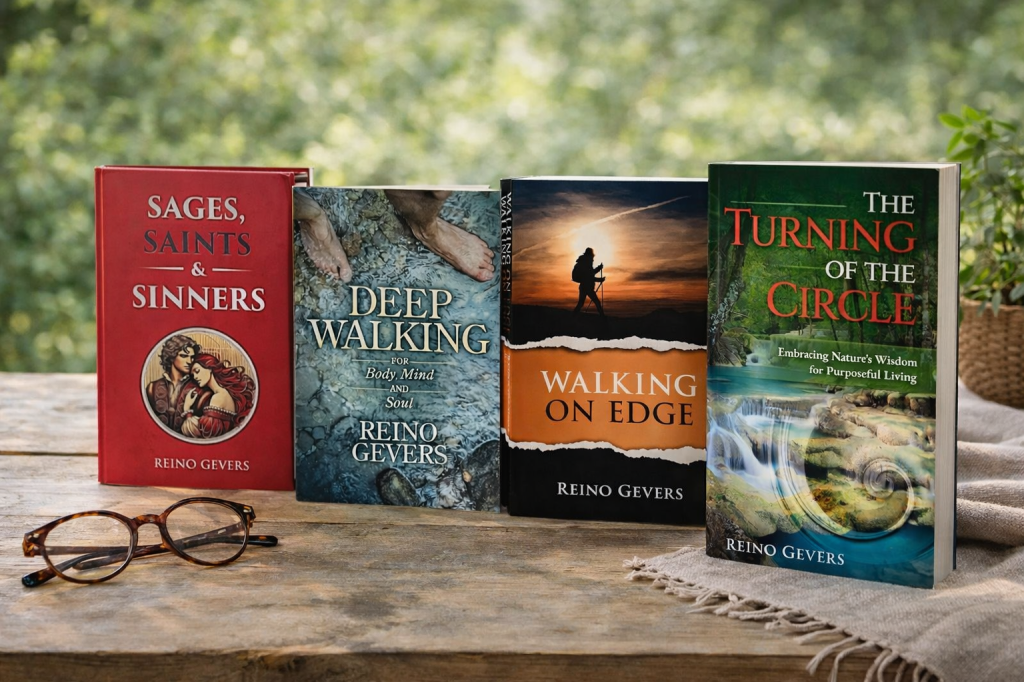
P.S: If you enjoyed this article you might be interested in reading: Sages, Saints and Sinners Get it today on Amazon, Barnes & Noble and where all good books are sold.

Leave a comment

Filed under Uncategorized

Protecting Your Energy and Your Purpose

I will begin with something that I had to painfully realize: Love without boundaries is not love. It is self‑abandonment.
Healthy boundaries are self‑respect in action. They are the quiet courage to say: This is my space.
A space I need to protect my emotional and spiritual well‑being so I can care deeply, give generously, and feel fully.

But here’s the subtle truth: boundary crossings rarely begin with something dramatic. They often start softly, almost imperceptibly. An “energy vampire” is not necessarily a bad person. Most of the time, they simply haven’t learned to honor boundaries — neither yours nor their own. They often struggle with low self‑esteem and, therefore, seek constant validation, reassurance, and emotional reciprocity.

The challenge is that spending time with such people leaves you feeling heavy, drained, or strangely unsettled. Your clarity fades, your energy dips, and your inner balance becomes harder to access.

Awareness is the first boundary

Pay attention to your body. Your nervous system rarely lies, giving you the perfect feedback loop on what people suck you dry and who nurtures and energizes you. It sometimes starts with the person who enters the room. Do I relax and feel a warm energy fill my body, or am I looking at ways to escape as soon as possible?

The first step is saying “no”. It is, for most of us, the hardest thing to do because we are social beings hard-wired to get along with our fellow human beings. Subconsciously, we fear being rejected, isolated, and even betrayed when saying “no.” But here is the thing: Saying “no” is saying “yes” to something else. It is a “yes” to presence, dignity, and self-respect. You owe nobody endless access to your time, energy, and emotional availability. Boundaries do not require justification. They require conviction.

It takes practice, and all comes down to how you say it: Here are some examples

  • “That doesn’t work for me.”
  • “I’m not available.”
  • “I need time to think about that.”
  • “No, thank you.”

What Nurtures My Energy? What Depletes My Energy?

Before you can even set healthy boundaries, you must be aware of your own needs, as well as where you are the person crossing the boundaries of others. Clarity creates responsibility. Once you know what nourishes you, it becomes your sacred task to protect it. Take a time out to reflect on what nurtures and what depletes your energy:

  • Silence or prayer?
  • Nature and walking?
  • Deep conversations?
  • Creative expression?
  • Time alone?
  • Physical movement?
What depletes my energy?
  • Information overload
  • Conflict?
  • Multitasking?
  • Negative environments?
  • Being responsible for everyone’s emotions?

Protecting Your Inner Space

Your inner world is sacred ground. Not every opinion deserves entry. Not every demand deserves a response. Not every crisis deserves your involvement. To protect your inner space:

  • Pause before responding. You can say: I need time to think about that
  • When is guilt not love driving your choice?
  • Create a daily grounding ritual that anchors you

Certainty does not mean rigidity.
It means knowing who you are.

Grounding practices may include:

  • Conscious slow breathing
  • Placing your feet firmly on the floor and noticing contact
  • Naming what you feel without judging it
  • Deep Walking in nature
  • Returning to faith when uncertainty arises

A Final Reflection

Setting healthy boundaries is an act of spiritual practice. It is the decision to stop outsourcing your worth. It is choosing integrity over approval. It is trusting that the right relationships will honor your limits. Boundaries do not push love away.
They make real love possible.

And perhaps the most important question is this:

Where in my life do I need to choose self-respect over fear?

That is where your next boundary is waiting.

To quote the mystic Teresa of Ávila:

“Let nothing disturb you,
Let nothing frighten you,
All things are passing;
God never changes.
Patience obtains all things.
Whoever has God lacks nothing;
God alone suffices.”

If you are currently finding yourself at a threshold—sensing that something has ended, but not yet knowing what comes next—you don’t have to walk this terrain alone. A Pilgrimage to New Beginnings is a gentle online journey created by me for moments just like this: a spacious, reflective path for those navigating endings, listening for what wants to be born, and learning to trust the wisdom of the in-between. If this speaks to where you are, you are warmly invited to join us on March 4th and take the next few steps—slowly, honestly, and in your own time.

Reino Gevers – Host of the LivingToBe podcast

Leave a comment

Filed under meditation, mental-health, psychology, self-development, Uncategorized

The Dark Side of Christian Nationalism

Having grown up in apartheid South Africa, I witnessed firsthand how religion can be distorted to justify some of the gravest human rights abuses. History offers chilling parallels: in Nazi Germany, the swastika found its way into church ceremonies, with clergy openly swearing allegiance to a dictator.

Today, a similar shadow—rooted in comparable theological distortions—is emerging within the Christian Nationalist movement in the United States.

Theology and religion are human constructions that often claim divine authority. Yet when they are used to sanctify power, exclusion, or domination, they stand in stark contradiction to the core teachings of early Christianity and the mystical tradition, which consistently point toward humility, compassion, and the radical dignity of every human being.

The Christian Nationalist movement operates with a social-Darwinist logic: power is taken as proof of truth, strength as legitimacy to rule, and survival as confirmation of human worth. The ideologues of apartheid followed the same reasoning. Racial domination was justified through a distorted theology that claimed the ruling white Afrikaner population had been chosen by God, much like ancient Israel, while other races were destined to serve the so-called “chosen people.”

Such an ideology devastates the very tenets of a caring, humane society. It dehumanizes not only its victims but, ultimately, also the perpetrators and those who wield power. Essential human qualities—empathy, love, and compassion—are sacrificed. Overarching foundational values and ethics are eroded. There is extreme polarization between “us” and “them,” sowing the seeds of a conflict-ridden society that can last generations.

For Christian mystics, however, God is never encountered at the top of a hierarchy. God is found in descent—into poverty of spirit, vulnerability, empathy, and the surrender of control and power.

The 13th-century mystic Meister Eckhart goes so far as to say that God can only enter the soul when it becomes nothing. This is the precise opposite of evolutionary ascent and nationalist thinking built on “us over them,” where identity precedes ethics. In early Christian ethics, election is always for the sake and service of others, never against them.

The apostle Paul shatters tribal and hierarchical thinking when he writes:

“There is neither Jew nor Greek, slave nor free, male nor female.”

The mystics radicalize this even further. God is encountered beyond all description and distinction. Ultimately, the soul is eternal and has no nationality.

Julian of Norwich’s famous vision—“All shall be well”—embraces all of creation, not a purified remnant.

Social Darwinism interprets weakness and poverty as failure. Jesus’ teachings, however, were taken literally by early Christians:

  • Blessed are the poor
  • Blessed are the meek
  • Blessed are the persecuted

These were not metaphors. Early Christians were often minorities without political power—socially marginalized and frequently persecuted. The Cross was not an abstract symbol but a mirror of their own suffering, where pain and challenge were understood as moments of revelation. To this day, many churches recognize care for the sick, the feeding of the poor, and the protection of the weak as faith made visible.

The mystics take this even further by turning inward, welcoming the soul’s own shadow. God is found where the ego loses its boundaries. Isaac of Nineveh writes:

“A heart that has learned compassion burns for the whole creation.”

This vision is anti-Darwinian and anti-predestination to its core.

The social-Darwinist logic of the state claims that violence preserves order and advances God’s evolutionary plan by eliminating the weak. Early Christians and martyrs exposed the lie of violence. They refused to cooperate with its false claims, rejected armed revolt, and resisted the sacralization of force.

Christian Nationalism imagines history moving upward through domination. Mystical Christianity understands history as being transformed from within, through the elevation of consciousness. The Kingdom of God is invisible, non-coercive, and never aligned with empire or government.

Truth does not require dominance. Love—not survival—is the measure of divine destiny.

Where social Darwinism asks, “Who deserves to live?”
Christianity asks, “Who is already loved?”

Reino Gevers – Host of the LivingToBe podcast

P.S. For those who feel drawn to explore this in-between season more intentionally, I am offering a six-week online course, Pilgrimage into New Beginnings. It is a quiet, reflective journey for times of transition, starting March 4th.

Leave a comment

Filed under gratitude, happiness, Uncategorized

Many languages. One human story.

In an age when narratives of division, exclusion, and separation grow louder, a quiet truth comes into view when we examine the origins of language and culture.

Diversity is not accidental. It is a divine principle of growth, evolution, and color. From the earliest words to the languages we speak today, we have always been—and will always be— one humanity, expressing ourselves in many voices and song. 

Languages and cultures did not arise in isolation. 

They grew as people moved, met, traded, worshipped, struggled, and learned from one another. English carries Germanic bones, Latin learning, French refinement, Norse pragmatism, and words from every corner of the globe. 

German shares ancient roots with English, shaped by regional sound shifts and centuries of cultural exchange with Slavic and Norse peoples.

Spanish is Latin at heart, enriched by Celtic echoes, Visigothic rule, and nearly eight centuries of Arabic wisdom. 

Chinese developed along a different path, yet with the same human impulse—to name the world, preserve meaning, and pass wisdom across generations—using a writing system that unites many voices into one shared tradition.

At their deepest level, all languages serve the same purpose: to connect human beings.

Whether through inflected verbs or tones, alphabets or characters, each language reflects the same universal needs—belonging, memory, meaning, and hope. 

Even where linguistic families differ, the patterns repeat: shared ancestors, adaptation through contact, and continuity through storytelling and faith.

No language is “pure.” Each is a living record of encounter. Every word carries footprints of those who came before—migrants, traders, teachers, farmers, poets, seekers. What appears as difference is, in truth, relationship written into sound. 

 Language reminds us that humanity has always been interwoven. Our histories overlap, our words borrow freely, and our voices echo one another across time and geography.

We are formed in relationship and sustained by exchange. When we build walls, and retreat into tribalism, we harden ourselves behind artificial boundaries. We diminish and extinguish divine purpose. What refuses connection withers; what remains open continues the work of creation. 

As the 13th century Mystic Meister Eckart reminds us: „The eye with which I see God is the same eye with which God sees me.”

English: Germanic (Angles, Saxons, Jutes), Latin, Old Norse (Viking), Norman French, Greek 

German: Latin, French, Latin, Greek, Sanskrit, Slavic 

Spanish: Iberian, Celtic, Basque, Latin, Germanic 

Chinese: Mandarin, Cantonese, Wu, Min, Hakka, etc.

Reino Gevers – Host of the LivingToBe podcast

P.S.: If you enjoyed this article, you might be interested in my latest book, Sages, Saints, and Sinners. Get it today on Amazon, Barnes & Noble, and wherever good books are sold.

Leave a comment

Filed under humanity, psychology, purpose, spirituality, Uncategorized

2026: Finding Meaning in Uncertain Times

At the start of a New Year, we find ourselves living in a time of heightened global tension. Multiple conflicts, political instability, and rapid social change have left many people feeling uncertain, anxious, and unmoored.

The quote: „We are living in interesting times,“ often attributed to the British statesman Sir Austin Chamberlain in the 1920s, encapsulates what many feel today.

The Changing World Order

I recently delved into the book by Ray Dalio „The Changing World Order – Why Nations Succeed and Fail.“

He analyzed why nations appear to follow recurring long-term cycles of growth and decline driven by economics, politics, and human nature.

Seen through a spiritual and moral lens, Ray Dalio’s message is less about markets and the decline of empires but more about the inner condition of a society.

Why nations rise and fall

Nations rise when they cultivate humility, discipline, fairness, and responsibility. Education and science is one of the keys to successful economies. But along with technical skill comes the moral formation; productivity flows from a shared sense of purpose, common values and trust.

Money is a reflection of values: when wealth is earned through contribution, innovation, and stewardship, it strengthens the whole.

Decline begins when a nation forgets its limits and loses its moral compass. Excessive debt mirrors spiritual debt—living off tomorrow rather than honoring today. Inequality widens when the common good is replaced by self-interest. Arrogance replaces gratitude; entitlement replaces service.

The decline begins when institutions are hollowed out not only because of bad policy, but because of character and moral erosion.

Internal conflict grows when people lose a sense of shared belonging. The “other” becomes an enemy rather than a neighbor. From a moral standpoint, this is the deepest danger: separation from one another and from transcendent meaning.

History shows that societies disintegrate when power is pursued without wisdom, and freedom without responsibility.

External conflict revealing a deeper crisis

External conflict, in Dalio’s cycle, reflects a deeper spiritual struggle: fear versus trust. Rising powers test declining ones not only materially, but morally. Violence and domination appear when dialogue, humility, and restraint have already failed.

But cycles also imply renewal. Collapse is not punishment but karmic consequence. Societies can realign when they recover timeless virtues such as truthfulness, stewardship, compassion, and reverence for what is larger than the self.

In spiritual terms, Dalio’s insight echoes an ancient teaching:

What a nation gains by losing its soul is never truly wealth and what it saves by recovering its soul can outlast empires.

In this liminal season of transition, we are called to clear the waters clouded by deception, obfuscation, and endless distraction. The longing for truth is no longer abstract; it has become a spiritual and human necessity—quite literally, a matter of survival.

Reino Gevers – Host of the LivingToBe podcast

P.S.: If you enjoyed this article, you might be interested in my latest book, Sages, Saints, and Sinners. Get it today on Amazon, Barnes & Noble, and wherever good books are sold.

Leave a comment

Filed under psychology, purpose, spirituality, Uncategorized

The Spiritual Meaning of Christmas: Hope Is Born in the In-Between Time

Just because you have walked through a dark past does not mean your story ends there. Christmas carries a deep and enduring message of hope.

The ancient mystics understood that time is an illusion, teaching full presence as eternity touching the present moment.

The days between Christmas and the New Year were honoured as the in-between time where endings soften and new beginnings quietly form.

Christmas is an invitation into this holy simplicity. The birth of Christ did not take place in a palace but in an unremarkable shelter, rough with straw and shadow. Yet kings traveled great distances to kneel there and pay homage.

This is the great paradox of Christmas: divinity arrives hidden in the ordinary. Love reveals itself not in grandeur, but in humility. The sacred is often found exactly where you least expect it.

In this season, you are gently reminded of your own worth. You are worthy of love. You can learn to love yourself, even the parts shaped by fear and survival. When you dare to face your fears with compassion, you begin to gather the tools for healing and growth. Peace is uncovered from within.

The Christmas story is also a story of clearing space. The stable had to be emptied and prepared to receive new life. In the same way, this season invites you  to release old entanglements, to lay down burdens that are no longer of service, and to allow the soul to breathe.

As you learn to care for yourself with gentleness, you become more capable of caring for others in the wider human family. 

This is the quiet miracle of Christmas: when love is born within, it radiates outward, warming a broken world in need of hope.

Reino Gevers – Host of the LivingToBe podcast

P.S.: If you enjoyed this article, you might be interested in my latest book, Sages, Saints, and Sinners. Get it today on Amazon, Barnes & Noble, and wherever good books are sold.

Leave a comment

Filed under spirituality, Uncategorized

Your Superpower in a Loud Society

Knowing yourself is the beginning of all wisdom.”— Aristotle

Standing guard at the doorway of your mind has become essential to maintaining spiritual and mental health in an age where our minds are drowning in information but thirsting for wisdom.

What you feed your mind, you ultimately become. A few careless minutes scrolling on your smartphone can trigger a cascade of emotions that can shape your entire day.

If you are reading this, you are likely one of the few who is actively reflecting on what is happening to us collectively.

Conflict and social disruption will always be part of the human condition—we are imperfect beings, after all. But we also carry within us the profound power of choice.

When the fringe becomes the megaphone

My impression is that the darker impulses of humanity are being amplified through the very technology meant to connect us. Fanatical fringe groups and those consumed by malice spend countless hours attacking others with hate-filled messages. Social media companies do little to halt this simply because emotionally charged content fuels engagement—and engagement fuels profit.

We may believe we are in control of what enters our minds, but for most people this is not true. Social media and search engine algorithms quietly track our behavior and serve up the content we are most likely to consume. In doing so, they shape not only our preferences, but our thinking.

Echo chambers of belief

Beliefs and opinions are constantly being reaffirmed within separate realities—information bubbles where each group hears only the echoes of its own worldview. Families, friendships, communities, and even congregations are fracturing along these invisible but powerful dividing lines.

What we need is a collective pushback from the quiet majority: the rational, thoughtful, grounded people who do not fall for emotional manipulation. That resistance begins by asking simple but profound questions:

Is this information expanding my energy or diminishing it?

Is it helping me grow, evolve, and reach my full potential?

A common misconception is that knowledge, information, and education alone equal wisdom. Yet many highly intelligent people refuse to learn from their mistakes, cling to fixed mindsets, and resist deeper reflection—never realizing they have been backing the wrong horse all along.

The power of who and what you surround yourself with

True wisdom is innate knowledge shaped through experience. It is the quiet confidence of intuition and higher consciousness. When you choose to surround yourself with wise friends, nourish your mind with spiritual teachings, and seek guidance from grounded mentors, you naturally grow in wisdom.

Equally essential is practicing self-care by setting firm boundaries with people, media, and environments that deplete your mind, body, and soul. Self-care is not indulgence—it is alignment. It is taking time for silence, contemplation, and reconnection with your inner life.

Choosing this path gradually fills your life with greater happiness and contentment because you begin building a bridge to your soul. Your actions shift from serving the ego to serving the greater whole.

Reino Gevers – Host of the LivingToBe podcast

P.S.: If you enjoyed this article, you might be interested in my latest book, Sages, Saints, and Sinners. Get it today on Amazon, Barnes & Noble, and wherever good books are sold.

Leave a comment

Filed under meditation, mental health, psychology, purpose, spirituality, Uncategorized

Regression or Awakening?

Is humanity sliding back into conflict and cultural regression or are we standing at the threshold of, an era of peace, prosperity, and progress on every level?

I’ve been reading The Changing World Order by Ray Dalio, whose research into the cyclical rise and fall of empires is both sobering and fascinating. History, it’s said, never repeats itself—but patterns do. And for thousands of years, they have shaped the destiny of nations and civilizations.

Today, we find ourselves in a remarkable moment. Humanity is literally creating a parallel intelligence through AI—an evolution that will profoundly transform our world. Since the 19th century, the global economy has gone through repeated waves of disruption, followed by bursts of innovation and rapid growth.

According to Dalio, those who recognize these cycles early tend to emerge stronger, while those clinging to the past often struggle. History shows that generations shaped by hardship and resilience create wealth and progress—only for their descendants, raised in comfort, to grow complacent and begin the downward turn. The result? Rising inequality, social unrest, political polarization, and eventual fragmentation. Sound familiar?

The good news, as Dalio notes, is that downward cycles tend to be shorter than the long upward phases of creativity, optimism, and expansion. Each decline, though painful, clears the way for renewal.

So how can we prepare on a personal level?

Embrace change. Disruption is often a cleansing force, clearing the old to make space for the new. Shift your mindset. See the universe as working for you, not against you. Trust the seasons. Nature teaches us that endings are never final—they are part of a larger rhythm of rebirth and growth.

If we learn to move with the current rather than resist it, we may discover that what looks like decline is really transformation. Go with the flow of the river—and you’ll find yourself carried forward into the next great awakening.

Reino Gevers – Host of the LivingToBe podcast

P.S.: If you enjoyed this article, you might be interested in my latest book, Sages, Saints, and Sinners. Get it today on Amazon, Barnes & Noble, and wherever good books are sold.

Leave a comment

Filed under organisational structure, psychology, Uncategorized