Tag Archives: mind

Lessons from the 14th Century Plague

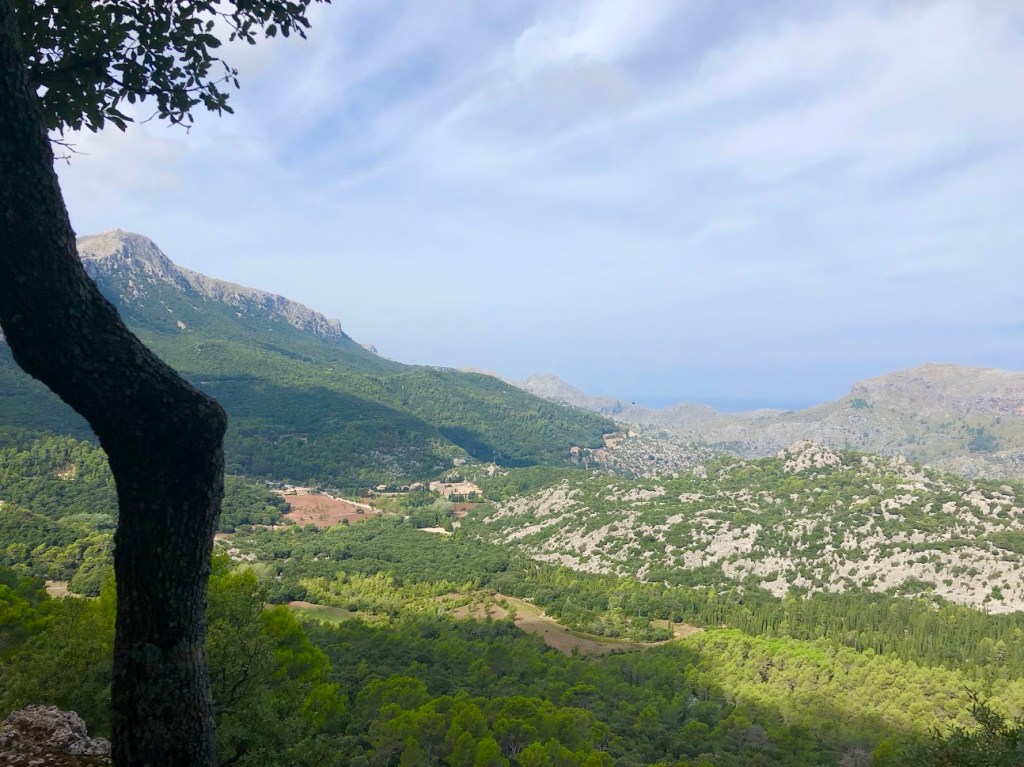
There are places where history feels very present and where the emotional residue of another age still clings to stone and air. Puig de Maria, rising above the town of Pollença, on the Mediterranean island of Mallorca is one such place. It is not simply an old monastery, but built as a human answer to a dark time.

In 1348, as the Black Death swept across Europe. Suffocating fear was everywhere. Death arrived without logic or mercy, dismantling the illusion of control that underpinned medieval life. It is in this context that Puig de Maria was conceived: not as an architectural ambition, but as a cry to the divine.

The decision to build a sanctuary on a mountain summit high above the town was not accidental. It carried symbolic weight. To ascend is to separate—from contagion, from chaos, from the unbearable proximity of suffering. But it is also to draw nearer to God, to meaning, to the possibility that fear can be held within something larger than itself.

In Sages, Saints and Sinners, I return to a question that refuses to stay buried: what becomes of us when certainty collapses? When the structures we trusted—faith, order, meaning—no longer hold, who do we become? Set against the desolation of the 14th-century plague, a time when vast stretches of Europe fell silent and entire communities vanished, the novel steps into that rupture. It is not only a story of loss, but of what emerges in its wake—of the fragile, defiant ways human beings rediscover courage, meaning, and even love when everything familiar has been stripped away.

Some retreat into despair. Others are in denial. But there is a third path, rarer and more demanding—the transmutation of fear into courage, and anxiety into love.

Puig de Maria stands as a physical manifestation of that third path.

The people who built it were not free of fear. They were defined by it. And yet, instead of allowing fear to contract their world, they expanded it vertically. They climbed. They carried stone up a mountain in the midst of plague, and in doing so, enacted a radical defiance: fear would not have the final word.

There is a discipline in the refusal to be mentally captured by catastrophe.

The monastery that emerged—first a chapel, then a place of ongoing devotion—became more than a sanctuary. It became a container. Within its walls, fear was transformed. Ritual, prayer, and community gave structure to what would otherwise have been overwhelming. The unknown was met not with paralysis, but with presence.

This is the essence of transmutation. Not the removal of darkness, but its reworking into something that can sustain life.

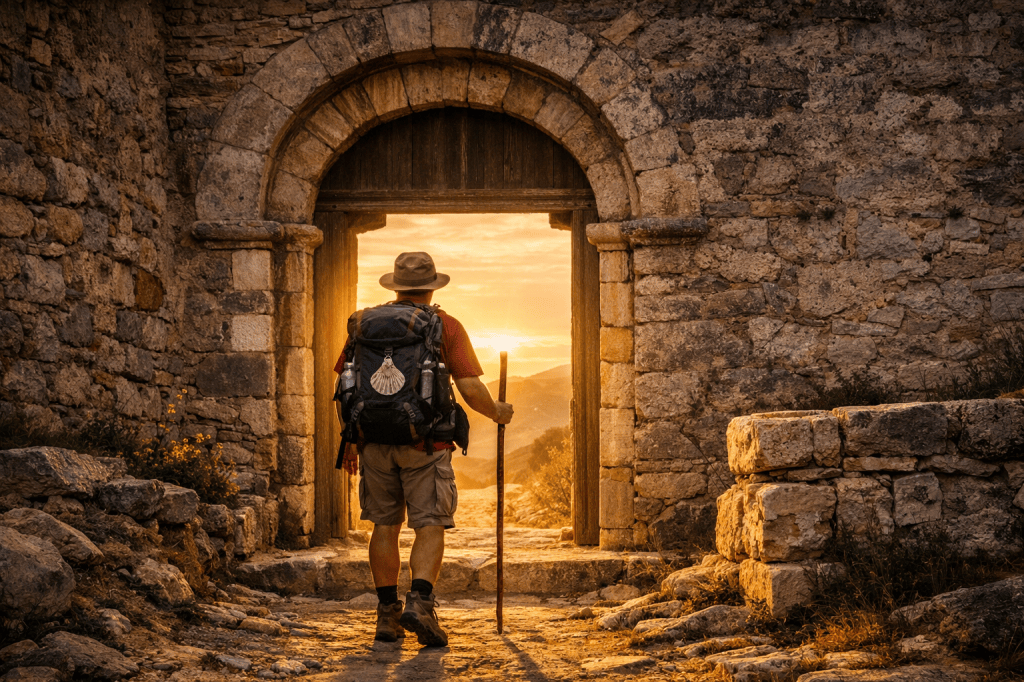
Walking up to Puig de Maria today, the path winds in steady, deliberate curves. It is not a punishing climb, but it demands attention. There is a rhythm to it—step, breath, step—that mirrors something older than the path itself. Pilgrimage is never only about arrival. It is about what is shed along the way.

Halfway up, the town below begins to recede. Perspective shifts. What felt immediate loosens its grip. By the time you reach the summit, something subtle but unmistakable has occurred: distance has been created, not just physically, but internally.

This is the overlooked power of sacred geography. It externalises an inner movement.

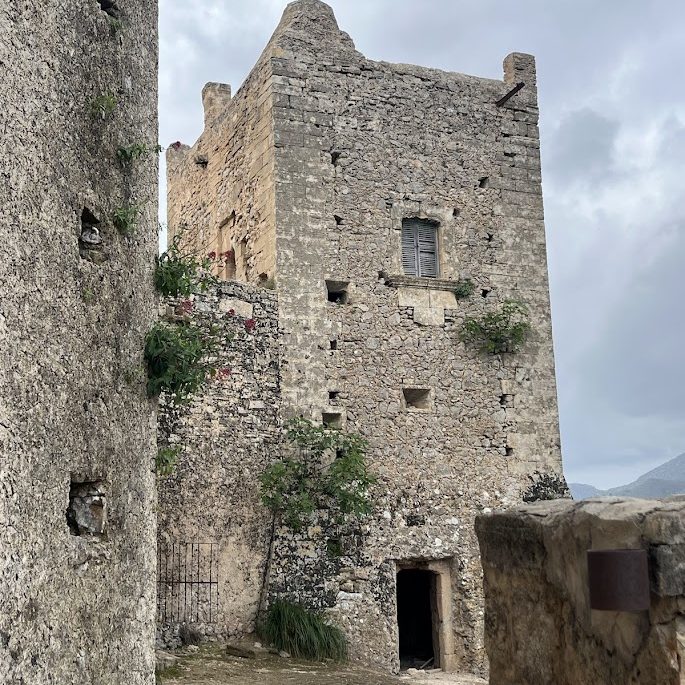
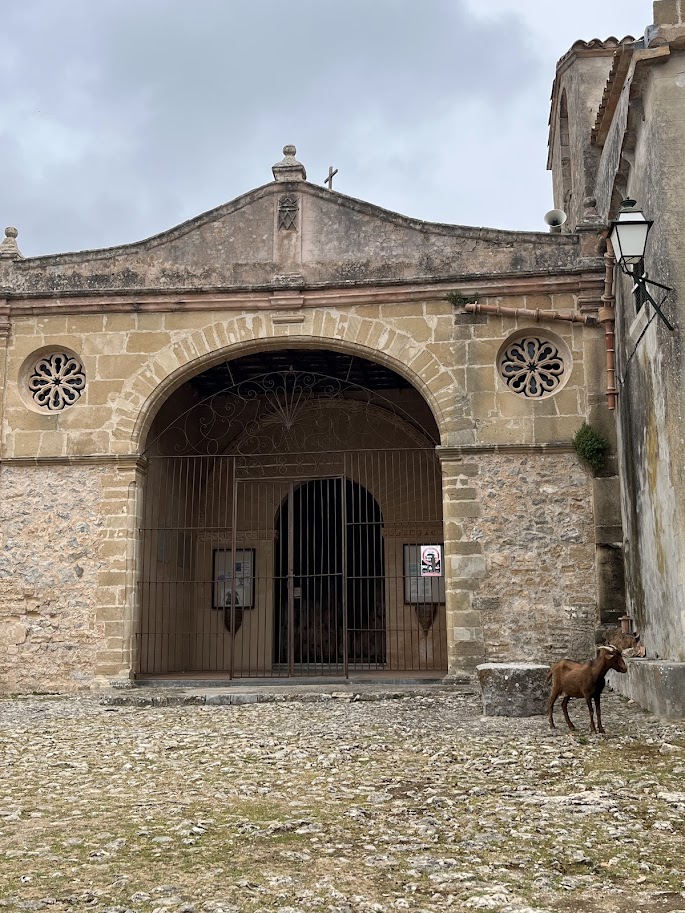
At the top, the monastery remains austere. A tower and thick walls. A chapel that holds silence rather than spectacle. There is no excess here, no attempt to impress. It was never meant for comfort in the modern sense. It was meant for clarity.

And clarity, in times of crisis, is everything.

In our own age, fear has taken on different forms, but its structure remains familiar. Uncertainty, fragmentation, and a sense that the ground is less stable than we were led to believe. The temptation is the same as it was in the 14th century: to collapse inward, to narrow, to protect.

But Puig de Maria offers another template.

Climb.

Not away from reality, but toward a broader vantage point. Build—not necessarily in stone, but in practice—structures that can hold anxiety without being defined by it. Create spaces, inner and outer, where fear can be acknowledged, but not enthroned.

The plague did not end because a monastery was built. Suffering was not avoided. But meaning was forged in the midst of it.

And meaning is what allows endurance to become transformation.

In Sages, Saints and Sinners, the figures who endure are not those who escape fear, but those who metabolise it. They refuse its finality. They insist, against all evidence, that love and courage remain alive.

Puig de Maria asks a question that is as relevant now as it was then:

When fear rises, will you descend into it—or will you climb?

Reino Gevers – Host of the LivingToBe podcast

P.S: If you enjoyed this article you might be interested in reading: Sages, Saints and Sinners Get it today on Amazon, Barnes & Noble and where all good books are sold.

Leave a comment

Filed under Pilgrimage, psychology, spirituality

The Hidden Costs of Rural Decline

I recently drove through rural South Africa on my way to a school reunion—one of those rare gatherings where time folds in on itself and five decades seem like yesterday. The landscape should have been familiar: wide horizons, scattered farmsteads, towns that once pulsed with industry. But what struck me most was not recognition—it was absence.

Roads pitted with potholes slowed the journey, but it was the towns that told the deeper story. Buildings sagged under neglect. Shopfronts stood empty or half-occupied. Once pristine and well-kept, towns seemed to have been abandoned to time. This was not just decay. It was a withdrawal. A slow draining away of people, energy, and purpose.

In my hometown of Dundee in KwaZulu-Natal alone, the closure of a sweets factory, a glass plant, and several coal mines has, over the years, stripped away thousands of jobs. At the reunion, I learned that the impact reached even further: a steelworks in the neighbouring town of Newcastle had also shut down, costing another 3,000 livelihoods.

And this is not a uniquely South African story.

Across the United States, the United Kingdom, Spain, and Germany, I have witnessed similar patterns unfold. Rural communities hollow out as younger generations leave in search of education, employment, and opportunity in cities. What remains are aging populations, shrinking tax bases, and a fraying social fabric. The causes are well documented—economic centralization, mechanization of agriculture, the pull of urban opportunity—but the consequences run deeper than statistics.

Dislocation Without Language

For those who leave, the move to the city often brings material improvement: better jobs, better services, broader networks. But something less tangible is lost.

Rural life, at its best, offers continuity. It binds identity to place. You are not just an individual; you are someone’s neighbor, someone’s history, part of a shared narrative that stretches across generations. When people leave, that continuity fractures.

In cities, identity becomes more fluid—but also more fragile. Relationships are often transactional, time-bound, and contingent. Community must be constructed rather than inherited. For many, this produces a subtle but persistent sense of dislocation: a feeling of being nowhere in particular.

The question then arises: are people happier?

The answer is not straightforward. Urban environments tend to score higher on measures of economic well-being and access to services. But they also correlate with higher levels of loneliness, anxiety, and social isolation. Rural areas, despite economic hardship, often report stronger social cohesion and a greater sense of belonging—at least where communities remain intact.

So the trade-off is not simply between poverty and prosperity. It is between different forms of wealth—material and relational.

The Social Cost

When rural areas decline, society loses more than population density. It loses balance.

Healthy societies depend on a diversity of spaces: urban centers of innovation, suburban zones of stability, and rural regions that anchor culture, tradition, and food production. When one of these weakens, the system becomes distorted.

Depopulated rural areas often enter a downward spiral. As people leave, services close—schools, clinics, shops. This, in turn, makes the area less viable for those who remain, accelerating further out-migration. Political attention shifts elsewhere. Infrastructure deteriorates. Eventually, these regions become peripheral not just geographically, but economically and politically.

This has consequences for social cohesion. When large segments of the population feel left behind, trust erodes—both in institutions and in the broader social contract. The divide between “somewhere” and “anywhere” populations widens: those rooted in place versus those who are mobile and globally connected. This divide increasingly shapes political outcomes across many countries.

The Cultural Loss: Memory Without Custodians

Rural communities are not just economic units; they are repositories of memory.

They carry dialects, customs, ways of life that cannot be easily transplanted into urban settings. When these communities empty out, cultural knowledge dissipates. Traditions survive as fragments—revived occasionally for tourism or nostalgia—but lose their lived context.

What disappears is not just heritage, but a particular way of understanding the world: slower, more cyclical, more attuned to land and season. In its place emerges a more standardized, globalized culture—efficient, connected, but often detached.

Can the Trend Be Reversed?

There are attempts—some promising, many insufficient.

Remote work has reopened the possibility of living outside cities, at least for certain professions. Targeted investment in infrastructure—digital connectivity, transport, healthcare—can make rural areas viable again. Policies that support local enterprise, sustainable agriculture, and decentralized energy systems can stabilize regional economies.

More fundamentally, the question is one of value: what do we, as societies, choose to preserve?

If rural areas are seen merely as economically inefficient, their decline will continue. If, however, they are recognized as essential to social resilience, cultural continuity, and even psychological well-being, then their renewal becomes a strategic priority rather than a sentimental one.

Returning, Briefly

At the reunion, conversations drifted—as they always do—between memory and present reality. Some had stayed. Many have scattered to all parts of the world. Each carried a different version of the same story.

Driving back, the landscape remained unchanged. But the question lingered:

What happens to a society when its margins begin to disappear?

Not all decline is reversible. But not all loss is inevitable either.

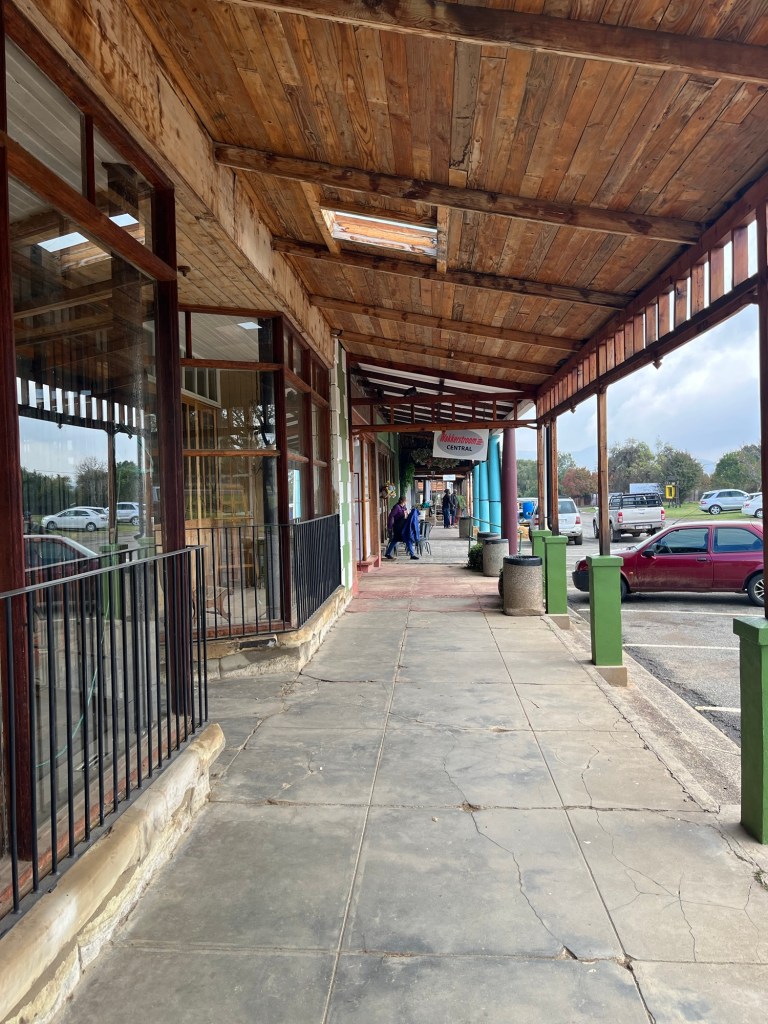
A welcome spark of hope on my return journey came with a stop in the village of Wakkerstroom. This rural gem has been thoughtfully revived: old homes and shopfronts carefully restored, now housing curios, excellent local food, and gateways to nature. It has become a magnet for artists and for those seeking a return to the sanctuary and sense of community that rural life can still offer.

Wakkerstroom
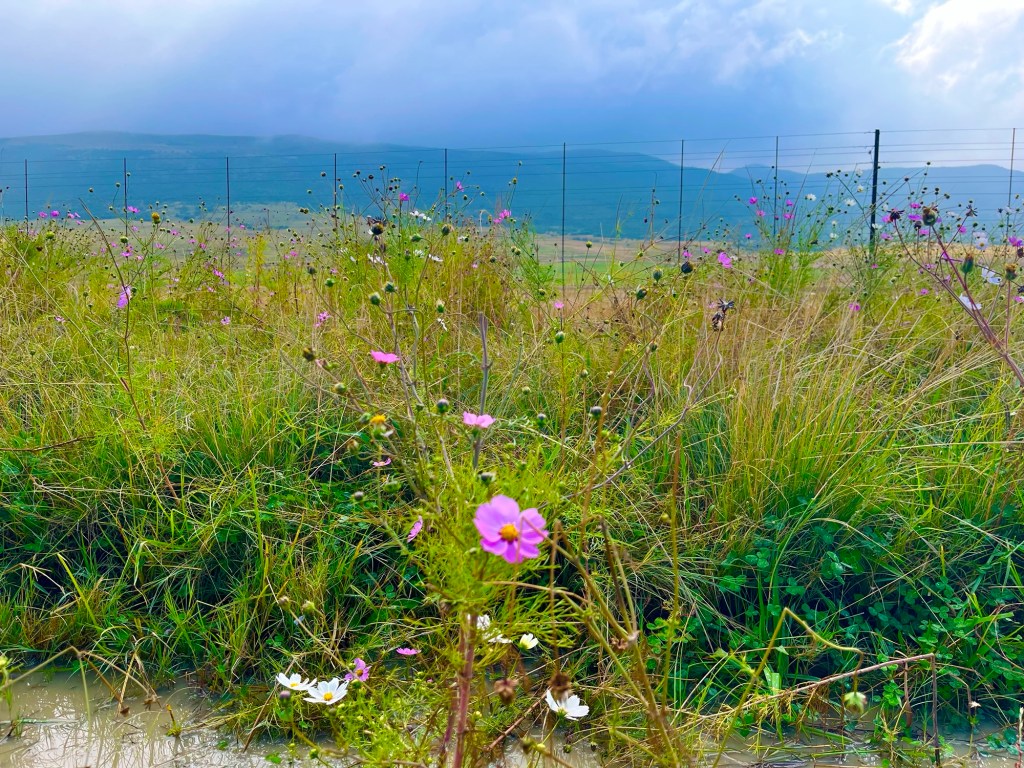
Rural KwaZulu Natal

The condition of rural places is not just a reflection of economic trends—it is a mirror. It shows us what we prioritize, what we neglect, and ultimately, what we are willing to let go.

And perhaps the more uncomfortable question is this:

In our pursuit of better opportunities, have we mistaken movement for progress—and in doing so, lost something we do not yet know how to measure?

Reino Gevers – Host of the LivingToBe podcast

P.S: If you enjoyed this article you might be interested in reading: Sages, Saints and Sinners Get it today on Amazon, Barnes & Noble and where all good books are sold.
Leave a comment

Filed under happiness, happiness research, mental health

A world in transition: The in-between season

Times of transition, like those we are living through now, are often marked by chaos, uncertainty, and the unraveling of certainties that no longer hold. These in-between seasons can be deeply unsettling, yet they are also profoundly formative. More than ever, such times call for clarity of purpose and a conscious alignment with our core values and guiding principles.

During such seasons, the new has not yet taken shape. The ancient Chinese I Ching, or the Book of Change, offers timeless guidance for such moments. It does not promise quick solutions or firm ground. Instead, it teaches us how to live wisely while the ground is moving beneath our feet.

The new struggling to be born

At the heart of the I Ching is a simple truth: change is not an interruption of life. Chaos is not a mistake. It is often the sign that something new is struggling to be born.

In times of transition, the I Ching counsels restraint rather than force. The outer world feels increasingly unstable, with the individual feeling helpless amid external circumstances that cannot be controlled. Yet the I Ching invites us to turn toward inner alignment. Before you act, you are asked to listen. Before you decide, you are asked to become still enough to discern what truly matters.

Waiting is not passive resignation

These in-between seasons call for patience. The I Ching reminds us that timing is sacred. Action taken too soon can distort what is forming; action taken too late can miss the moment entirely. As the book puts it:

“Waiting. If you are sincere,
You have light and success.”

I Ching, Hexagram 5

This waiting is not passive resignation. It is an active, attentive presence—a way of staying faithful to the process even when the outcome is not yet visible.

Discovering what genuinely sustains you

Integrity becomes the anchor in such times. When familiar supports fall away, you discover what genuinely sustains you. The I Ching repeatedly emphasizes that inner truth—not certainty, control, or speed—is what carries us through periods of upheaval. To remain faithful to what is essential within you is, in itself, a spiritual practice.

The book also teaches adaptability without self-betrayal. Like water, we are encouraged to yield without losing our depth, to respond without hardening, to move with change rather than against it. True transformation, it suggests, begins quietly, often invisibly, long before it takes form in the outer world.

Perhaps most importantly, the I Ching directs our attention away from grand solutions and back toward the small and the near:

  • The words we choose to speak
  • Listening with mindfulness
  • Caring for one another
  • Paying attention to the inner life and consciousness.

In times of uncertainty, it is these humble acts that carry the future.

The in-between is not a void. It is a threshold.

When we stop trying to escape it, fix it, or rush through it, we begin to sense its hidden gift. Something is loosening. Something is aligning. Something is quietly taking shape.

And the invitation is simple, though not easy: to become still enough to hear what this season of change is asking of you.

Reino Gevers – Host of the LivingToBe podcast

P.S. For those who feel drawn to explore this in-between season more intentionally, I am offering a six-week online course, Pilgrimage into New Beginnings. It is a quiet, reflective journey for times of transition, starting February 4th.

Leave a comment

Filed under meditation, mental health, psychology, raised consciousness, spirituality

Your Superpower in a Loud Society

Knowing yourself is the beginning of all wisdom.”— Aristotle

Standing guard at the doorway of your mind has become essential to maintaining spiritual and mental health in an age where our minds are drowning in information but thirsting for wisdom.

What you feed your mind, you ultimately become. A few careless minutes scrolling on your smartphone can trigger a cascade of emotions that can shape your entire day.

If you are reading this, you are likely one of the few who is actively reflecting on what is happening to us collectively.

Conflict and social disruption will always be part of the human condition—we are imperfect beings, after all. But we also carry within us the profound power of choice.

When the fringe becomes the megaphone

My impression is that the darker impulses of humanity are being amplified through the very technology meant to connect us. Fanatical fringe groups and those consumed by malice spend countless hours attacking others with hate-filled messages. Social media companies do little to halt this simply because emotionally charged content fuels engagement—and engagement fuels profit.

We may believe we are in control of what enters our minds, but for most people this is not true. Social media and search engine algorithms quietly track our behavior and serve up the content we are most likely to consume. In doing so, they shape not only our preferences, but our thinking.

Echo chambers of belief

Beliefs and opinions are constantly being reaffirmed within separate realities—information bubbles where each group hears only the echoes of its own worldview. Families, friendships, communities, and even congregations are fracturing along these invisible but powerful dividing lines.

What we need is a collective pushback from the quiet majority: the rational, thoughtful, grounded people who do not fall for emotional manipulation. That resistance begins by asking simple but profound questions:

Is this information expanding my energy or diminishing it?

Is it helping me grow, evolve, and reach my full potential?

A common misconception is that knowledge, information, and education alone equal wisdom. Yet many highly intelligent people refuse to learn from their mistakes, cling to fixed mindsets, and resist deeper reflection—never realizing they have been backing the wrong horse all along.

The power of who and what you surround yourself with

True wisdom is innate knowledge shaped through experience. It is the quiet confidence of intuition and higher consciousness. When you choose to surround yourself with wise friends, nourish your mind with spiritual teachings, and seek guidance from grounded mentors, you naturally grow in wisdom.

Equally essential is practicing self-care by setting firm boundaries with people, media, and environments that deplete your mind, body, and soul. Self-care is not indulgence—it is alignment. It is taking time for silence, contemplation, and reconnection with your inner life.

Choosing this path gradually fills your life with greater happiness and contentment because you begin building a bridge to your soul. Your actions shift from serving the ego to serving the greater whole.

Reino Gevers – Host of the LivingToBe podcast

P.S.: If you enjoyed this article, you might be interested in my latest book, Sages, Saints, and Sinners. Get it today on Amazon, Barnes & Noble, and wherever good books are sold.

Leave a comment

Filed under meditation, mental health, psychology, purpose, spirituality, Uncategorized

Beyond Noise: Rilke’s Invitation to Stillness

I’ve been contemplating one of Rilke’s poems lately. It has stayed with me because it speaks so directly to our world today, where noise and distractions pull from all directions. Rilke envisions a silence so profound that all the noise, chatter, busyness of the senses, and endless distractions simply fall away.

And, in that stillness, he says, we might finally glimpse the divine with full clarity.

If only it would be, just once, completely quiet…
If only it would be, just once, completely quiet.
If the random, and the approximate
went mute, and the neighbors’ laughter,
if the noise that my senses make
wouldn’t so stubbornly keep me from waking–
Then I could, in a thousandfold
thought, think you right to the edge of you
and have you (just a smile long),
to give to all life as a gift
like a thank-you.

Reading this, I couldn’t help but notice how often we treat noise, chatter, and distraction as normal. Yet maybe our constant talking, scrolling, and background hum are really a way of avoiding something scarier: just sitting with the stillness within.

Stillness can feel so unsettling because it invites us to hear the inner voice we’ve been ignoring, the voice of authenticity, of truth, of God. Rilke reminds me that silence isn’t empty at all. It’s a threshold. If we dare to step into it, we may discover presence, gratitude, and a deeper connection with life than all our distractions could ever offer.

You could also take a walk in nature, opening the senses to natural sounds that are different from noise. Birdsong, the waters of a creek, the rustling of leaves in the trees—all of it forms a beautiful symphony. In those moments, you can feel yourself connected to a larger whole and begin to perceive the subtle whispers of the universe.

So here’s a simple practice: find just five minutes today to sit in stillness. Turn off the phone, close your eyes, and notice the quiet beneath the noise. At first it may feel uncomfortable, but stay with it. Listen for that subtle inner voice—the one that whispers rather than shouts. You may find, as Rilke did, that in the stillness something sacred begins to stir.

Reino Gevers – Host of the LivingToBe podcast

P.S.: If you enjoyed this article, you might be interested in my latest book, Sages, Saints, and Sinners. Get it today on Amazon, Barnes & Noble, and wherever good books are sold.

Leave a comment

Filed under happiness, meditation, mental health, psychology, purpose, Uncategorized

The Sacred Principle of Diversity

There’s something quietly profound about spending time in a natural landscape that hasn’t been tamed or touched by human hands. Whether it’s in the African bush, a lonely walk in the Galician mountains, or on a mundane path in the Meseta. What strikes me every time is how life insists on diversity. Every insect, tree, bird, and creature is somehow interconnected in a grand, mysterious harmony. Nature doesn’t strive for sameness. It thrives because of its differences.

And I’ve come to believe the same is true for humanity.

Every different culture, cuisine, language, and spiritual tradition feels like a distinct fingerprint of life, carrying its own wisdom, colors, and cadence. They’re not threats to one another but complementary parts of a much larger whole.

When we try to flatten the world into one belief system, one way of being, one “truth,” we violate a deep principle embedded in creation itself.

So many of the “isms” we’ve inherited, such as nationalism, tribalism, and certain flavors of extreme patriotism, tend to dehumanize those who don’t fit neatly into the mold. When difference becomes a threat instead of a teacher, it often escalates into exclusion, oppression, and even violence.

And yet, the ancient sages and mystics remind us: under all these differences, there is unity.

The Baha’i Faith teaches that all religions stem from the same divine source, evolving like chapters in one great story of spiritual awakening with the great spiritual teachers from different religions appearing at a certain chosen time and place.

Mahayana Buddhism tells us that all beings possess Buddha-nature, regardless of the path they walk; the light within is the same.

In Christian Mysticism, creation is declared “good,” and every human made in the image of God, each of us carrying a unique spark of divine purpose. Meister Eckhart, the 13th-century mystic, wrote:

“The eye through which I see God is the same eye through which God sees me; my eye and God’s eye are one eye, one seeing, one knowing, one love.”

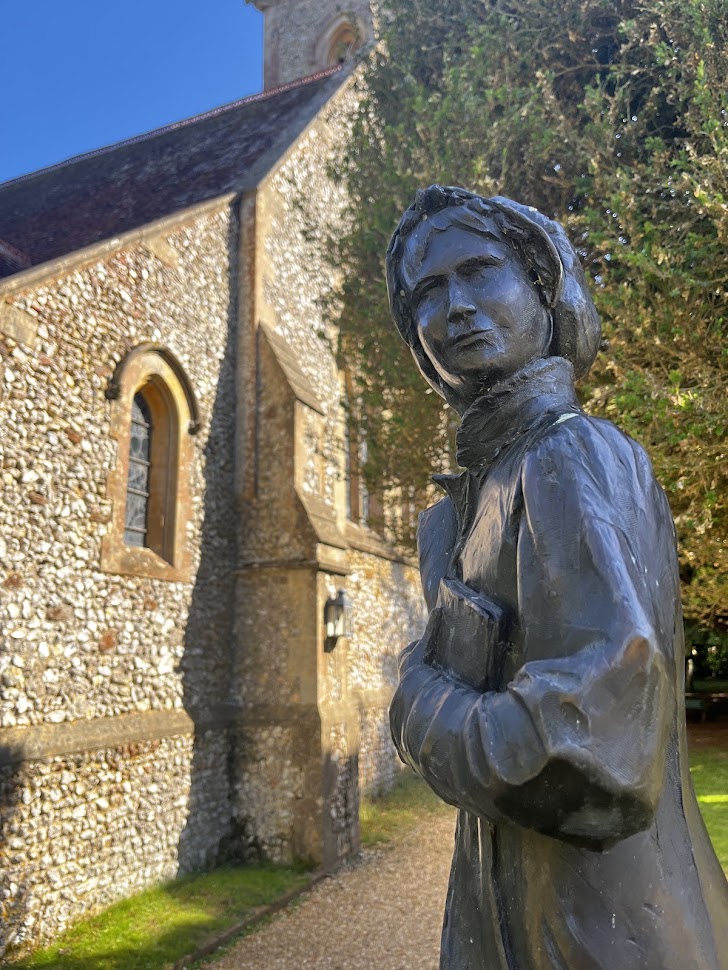
Another echo of this truth comes from the writings inspired by Julian of Norwich (c. 1342 – after 1416), an English woman who lived in quiet prayer and seclusion:

“Each soul is a unique expression of God’s love, as varied and wondrous as the colors in creation.”

This isn’t just theology. It’s a call to practice. A spiritual responsibility. If diversity is sacred, then how I relate to it matters. Am I listening? Am I open? Am I willing to be changed by what I don’t yet understand?

This can become a daily transformative spiritual practice:

  • What can I learn from the differences I perceive in others?
  • What is it that provokes my discomfort, anger, or fear?
  • Why am I drawn to some cultures and landscapes, and repelled by others?

These questions may serve as an invitation into a deeper clarity and humility.

In a world increasingly shaped by division, choosing to honor diversity is a form of sacred resistance. It’s a return to the original design of creation: not uniformity, but unity through difference. And when you lean into that, something holy begins to take shape both around you and within.

Reino Gevers – Host of the LivingToBe podcast

P.S.: If you enjoyed this article, you might be interested in my latest book, Sages, Saints, and Sinners. Get it today on Amazon, Barnes & Noble, and wherever good books are sold.

Leave a comment

Filed under raised consciousness, religion, spirituality

Cycles of Renewal: Embracing Life’s Challenges

“A human being is a part of the whole called by us ‘universe,’ a part limited in time and space. He experiences himself, his thoughts and feelings, as something separated from the rest — a kind of optical delusion of his consciousness.”
Albert Einstein

For millennia, ancient sages and saints taught that a sacred order underlies all of creation with a divine intelligence woven into the fabric of life itself. Today, modern science is beginning to echo this timeless wisdom, recognizing patterns of evolution and interconnection that hint at a universal consciousness at work.

When we begin to see that there may be a higher purpose behind life’s chaos, pain, and obstacles, we are invited into a deeper surrender, trusting that the challenges are shaping us into the fullness of who we are meant to become.

At the heart of this understanding lies a universal truth: The Law of the Seasons.

Life, like nature, moves in cycles in an eternal rhythm of growth, shedding, rest, and rebirth.

This rhythm is beautifully expressed in the Chinese philosophy of the Five Elements: Wood, Fire, Earth, Metal, and Water. Rooted in ancient Taoist and Buddhist traditions, these elements reflect the dynamic forces of nature and the continuous flow of transformation that is the secret of life. The sages who developed this framework were not only spiritual teachers but also profound observers of the natural world, recognizing that every season, every phase of life, mirrors a deeper cosmic order.

Spring, the season of the Wood element, marks the beginning of life’s great unfolding. It is the time of birth — when we take our first breath with a cry, entering the world with raw vitality. Just as a newborn deer rises and leaps within moments of birth, life itself surges forward with energy and possibility. In nature, it is the season of sowing: farmers plant seeds, trees awaken with tender blossoms, and birds gather twigs to build their nests. Everything is in motion, fueled by the vision of youth, growth, and a sense of new beginnings.

Summer, aligned with the element of Fire, is the season of full expression. What was planted in spring now bursts into bloom, radiating color, energy, and vibrancy. Fire represents passion, joy, and connection. It is the time of reaching outward into the world and celebrating life’s fullness. Like the sun at its peak, we shine our light most brightly, engaging with others, forging relationships, and expressing our true essence. In this season, nature is alive with movement, with bees humming between blossoms, fruits ripening, and long days inviting us to dance with life.

Late summer ushers in the Earth element. This is the stabilizing force that grounds and nourishes. It is the season of ripening and harvest, when the fruits of earlier seasons are gathered and shared. Earth represents balance, care, and sustenance. It is a time of reflection and integration, when we pause to absorb, digest, and appreciate what has come to fruition. In nature, the fields are golden, the air thick with the scent of abundance, and the pace begins to soften. Earth reminds us of the importance of centering ourselves of being rooted, generous, and in harmony with the rhythms of life. It is time to give gratitude for all the blessings and opportunities that life has provided.

Autumn, governed by the element of Metal, is the season of refinement and release. As the trees let go of their leaves, we too are called to surrender what no longer serves us. Metal represents clarity, value, and the distillation of wisdom, the process of turning experience into insight. It is a time of letting go with grace, making space for what is essential. The air grows crisp, the light softens, and the world becomes quieter, more reflective. In this sacred shedding, we reconnect with our inner worth and recognize the beauty in simplicity and stillness.

Winter, the domain of the Water element, draws us inward to the depths of stillness and rest. It is the season of restoration, of returning to the source. Water symbolizes wisdom, intuition, and the unseen currents of life. Beneath the frozen surface, life is quietly gathering strength. Just as seeds lie dormant beneath the soil, preparing for rebirth, we are invited to pause, reflect, and reconnect with our inner truth. This is a time for dreaming, for listening deeply, and for trusting the mystery of the unknown. Water teaches us that even in darkness, life continues, silently, powerfully, and with purpose. As in life, there is a season to pause, to withdraw, and to hold still.

Together, the Five Elements offer more than a framework for understanding nature. They mirror the unfolding journey of life. Each season calls forth a different quality within you: the courage to begin, the joy of full expression, the grounding of nourishment, the wisdom of release, and the depth of renewal. When you attune yourself to these rhythms, you begin to see that life is not a straight line but a sacred cycle.

It fills me with hope, and I can affirm this from my own experience, when looking back and connecting the dots to life-changing events, that even in times of struggle or uncertainty, you can trust that everything is always in motion, evolving, becoming, and returning again to the truest self. There is a great truth to the saying, attributed to Abraham Lincoln at the height of the American Civil War: This too shall pass!

Reino Gevers – Host of the LivingToBe podcast

P.S.: If you enjoyed this article, you might be interested in my latest book, Sages, Saints, and Sinners. Get it today on Amazon, Barnes & Noble, and wherever good books are sold.

Leave a comment

Filed under gratitude, happiness, mental health

Why are we all feeling so disconnected?

Have you ever found yourself surrounded by people, yet feeling completely alone? Or waking up with a low hum of worry in your chest, and you can’t quite name why? If so, you’re not alone.
You may be carrying what many experts now recognize as one of the most widespread pains of our time – loneliness.

Emotional loneliness rooted in disconnection has become an epidemic of our time. The World Health Organzation Commission on Loneliness equates the health risks of loneliness to smoking 15 cigarettes a day with increased risk of heart disease, stroke, dementia, anxiety and depression. Social isolation and loneliness is a global epidemic affecting at least one in six people across all age groups.

Disconnection doesn’t just happen when we lose touch with others. It happens when we lose touch with the inner self, with purpose and the divine.

This can be especially true during transitions in life, such as adolescence, retirement, when old friendships fade, or when mothers in midlife face a season of redefinition after their children have left home. You may feel invisible after years of showing up for others.

But here’s the sacred truth: Your worth is not tied to your productivity. You are not meant to disappear. You are meant to go deeper into exploring your soul purpose and who you really are.

The Underlying Hum of Anxiety

Modern life is overstimulating, and there is a constant information overload, which compounds underlying anxieties such as financial, health, and other concerns. This emotional static gradually wears down your spirit and vibrational energy.

But the way out isn’t to hustle harder. It is to pause, reflect, and readjust. Take a step back with a deep inhaling and exhaling breath. Say to yourself. I love and accept myself the way I am. I am guided and protected.

Shifting grounds

Our world is shifting rapidly, technologically, politically, and spiritually. Change is part of the evolutionary process and the cycle of life. It can be a gift, but it can also create uncertainty, fea,r and the retreat into an “uncomfortable” comfort zone. But stability is never created externally. It begins with the sacred center. In the space of stillness, the spirit speaks.

What Can You Do?

Here are a few soul practices to gently guide you home:

Sacred Silence

Take just five minutes a day to sit in stillness with no agenda, no expectations. Simply be. Let your breath become your prayer, anchoring you to the present moment. If sitting feels challenging, take a gentle walk in nature. Tune your awareness to the symphony around you, the birdsong, the hum of bees, the whisper of the wind through the trees. I feel especially connected when I practice Tai Chi outdoors. Often, I’ve experienced magical moments with animals drawing near, as if responding to the quiet presence and deep focus of the moment.

Reach Out

Talk to friends, reach out to people that you connect to deeply, and who elevate your energy. A great way of building resilience is to really connect with people. We are hard-wired as social beings. But sometimes we tend to retreat into quiet, lonely suffering if we don’t feel good.

Affirm Your Truth

How you talk to yourself, both positively and negatively, has a huge impact. Instead of saying: “This will never work. I’m a fraud and a failure. Nobody loves me.” “I’m alive and blessed in multiple ways. Opportunity and abundance come my way.

Or,

“I am not alone. I am connected. I am safe in this moment.”

Repeat it until it begins to feel true.

And here are some gentle questions for reflection:

  • Where in my life do I feel most disconnected?
  • What do I need to feel seen and supported?
  • What practices help me return to my grounded self?

Reino Gevers – Host of the LivingToBe podcast

P.S.: If you enjoyed this article, you might be interested in my latest book, Sages, Saints, and Sinners. Get it today on Amazon, Barnes & Noble, and wherever good books are sold.

2 Comments

Filed under happiness

From Burnout into Becoming who you really are

Have you ever felt like you’re just running on empty, and feeling emotionally exhausted that comes from carrying too much, too often, and for too long? You’re not alone.

At some point, most of us find ourselves stuck in the burnout spiral by juggling responsibilities, absorbing too much information on social media, and feeling the quiet weight of stress pressing in from every side. It’s easy to lose your sense of calm, purpose, and energy when overwhelm takes hold.

You might feel disconnected from what is ultimately your journey into becoming who you really are.

But here’s the truth: You don’t need a dramatic life reset to feel better.
Small, intentional steps can help you rebuild your energy and resilience. Doable practices that can help you restore your strength from the inside out.

Acknowledge the Overwhelm

“Let’s start with honesty: Are you constantly running on empty?” The difference between normal stress vs. chronic overwhelm. Common sources: caregiving, decision fatigue, emotional burnout, information overload.

The Science

The body has a natural defence mechanism when under duress. The hormone cortisol puts you into fight, flight or freeze mode. Your breathing becomes fast and shallow as all your senses go into survival mode. Your cognitive functions, the ability to find creative solutions is impaired. At the same time all your vital body organs do not get the nutrients they need, steadily breaking down your immune system. We are simply not designed to cope with permanent stress over long periods of time.

Common misconceptions on building resilience

A common misconception about building resilience is to “toughen it out.” But it’s not about swimming against the tide and bouncing back as before. It’s more about integrating the experience and adapting accordingly.

Micro-Shifts That Build Strength

Simple routines and mind habits can restore control. Your intuition will tell you that you are not aligned if what you are doing is inevitably causing fatigue and exhaustion. Learning to say „no“ and setting healthy boundaries to people who deplete your energy takes practice. Pause for a moment and breathe before reacting. In this way you are building space between stimulus and response.

The Role of Faith and Belief

Integrating faith can be pivotal in providing an anchor of guidance during stormy times. It could be a morning meditation or prayer that aligns you with your authentic self. Several studies have confirmed that taking a walk in the green and blue spaces of nature and opening the senses to the sights, sounds, and smells of nature reduces the stress hormones in your body significantly.

Building a Resilience Toolbox

Stress is not necessarily harmful. It can help you focus on the task at hand. But too much of it is harmful. The key is finding a good sprint and recovery system. Practices such as breathwork, walks in nature, digital breaks, gratitude reflection and nurturing positive relationships are just some examples. What and who grounds you? Mental reframing: “Is this pressure pointing to a shift I need? What is life throwing at me from which I can learn?“ You can ask for help without guilt. Learn to sit with discomfort without shutting down.

What’s one small choice you can make this week to calm the overwhelm? It could be a simple question such as: “When I feel overwhelmed, I want to remember…”

Reino Gevers – Author – Mentor –Speaker

P.S.: If you enjoyed this article, you might be interested in my latest book, Sages, Saints, and Sinners. Get it today on Amazon, Barnes & Noble, and wherever good books are sold.

Leave a comment

Filed under exercise mental health, stress, stress hormones, Uncategorized

Art as a Lens: Exploring History and Human Experience

Great artists possess the rare ability to pierce through the veil of the ordinary, revealing the deeper truths that lie beneath life’s surface. In times when power distorts reality and fear stifles truth, their work becomes a courageous act of revelation.

A few days ago, I was vividly reminded of this while visiting the Tate Britain gallery in London. Entrance to most of London’s famous galleries is free, and it’s a great way to spend a few quiet hours in a big city.

I was particularly struck by the works of the late 17th and 18th centuries. The expanding British Empire was marked by conflict, built by the sacrifices of soldiers and the toil of slaves and factory workers. Child labour was common, and women were condemned to giving birth and running the household.

Subtle hints beneath the surface

Artists were often commissioned to glorify the king and the empire, yet beneath the surface of landscape paintings, market scenes, and depictions of mixed-status couples, subtle traces of class divisions and social tensions quietly emerge.

The tumultuous times of the late 18th and 19th centuries, along with global wars, came at a huge cost, marked by massive taxation for ordinary people, widening wealth gaps, poverty, and unemployment. Artists responded by painting dramatic battle scenes or images that either evoke a Romantic past or feelings of awe and terror.

Art and spirituality

Much of religious art was commissioned by monasteries in medieval times to convey the gospel because most people were illiterate. In contemplation of the art, the individual had a unique gateway to experiential spirituality.

Apocalyptic imagery from the Book of Revelation reflects the deep anxieties of a time when rapid technological and social upheaval left many feeling unmoored. Long-held certainties, norms, and values were beginning to crumble. In many ways, these ancient fears echo our own and mirror the disruptions in today’s world.

Artists sensing underlying tensions

Major social and political shifts are often preceded by conflict and upheaval. Artists sense these underlying tensions long before they burst into the open ,but also give some cues to a brighter future.

Art offers us a unique lens through which to view the past, revealing not just historical waymarkers but the deeper rhythms of human experience.

History moves in cycles. Out of hardship and resilience emerges renewal and growth, only to give way once more to seasons of disruption and decline. Yet, from each winter of decay, a new spring is born, reminding us that regeneration is woven into the very fabric of life.

Reino Gevers – Author – Mentor –Speaker

P.S: If you enjoyed this article you might be interested in my very latest book: Sages, Saints and Sinners Get it today on Amazon, Barnes & Noble and where all good books are sold.

Leave a comment

Filed under art, Uncategorized