All my life I have grappled with a question that has never allowed me much peace: How can ordinary, seemingly good people turn almost overnight against their fellow human beings and participate in acts of terrible cruelty?
History gives us countless examples. Perhaps among the most shocking are the genocidal conflicts in Rwanda, where people who had lived alongside one another for generations suddenly turned on their neighbours, friends and even family members in a frenzy of violence.
In Nazi Germany, ordinary citizens looked away as Jewish neighbours were arrested and deported. Some went further, informing the authorities where those who were hiding could be found.
These events are difficult to comprehend because they challenge one of our most comforting assumptions: that good people and evil people are fundamentally different kinds of human beings.
During my years as a journalist, I came to question that assumption.
A few months into my first job as a junior reporter, an elderly colleague took me aside one day. He had been watching me, he said, and there was something I needed to understand about the profession.
“You really need to stop being so naïve.”
At the time, I thought he was talking about journalism. Over the years, I came to understand that he was talking about something much larger: human nature.
Each of us carries within us the capacity for both compassion and cruelty, courage and cowardice, generosity and selfishness. The fact that we may currently live peaceful, decent lives does not make us immune to the darker possibilities within ourselves.
Sometimes the greatest good and the greatest evil can even exist within the same person.
This is one of the most uncomfortable truths of being human.
The great thirteenth-century mystic Meister Eckhart understood suffering not simply as punishment or divine cruelty, but as something that could chisel us into beings capable of carrying light.
St. Augustine, too, understood evil not as an independent force competing with God, but as a form of absence — a turning away from the source of being and love.
These ideas have stayed with me because they suggest that darkness is not something we overcome simply by declaring ourselves to be good. It has to be seen.
And this is where the idea of the shadow becomes important.
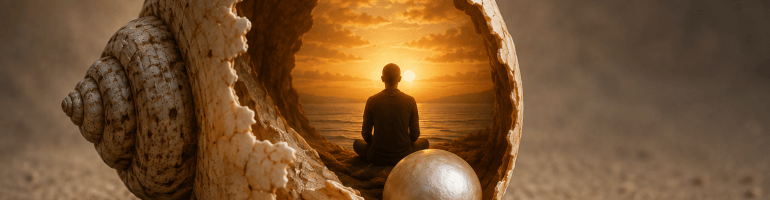
The shadow is everything within us that we would rather not acknowledge: our fear, envy, resentment, shame, aggression, insecurity, grief and woundedness. It contains the parts of ourselves that we have pushed out of conscious awareness because they do not fit the image we have constructed of who we are.
But what we refuse to see does not necessarily disappear.
It can operate from the darkness. You can project it onto others. You can turn unresolved fear into suspicion. Or humiliation into hatred. Pain into aggression and insecurity into the need to control. The sense of powerlessness turns into the desire to find someone weaker to blame.
This may help explain one of the great paradoxes of human history: why people who have themselves suffered persecution can sometimes become persecutors.
Afrikaners who carried the historical memory of British colonial oppression later participated in a political system that subjected Black South Africans to systematic discrimination and humiliation.
I witnessed another contradiction in my own childhood.
Members of my church congregation could receive communion on a Sunday, be loving husbands and fathers, generous to their fellow parishioners and apparently sincere in their Christian faith — and yet treat their Black farmworkers with extraordinary cruelty. They could compartmentalize their lives so completely that compassion existed in one part of their world while dehumanization existed in another.
And history continues to remind us that liberation from one form of oppression does not automatically free us from the impulses that created it. Some people who once fought apartheid have themselves later been accused of corruption and abuse of power.
The lesson, for me, is not that one political group or another is inherently good or evil. It is that no human being, movement or community is automatically protected from the shadow.
We remain incomplete beings.
Nobody is immune to temptation. Nobody is entirely free from fear. And nobody can honestly claim that darkness belongs only to someone else.
This is why I have become increasingly convinced that one of the most important tasks of a human life is to transmute fear and integrate the shadow.
By transmutation, I don’t mean suppressing fear or pretending that it isn’t there. Nor do I mean excusing harmful behaviour because someone has been wounded.
You have to become conscious of what moves within you. You have to be willing to sit with your fear long enough to understand what lies beneath it. What are you protecting? What are you afraid of losing? Where did the fear begin? What old wound does it touch? What story about yourself or other people has grown around it?
When fear remains unconscious, it easily becomes a justification.
It tells us that they are the problem.
They are dangerous.
They are taking something from us.
They don’t belong.
They must be controlled.
And once another human being has been reduced to they, compassion becomes much easier to abandon. There is separation between them and us and the seeds of tribalism are sown.
It can become xenophobia. Racism. Religious hatred. Political extremism. Nationalism stripped of compassion. The search for scapegoats. Fear narrows the field of perception until the other person is no longer experienced as a human being with a story, a family, wounds and hopes of their own.
Love, by contrast, reconnects.
This does not mean that fear is always irrational. Fear has an important biological function. It protects us from genuine danger. The problem begins when old fear, inherited fear or unprocessed trauma becomes the lens through which the present is interpreted.
Trauma can travel through families and communities. Historical grievances can become part of collective identity. Stories of humiliation and victimhood can be passed from one generation to another until they become almost indistinguishable from truth itself.
Unless someone interrupts the pattern through consciousness.
It requires the courage to look inward and ask not only, What have they done to us? but also, What is happening inside me because of what has happened to us?
This, I believe, is where genuine transformation begins.
To transmute the shadow is to bring what has been unconscious into consciousness and, rather than acting it out, allow it to be understood.
Fear can become discernment.
Anger can become a recognition of injustice without becoming hatred.
Grief can become compassion.
Shame can become humility.
Pain can become wisdom.
The darkness does not necessarily have to be destroyed. It has to be brought into the light.
Perhaps this is what Eckhart meant by being chiselled into someone capable of carrying light. The work is not to become a person who has no darkness. It is to become a person who knows their darkness well enough not to be ruled by it.
This is also why I have become wary of the temptation to divide humanity into the good and the bad, the enlightened and the unenlightened, the victims and the perpetrators.
Those distinctions may sometimes be necessary when confronting injustice. Responsibility must never disappear into spiritual abstraction. People must be held accountable for what they do.
But accountability and shadow work are not opposites.
The more honestly we recognize our own capacity for darkness, the less easily we can project that darkness onto others.
Perhaps the real work of becoming human is not to prove that we are good.
It is to become conscious enough to choose goodness when fear gives us another option.
Because the shadow will always be there.
The question is whether we remain unconscious of it — allowing it to shape our thoughts, our relationships and our societies from beneath the surface — or whether we have the courage to turn towards it, understand it and gradually transform its energy into something life-giving.
That, for me, is the deeper meaning of inner work.
You cannot create a less divided world simply by changing other people. You can only begin by becoming conscious of what lies within that divides.
And perhaps the most important spiritual journey of all is the journey from fear back into connection — from separation back into wholeness, and from the unconscious shadow into the light.
Reino Gevers – Host of the LivingToBe podcast
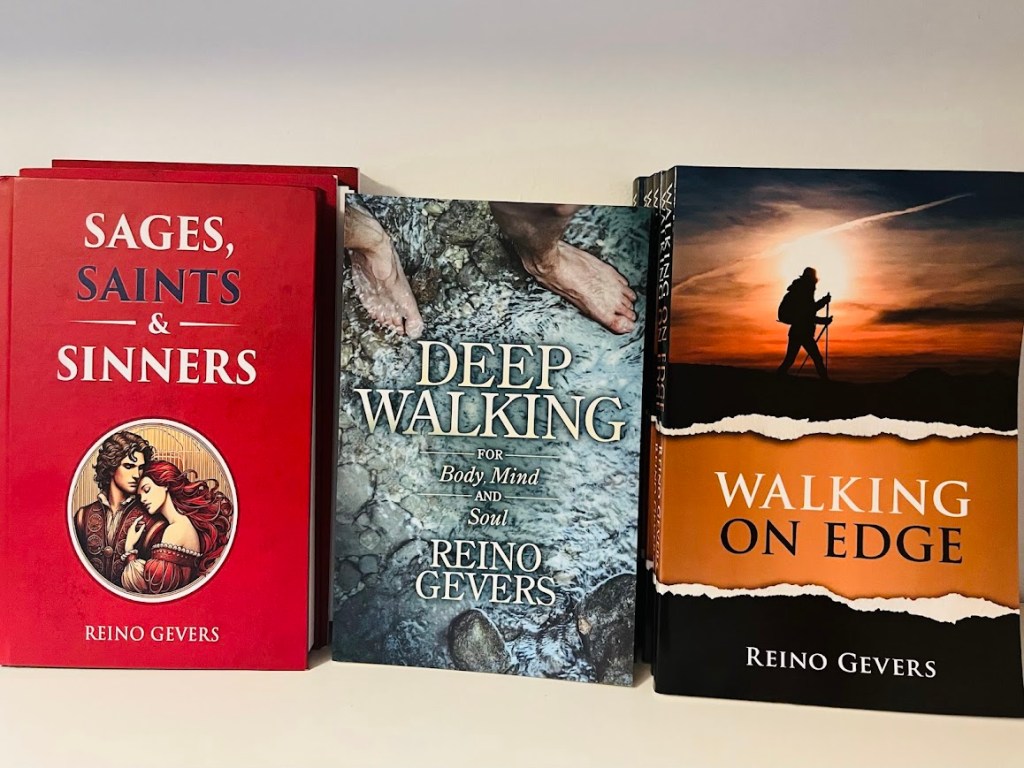
P.S: If you enjoyed this article, you might be interested in reading one of my four books, available where all good books are sold.