Over the years, I have walked thousands of kilometres on pilgrimage routes across Europe, often finding myself stepping off the trail into small churches and ancient chapels. Sometimes I entered simply to escape the midday heat. Sometimes to rest tired legs. Often there was no one else inside. The silence itself became a companion.
I would sit for a while and let my eyes wander over faded frescoes, carved crucifixes, stained-glass windows, and centuries-old icons. I rarely tried to analyse what I was seeing. Instead, I simply allowed the artwork to speak. Those precious moments became as much a part of the pilgrimage as the walking itself.
Walking a pilgrimage is not only about moving through landscapes; it is about allowing the landscape of the soul to change. The art in those ancient sanctuaries invited me to slow down, to become present, and to notice the subtle movements of the heart that are easily drowned out by the noise of everyday life. There are paintings we admire for their beauty. There are others we appreciate for their historical importance. And then there are a rare few that seem to look back at us, inviting us into a conversation that transcends words.
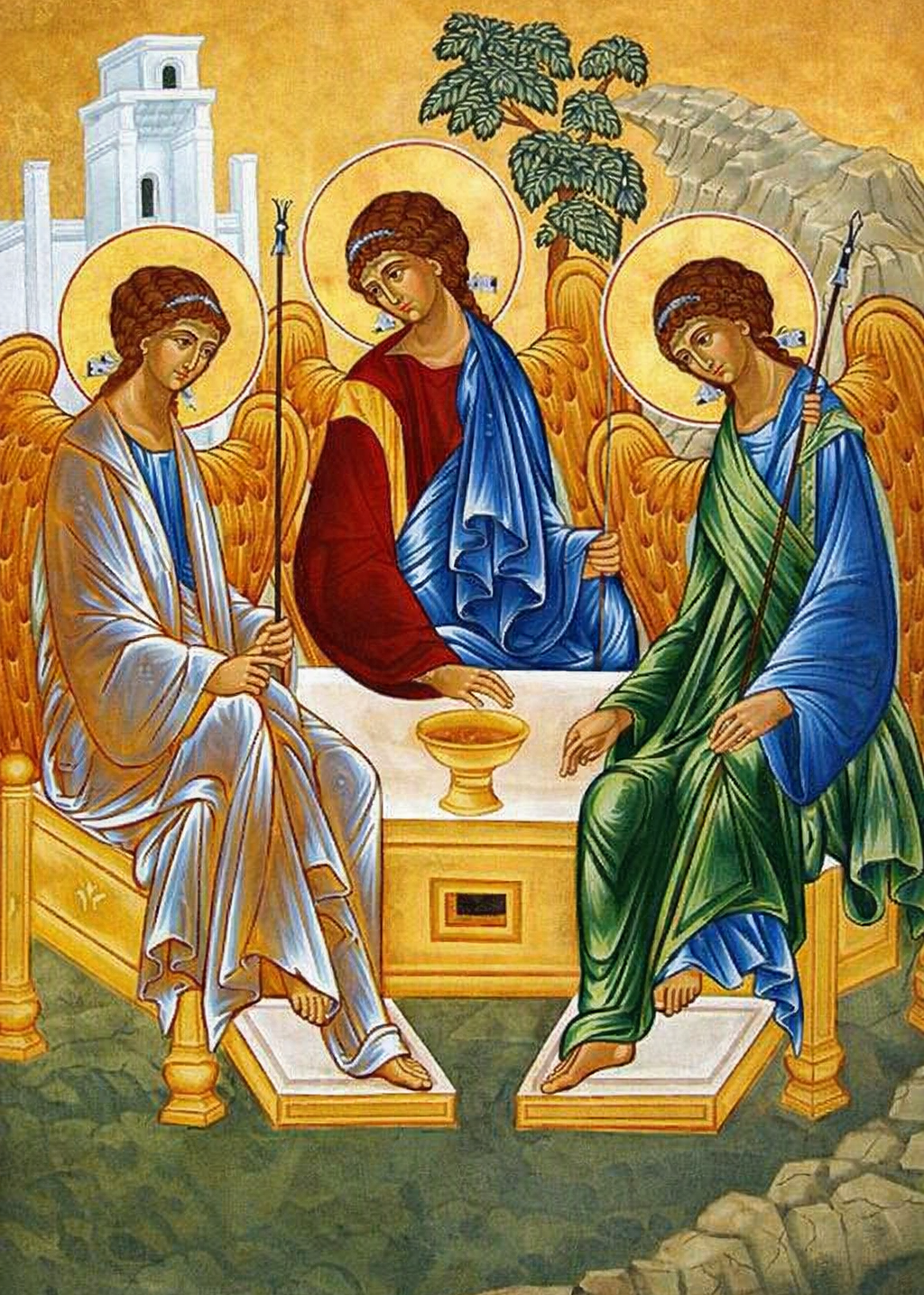
For more than six centuries, pilgrims, monks, artists, and seekers have returned again and again to Andrei Rublev’s The Trinity. Many consider it the greatest icon ever painted—not because of its artistic perfection, but because of the quiet mystery it reveals.
Most religious art portrays God as distant, enthroned, or judging from above. Rublev offers an altogether different vision. Three figures sit around a simple table beneath the shade of an oak tree. Their bodies incline gently towards one another. Their gaze moves in an endless circle of mutual love. There is no struggle for dominance, no assertion of rank, no hint of rivalry.
Everything about the icon whispers that the deepest reality of existence is relationship.
Rublev’s The Trinity embodies that same invitation.
At the front of the table there is an empty place.
It is impossible to ignore once you see it.
That space has been left open intentionally.
It is your place.
Icons were never intended simply to decorate churches or illustrate theology. In the Eastern Christian tradition, they are often called windows into heaven. Their purpose is not merely to tell us something about God but to draw us into an encounter with the Divine.
This is the difference between knowing about the sacred and experiencing it.
Modern culture encourages you to gather information, formulate opinions, and seek certainty. Yet the deepest spiritual experiences often arise when you stop trying to master the mystery and allow the mystery to embrace you instead.
That, for me, is the gift of pilgrimage.
Walking hour after hour strips away the unnecessary. There comes a point when the questions become more important than the answers, when silence speaks more eloquently than words, and when simply sitting in an ancient chapel can become a profound act of prayer. The journey teaches that God is encountered less through explanation than through attention—through learning to be fully present to the present moment.
When you sit quietly before Rublev’s icon, something subtle begins to happen. The image ceases to be an object we observe. Instead, it becomes a mirror. It reveals where lives have become fragmented, where fear has replaced trust, where ambition has overshadowed compassion, where you have forgotten that you belong to something infinitely larger than yourself.
The invitation is not to acquire another belief.
It is to enter the circle.
The early Christian mystics spoke of the Trinity as an eternal movement of self-giving love—a divine dance in which each person exists for the other. Creation itself flows from that love. Humanity is not called merely to admire it but to participate in it. It reminds me of the African philosophy of Ubuntu – that you become who you are through interaction with others.
Seen in this light, spirituality is no longer about escaping the world or accumulating religious knowledge. It becomes a way of seeing. A way of listening. A way of walking through ordinary life with an awakened awareness that every encounter can become sacred.
The empty place at the table reminds you that you are already included.
You do not earn your seat through achievement, moral perfection, or religious certainty but in simply accepting the invitation.
Perhaps this explains why The Trinity continues to move people after more than six hundred years. In a world marked by polarisation, tribalism, and the relentless pursuit of status and power, Rublev reminds us that the deepest reality of the universe is not domination but communion. Not fear, but love. Not exclusion, but belonging.
Every time I leave a quiet church or chapel on pilgrimage, shoulder my backpack, and return to the path, I carry something invisible with me. Not a new doctrine or a fresh certainty, but a deeper awareness that the sacred is never confined to the sanctuary. It walks with us along dusty paths, through forests and villages, in conversations with strangers, and in the silence between footsteps.
Perhaps that is the greatest lesson Rublev’s icon has to teach. The spiritual journey is not about climbing towards God.
It is about awakening to the astonishing possibility that God has been making room for us all along.
And perhaps, having taken our place at the table, our calling is to leave an empty chair in our own lives—for the stranger, the wounded, the forgotten, and those with whom we disagree.
For love always makes room.
Reino Gevers – Host of the LivingToBe podcast
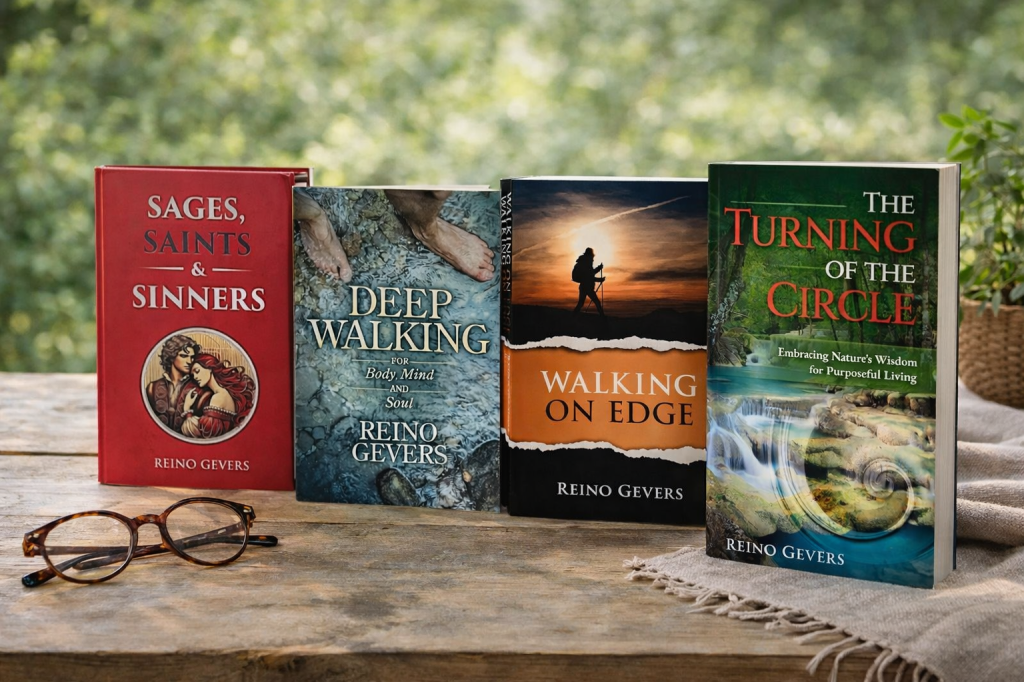
P.S: If you enjoyed this article, you might be interested in reading one of my four books, available where all good books are sold.