Tag Archives: travel

Why the Camino de Santiago is Captivating Today’s Seekers

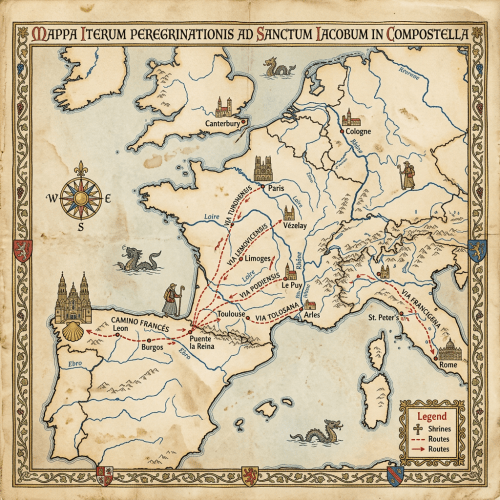
A lost ritual once firmly embedded in medieval Europe has found new life among modern burned-out souls and those disillusioned with institutional religion. Walking the same ancient paths travelled by pilgrims centuries ago has become, for hundreds of thousands of people, a modern route to purpose, silence, healing, and experiential spirituality.

During the Middle Ages, a vast network of pilgrimage routes stretched across Europe — from Warsaw in Poland, Oslo in Norway, and Walsingham in England to Einsiedeln in Switzerland, Cologne in Germany, Rome and Assisi in Italy, and the Via Tolosana, or Arles Route, in France. These paths eventually converged toward some of Christianity’s most revered destinations, especially Santiago de Compostela in Spain and Rome in Italy.

For medieval pilgrims, it was common to leave directly from one’s doorstep and walk for months across mountains, forests, and foreign territories. The journey was often undertaken as an act of penance, spiritual devotion, or thanksgiving. In some cases, one member of a family would walk on behalf of the entire household.

Pilgrimage was never easy. Even in medieval times, it required considerable resources, endurance, and courage. Pilgrims faced illness, disease, hunger, harsh weather, and the constant danger of robbery. Many never returned home. Yet despite the risks, historians estimate that by the late Middle Ages, millions of people had travelled these sacred routes, making pilgrimage one of the defining spiritual practices of medieval Europe.

Pilgrimage also became deeply woven into the economic and cultural fabric of the continent. Pilgrims needed food, shelter, clothing, medical care, and transport. Inns, monasteries, bridges, hospitals, and marketplaces flourished along the routes. Wealthier travellers journeying on horseback or in carriages relied on blacksmiths and craftsmen for repairs and supplies.

But the pilgrimage routes were far more than economic arteries. They became channels for the exchange of ideas, languages, customs, art, and knowledge. Along these roads, Europe slowly developed a shared cultural consciousness.

One important spiritual centre on the Camino route was the monastery of San Juan de la Peña near Jaca in northern Spain. According to medieval tradition, the monastery housed the Holy Grail for several centuries — the cup believed to have been used by Jesus at the Last Supper. Beyond its religious significance, San Juan de la Peña also became an important centre of scholarship and monastic learning during the Middle Ages.

By the 18th century, however, much of the great pilgrimage tradition had declined. The Protestant Reformation, the suppression of monasteries, political upheaval, changing religious attitudes, and centuries of war dramatically reduced pilgrimage across Europe. In England, King Henry VIII dissolved the monasteries between 1536 and 1541 and effectively outlawed many traditional pilgrimage practices.

Then, in the late 20th century, something remarkable happened.

In the early 1980s, the Spanish priest Father Elías Valiña Sampedro became convinced that the ancient Camino de Santiago could live again. Armed with cans of yellow paint and driving his small Citroën 2CV through rural northern Spain, he began marking forgotten sections of the route with the now-famous yellow arrows that guide pilgrims to this day.

Father Elías was far more than a parish priest. He was a respected scholar who had completed a doctoral thesis on the Camino de Santiago in the 1960s, long before the modern revival began. At the time, very few people could have imagined that the Camino would once again attract pilgrims from across the world.

When I first walked the Camino in 2006, around 100,000 pilgrims received the Compostela certificate in Santiago annually. Most were students, retirees, or spiritual seekers with the time to undertake such a journey. Since then, the numbers have grown dramatically. In 2024, more than 446,000 pilgrims officially received the Compostela in Santiago de Compostela, and the real number of walkers is believed to be substantially higher, since many people complete sections of the Camino without registering officially.

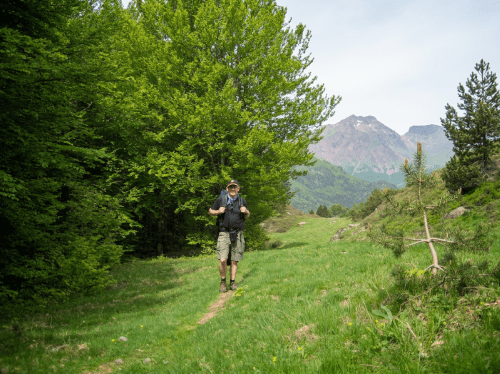
Over the years I have walked more than a dozen Camino routes through Germany, Switzerland, France, Italy, and Spain, speaking to hundreds of pilgrims along the way. My overwhelming impression is that many people walking these ancient paths are searching for something they are no longer finding within institutional religion alone.

Pilgrims come from every imaginable background, age group, profession, and nationality. Many are standing at a crossroads in life. Some are grieving the death of a loved one. Others are recovering from divorce, burnout, illness, or emotional exhaustion. Some arrive carrying deep spiritual questions they can no longer ignore.

Few people return home unchanged.

Stepping away from the noise and acceleration of modern life for several weeks affects body, mind, and soul in profound ways. Long days of walking create space for reflection rarely possible in ordinary life. Many pilgrims return home and change careers, relationships, priorities, or even countries after realizing that a life centred on Being feels fundamentally different from a life driven primarily by external achievement and accumulation.

What we are witnessing may be more than the revival of an ancient tradition. It may reflect a broader transformation in humanity’s understanding of spirituality itself.

Increasingly, people are questioning whether spiritual meaning can be mediated exclusively through institutions, doctrines, or systems of belief. The modern pilgrimage speaks to a growing hunger for direct experience — for silence, mystery, transcendence, and inner transformation.

Experiential spirituality cannot simply be inherited intellectually. It must be encountered.

And perhaps that is why so many people are becoming pilgrims again.

Reino Gevers – Host of the LivingToBe podcast

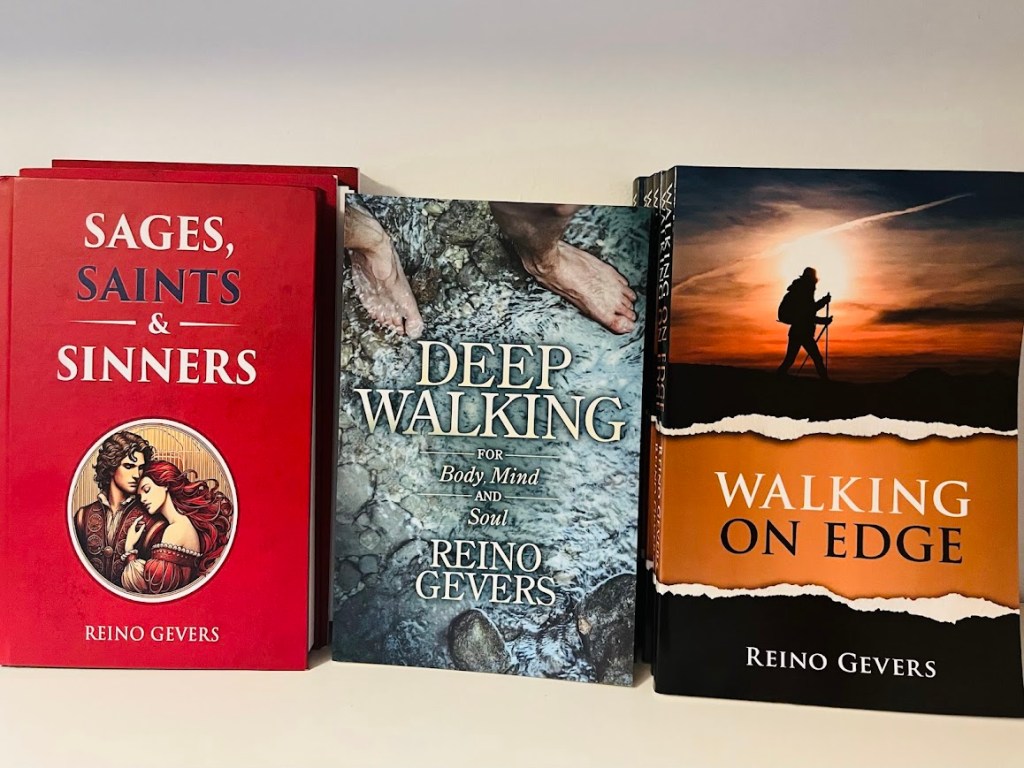
P.S. Over the years, my own Camino journeys have inspired two books exploring the deeper inner dimension of pilgrimage and transformational walking: Deep Walking for Body, Mind and Soul and the newly revised edition of Walking on Edge. Both reflect on the Camino not merely as a physical journey, but as a path of inner change, reflection, and rediscovery.

Leave a comment

Filed under Camino de Santiago, purpose, religion

The Cross: A Symbol of Resurrection and New Beginnings

Wishing you a peaceful Easter. I’m sharing this extract from my book: Deep Walking for Body, Mind and Soul as a reflection for the season — on the Cross, on suffering, and on the possibility of new beginnings.

“It is easy to bond with people on the Camino. You share daily experiences, memories and the highs and lows that come with a pilgrimage walk.

Then comes the time to say goodbye, which can be a painful process if you have spent days and weeks walking with someone. It is like saying goodbye to an old friend when you know it will be some time before you will see each other again.

Ray was a veteran pilgrim, walking the Camino for the last time. He had undergone surgery for colon cancer some weeks before, and was taking his walk slowly and with great mindfulness.

It was from the awareness that every moment that he still had to live was precious. “I’ve been on this same path many times,” he confided, “but this time I am seeing so many things I did not see before.”

“It is like reading a good book, and then you read it a second time and a third time, discovering each time something new from a different state of awareness,” he said.

Talking with Ray led to the realization that life itself is meaning and the purpose of each individual is moving to a higher state of consciousness during a lifetime whose end we cannot predict.

Ray decided to take a few days’ rest near the town of Sarria, wanting to walk the last 100 kilometers (62 miles) to Santiago in his own time.

On saying goodbye, Ray gave me a Christian cross that he had lovingly carved out of wood from an olive tree.

While I was touched by his gift that came from the heart, I had mixed feelings about the cross that also symbolized the “corporate identity” of the church with which I had a long-troubled relationship.

I was unaware at the time that my pilgrim friend had given me an astounding gift. I hung it around my neck, its mystery opening to me with every step to Santiago and healing the old wound.

In the Christian tradition the cross is the symbol of Christ’s pain and suffering. It resonated with the people in the Middle Ages who themselves went through a dark time of humanity. But in the modern era?

The tragedy is that the fixation on this symbol of suffering misses the essence of Jesus’ teachings—that of transmuting suffering and death in resurrection.

This might sound blasphemous for some but we have a religion focused on life being an endless endurance of pain and suffering with the salvation only coming in the hereafter.

This was very much the thinking during the Middle Ages. Christians paid tithes to the church to “buy” their way into heaven. With disease, war and childbirth being a constant daily reminder that life on earth could be a short sojourn, the church fed into the fears of what comes in the afterlife. If certain beliefs, habits and rules were not followed, you ended up in the eternal flames of hell.

Life on earth at the time must surely have been hell for many people, struggling to eke out a living in the overcrowded towns and cities infested with rodents and human excrement. Living in the rural areas was no better, as every freak weather condition could mean a failed harvest and famine.

The devil was blamed for bad luck, accidents, immoral behavior, theft, illness and death. He was frequently depicted in places of worship, paintings and manuscripts of the time. Hell was a dark underground world ruled by Satan and full of demons, monstrosity and deformity. The horrors could not be worse if you turned your back against God and the church.

At the same time Christ was the savior in the sky above. Depictions of heaven and Christ could frequently be found on high ceilings and on top of the altar. God’s mercy and the reward in the afterlife came after leading a life following rules and beliefs.

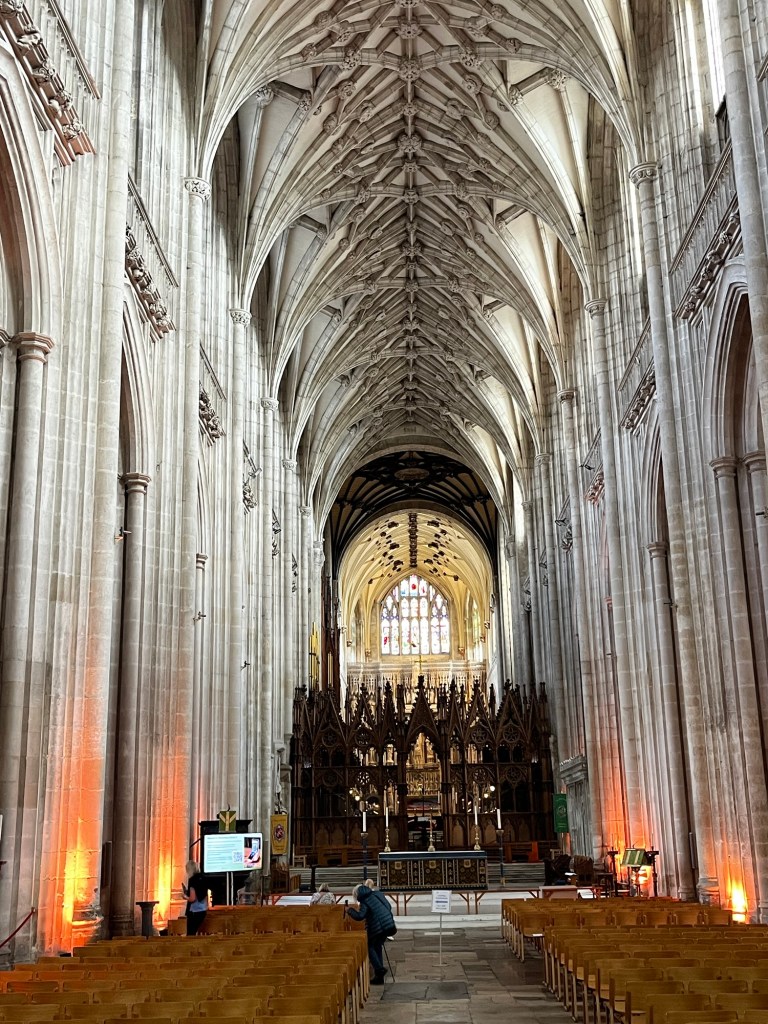
There are many depictions of the world of darkness and the world of light in the old cathedrals, chapels and churches on the Camino, such as in Jaca, Lugo and Oviedo, giving an inkling of the mindset of the time.

The dividing lines between good and evil could not be more vivid.

In contrast, the Cathedral of Santiago is an expression of joy. It probably stems from the joy many pilgrims felt in finally reaching their destination after months of arduous walking. The Monte de Gozo, or Mountain of Joy, is situated on a hilltop from where the pilgrims had a beautiful view of the ancient city of Santiago.

The Portal of Glory in the cathedral features over 200 Romanesque sculptures, featuring angels, saints and prophets. Angels carry and lead the soul to paradise. The angels play instruments in concert to the glory of God.

Built in the form of a cruciform, the cathedral is almost austere coming from the entrance but opens up to a magnificent organ and choir with illuminated chapels on either side.

Even today pilgrims are overwhelmed when entering the cathedral for the first time.

If he or she has walked on the northern route, he/she will have passed by numerous crosses along the wayside, depicting the crucified Christ in many shapes and forms of gruesome suffering.

No wonder the first Vikings visiting England went back to their homeland telling their people that the Anglo-Saxons were easy prey because they were worshipping a dead God.

The cross is in fact an old symbol pre-dating Christian times and deeply embedded in pagan and Celtic tradition.

In many of the churches and chapels on the Camino the “Goddess,” the Virgin Mary, is the central figure on the altar. Especially in Galicia the ancient stone crosses depict Jesus on the one side and the Mother Mary on the other, which on a symbolic level unites the male and the female aspect.

One of the sad aspects of the Protestant movement was the banishment of the Madonna, the female aspect, from the altar, replacing it with the crucifix.

Many priceless artifacts were burned and destroyed in the fanatic 30-year religious war between Catholicism and Protestantism that ravaged central Europe in the 15th century.

While the Roman Cross has a long central vertical line, the Celtic cross has both the vertical and horizontal lines in equal length, with a circle around it.

The horizontal lines symbolize the past and the future, with the mind locked in one of these two thoughts on a daily basis. The vertical line, however, represents the alignment with the above and the below, the awakened state of the present “heart moment” in the center where the cross meets.

We thus find many an ancient painting depicting a heart or a mandala in the center of the cross.

As we say the old Celtic powerful prayer of protection, we visualize the Goddess, the Mother, Mary, the Madonna:

She is as above me as below, to the left and to the right, before me and behind me as well as within me.”

Reino Gevers – Host of the LivingToBe podcast

P.S: If you enjoyed this article you might be interested in reading more in “Deep Walking for Body, Mind and Soul” published by Morgan James, New York. Get it today on Amazon, Barnes & Noble and where all good books are sold.

Leave a comment

Filed under Camino de Santiago, humanity, spirituality

Free Trade vs. Protectionism: Lessons from History

Humans are inherently wired for connection and cooperation. Our mental, emotional, and even physical health depends on it. Prolonged isolation, whether personal or collective, challenges our capacity to thrive. When nations retreat into isolationist protectionism, they may gain short-term relief but risk long-term stagnation, weakened innovation, and social fragmentation.

Historically isolationist economic policies leads to stagnation, inefficiency, and missed opportunities. One of the best examples of a nation falling behind in naval, military, and industrial technology was the Chinese Ming and Qing dynasties of the 14th century. Fearing foreign influence and cultural impurity, the rulers severely restricted trade, costing China its competitive edge for centuries.

Industries become bloated and inefficient under protectionism

Post-independence, India adopted a protectionist, centrally planned economy. Foreign goods and investment were restricted, and most industries heavily regulated. The result: industries became bloated and inefficient. India nearly defaulted on its debt in 1991 and was forced to liberalize its economy.

Throughout history, we can find countless examples of nations thriving when they get together to form a common economic space, standardize rules and break down commercial barriers.

The success story of Hanseatic League of medieval merchant cities

The Hanseatic League (from the 13th to 17th century) was a confederation of merchant towns that collaborated for mutual benefit, and in many ways was a precursor to the European Union. Located along the North Sea and Baltic sea routes cities like Hamburg, Bremen, Lübeck, Danzig created an economic powerhouse based on shared interests, smart geopolitics, and commercial innovation.

The European Union stands as a remarkable testament to the power of unity, bringing together nations like France and Germany, once bitter enemies in centuries of war, into a partnership of peace and collaboration.

Countries once marked by poverty, such as Spain and Portugal, along with former Soviet Bloc nations like the Czech Republic, Poland, the Baltic states, and Romania, have found profound benefits in their EU membership—economically, politically, and socially. The EU has not only transformed these nations but has also reshaped the very idea of cooperation, showing how shared purpose can overcome history’s deepest divisions.

The notion that free trade is beneficial for all was first mooted by David Ricardo, a 19th-century British political economist. Ricardo introduced in 1817 the theory of comparative advantage in his book “On the Principles of Political Economy and Taxation.” His idea was that even if one country is more efficient at producing all goods than another country, both can still benefit from trade if they specialize in the goods they produce relatively more efficiently.

Factories in Bangladesh, Vietnam or China can for instance produce clothing much cheaper than in the United States, Canada or Europe. Consumers in these countries again can buy such imported clothing at a much cheaper price than if they were produced at home.

Key Points of Ricardo’s Concept:

  • Comparative advantage (not absolute advantage) determines what a country should specialize in.
  • By each country focusing on producing goods where they have the lowest opportunity cost, total global production increases.
  • Then, through trade, all countries can consume more than they could in isolation.

Before Ricardo, Adam Smith had also praised free trade in his 1776 book “The Wealth of Nations,” arguing for absolute advantage—that countries should produce what they’re best at. But Ricardo’s theory was more powerful because it showed how even less efficient countries can benefit from trade.

Open markets push companies to innovate or die. Exposure to international competition fosters dynamic economies and technological advancement. Countries that trade together are less likely to go to war with trade interdependence promoting diplomatic ties and global stability. Free trade has lifted millions of people out of poverty especially in east Asia.

Most economists agree that tariffs or quotas should only be used selectively such as protecting key sectors during economic transitions. Free trade should also include safety nets such as retraining programs and unemployment benefits.

Brexit is one of the most compelling modern case studies on free trade vs. protectionism, and more broadly, economic integration vs. sovereignty. The United Kingdom (UK) was a member of the European Union from 1973 until 2020. It decided to leave the EU, known as “Brexit” following a referendum in 2016. The populist call for protectionism and sovereignty gained more traction than rational economic arguments. Economists and analysts at Cambridge Econometrics found that, by 2035, the UK will be 311 billion pounds worse off and is anticipated to have three million fewer jobs. Other estimates put the annual loss in GDP at four per cent annually.

In summary, at the micro level, individuals who come together in a community experience greater mental and physical well-being. Human connection fosters resilience, purpose, and meaning. At the macro level, nations that cultivate shared values, mutual cooperation, and strategic alliances lay the foundation for lasting prosperity and peace. Connection is based on trust and courage. Isolationism however is marked by fear, divisive tribalism, and conflict.

Reino Gevers – Author – Mentor –Speaker

If you enjoyed this article you might be interested in my latest book: Sages, Saints and Sinners to be launched globally on April 8th, 2025.

Leave a comment

Filed under connection, contentment, extremism, happiness, happiness research

Walking the Camino: Lessons in Life and Faith

Walking the Camino is a spiritual journey that mirrors the journey of life, unfolding in three profound stages: a beginning, a middle, and an end. Kierkegaard describes these three stages of life as the aesthetic, the ethical, and the religious.

The first stage—the crucifixion—represents the struggle and hardship of making mistakes, forcing the boat upstream, and losing your way on the wrong path. During the first stage in life we face trial and error, effort often feels futile. You sometimes engage in aimless wandering and deviations. You may easily lose your way with countless distractions in the monkey mind.

The middle stage, symbolized by the Valley of Death or the Meseta, is a surrender of the ego to a higher purpose and deeper meaning. Here, the ego must die for the soul to awaken to its inner truth, allowing for transformation and clarity.

According to Kierkegaard the appeal during this “ethical stage” lies in walking the path with confidence, even though it may be monotonous and exhausting at times.

The final stage—the resurrection—is a state of flow, where you align with the current of life and begin to see that every experience, even the challenges, has been an expression of divine grace, sculpting you into the BEING you were always meant to become.

You feel the ecstasy in the dance of life. Your walk is a gentle surfing of the path without a sense of gravity. There is an unspoken faith in the journey that drives you forward, and quickens your pace.

Reaching the Cathedral of Santiago is a celebration of joy and homecoming, marking the soul’s return to its true essence. Ultimately, the Camino is a journey of the soul, finding its way back home.

Reino Gevers – Author – Mentor – Speaker

P.S. If you enjoyed this article you will be interested in my books available where all good books are sold.
Leave a comment

Filed under Camino de Santiago, meditation, mental health, mental-health, Pilgrimage, psychology, purpose, religion, self-development

Home: Reflections on Place and Belonging

The landscape that you inhabit shapes you in profound ways, prompting the question: Where is home, and what environment truly nurtures your joy, energy, and zest for life?

Recently, I returned to South Africa, revisiting the places that defined my childhood. The journey was deeply reflective, stirring memories and a realization: home is no longer where it once was.

While timeless landmarks like the mountains and rivers of the Drakensberg endure, everything shaped by human hands changes—and often, tragically, deteriorates.

In rural South Africa, essential infrastructure like roads, sanitation, water, and electricity has largely collapsed or is on the brink of failure. Political corruption has turned state institutions into feeding troughs for party loyalists, leaving what was once the pride of Africa’s railways and roads in disrepair.

The place of home can shift

Circumstances led me to leave my birthplace at a young age. For years, I lived and worked in Germany—a land tied to my ancestral roots but one I could never truly call home. The long, cold, and wet winters left me battling colds and flu for weeks, an unmistakable signal that my well-being needed a different environment.

At times I was terribly homesick, longing for the blue skies, expansive landscapes, sounds and smells of my African homeland. It is easy to fall into the trap of melancholy sadness of what once was and is no more, the past becoming an idealized and distorted image.

Finding the place in the sun

Seven years ago, I found my place under the sun in Mallorca, Spain. It wasn’t until then that I fully understood how deeply geography, culture, and community impacts not just physical health but mental vibrancy and energy.

Sometimes, choosing to live someplace else does change everything for the better, notwithstanding that you always take yourself with you. Home is ultimately within. Home is what creates a sense of belonging and purpose.

Feeling at home sometimes shifts as you grow, adapt, and explore the world. At times, it’s where you were born or raised, rooted in childhood memories and traditions. At other times, it’s where you feel most alive, inspired, and at peace—a place or state of mind that aligns with your values, dreams, and well-being.

Recently the most renowned South African writer and poet Breyten Breytenbach passed away in his home in Paris. In his prose, Breytenbach frequently explored how the home one remembers rarely aligns with the home one finds upon return. The landscapes may remain familiar, but the social, political, and personal contexts often shift dramatically.

Returning home can evoke a profound sense of loss—of the self that once belonged fully to that place and the home that no longer exists as it was. Returning to childhood landscapes can be a complex, bittersweet experience, marked by both longing and alienation.

In a poignant in his book “Return to Paradise”, Breytenbach reflects:

We carry our homes within us,
shaped by the stories of our scars.
The land may hold its silence,
but the roads remember our footsteps.

Where is the place where you can truly breathe and thrive?

What does home mean to you?

Reino Gevers – Author – Mentor – Speaker

P.S. If you enjoyed this article you will be interested in my books available where all good books are sold.
Leave a comment

Filed under happiness, psychology, purpose, spirituality, Uncategorized

Pilgrimage, Mystery, and Healing

In London’s Westminster Cathedral stands a strikingly beautiful statue of Our Lady of Walsingham, emanating timeless grace, peace, and compassion.

The Marian shrine of Our Lady of Walsingham, located in Norfolk, England, traces its origins back to the early 11th century. Known as “England’s Nazareth,” it became one of the most significant and ancient pilgrimage sites in the country.

Known as the „Walsingham Way,” countless pilgrims visited the Holy House with a wooden statue of the Virgin Mary as a focal point of contemplation. It was a time when monasteries and shrines connected medieval pathways in a powerful matrix throughout Europe.

But in 1538 Henry VIII ordered the Walsingham statue to be taken to London and destroyed. As part of his break from Catholicism, monasteries were dissolved, pillaged and pilgrimages prohibited.

Only in recent times, the Walsingham pilgrimage path has been revived now officially forming part of the network of pilgrimage paths to Santiago de Compostela in Spain.

The shrine in Walsingham has regained its medieval significance, often referred to as the “English Lourdes” because of its central place in Catholic and Anglican devotion in England.

Pilgrims to Walsingham seek healing, spiritual guidance, and a deepened relationship with the Virgin Mary. It remains a place of great spiritual renewal for many, with visitors walking the Holy Mile, a traditional part of the pilgrimage route.

The beautiful statue of the Walsingham Lady in Westminster Cathedral was commissioned by Cardinal Griffin in 1954 and sculpted by Pius Dapre. For many years it remained hidden and almost unknown in the Cathedral Crypt until it was recovered.

Mystery still surrounds the original wooden shrine which may have never been burned and destroyed as ordered by Henry VIII.

An article recently published in The Catholic Herald quoted art historians as saying that The Langham Madonna, a battered 13th-century English statue in London’s Victoria and Albert Museum, is in fact the original statue of Our Lady of Walsingham.

There were no eyewitness accounts that the statue was actually destroyed in London, according to the historians but hidden by Catholic loyalists until it reappeared centuries later in the museum.

Throughout history, countless myths, legends, and mysteries have surrounded the figure of the Goddess—whether Mary, Brigid, Kali, Isis or others—appearing and reappearing in various forms. At times, she has been revealed as a beautiful statue, carved from wood, stone, or marble, inspiring the creation of shrines, monasteries, or cathedrals at the place of her discovery.

Mary, in particular, has been known to appear in sacred apparitions at sites like Walsingham, Lourdes, and Fatima—places where the veil between worlds seems thin. Regardless of whether one is a believer, agnostic, or of another faith, her presence has been tied to stories of miracles that defy logic. Yet, time and again, she has brought comfort, solace, and peace to those facing pain and confusion.

Reino Gevers – Author – Mentor – Speaker

P.S. If you enjoyed this article you will be interested in my books available where all good books are sold.
Check out also the recent episode on the Living to BE podcast and Youtube with our special guest Matt O’Neill. The topic: Happiness is a Choice.

Leave a comment

Filed under mental health, Pilgrimage, spirituality, Uncategorized