
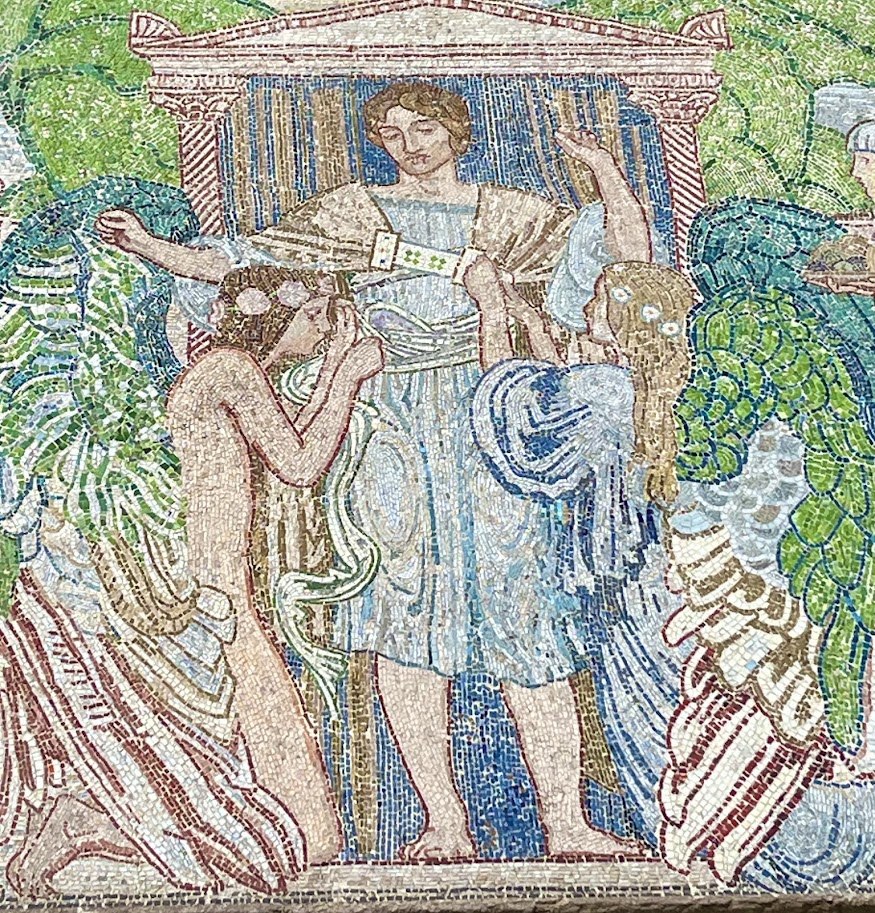
On a recent visit to the Horniman Museum and Gardens in London, I found myself pausing at the entrance. Set into the façade is a compelling mosaic, almost easy to overlook. Created by Robert Anning Bell at the turn of the twentieth century, it feels less like decoration and more like a question posed across time. Its message lands with particular force in a world where volume substitutes for depth, where opinions harden into slogans, and identities calcify into positions that leave little room for movement.
In Humanity in the House of Circumstance, a central figure—Humanity —is gently attended by Love and Hope. Standing before it, I was struck by how quietly subversive this image is. It does not present us as self-made or self-sufficient, but as shaped—formed in relationship, in dependence, in the interplay between our inner lives and the limits that surround us.
And yet, the instinct is to simplify and to reach for fixed categories. What feels unfamiliar, unsettling, or threatening is quickly reduced, flattened into binaries: for or against, right or wrong, aligned or opposed. In doing so, something essential is lost.
Nuance in such a climate is perceived as weakness and the inability to “take a stand.” Yet, in truth, nuance is a deeper form of strength and wisdom.
To hold nuance is to allow multiple perspectives to coexist within the mind without rushing to premature judgment. It is the discipline of pausing before concluding, of listening not just to respond but to understand. Where dogmatism seeks closure, nuance remains open—curious, attentive, and alive to the subtleties of reality.
Rigid thinking serves psychological needs:
- Certainty offers comfort. The world feels unpredictable and filled with contradictions. Dogmatic beliefs simplify this chaos into something manageable. They provide a sense of control, even when that control is illusory.
- Identity and Ego play a powerful role. Beliefs are often tied to who you believe yourself to be, rooted in culture, community, or personal history. To question those beliefs can feel like questioning who you are. Dogmatism becomes a form of self-protection.
- There is a social reward. Strong, uncompromising opinions are amplified on social media. Nuanced thinking, by contrast, appears hesitant or indecisive and doesn’t translate into viral soundbites.
Something essential is lost when we abandon nuance.
To think with nuance is not to drift aimlessly between opinions. It is an active, often demanding process. It requires intellectual humility and the recognition that your understanding is always a partial perspective. No matter how informed you are, there will always be an angle you have not considered.
When you allow conflicting ideas into your awareness, you may feel tension, even discomfort. Dogmatism relieves that tension quickly by choosing a side. Nuance asks you to stay with it longer, to let the mind stretch rather than snap into certainty.
It also requires empathy. To truly weigh different perspectives, you must enter into the worldview of others. This does not mean agreement. It means understanding the logic, the fears, and the hopes that shape another position.
Nuance as a Path to Wisdom
Wisdom is not the accumulation of facts alone, but the ability to discern, to contextualize, and to integrate. Nuance is its foundation.
Consider any complex issue—whether personal, political, or spiritual. Beneath the surface, there are layers: historical context, emotional undercurrents, competing values, and unintended consequences. Dogmatic thinking tends to isolate one layer and elevate it above all others. Nuance, by contrast, seeks to see the whole.
This does not lead to paralysis. On the contrary, decisions made with nuance are often more grounded and enduring. They are less reactive, less driven by fear or tribal loyalty, and more aligned with a deeper understanding of reality.
The Courage to Resist Simplicity
It requires courage in resisting the pull of simplicity. It is easier to adopt a ready-made belief than to wrestle with complexity. Easier to echo the consensus of one’s group than to risk standing in a more ambiguous space.
In a world that grows louder and more polarized, the practice of nuance becomes not just a personal virtue, but a social necessity. It creates space for dialogue where there would otherwise be division. It invites curiosity where there might be judgment. It allows us to meet one another not as adversaries, but as participants in a shared search for understanding.
Returning to a Deeper Way of Seeing
At its heart, nuance is an act of respect for complexity, for truth, and for the dignity of perspectives that differ from your own. It requires you to slow down when the world urges you to run, to listen when you are tempted to react, and to think with care rather than certainty.
Standing before Humanity in the House of Circumstance at the Horniman Museum and Gardens, this feels less like an abstract ideal and more like an invitation. The mosaic does not resolve the tensions of life; it holds them. It is a powerful reminder that we are shaped not only by what we believe, but by how we remain open to Love, to Hope, and to the limits within which we live.
Reino Gevers – Host of the LivingToBe podcast
P.S: If you enjoyed this article you might be interested in reading: Sages, Saints and Sinners Get it today on Amazon, Barnes & Noble and where all good books are sold.


 ReinosBlog