Category Archives: spirituality

Space and time

Day 5: Via Francigena – Siena to Monteroni d’Arbia

When observing the Siena Cathedral and other architectural highlights of the 12th and 13th centuries on the Via Francigena it comes to mind that people in medieval times felt a strong connection between the physical and the spiritual.

The cathedrals were an expression of faith with everyday life closely intertwined with religion.
Records from the Siena Cathedral show that construction started around 1226 with the transportation of black and white marble, probably for the construction of the façade and the bell tower. The craftsmen who started the intricate works of art inside and outside the building often did not see their masterpieces completed during their lifetimes, yet put all their energy and creativity into the project.

Head mind and heart mind

Along the path to industrialization and the material comforts of modernity something has gotten lost with the disconnect from physical and soul needs.

The head mind is preoccupied with the distractions of the 10,000 things of short-term gratification, and emphasis on youthful vigor and performance-driven culture. It is the breeding ground for greed and egocentric behavior, the results of which we can see in the destruction of natural ecosystems, irrespective of the consequences for future generations.

The heart-mind is timeless and rooted within a multi-dimensional perspective of unity between the physical and the spiritual. It is restorative rather than exploitative. There is mindful awareness of life within a complex matrix of interdependency.

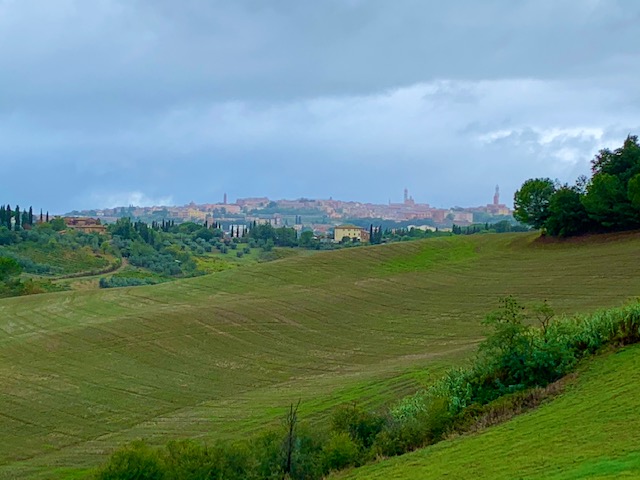
Leaving Siena and looking back the skyline is still dominated by the Cathedral on the hill. The walk itself takes the pilgrim through open, expansive countryside with unlimited views, especially of the old walled barn complex in La Grancia di Cuna, one of the most impressive agricultural buildings in the Tuscany landscape. From the 12th century it offered pilgrims and merchants on the Via Francigena accommodation and food.

The entire installation is walled with two towers facing the southern entrance. The main entrance leads to an L-shaped square from where mule packs could reach the upper floors of the barn.

Reino Gevers – Author. Mentor. Speaker

One more thing…

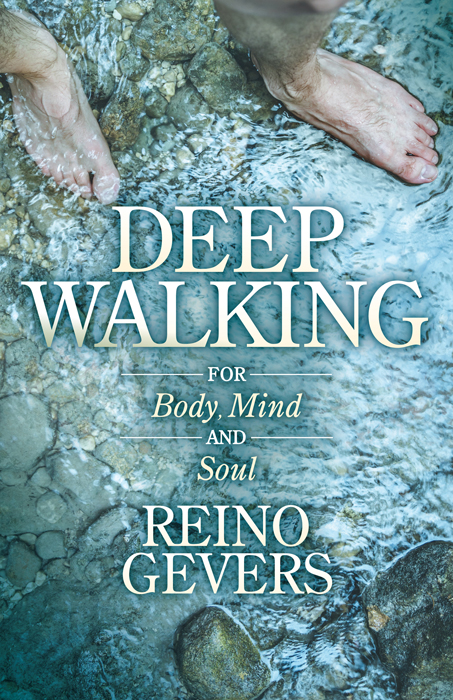
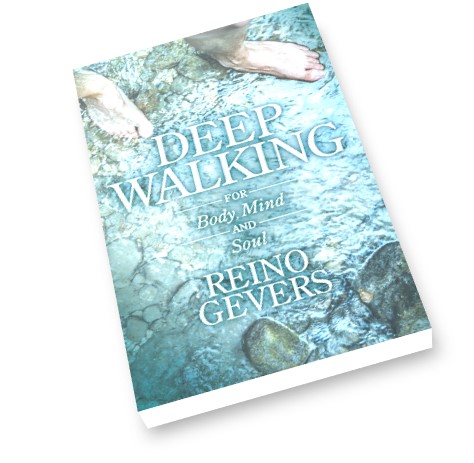
You might want to check out my new book “Deep Walking for Body, Mind and Soul” released as a paperback by Morgan James Publishing on August 11, 2020. It has some valuable tips on creating happiness and boosting your vibrational energy on many levels. You can order it at all major outlets such as Amazon, Barnes and Noble or in my own store.  Check out the latest five-star reviews on Goodreads.
This image has an empty alt attribute; its file name is bookcovers_sideview.jpg

“A breathtaking, captivating, transformative walk,” – Tom Dutta, Canada

“The book reminded me of my own journey in life I am walking and how bringing stillness to my busy life and mind is essential.” – Karin, France

“The book compresses on its slim 190 pages an extreme density of life wisdom.” Christina Germany

Leave a comment

Filed under Camino de Santiago, spirituality

Walking in medieval lands

Day  5 on the Via Francigena – from Monteriggioni to Siena

The 20 kilometer walk from the hilltop town of Monteriggioni to the city of Siena is fairly easy, continuing on ancient tracks, bypassing medieval castles, fortress towers and Romanesque chapels.

At the Ponte Rosso we cross a humpback bridge common during the Middle Ages because of a wide span that were perfect for supporting pack mules of the time.

A pile of stones on a humpback bridge

Several stone pires have been left on the bridge by previous pilgrims. I love the tradition of placing gratitude stones or prayer stones along the way. It is common on the Camino de Santiago but it was the first time I saw them here on the Via Francigena.

Today I placed a pile of stones in memory and gratitude of my ancestors. We carry within us the collective memory of those that went before us. It is the reason why ancient cultures celebrate the connection in ritual and religion.

Placing stones for your ancestors at the side of the road and asking them for protection is a tradition I know very well from the Zulu culture in South Africa. I also like the thought of our ancestors guiding and protecting us with angel wings from another dimension.

Shortly before reaching Siena the trail takes the pilgrim through a forest with nature speaking through the aroma of fresh earth, walnut and fig trees.

The architectural marvels of Siena

The last stretch of a stage is often the hardest with a climb up a hill and a long walk through the dreary modern outskirts of town before reaching the old city of Siena through a 15th century gateway.

It is a city that needs more than a day to explore. The medieval center is a UNESCO world heritage site. There are numerous architectural marvels such as the central square, Piazza del Campo, the 14th century Torre del Mangia tower, the Palazzo Salimbeni, The Palazzo Publico and the Loggia della Mercanzia to name just a few.

Reino Gevers – Author. Mentor. Speaker

One more thing…

You might want to check out my new book “Deep Walking for Body, Mind and Soul” released as a paperback by Morgan James Publishing on August 11, 2020. It has some valuable tips on creating happiness and boosting your vibrational energy on many levels. You can order it at all major outlets such as Amazon, Barnes and Noble or in my own store.  Check out the latest five-star reviews on Goodreads.

This image has an empty alt attribute; its file name is bookcovers_sideview.jpg

“A breathtaking, captivating, transformative walk,” – Tom Dutta, Canada

“The book reminded me of my own journey in life I am walking and how bringing stillness to my busy life and mind is essential.” – Karin, France

“The book compresses on its slim 190 pages an extreme density of life wisdom.” Christina Germany

2 Comments

Filed under Camino de Santiago, spirituality, Uncategorized

On ancient tracks

Day  4 on the Via Francigena – from Colle di Val d’Elsa to Monteriggioni

There are so many  happiness moments on a pilgrimage walk. Although the Via Francigena is not as famous as the Camino de Santiago in Spain it is by no means less spectacular with its architectural marvels, cultural heritage and natural beauty.

On the fourth day of our walk we took the alternative route from Colle di Val d’Elsa along the River Elsa. For centuries the local inhabitants have revered the river as a source of life and livelihood. The  turquoise water comes in different hues and shades, contrasting with the luscious green surrounding forest.   Sunlight reflects from the fish swimming against the current from the waterfalls.

A pathway snakes through dense forest, taking  the hiker to the left and right of the river over natural stone pathways through shallow parts of the waters.

After rejoining the main route to Monteriggioni a friendly farmer In his SUV stopped to say hello proudly showing his pet in the passenger seat – a pigeon perched on a little wooden ladder, apparently looking very comfortable being taken for a drive.

A well marked route – cyclists have a separate path

For many sections the Via Francigena offers complete solitude with very few pilgrims on the path. It is well signposted and there are separate paths for cyclists who at times can be of particular annoyance to slow-walking pilgrims on the Camino Frances in Spain.

Walking on medieval mule tracks

The Via Francigena in parts follows the medieval mule tracks used by traders, wayfarers and pilgrims that was part of the network of roads between the most important Christian strongholds of Jerusalem, Rome and Santiago de Compostela.

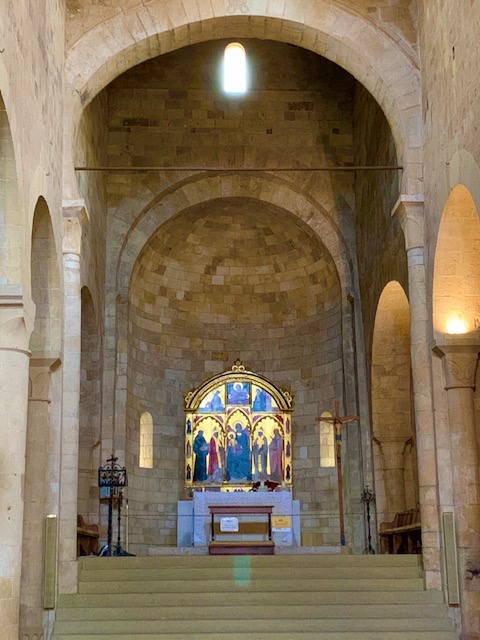
A visit to the abbey at  Abbadia Isola Ostella offers a glimpse of these times. The abbey was founded around 1001 by the noblewoman Ava of the Lambardi di Staggia family, and for many centuries offered respite for pilgrims. The Romanesque church with three naves and three apses is surrounded by a small hamlet with the remains of the medieval fortifications.  Among the precious works of art in the church is the polyptych of the main altar created in the 15th century by the Siena born artist Sano di Pietro..  

From there the walk is up a steep hill to the largely still intact medieval fortification surrounding the village of Monteriggioni.

It is a great privilege to do this walk. This walk is dedicated to the many pilgrims, especially those coming from afar such as the United States, Australia, New Zealand and South Africa, who have had to cancel their plans this year due to the Covid-19  travel restrictions.

Only a few countries in Europe are currently still open for travel with the likelihood of more restrictions coming in the wake of a further spike in Covid-19 infections.

So many pilgrims, who are unable to travel this year, are reliving their past walks, going through their journals and picture albums. Memories from deep walking experiences stay for a lifetime.

Reino Gevers – Author. Mentor. Speaker

One more thing…

You might want to check out my new book “Deep Walking for Body, Mind and Soul” released as a paperback by Morgan James Publishing on August 11, 2020. It has some valuable tips on creating happiness and boosting your vibrational energy on many levels. You can order it at all major outlets such as Amazon, Barnes and Noble or in my own store.  Check out the latest five-star reviews on Goodreads.

This image has an empty alt attribute; its file name is bookcovers_sideview.jpg

“A breathtaking, captivating, transformative walk,” – Tom Dutta, Canada

“The book reminded me of my own journey in life I am walking and how bringing stillness to my busy life and mind is essential.” – Karin, France

“The book compresses on its slim 190 pages an extreme density of life wisdom.” Christina Germany
Leave a comment

Filed under Camino de Santiago, spirituality

Two wolves and a choice

Day 3: Via Francigena – San Gimignano to Colle di Val d’Elsa

We decided today to take the alternative route to Monteriggioni via Colle di Val di’ Elsa also known as the “crystal city” because of its high-quality glass ware.

Also simply known as Colle the town has for centuries been frequented by pilgrims on the Via Francigena. On a little hill opposite the castle in the medieval town is the 13th century convent of San Francesco where the saint’s followers would assemble for prayer.

On the walk through the shady forests and hilltops kissing the clouds I was reminded of the story of how St. Francis tamed a wolf that was terrorising the population of the Umbrian town of Gubbio.

The tale of the wolf and emotions running wild

The story goes that the wolf waited outside the city gates waiting to feast on anyone foolish enough to venture outside. Francis, who had lived in the city at the time, then announced that he himself would visit the wolf in its lair. With the wolf charging at Francis he made the sign of the Cross and commanded the wolf to cease its attacks in the name of God, at which point the wolf trotted up to him docilely and lay at his feet, putting its head in his hands.

The symbolism of the story is telling. There is a similar tale of an old Indian chieftain telling his grandson the story of two wolves constantly struggling in the heart of the human:

“There is the wolf of darkness, who is full of envy, desperation, fear and anger. The other is the wolf of light. It is the wolf of love, generosity, compassion, kindness and joy.”

The grandson asks, “And which of the two wolves is going to win?”

Sighing, the old chieftain replies, “The wolf you choose to feed.”

The story from Zen Buddhism on the taming of the bull has similar connotations. It says much about maintaining control of emotions. Uncontrolled outbursts of anger have destroyed countless marriages, long friendships, and destroyed careers and business deals.

The wolf has a voracious appetite and the warning from St. Francis and the Indian chieftain is clear. We have the freedom of choice. The wolf could be tamed because St. Francis had made him aware that a life in fear, hunger and being constantly on the run was one of suffering. In the The Fioretti di San Francesco that describes the life of St. Francis, the wolf is described as bowing its head and submitting completely at his mercy.

“As thou art willing to make this peace, I promise thee that thou shalt be fed every day by the inhabitants of this land so long as thou shalt live among them; thou shalt no longer suffer hunger, as it is hunger which has made thee do so much evil; but if I obtain all this for thee, thou must promise, on thy side, never again to attack any animal or any human being; dost thou make this promise?”

Reino Gevers – Author. Mentor. Speaker

One more thing…

You might want to check out my new book “Deep Walking for Body, Mind and Soul” released as a paperback by Morgan James Publishing on August 11, 2020. It has some valuable tips on creating happiness and boosting your vibrational energy on many levels. You can order it at all major outlets such as Amazon, Barnes and Noble or in my own store.  Check out the latest five-star reviews on Goodreads.

This image has an empty alt attribute; its file name is bookcovers_sideview.jpg

“A breathtaking, captivating, transformative walk,” – Tom Dutta, Canada

“The book reminded me of my own journey in life I am walking and how bringing stillness to my busy life and mind is essential.” – Karin, France

“The book compresses on its slim 190 pages an extreme density of life wisdom.” Christina Germany

Leave a comment

Filed under Camino de Santiago, Pilgrimage, spirituality

Food for thought

„Walk as if you are kissing the Earth with your feet.” – Thich Nath Hanh

Day  2 on the Via Francigena – Gambassi Terme to San Gimignano

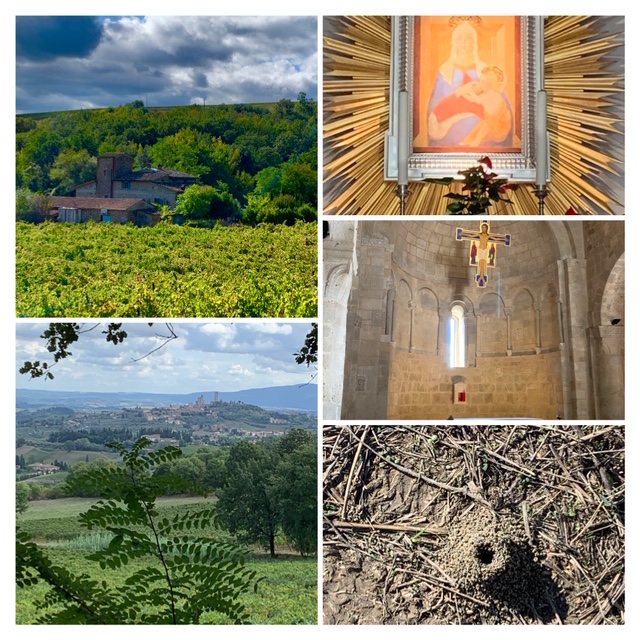
On a hilltop between the medieval Tuscan towns of Gambassi Terme and San Gimignano the pilgrim enters the village of Pancole famous for the 15th century painting by Pier Francesco Fiorentino of the “Virgin feeding her Son.”

The original sanctuary was built in 1668 on the site where the sacred image originally stood along a country road where it had been abandoned and covered by undergrowth. Several miracles were attributed to the Madonna.

One of the miracles is the survival of the painting itself after the Nazis destroyed the original sanctuary in an act of indiscriminate vandalism in a bid to destroy the very soul and ancestral roots of a nation.

The sanctuary was reconstructed in 1949 and along with the nearby Monastero di Bose offer wonderful spaces for quiet  contemplation.

Landscapes that inspired poets and artists throughout the ages

It is no surprise that spectacular landscapes and the quiet pathways throughout the centuries inspired poets, musicians and religious orders

Spending hours in the heart of nature after only a few days of walking opens the heart and mind to the whispers from the universe.

You are forced to go slow up the steep inclines and then you begin to notice the small creatures on the ground such as the lizards, beetles, ants, and butterflies.  When in a hurry it is easy to mindlessly trample on these small creatures who are all fighting for survival when perceiving the heavy boots of an oncoming pilgrim.

St. Francis – the original ecologist

There are numerous stories of St. Francis, the patron saint of the animals, communicating and preaching to the animals as fellow creatures of God.  The saint was well known to walk long distances to spread his message and there are no numerous shrines on the Camino in Spain and along the Via Francigena dedicated to him.

St. Francis can be described as the original ecologist and his central message of social justice and greed causing harm to both the victim and the perpetrator ringing more true than ever.

Spending time in nature creates awareness on how complex the interaction of plant, insect, bird and mammal are intertwined and co-dependent on each other.  Nature starts tilting into imbalance when one species gains dominance and threatens the livelihood of all others. It is offers much food for thought.

Reino Gevers – Author. Mentor. Speaker

One more thing…

You might want to check out my new book “Deep Walking for Body, Mind and Soul” released as a paperback by Morgan James Publishing on August 11, 2020. It has some valuable tips on creating happiness and boosting your vibrational energy on many levels. You can order it at all major outlets such as Amazon, Barnes and Noble or in my own store.  Check out the latest five-star reviews on Goodreads.

This image has an empty alt attribute; its file name is bookcovers_sideview.jpg

“A breathtaking, captivating, transformative walk,” – Tom Dutta, Canada

“The book reminded me of my own journey in life I am walking and how bringing stillness to my busy life and mind is essential.” – Karin, France

“The book compresses on its slim 190 pages an extreme density of life wisdom.” Christina Germany
Leave a comment

Filed under Camino de Santiago, environment, meditation, Pilgrimage, self-development, spirituality

One step at a time …

Day  1: Via Francigena – San Miniato to Gambassi Terme

The question often arises about the differences between a hike and a deep walking pilgrimage. The easiest way for you to find out would be to follow in the footsteps of the ancient pilgrims on one of the famous European routes.

Experiencing it cannot be explained in full

I have met many people who started walking the Camino de Santiago as a hiker and ended it as a pilgrim. Experiential spirituality cannot be explained. It can only be experienced.

Today I started my 13th pilgrimage walk on the Via Francigena in Italy. The original plan was to once again walk one of the Spanish routes but Covid-19 forced a change of plan. Italy is currently  a safer country to travel after initially suffering the worst outbreak of the virus in Europe  earlier this year. It is now hailed as one of the countries that have  been more successful in containing the virus.

Like the Camino de Santiago the Via Francigena is one of the ancient pilgrimage routes dating back to the Middle Ages with the exception that pilgrims walked to Rome rather than Santiago.

A blessing from a stranger

Our walk started in the northern Italian town of San Miniato  near Pisa. On leaving the town a friendly granny stamped our pilgrims’ passports, handing each of us a small shell with the blessing of the Holy Mary.

We would not be able to comfortably enjoy these marvelous pilgrimage paths without the support of thousands of such local volunteers who maintain the paths with way markers, first aid kits, and offering their service in the pilgrims’ hostels. It is not uncommon for these people to spend whatever they have left from their small pensions and salaries to maintain these old paths, chapels and other holy sites.

The 24 kilometer route to Gambassi Terme is challenging for a first day, lacking the typical cafes and small towns that you find on the Camino de Santiago. The countryside nevertheless offers marvelous views of the Tuscany landscape and after some hours of walking, the town of San Miniato can be seen in the distance with its unmistakeable hilltop fortress tower.

The physical challenge

Forced by the circumstances to carry more weight than usual in my backpack, this first day was physically strenuous. I would always advise first-time hikers to start with short-distance walks of no more than 12-15 kilometers so that the body can gradually become attuned to long-distance walking. I was reminded of my first walk on the Camino carrying too much weight and starting wholly unprepared. The back pain, blisters and other physical and mental ailments followed inevitably.

Lessons in humility

The pilgrimage path is an important lesson in humility. “If you don’t walk  the path with humility it will teach you humility,” a pilgrim once said to me.

It is in the recognition of one’s own brokenness, and in opening up to the beginners’ mind that possibility and elevation  of consciousness is possible.

Especially in the current situation it is easy to get pulled into the maelstrom of news negativity and doomsday prophets. A pilgrimage walk is the perfect opportunity to realign and center the mind to higher purpose and meaning.

Walking a path more than once is like reading a good book several times over. What you have not seen or read the first time will be seen differently, from a different angle and new window of consciousness.

The lesson of the day:

  • Take one step at a time. If you look at the mountain ahead, your walk will be so much more difficult. On the other hand if you turn around you will be amazed as to how far you have walked.
  • Looking at the mountain to climb is the trap that leads to procrastination.
  • One blessing, one good thought at a time, one positive action at a time leads to the compound effect that makes all the difference both to you and the world.

Reino Gevers – Author. Mentor. Speaker

One more thing…

You might want to check out my new book “Deep Walking for Body, Mind and Soul” released as a paperback by Morgan James Publishing on August 11, 2020. It has some valuable tips on creating happiness and boosting your vibrational energy on many levels. You can order it at all major outlets such as Amazon, Barnes and Noble or in my own store.  Check out the latest five-star reviews on Goodreads.

“A breathtaking, captivating, transformative walk,” – Tom Dutta, Canada

“The book reminded me of my own journey in life I am walking and how bringing stillness to my busy life and mind is essential.” – Karin, France

“The book compresses on its slim 190 pages an extreme density of life wisdom.” Christina, Germany

Leave a comment

Filed under Pilgrimage, self-development, spirituality

Prayer or meditation?

There is sometimes confusion on the differences between prayer and meditation. It can mean the same thing but could have differences and meaning, depending on the individual or the faith.

The Oxford dictionary defines prayer as “the relating of the self or soul to God in trust, penitence, praise, petition, and purpose, either individually or corporately”.

In the biblical stories God is perceived as an external creator, deity, or strict father who punishes or rewards. Natural or personal catastrophes were perceived as punishment where penitence had to be sought or sacrifices had to be made.

The pilgrimage to Santiago de Compostela in the Middle Ages was primarily an act of penitence. Today the pilgrim to Santiago reflects many of the changes in the collective on the spiritual level.

Prayer is a direct conversation with the “universe”, “God,” or the “creator”. From a very early age my grandmother taught me how to pray. It was first a prayer for the well-being and protection of family members who were named by name, especially if they were going through a difficult time.

Praying for the well-being or healing of others is a way of transcending the ego and the direct needs of self. There have been events in my life where I even had angry conversations with God.

“Why did this have to happen to me?” “If you are out there why are you allowing such bad things in the world to happen.” It is something many people were asking after the 9/11 terror attacks. “Why does God allow evil? Why did he not prevent all those people from dying.”

In what is the eternal polarity of life there will always be good and evil. God has given man the freedom of choice. Where there is the evil of division, incitement of hatred, and destruction of life there is absence of God just as much as there is presence of God in unconditional love, compassion, kindness and generosity.

God cannot be explained. God can only be experienced.

In essence meditation is experiential spirituality. It is going into a quiet space and allowing God or the voice of the universe to whisper to the soul.

I have experienced the most intense spiritual experience just after some of those “flat on the ground” moments. On my second Camino pilgrimage walk I got hopelessly lost in the Pyrenees mountains during a massive thunderstorm. It was early May. I was badly prepared wearing summer hiking clothing at a time of year when subzero temperatures at night, often claimed the lives of hikers. After wandering about aimlessly in the dark for hours, close to the point of complete surrender, I noticed a light in the distance that finally led me to a village and safety.

When faced with a problem or having to make a difficult decision it helps to go into silence or to take a time out for introspection. The answer can come sometimes in the most unexpected of ways: A passing remark by a stranger, an image, a dream, a sudden thought or idea where you instantly know what needs to be done.

We are living at a time where the senses are being bombarded with distractions that pull the mind into the confusion of all directions. Meditation calms and centers the mind. There is no right or wrong on how to meditate.

One of the most popular forms is the mindfulness meditation originating from Buddhism. Attention is paid to breathing in the sitting position. When the mind inevitably starts wandering, attention is focused back to the breathing. In the Zen tradition everything can be meditation if done with awareness. There is a saying: When I eat I eat. When I talk I talk. When I walk, I walk. When I listen, I listen.

In the walking meditation every movement of the foot is connected to an inhaling and exhaling breath, while at the same time opening the senses to the surroundings in awareness of “presence.”

As you learn to meditate while sitting or walking you become aware of the importance of standing guard at the doorway of the mind. What you think you become.

Going into dialogue with that inner truth, whether in prayer or meditation, helps answer that age old question. Where do I come from? What am I doing? Where am I going.

Reino Gevers – Author. Mentor. Speaker

One more thing…

You might want to check out my new book “Deep Walking for Body, Mind and Soul” released as a paperback by Morgan James Publishing on August 11, 2020. It has some valuable tips on creating happiness and boosting your vibrational energy on many levels. You can order it at all major outlets such as Amazon, Barnes and Noble or in my own store.  Check out the latest five-star reviews on Goodreads.

BookCovers_Sideview

“A breathtaking, captivating, transformative walk,” – Tom Dutta, Canada

“The book reminded me of my own journey in life I am walking and how bringing stillness to my busy life and mind is essential.” – Karin, France

“The book compresses on its slim 190 pages an extreme density of life wisdom.” Christina, Germany

Leave a comment

Filed under spirituality

Can God be believed?

There is an ancient Chinese proverb, “better to see something once than to hear about it 1,000 times.” Its something I had to think a lot about during and after my walks on the pilgrimage routes of northwestern Spain.

It was on the Camino that I had an epiphany that God cannot be believed.  God, the universe, or whichever term you would like to give it can only be experienced. With every step on these ancient paths walked by pilgrims for past centuries the conviction grew that there is a force so much greater than the human mind can comprehend.

Words skimming the surface of meaning

As a teenager, I grappled with traditional Christian dogma that takes the Bible teachings literally. “You must just believe and not doubt,” the pastor scolded. The human mind tends to simplify, label, dissect, and rationalize over that which cannot be explained by words alone.

fresco2blog

The ancient languages such as Aramaic, the language spoken by Jesus, Sanskrit,  Egyptian, and Irish Gaelic have retained the richness of imagery and multi-lateral meaning. The ancient cathedrals and monasteries along the Camino are filled with precious works of art from an era where the observer found his/her truth in the contemplation thereof.  The emphasis was not on “preaching” but in singing and chanting of liturgy.

The divide between religion and the spiritual

There is a deep divide between religious dogma and the spiritual. Religion is embedded mostly within an external theology while the spiritual is experiential and rooted in the mysticism of the ancients. The tradition survives in the Christian mystical teachings, Sufism, the Jewish Kabbalah, and Buddhist mysticism.  Practise of certain rituals, meditation and the “mystical experience” through higher consciousness creates the connection to God or the Universe.

Find your own inner truth 

Finding your own truth and reconnecting to your own natural rhythm is the big challenge of our times.  With the pull of the monkey mind with its 10000 distractions flickering from every digital screen, and pulling the mind into many different directions, we are left with a feeling of emptiness and spiritual hunger that is often compensated with addictive behavior.

Happiness is a state of “Being” and not something to be achieved, found in the silence on holy ground, in the green and blue spaces of nature, the opening of the senses to the magic of the moment.

In becoming mindful for the subtle messages of the universe transmitted in dreams, images and symbols, life takes on an entirely different meaning.
Reino Gevers – Author. Mentor. Speaker

https://www.reinogevers.com

Gevers-DeepWalking CVR.indd               paperback_cover_1

Order here

Leave a comment

Filed under spirituality

Have we lost the ability to communicate?

The current wave of protests against lockdown regulations is indicative of how deeply divided our societies have become. There is a dangerous groundswell of anger easily manipulated by professional deceivers and political demagogues.

Donna parla con lettere su sfondo biancoWith a presidential election coming up in the United States the dividing lines between Democrats and Republicans have never been bigger and more dangerous. If even the wearing of masks becomes a political issue there is a problem.  Be prepared for a very dirty election with global implications.

The trigger words that end “communication”

A normal conversation quickly gets out of hand when trigger words such as “vaccination”, “Trump”, “climate change”, “migrants”, or “Bill Gates” are thrown in. One of the side-effects of lockdown has been that millions of people have not only been locked in their homes but also in their belief systems in scouring the Internet to confirm existing beliefs.

Conventional religion and other institutions formed for a long time the cornerstones and value systems of societies. These have steadily lost influence in the competition for instant gratification. The hypocrisy of institutionalized religion has not helped either with millions of faithful turning either to fundamentalism or pseudo-religion.

Pseudo-beliefs filling the void of religion 

The search for meaning and soul purpose has never been greater. But as humanity moves to higher consciousness, the walk over the hot coals has also become very painful. We are at the crossroads with humankind either falling back into the spiral of fear-based radicalism or moving forward into a restorative, sustainable future where diversity is respected and tolerated.

We will have to learn to communicate again. Communication is not a one-way street of blasting a tweet, or an Instagram post.  Social media has become the rocket fuel of narcissism.  Somewhere along the process of transmission the concept of real  “sharing” of ideas, opinions, facts, and values has been left by the wayside.

We have become so obsessed with our ego-centered own opinion and “belief” that we have lost the ability to listen.  Narcissists are masters in denialism and creating their own truth. They will never admit to human fallibility.

But it is only through the admission of vulnerability and fallibility that we open the realm to listening, asking the who, what, where, when, and why? This is where we learn, adapt, revise, and grow as human beings.

Reino Gevers – Author, Mentor, and Consultant

Resiliencepic

Subscribe and get my FREE Booklet:

“Resilience: What makes you strong during times of crisis?


Leave a comment

Filed under spirituality

Joseph and the power of forgiveness

Are you struggling to forgive yourself and others? The biblical story of Joseph is one of the most powerful teachings of how the ways of the universe or God can be very different from the plans we often make in life.

Joseph was slandered, beaten, and sold into slavery by his own brothers because of jealousy. Joseph could have easily succumbed to his fate but he never lost faith that everything in life had purpose and meaning.

slavery

Photo by Hussain Badshah on Unsplash

The trap of the blame game

Only from such a perspective could he forgive his brothers and move out of the trap of the blame game. He made the best out of his situation to such an extent that Potiphar, the man who bought him on the slave market in Egypt, soon promoted him to a higher position. Later he was put in charge of managing Potiphar’s huge estate.

Potiphar had taken a liking to Joseph and must have been impressed by his kindness, wisdom, and humility. For all intents and purposes, Joseph had made it. But Potiphar’s bored wife had taken just as much a liking to the handsome young Joseph. Realizing that he would betray his master who had done so much for him, Joseph avoided the advances of Potiphar’s wife who became so upset that she accused him of rape. Joseph was thrown into prison losing everything. He could again have succumbed to despondency.

But it so happens that he meets in prison two of the Pharaoh’s ministers who had lost favor with the ruler. One of them was eventually released from prison and restored to his old position. Only when the Pharaoh had a strange dream did the minister remember the time in prison with Joseph who had impressed him as an interpreter of dreams. Long story short, Joseph gets released from prison to interpret the Pharaoh’s dream. The essence of the dream was that the ruler had to prepare the country for seven years of drought. Amazingly Joseph’s fortune changed in an instant when the Pharaoh recognized the wisdom of the man he was dealing with.  Joseph gets made viceroy of all of Egypt as the righthand man of the most powerful ruler of the world at the time.

Life comes in strange twists and turns

True to the dream interpretation the drought did come and only by wise management of the food and grain resources could countless lives be saved including those of Joseph’s brother and aging father Jacob.

Life comes often in strange twists and turns. Fortunes can be earned and lost overnight. High positions of political power and influence may be gone tomorrow. The amazing story of Joseph is that he never lost trust and faith. By forgiving his brothers and Potiphar’s wife for falsely accusing him, he made peace with himself and could go into trust and humility. From that energy grew his wisdom and incredible foresight to prevent a catastrophe.

Forgiving does not mean approval of wrongdoing

Forgiving does not mean that you are approving of wrongdoing, of abuse, and all the terrible things that humans do to each other. It is making peace with the past in the knowledge that you are the person today because of all of that which you have experienced. The famous Austrian psychiatrist Victor Frankl only survived the Nazi death camps by telling himself that “everything can be taken from a man but one thing: the last of human freedoms – to choose one’s attitude in any given set of circumstances, to choose one’s one way.”

Nelson Mandela was often asked why he did not seek retribution from the white apartheid rulers who imprisoned him for 27 years. His answer: “Forgiveness liberates the soul, it removes fear. That’s why it’s such a powerful weapon.”

Reino Gevers – Author, Mentor, and Consultant

Resiliencepic

Subscribe and get my FREE Booklet:

“Resilience: What makes you strong during times of crisis?


Leave a comment

Filed under spirituality, Uncategorized