Monthly Archives: November 2023

Autumn and the time to let go

Here in the northern hemisphere, autumn unfolds its colorful spectacle. Trees shed their leaves as a brisk breeze weaves through bare branches. A nimble squirrel gracefully navigates from one tree to another, scouting for the optimal spot to hibernate through the coming winter.

Autumn marks a period of natural slowdown, where the vibrancy of summer yields to the quieter preparation for the colder months ahead. Yet, within this apparent tranquility, there exists a wild and unpredictable quality. A gentle, warm wing might whisper promises of impending spring, only to be followed by tempestuous storms.

In observing autumn’s dichotomy, we find a reflection of our own complexities. It teaches you the art of conserving energy for the inevitable challenges, mirroring nature’s rhythmic dance between repose and upheaval.

In studying nature you inevitably embark on a journey of self-discovery, unraveling the intricacies of your own existence in the ever-changing seasons of life.

We often forget that we are part of the bigger matrix. Your entire body is a composition of the elements around you. In the ancient Chinese philosophy of the Five Elements, autumn is associated with the element of metal. By getting into alignment with nature, you will recognize your innate and authentic nature.

Thus autumn is a time for introspection. These are questions you could ask:

What was really good this year?

What was a mistake and should be avoided in the future?

Life can be hard in teaching you the lessons you need to learn, especially when you fail to heed the whispers from the universe that tell you where to walk. It could be the advice from a total stranger, a sentence you coincidentally pick up in a conversation. A sudden inclination or feeling, a strong symbol from a dream, or a work of art you are observing.

Like the falling leaves of autumn, this is a time to let go of relationships, beliefs, and concepts that no longer serve you.

Harmonizing the inner and outer worlds is a major challenge in a world where attention is constantly being pulled at by external distractions.

Your breathing pattern is a reflection of your inner state of mind

Being aware of your breathing pattern plays a key role in relaxing your mind. Shamans and yogis have for centuries used breathing techniques to explore new realms of consciousness. In studying your breathing and improving on it, you become aware of hidden emotions and feelings. Fear, for instance, expresses itself with a flat breathing pattern and clogged feeling in the throat. A symptom of stress is strained breathlessness coming from shallow breathing from the upper chest.

A tense and stressed body finds no solace. Worries, fears, and other emotions create an imbalance that makes it susceptible to illness.

Recognizing the shadow aspect, such as your fears, your anger, your hurt, your shame, envy, or greed, is the first step in transmuting those negative emotions.

In a reflection of the metal aspect of the personality, we would look at the following questions:

Is there an old melancholy sadness that binds my spirit from making a move forward? Can I really admit to that sadness that is still there? Could it be that I should set a boundary toward certain people and make a healthy separation? Are my immediate surroundings, like my home and job, still fulfilling?

Are there too many superficial distractions in my life that prevent me from going on the path of my true destiny? Am I in the position of letting go of old concepts, ideas, or other so-called truths that have outlived their value for me?

Is my basic outlook on life of a positive or negative nature? Do I perceive tension and looming conflict situations in my immediate surroundings before they actually erupt? Do I have enough room to breathe? What is preventing me from exploring new avenues? Where are the boundaries set by myself or others? Could it be that I am also crossing the boundaries of others without realizing this?

The unique, authentic self only manifests itself when you liberate yourself from the magnetic pull of countless distractions, selling images, wants, and needs.

We need a truly strong metal element to preserve that space of true authenticity. When we are authentic with the true self, we are immune to mental and physical exhaustion that mostly comes from playing with the images of the false self.

Reino Gevers – Author – Mentor – Speaker

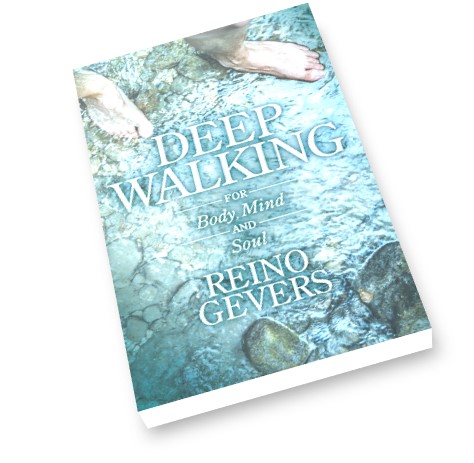
P.S. I’m excited to announce the release of my latest book, “The Turning of the Circle: Embracing Nature’s Wisdom for Purposeful Living.” If you enjoy it, you might also be interested in my previous works, “Deep Walking for Body, Mind and Soul” and “Walking on Edge: A Pilgrimage to Santiago.” You can find all of these titles at reputable bookstores near you.

Leave a comment

Filed under mental health, mental-health, spirituality, Uncategorized

Lessons from the Gaza war

As the major battlefronts in Ukraine find themselves in a protracted stalemate, the conflict in Gaza has been readily embraced by mass media as an alternative, offering a boundless supply of dramatic narratives of bombings, injured children, and distraught mothers.

On-the-ground reporters emphasize the tragic unfolding events with a flair for dramatic language, often neglecting to furnish the essential context and nuanced analysis that might otherwise prove less sensational but more informative.

Stirring a potent mix of toxic emotions

Intricate details and complexities of geopolitical situations risk being overshadowed, as the media opts for a continuous stream of emotionally charged visuals, skillfully crafting a narrative that stirs a potent blend of anger, disgust, and fear among its audience.

It is prudent to contemplate the underlying origins of wars, which often revolve around mythical concepts of land ownership. Fundamental rights of those actually living on the land are callously disregarded in the name of religious ideologies and historical claims that, upon closer scrutiny are tenuous at best.

The land belongs to those who live on it

A world characterized by broader acceptance of the principle that land belongs to its inhabitants could pave the way for greater global peace. Human history reveals a nomadic evolutionary journey, where migration has consistently been an intrinsic human inclination. However, substantial population shifts have frequently been involuntarily, triggered by natural catastrophes and conflicts, disrupting the harmonious coexistence that a more inclusive understanding of land ownership might foster.

Do we really want to open a debate on who rightfully owns Australia, New Zealand, the United States, or South Africa? Take back all the land from who owns it now and give it back to the indigenous people? We could also go back to when the earliest homo sapiens started migrating from Africa to Europe and conflicted with the Neanderthals on hunting grounds? If Vladimir Putin gives history “lectures” on why Russia has the “right” to annex Ukraine, we can ask why Austria doesn’t have the right to recreate the Austro-Hungarian Empire and why not recreate the Holy Roman Empire, a complex political structure that existed from the Middle Ages until 1806.

Redrawing history maps for ideological and empire-building purposes is a mindset from the last century that triggered countless wars, especially in Europe. It was the reason why the founding fathers of the European Union had the vision of creating an alliance of nations, some of whom had fought each other for centuries, in an interdependent union of equals with open borders and the free flow of peoples and goods. It has ensured the longest era of peace and prosperity in central Europe and is the reason why most countries in eastern Europe, including Ukraine, are clamoring to join.

In antiquity, the Middle East was predominantly inhabited by nomadic tribes, whose dwellings were dictated by the grazing needs of their livestock. The concept of national boundaries is a relatively recent historical development. They were often the result of indiscriminate colonial map makers sitting in European capitals.

The debate over historical claims to Palestine by either the Jews or the Arabs becomes somewhat mooted when acknowledging that we have a modern reality where approximately 20 percent of Israel’s citizenry is Arab. Within the self-identified Jewish population we have a rich tapestry of diversity, encompassing Ashkenazi, Sephardic, Mizrahi, and other Jewish ethnicities. Beyond this, Israel is home to a mosaic of minorities, including the Druze, Bedouins, Circassians, and various Christian groups.

The primary objective of the Hamas terrorist organization is to establish an Islamic state. Dozens of foreigners from across the globe were among the victims of the October massacre this year. It was a callous and brutal demonstration of the organization’s complete disregard for human life. Innocent children, babies, fathers, mothers, and the old and frail were often shot at point-blank range. The trauma, horror, and rage in Israeli society is understandable but can never warrant a response that likewise causes massive civilian casualties.

The Hamas attack was planned in horrific detail to provoke the Israeli response. It was to be expected that Israel’s most rightwing leader ever, Benjamin Netanyahu, would react the way he did by ordering an invasion to “eradicate Hamas.” By using civilians as cover Hamas is callously taking into account the casualties as part of its greater global strategy, and it appears they are having much success:

The global landscape is witnessing the troubling aftermath with a surge in anti-Semitism and Islamophobia. The voices of moderation find themselves overshadowed by extremists who vehemently advocate an ultimatum: a stark choice between good and evil “Palestine” or “Israel.” The polarizing narrative fosters an atmosphere of divisiveness and conflict, the breeding ground for extremists and demagogues eager to recruit new followers.

We have to connect the dots to understand why Hamas launched its attack on innocent Israeli civilians in the first place.

  • It is no coincidence that the attack came after Israel was having some diplomatic success in improving relations with moderate Arab countries.
  • Was Hamas instigated to launch the attack by Russia’s ally Iran to deflect attention and military resources from Ukraine? There is some evidence, though not confirmed, that Russian mercenaries were involved in the training of Hamas.

If Israel had a wiser leader, other options in response to the invasion of Gaza would have been the better choice. In the wake of massive Israeli bombings and civilian casualties in Gaza, Israel has lost the moral high ground.

The wiser option

Indian Prime Minister Manmohan Singh faced a similar dilemma when Pakistani terrorists carried out in November 2008 a series of coordinated attacks including on the Taj Mahal Palace Hotel. It was one of the deadliest attacks in Indian history claiming the lives of an estimated 166 people with 300 others injured. Singh was under great pressure to launch an attack on Pakistan but urged caution. Later European and American analysts pinpointed rogue elements within Pakistani intelligence as having planned the attack to draw international attention to the India-Pakistan conflict by provoking an Indian military response.

By not escalating in 2008, India created a policy option to employ legal methods against the attack’s perpetrators and retained the moral high ground. If it had gone to war with Pakistan the result would probably have been a stalemate with the world sharing the blame 50:50.

After the 9/11 terrorist attacks, the United States received an outpouring of sympathy from all parts of the world. Instead of carefully considering its options, President George Bush ordered the invasion of Iraq, not having a real plan of what would come afterward. It was by all means a mistake of historical dimensions with many lives unnecessarily lost.

Evil can never be fought with a simplistic “eye for an eye” concept. Violence breeds more violence. The children traumatized by the bombings in Gaza are likely to be eager recruits for the next terror organization.

What does this all mean for you and me on a personal level?

Political conflicts are a reflection of the collective state of mind of the state or the nation. We will never eradicate war or conflict. It is part of the human condition that we are incomplete beings prone to irrational behavior.

Being pulled into the rabbit hole of daily images of disaster and conflict does something with your mindset and your emotions. It can numb the senses to real feelings of empathy and compassion and trigger anger, frustration, and melancholy sadness. You are not in control of external events but you are in control of how you perceive and react to these events.

During these times of conflict in the external world, it takes discipline to set boundaries to over-exposure to negative news without ignoring what is happening in the external world. A good antidote to grievance culture, negativity, and pain is the ability to find meaning, grace and beauty in every moment.

No matter how challenging these times may be, practicing the discipline of thought, taking a different perspective, and shifting your focus, will bring you into a higher vibrational field. A kind word here, compassion and a smile there, and being grateful for the smallest of things. Gratitude, love, empathy, peace,and kindness are the threads that weave together humanity.

Reino Gevers – Author – Mentor – Speaker

P.S. I’m excited to announce the release of my latest book, “The Turning of the Circle: Embracing Nature’s Wisdom for Purposeful Living.” If you enjoy it, you might also be interested in my previous works, “Deep Walking for Body, Mind and Soul” and “Walking on Edge: A Pilgrimage to Santiago.” You can find all of these titles at reputable bookstores near you.

Leave a comment

Filed under mental health, mental-health, Uncategorized

How worthy are you?

Practicing full self-acceptance with all the pain, trauma, and shame from the past are the building stones of resilience against grievance culture feeding on the toxicity of anger and fear.

Much of the dysfunctional behaviors prevalent in our contemporary society can be traced back to an inflated Ego-Mind and a prevailing narcissistic culture, rooted in poor self-worth.

Negative thought patterns inevitably lead to negative actions and an endless cycle of suffering until the cycle is broken with a heightened state of awareness.

Narcissism is often an overcompensation for an underlying feeling of inadequacy. The need for constant admiration and validation from others is driven by an inner void.

There might be an inner voice telling you: “I’m too fat, too thin, too short, too old, and have an ugly nose.” The thoughts and voices that often come from programming stem from hurts inflicted during early childhood.

Photo by nicollazzi xiong on Pexels.com

The mantra of self-acceptance

You can transmute that inner voice with a new mantra: “I unconditionally love and accept myself the way I am. I am so happy and grateful to my body that has served me so well. I am healthy and I am strong.”

Self-love should not be confused with narcissism. You can only serve your higher purpose if you are no longer at war with yourself. The more you practice self-compassion, self-love, and self-acceptance the more you will attract this in the external world.

Life is a constant cycle of ups and downs. It is part of life that you have at times messed up, been disappointed, faced trauma, loss, and real “down on the ground moments.” During these times you might have neglected self-care like proper nutrition, exercise, and adequate sleep.

When you dig deep into your inner resources

But on deeper reflection, these dark nights of the soul have very often forced you into introspection and to dig deep into your inner resources. Once you start feeding your body with high-nutrient foods, exercising regularly, and programming your mind with positive thoughts, you start moving into a higher vibrational field.

Spiritual growth and soul elevation very seldom come during those times when you are feeling high and on top of the world. The pain can be the path where the light begins to shine. You will have greater ease in transitioning from challenges and adversity when you are in the awareness that every chapter in life has a season and that “this too shall pass.”

Reino Gevers – Author – Mentor – Speaker

P.S. I’m excited to announce the release of my latest book, “The Turning of the Circle: Embracing Nature’s Wisdom for Purposeful Living.” If you enjoy it, you might also be interested in my previous works, “Deep Walking for Body, Mind and Soul” and “Walking on Edge: A Pilgrimage to Santiago.” You can find all of these titles at reputable bookstores near you.

Leave a comment

Filed under mental health, self-development, spirituality

Now and Then

“Musical training is a more potent instrument than any other because rhythm and harmony find their way into the inward places of the soul.” – Plato

It appears to be no mere coincidence that music has spearheaded profound social and political transformations throughout history. Powerful lyrics that strike the tune of the time seem to penetrate an unseen realm, resonating with the deepest chords of human experience.

It’s almost a miracle that we can enjoy today the crisp and clear voice of John Lennon in the newly released Beatles song “Now and Then” with machine learning technology managing to extract the deceased band member’s vocals from a poor 1970s cassette recording.

The new song triggers memories of the famously successful, “Eleanor Rigby” with the introductory lyrics: “Ah, look at all the lonely people!” The theme of loneliness and isolation was a clear departure from earlier Beatles love songs into a new genre.

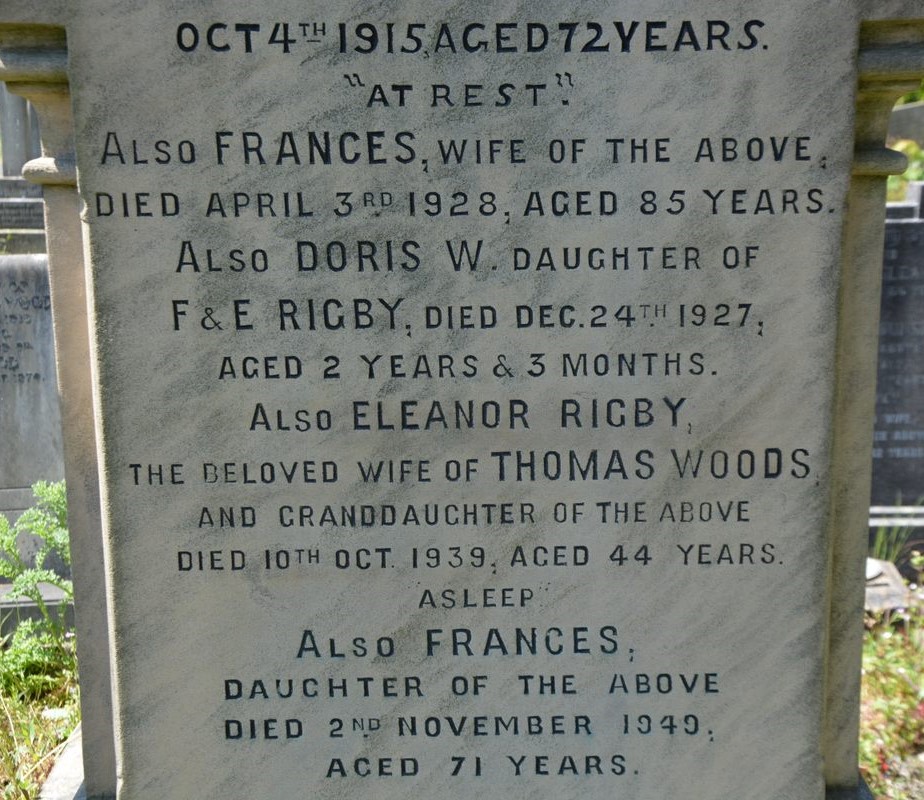
It is the only song where none of the Beatles plays an instrument. There is an eery aspect with the name “Eleanor Rigby” found on a gravestone at St. Peter’s Parish Church, in Woolten, Liverpool where Paul McCartney and John Lennon first met as teenagers in 1957.

The real Eleanor Rigby

It tells the story of a lonely woman named Eleanor Rigby, and the gravestone allegedly served as the inspiration for Paul McCartney when writing the song. The actual grave belongs to a woman named Eleanor Rigby, who died in 1939 at the age of 44.

In a 2021 article for the New Yorker, McCartney writes that after being introduced to John Lennon they most certainly wandered about in the churchyard talking about their future. But McCartney writes that he couldn’t consciously recall having seen the gravestone.

“I don’t remember seeing the grave there, but I suppose I might have registered it subliminally.”

McCartney goes on to write that several coincidental meetings led to the formation of the band: “All these small coincidences had to happen to make the Beatles happen, and it does feel like some kind of magic. It’s one of the wonderful lessons about saying yes when life presents these opportunities to you. You never know where they might lead.”

During its time Eleanor Rigby struck a chord with many people perceiving and feeling the “social isolation” that comes with living in large cities, geographically distant from close family and friends with limited opportunities for social interactions apart from the workplace.

It is no coincidence either that the Beatles arrived at a time in the 1960s when a new generation yearned to break free from the suffocating morality of the 1950s. Music has played a pivotal role in driving change throughout history, giving a voice to the simmering social undercurrent.

Songwriters and musicians have shared sentiments about a mysterious, almost mystical process of creating music. McCartney mentioned in several interviews how some of their most famous songs seemed to flow effortlessly as if the melodies and lyrics were already there, waiting to be discovered.

Joni Mitchell describes the art of creative songwriting as a form of channeling, arriving from a place she can’t fully explain, almost as if they are given to her.

Leonard Cohen said: “If I knew where the good songs came from, I’d go there more often.”

Bob Dylan describes his songwriting process as tapping into something beyond his conscious mind, often coming to him almost fully formed, as if he’s a conduit for something greater than himself.

Bach: Infused by spirituality

One of the greatest composers of all time, Johann Sebastian Bach, infused his music with his deep spiritual beliefs. His music is timeless and continues to inspire millions across all national, cultural, and religious boundaries. The complexity of Bach’s compositions and emotional resonance has scholars citing it as evidence of a profound connection to something beyond the human realm.

Deep walking in solitude over long distances, undeniably also influenced Bach’s compositions. Walking between his home and a parish that did a first performance, he would often refine and adapt the composition. Walking has a natural rhythm, that might have influenced Bach’s sense of musical rhythm.

In 1705 the young Bach made a 400-kilometer journey on foot from Arnstadt to Lübeck in northern Germany to learn from the then-famous organist Dietrich Buxtehude.

Ludwig von Beethoven took daily walks in nature. Many of his best ideas came to him during walks in the country, including his ‘pastoral’ Symphony No. 6. Completed in 1808.

Lennon’s last words to McCartney were reportedly: “Think about me every now and then, old friend,” which makes “Now and Then” seem almost like a message from the beyond. The song is the final official Beatles farewell. There are only two surviving members – McCartney and Ringo Starr both now in their 80s.

Reino Gevers – Author – Mentor – Speaker

P.S. I’m excited to announce the release of my latest book, “The Turning of the Circle: Embracing Nature’s Wisdom for Purposeful Living.” If you enjoy it, you might also be interested in my previous works, “Deep Walking for Body, Mind and Soul” and “Walking on Edge: A Pilgrimage to Santiago.” You can find all of these titles at reputable bookstores near you.

.

Leave a comment

Filed under longevity, mental health, self-development, spirituality, Uncategorized