Author Archives: Reino Gevers

Reino Gevers's avatar

About Reino Gevers

Author, mentor and trainer

A future without cars?

We just spent a couple of days on the southern North Sea island of Juist which was a bit like travelling back in time when the main means of transportation was by bike or horse-drawn carriage.

All that could wake you in the morning is the sound of seagulls or the passing of the odd horse and carriage on the cobblestone streets. Children are on the streets playing ball or driving go-carts.

Image  Image

The German island is just 17 kilometres long and half a kilometre wide. The only cars allowed are from the fire and rescue services. So it is quite an anomaly in a country known for its love affair with the motor car and virtually no speed limits on the autobahn.

Image   Image

The only other place I know that does completely without the car is Venice where there are no roads linking the network of islands. But Juist provides for even more solitude because you don’t hear the sounds of motor boats. I do enjoy motor cars and have a faible for the open-top classics of the 1950s and 1960s but it is time to rethink the role of transportation, especially in big cities where the quality of life has been ruined by congestion and smog.

The northern German port city of Hamburg has laid out plans to eliminate cars completely in the inner city during the next two decades, by creating a green network improving public transportation and the bicycle path network.

Several other big cities are rethinking the role of the motor car. London introduced a controversial congestion charge for vehicles driving into the city centre. New York has debated similar plans.

While in the 1970s the car was still the most efficient mode of transport, this has changed with traffic in most urban centres going at a stop-and-go pace. In many modern cities we are indeed today no faster than a horse-drawn carriage in the 19th century. We waste hours of our precious life-time in traffic jams.

Growing traffic density and the move from rural to urban areas in many developing countries is demanding a major rethink to our mode of transportation and maybe a future without cars.  We need to reoccupy our cities and make them more human again with green belts of parks and trees and a network of paths reserved for the bicycle or small electric vehicle.


Leave a comment

Filed under Uncategorized

Long term effects of stress on the cellular level

Reino Gevers's avatarReinosBlog

In my previous blog I wrote about typical symptoms of psychological stress such as a stiff neck and shoulders. These are in most cases the first signals the body is sending “of a load too much to carry.”

Long-term effects of stress are far more serious. High blood pressure over many years often leads to a stroke, a heart attack or other serious health problems.

When the body is under constant stress it is more or less in a state of war with havoc caused on many levels. Muscles and blood vessels tighten up and begin to tear. Tendons are damaged.

Every cell is working overtime in trying to get the necessary nutrients. The body already has to deal with all the toxins found in processed food, chemicals, water and the atmosphere. In stress situations, cellular malfunction becomes more frequent. With the cells unable to do their job properly this…

View original post 497 more words

Leave a comment

Filed under Uncategorized

Long term effects of stress on the cellular level

In my previous blog I wrote about typical symptoms of psychological stress such as a stiff neck and shoulders. These are in most cases the first signals the body is sending “of a load too much to carry.”

Long-term effects of stress are far more serious. High blood pressure over many years often leads to a stroke, a heart attack or other serious health problems.

When the body is under constant stress it is more or less in a state of war with havoc caused on many levels. Muscles and blood vessels tighten up and begin to tear. Tendons are damaged.

Every cell is working overtime in trying to get the necessary nutrients. The body already has to deal with all the toxins found in processed food, chemicals, water and the atmosphere. In stress situations, cellular malfunction becomes more frequent. With the cells unable to do their job properly this eventually leads to organ malfunction.

But there are many warning signs that something must be wrong such as chronic fatigue, neurological disorders, gastric problems, or acute infections, pain in the joints. The cells are literally screaming out for help that a certain organ or system is heading for a major problem.

During such a “state of war” the only protection is giving the cells enough of the vital nutrients to deal with the constant assault. It has been found that chronic fatigue or “burnout” patients often have an acute deficit of essential nutrients such as Omega 3 fatty acids which keeps the stress hormones such as cortisol and adrenaline under control. While the body has an abundance of carbohydrates and fats there is an acute lack of magnesium, calcium and other essential nutrients.

Image

So removing the toxins from the cells with the right nutrients and providing them with the right source of energy is the way to go. It is estimated that 70 per cent if not more of our health is attributed to lifestyle habits with only a small portion affected by genes, injuries or other factors.

There is compelling evidence that the chronic shortage of Omega 3 fatty acids in most foods is responsible for many psychological disorders such as depression and Attention Deficity Syndrome (ADS).

Eating the right superfoods will do a lot to reduce stress and anxiety and help provide the essential nutrients to the cells. Here are some:


Image

  • Avocados are rich in Vitamin B and monunsaturated fat and potassium which can help lower blood pressure.
  • Fish such as salmon is rich in Omega 3
  • Fresh spinach, broccoli, kale and other rich greens are packed with vital magnesium and other vitamins.
  • Sweet potatoes are a good alternative to carbohydrates and the urge to eat sugars when we have too much cortisol in our bodies.
  • Almonds, pistachios and walnuts have all those B and E vitamins which help boost the immune system and help lower blood pressure.
  • And, here is the absolute top of the pops – chia seed. According to legend it was already a powerfood for the Aztecs. It has a multitude of nutrients. It is packed with Omega 3. A little chia in your juice or salad will provide your daily intake of calcium which is essential for bone and teeth density. It will provide at least 30 per cent of the manganese and phosphorus you need for the day. The amino acid tryptophan helps regulate the appetite and has a strong mood influence. Chia seeds have also been shown to improve blood pressure for diabetics.
  • Reducing carbohydrates in your food and doing away with industrial sugars and salts will do a lot to overcome the high-and-low energy cycles.

Remember the state of your health now is the result of the life you have been leading the past five years. Nothing is as rewarding as feeling physically and emotionally in top form which also immensely improves your coping-strategy in stress situations.


1 Comment

Filed under Uncategorized

Muscle tension and stress

Psychological stress and tension affects us on many levels. A stiff neck and shoulders or back pain are typical symptoms.

Image

When we face stress the body is flooded by stress hormones such as adrenalin, noradrenaline and cortisol. These cause the muscles to tighten up. In extreme cases the muscle fibres pressure the blood vessels causing circulatory disorder that can trigger inflammation.

A good circulation is particularly important to flush acidic waste or other products from cell tissue. Lack of nutrients and too much acidity typically cause fatigue and pain.

We might feel a stinging pain, sensitivity to pressure and limitation to body movements. Tense muscles or pain causes further tensing-up which puts us into a vicious cycle of stress and pain.

With most people doing office jobs we are top-heavy, meaning there is a lot of pressure and tension in the upper part of the body with the lower abdomen and the feet “losing their grounding”.

Muscle tension is not to be underestimated. A painful back and shoulders are often the first signs that “we are carrying too much”. It is amazing how many people just bear with it and become used to this pain. But the longer we wait in dealing with our stress management, the worse it will get. The quality of life suffers enormously on the long run.

Focusing our mind on slow, deep gentle breathing will help you relax, especially if you breathe out into the region of muscle tension. Take time out for yourself and find a spot where you can be at peace.

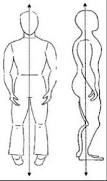
In the Taiji body arts we spend a lot of time aligning the three energy centres:

  • The lower Dan Tien below the navel that encompasses the area of the lower back and kidneys. Here we work on loosening the thighs so that energy can flow from the feet and legs.

  • The second Dan Tien from the breastbone to the lower end of the shoulder blades. Opening the chest and relaxing the shoulders

  • The third Dan Tien or “third eye” between the eyebrows. Lowering the chin towards your chest and aligning the centre of your head to a point about 60 cm above you so that your neck muscles are slightly stretched.

     Image

With an improved posture and good vertical alignment of the body your breathing will automatically improve and help you relax, even during times of stress. This takes time and patience, especially if you decide to learn the body arts such as yoga, taiji or qi gong. But the reward is immense. It makes you become more aware of your real needs on many levels and certainly improve your quality of life – pain free.

1 Comment

Filed under Uncategorized

The power of alignment versus distraction

A few days ago our daughter came home from school telling me this strange story: A Romanian gang was abducting innocent young children. In one incident a blonde young girl had been abducted in a shopping centre, had her hair cut in the toilet, drugged and then dressed-up as a gypsy. She was only saved at the last minute when a warning was given on the intercom and all the doors to the shopping centre had been closed. Police, so the story, have asked the public to look out for a white van with eastern European occupants driving around the vicinity of shopping malls.

Had I not heard exactly the same story in a South African version some years back, I would probably have taken the story seriously. Fact is police in Germany had to issue a warning that the story was an absolute hoax after it made its rounds over countless “Whats-App” and “SMS” messages, causing near panic among schoolchildren and parents.

It is just one example of the power of distraction in today’s world of social media. Whoever started this urban myth either thought it a joke or deliberately planned sowing fear and panic. But that this urban myth could make its way to Germany after I had heard it for the first time about ten years ago had me stupefied. Without the Internet such urban myths were checked and double-checked by news desks and seldom, if ever made their way into the public domain.

This brings me to my point. Never before have we been confronted by such a plethora of electronic media and other distractions. We humans are especially prone to visual stimulation that has us fixated to a screen, depending what it is. Our two teenagers have a really hard time when we put our foot down in limiting X-Box, TV or smart phone chatting.

But seriously, how often do we catch ourselves checking our emails and facebook accounts per day? We are gradually forgetting to experience the wonders of life in the here-and-now. We are becoming prey to the sway of whatever emotion is being put out there.


Image

A recent edition of the “Shambhala Sun” ran a cover story on the “modern obsession” of distraction. It provides for some interesting reading. Buddhist teacher Judy Lief recommends that letting go of all our distractions and entertainments is the path to awakening. There seems to be a deeper truth we’re distracting ourselves from, says the famous Vietnamese monk Thich Nhat Hanh.

Here are some tips on how you can avoid the power of distraction and to stay in alignment:

  • Concentrate on your breathing. Is it coming in short bursts from your throat or chest (fear and anxiety) or is it centred in your lower stomach (relaxation, ease of mind)

  • How is your body posture? By imagining the centre of your head connected with an invisible string to your higher self and the centre of your feet grounded to a point deep in the earth, you will feel a wave of energy flowing through your body. It is a complete contrast to being slumped over a desk or in a chair, and make you really feel your body.

  • Resolve to listen more rather than talking and giving an immediate response

  • Take time out from all those distractions such as iPhones and iPods

  • Take a walk in nature. Listen to the huge variety of birds, insects or other animals, sense the smell of fresh blossoms, feel the wind on your skin. Feel alive. Experience the here-and-now. What a wonderful experience to be living!


Image


1 Comment

Filed under Uncategorized

How happy are you in your job?

Some time ago an employee of Burger King in Ohio, U.S., posted a picture of himself on the net stomping with his shoes on lettuce, adding the words:This is the lettuce you eat at Burger King”. 

The employee was tracked down and fired but the harm had been done. Burger King probably lost a fortune in lost customers as a result. It is an extreme case but it demonstrates what harm dissatisfied employees can do to a company.

A recent survey conducted by Gallup in Germany revealed that 67 per cent of employees in the country were just doing the minimum amount of work required, which means that most of them are present at the workplace but not really much more. Only 16 per cent felt they could identify with their company and its goals.

You could argue that they are a pretty thankless lot bearing in mind that many southern Europeans are without a job. However it reveals a deeper problem and doesn’t only affect the employee at Burger King.

Clergymen, self-employed medical doctors and social workers are among the professionals most affected by burnout. The place where we spend most of our “life-time” is supposed to provide the money we need for a living, give us the feeling that we are doing something meaningful and make us happy.

But a job we once chose out of passion and idealism may have changed so dramatically that we fail to realise that it no longer conforms to our inner value system.

The inner stress of spending much of your “life-time” doing something you no longer enjoy doing is going to make you ill on the long run. I started my career in journalism in the late 1970s in South Africa. I spent much of my day in court rooms, fire stations, at crime scenes or at social or political events. Gradually I built up a network of people (“sources”) who gladly passed on information about some local scandal or event. Most of the day was spent inter-acting with people. Most newspapermen from the English language press in South Africa at the time were highly critical of the apartheid government. Within the limitations of press restrictions there was much reporting on the human rights abuses. Most of all we had the feeling that we were doing something meaningful to make our world a better place. These early years in journalism were enormously fulfilling. Its a far cry from what it is today. The media industry has been hit by massive staff cutbacks and drop in revenue. I left my job with a news agency in frustration faced by the prospect of spending most of my day in front of a computer screen regurgitating news from other media sources in a newsroom with several hundred other – “mostly frustrated” – people.

I’ve heard some real horror stories from medical doctors. Hospital and health care structures have become so dysfunctional that doctors and nurses have very little time, if at all, to actually hear out the needs of patients. Instead of “helping people” social workers and church pastors are caught in the tentacles of bureaucracy.

So every now and then it might be worth spending some “life-time” minutes to reflect on whether I still enjoy doing the job I’m doing:

Image

  • Am I happy getting up in the morning to go to work?
  • Does my job provide room for expression and freedom to use all my talents?
  • Am I exhausted after getting home from work or do I still have enough energy to visit friends and family?
  • Do I have to keep on motivating myself month after month, year after year that I’m in the right job doing the right thing?
  • Do I view my workplace mainly negatively and am I surrounded by cynical or negative colleagues?
  • What were the decisive factors that made me choose a specific career? Do these factors still apply today?

Once you reach the stage where you start counting the months and years to retirement you need to seriously ask yourself whether you want to spend precious “life-time” at the place where you’re currently at. Life has so many choices and possibilities. You would not one day want to be sitting in a rocking chair in an old age home full of regrets, mulling over the question:

Why did I not make that change which would have given my life a completely new direction.”

Book: Yield and Overcome: How change can positively impact our lives


Leave a comment

Filed under Uncategorized

7 Simple ways to get your energy levels back up – Part II

Here is the second of my two-part Blog series on the seven simple ways to boost your energy level, increase your lifespan and improve your general outlook on life.

The first three steps I elaborated on in my last blog were:

1. Liberating yourself from sugar addiction

2. Drinking good water

3. Eating less and eating good, seasonal local foods

  1. Moderate exercise

There is a wonder cure out there and it is so glaringly obvious that most people are simply not seeing it. You can significantly improve your health, boost your life-span, reduce your stress level, improve your mood, reduce high blood pressure and improve your bone density by simply getting more exercise.

All the latest medical research pinpoints lack of exercise as one of the major causes of many of our modern-day diseases. Even such psychological illnesses as depression are at least partly linked to lack of exercise.

Only a generation or two ago most of us humans had exercise equivalent to a brisk 20 kilometre run per day. Since the 1950s most jobs have moved from agriculture and heavy labour on the factory floor to sitting in the office.

Our anatomy and our body metabolism are not designed to sit in a chair for eight hours a day. Taking a break does not mean having your lunch in front of the computer and multi-tasking at the same time. Why not take a walk around the block for at least 20 minutes? You will feel much, much better and have more energy to cope with the typical “early afternoon energy sink-hole.”

But when you decide to get more exercise, it would be wise to do it right. Doing heavy workouts in the gym or going for long, exhausting jogging runs with no prior preparation or only periodically, will do you more harm than good. If you have to catch your breath and can hear your heartbeat “bursting from your eardrums” you are overdoing it. Give your body time to adjust, the energies to regulate themselves, before continuing at a more moderate pace.

One of my course participants, who had trouble fitting in an exercise schedule during her busy working day, chose to cycle to work by bicycle, triggering a major shift in her sense of well-being and personal health. You could also choose to climb the stairs rather than taking the elevator. Another way of tricking out the inner monster telling you it is nicer to slump down on the coach than going for a walk, would be to park the car further down the road

  1. Power nappingImage

Some of the most successful people in the world, had a habit of taking a short afternoon nap to rejuvenate. To name a few: Albert Einstein, Salvador Dali, Winston Churchill, Margaret Thatcher and John F. Kennedy. Here are some tips on good power napping: http://www.wikihow.com/Power-Nap

Most of us are not getting enough sleep. Research (Read: The science of power naps: http://goo.gl/CDQi0L) indicates that power naps lasting no more than 10-15 minutes can boost our brains, including improvements to creative problem solving, verbal memory, perceptual learning, object learning, and statistical learning. Naps also improve our mood and feelings of sleepiness and fatigue.

  1. Avoiding vampires

 We all have vampires around us. These are the folk that are so angry and upset with life that they are preoccupied in finding the first person in the vicinity to throw their verbal garbage of negativity at you. You want to be polite and aren’t getting in a word edgewise at this person who is telling you the world has gone mad and is going downhill because all the young people are on drugs and too lazy to work. The government is controlled by a secret organisation manipulating us and isn’t it so terrible what is just happening in Timbuktu. True there are bad things happening in the world. But at the same time a lot of good things are happening at the same time. Why not shift the focus. The art of happiness is in dealing with the normal yin and yang cycle, the ups and downs, the darkness and the light of what is life. We are co-creators of our reality. Reframing and shifting the mindset to a positive spin, immediately opens the gate to a warm flow of energy.

  1. Getting into sync with nature

For the past couple of years, I’ve made it a personal ritual to take at least a two-week time-out in nature on a hike. Luckily my wife has found just as much joy in the activity. Initially you take a few days to get accustomed. The body detoxes, muscles ache and your back is hurting from lugging a backpack all day. But after walking for a couple of days many of the basic senses return. You find your natural rhythm. You smell the fresh mountain air, the grasses and herbs, hear the different bird songs, the rushing waters of a creek and feel the rain and the sun on your skin. For months after the hike, I’ve felt myself surging on a much higher energy level. It need not be a hike. You can get your hands dirty by digging in the garden, planting a tree or flower and reconnecting with the natural forces.

I am convinced there is a universal truth surrounding us from which we have been disconnected by living in concrete jungles.

Nature is a source for solace and regeneration, a way of reconnecting to your soul’s purpose by sensing your part as a human in the bigger play of things.

Image

Leave a comment

Filed under Uncategorized

7 Simple ways to get your energy levels back up

During my workshops people frequently tell me how exhausted they are from many things ranging from work pressure to emotional stresses at home. That, I tell them, is a good sign, because they are feeling their bodies and the need to do something about it.

 Your energy level determines your sense of well-being, happiness, creativity, mood and long-term quality of life. And, it is so easy to do something about it. You have the power to make that decision. Here are the first three steps. The others will follow in my next blogs:

1. Liberate yourself from sugar addiction

Freeing yourself from sugar addiction is one of the most important things you can do to boost your health. Sugar is a stimulant that puts your body on alert by boosting the stress hormone cortisol. Your blood pressure increases and initially you feel a boost of energy. The downside is that such a feeling is only short-lived like taking an addictive drug.

 Did you know that the average Pizza you buy from the supermarket is filled with the equivalent of 25 teaspoons of sugar. All the common soda drinks have equally high white sugar content. Artificial sweeteners are suspected of causing Alzheimer and many other modern-day illnesses. See this damning report on how the pharmaceutical industry managed to bring it onto the market

http://goo.gl/Hr04uJ

Sugar upsets the calcium/phosphorus ratio and thus the homeostasis process in the body. Phosphorus is one of the most important nutrients your body needs because it helps filter out waste in the kidneys and stores energy. Most of it is also used to strengthen the bones and teeth.

Try and do without sugar for about 40 days and you will feel the difference. There are alternatives out there such as unrefined raw cane sugar, honey and stevia that you can buy in any organic store.

2. Drinking good water

Water is crucial to flushing out toxins in your body and is the most crucial life-sustaining drink.  Between 50 and 75 per cent of your body is composed of water. It is responsible for functions such as digestion, absorption, circulation, creation of saliva, transportation of nutrients, and maintenance of body temperature. There are different views on how much each individual needs. It depends a lot on your age, the temperature and the amount of exercise you are doing. A lot of our tap water however is contaminated with heavy metals, hormones and pesticides. So be sure that your source of water is healthy  – ideally spring water. You can also add flavour to your water by adding frozen berries, lemon or cucumber. Your intake of calory foods and soft drinks will naturally decrease.

Image

3. Eat less and eat healthy seasonal foods

Local seasonal foods with short transportation routes still carry a lot of nutrients that you won’t find in those supermarket foods that have been in storage for a long time before they reach your table. Even many of the power foods no longer have the nutrient level they once had because of degenerating soils, long transportation routes and genetic manipulation. (see graph below) If you eat better quality food your portions can also be smaller. Eating slowly and with pleasure also gives the body time to digest. 

Tested Vegetable

Nutrient

1985

1996

2002

Variation

in %

1985-1996


1985-2002

Broccoli


Calcium

manganese

103

24

33

18

28

11

-68

-25

-73

-55

Spinach

Magnesium

Vitamin C

62

51

19

21

15

18

-68

-58

-76

-65

Banana

Calcium

folic acid

magnesium

Vitamin B6

8

23

31

330

7

3

27

22

7

5

24

18

-12

-84

-13

-92

-12

-79

-25

-95


 Source: 1985 Geigy. 1996 and 2002 Food laboratory Karlsruhe/Sanatorium Oberthal, Germany. 


1 Comment

Filed under Uncategorized

Trends that could change our world

Big changes often come in many small almost unnoticeable steps. When looking back two or three decades none of us would ever have predicted the break-up of the Soviet Union and the end of apartheid in South Africa.

 We could never have imagined using technology like skype or facebook to communicate with family and friends living in distant corners of the world with a pocket-sized smart-phone from virtually any location.

 On the political side we have seen the bankruptcy of ideologies such as communism and apartheid that tried to impose fixed systems that simply could not work in a fast-changing world. I would even dare to say that what we are now seeing in the Ukraine, Russia, the Middle East, North Korea and China are the last kicks of the dying horse of political and religious dogma. And we know from the past that when major changes are coming it is initially accompanied by a lot of turmoil.

 Russian President Putin’s power-posturing in the Crimea comes out of a position of weakness and the loss of the eastern Ukraine to a people’s revolution seeking freedom. There is more to come, even in Russia itself.

 The telecommunication/communication revolution on the economic side has given hundreds of millions of people the opportunity to access information they would otherwise never have had, cutting a swathe through the censorship attempts of dictatorial governments. The Internet is far more efficient at spreading information from the grassroots than the print media ever was, much to the chagrin of many a journalist from the old school.

 After the Internet revolution of the 1990s we are now moving into an era of networking, cooperative partnerships and sustainable economies. The signs are all out there. A lot of start-ups and many very creative individuals out there are getting together to form business partnerships, sharing their talents and knowledge. Many of them are so fed-up with the banking system that they are going into Bitcoin and other alternative forms of financing such as crowd-funding, getting a lot of new technology out there that would otherwise never be available.

 The Internet makes it all possible. Many of us are already working from home and offering our talents and skills to many different employers at the same time or joining groups of other people (living in many different parts of the world) for specific projects. I am seeing a lot of the younger folk simply refusing to join the system in big companies that have a reputation of treating their employees like machines. The most innovative, creative companies are those with small, highly motivated and talented teams. These are people with a similar mind-set getting together to start something really new and enjoying what they are doing.

 We are after all social animals that love to interact with our fellow human beings. So sooner then we might think we will be beaming 3D images of ourselves across the world with the famous catch phrase from the science fiction series Star Trek “Beam me up, Scotty.”


Leave a comment

Filed under Uncategorized

How wolves change rivers

I saw this amazing video on how the return of wolves in Yellowstone actually sees the entire ecosystem change for the positive, giving life to many different species.

http://www.filmsforaction.org/watch/how-wolves-change-rivers/

Just a few months ago the first wolves were sighted in our district near Lueneburg, southeast of Hamburg. They have returned for the first time in over 200 years, probably having migrated from Poland or Romania. In the past the Iron Curtain prevented them from crossing. But they were also relentlessly shot by ruthless hunters stuck in “old thinking” that these wonderful animals are a danger to humans.

But even here the wolf is hardly being welcomed. The population is more or less divided 50-50 between eco-friendly “wolf fans” and fearful farmers, dog owners and even parents fearing their children or dogs might be attacked.

Fear of the wolf is deeply ingrained in human nature and almost all the fears are irrational.  Lets look at the facts. During the past 100 years, there have been only two incidents in North America, in 2005 and 2010, where wolves have allegedly killed a human.  The most comprehensive report on wolf attacks ist the  “Linnell-Report” conducted by Norwegian researchers based on data over the past 400 years from North America, Europe and Asia. Between 1950 and the year 2000 there were 59 attacks on humans in Europe from an estimated wolf population of 15.000 (excluding Russia and Belarus) Some 38 of the attacks were from wolves infected with rabies. Five humans actually died in the attacks.

.ImageMy homeland South Africa is still blessed  with regions like the Mkzuzi and Hluhluwe game reserves that are virtually untouched by mankind. When going on a hike with an experienced ranger in these areas you can learn how everything from the Acacia tree to the Rhinoceros are interconnected. Take out one species and the whole system goes into imbalance.  This is why poaching is wreaking such havoc at the heart of Africa.

The principle is that nature always eventually returns to the balanced state of ” interconnectedness”. It is only recently that we have begun to understand that we too as humans cannot separate ourselves from nature.

The huge task of this and coming generations is that we need to find our niche within the system if we want to survive as a species.  I have gone into more detail on this in my book: Yield and Overcome


Leave a comment

Filed under Uncategorized