Category Archives: lifestyle management

Are we heading for an apocalypse?

A barrage of negative news from the mass shootings of innocent people, trade wars and the melting of the polar ice caps from the effects of global warming easily creates the impression that mankind is heading for an apocalypse. But moaning about the state of the world is no solution and creates a mindset of negativity.

Where attention goes energy flows

In the duality of what is life, we are confronted constantly with light and shadow. There is good and there is evil.  Where attention goes energy flows. The human mind is unfortunately hard-wired to perceive the negative before seeing the positive. It is part of the survival instinct of homo sapiens.

Magic of the moment

The downside is that we at the same time have the capacity to dwell constantly in the past or in the future, missing the magic or the gratitude of the moment. I just need to observe my dog, who will jump with joy, wagging her tail, when I just mention the sentence: “Time for a walk, Klara.”

LaVictoria.jpg  IMG_2619

It is particularly difficult to find the emotional shift to positivity when we are bombarded from all sides by news of negative events.  But instead of falling into the trap of wallowing in the cloud of negativity, we need to ask ourselves the question. What can I do to change it?

The emphasis on the negative puts mankind in a defeatest, “can’t do anything about it anyway” mode. The “fight climate change” campaigns have the opposite effect as intended because the problem seems so overwhelming.

Becoming pro-active

Enormous energy can be released in human beings if they feel they are doing something purposeful for the bigger whole. Ethiopia, India, and China are some of the countries that recently launched massive tree-planting campaigns to restore landscapes and to mitigate the effects of climate change.  If every human being on earth planted a tree or a shrub we would be well on our way to boosting a restorative mindset.

The world today is a better place

Life is living on the edge. Humanity has been on the brink of extinction on numerous occasions in history. But we have come a long way since the plagues of the Middle Ages, the burning of “witches” at the stake or the sacrificing of human beings in the name of religion.  In the bigger picture, humanity today is far better off than it ever was. The average middle-class family in the Western world today has a better lifestyle than any king or queen centuries ago when there was no such thing as central heating or running water.

The problem in the modern era is information overload. We are confronted with the constant pull of countless distractions that have a mainly negative message. Should we then be surprised at the enormous rise in depression and mental illness?  We need a radical reduction in the dosage of negative news and more messages that stir hope.  And, we need to seize those moments for stillness and peace of mind, creating the space for self-discovery and purpose. It is a space that every individual needs to vigorously defend. Do not let your mind be captured by apocalyptic negativity.

Reino Gevers – Author, Mentor, and Consultant

https://www.reinogevers.com

                                             applepodcast         


Leave a comment

Filed under environment, happiness, humanity, lifestyle management, spirituality, Uncategorized

Camino hostels: Love them or hate them

After serving for two weeks as a volunteer in a pilgrims hostel on the Spanish Camino, I was wondering why hardly any Germans were staying overnight in the Municipal Albergue in Najera – until I coincidentally stumbled upon a comment in a popular German Camino guide book.

The description: “A hall of snorers with 90 bunk beds. Only four toilets and four showers.”

Albergues are run by volunteers

In reality, this could be said about any of the public hostels on the Camino. The places are run by mainly local volunteers. The funds for the upkeep are provided by the local municipality and donations from other pilgrims. The Albergues are usually clean but provide no more than a very basic shelter for the night in line with the pilgrimage tradition going back hundreds of years.

IMG_2494

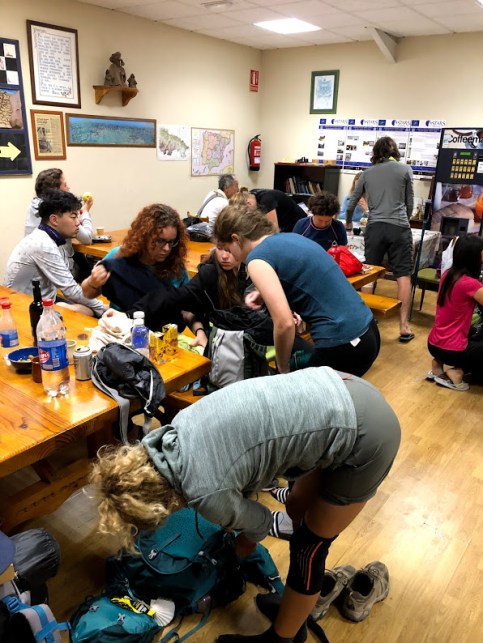
Sharing a meal in an Albergue is one of the joys of the day on the Camino 

But why go through the discomfort of sharing a stuffy dormitory with up to 90 other pilgrims, where some individuals ride roughshod over the sleeping needs of everyone else in setting their alarm clocks at 3.30 a.m and then noisily go about packing their backpack. Inevitably, there are two or three loud snorers who would keep everyone awake.

Popular Camino makes staying in an Albergue the only alternative

Sometimes there is no other choice. With more than 300,000 people now walking the Camino annually, the municipal Albergues are often the only places with beds available. Towns have had to open sports halls in the summer months to cater for the influx of pilgrims.

Such situations are real testing times for humility. What you make out of the situation in an Albergue is always a reflection of where you are at mentally.  I recall meeting a very moody and sleepy-eyed pilgrim in an Albergue last year who threatened all sorts of “warning letters to the authorities” about conditions in the Albergue. Then I noticed that her general negativity was creating an invisible wall between her and everyone else in the room.

Nothing beats the bonding spirit in an Albergue

Some pilgrims, who could easily afford better accommodation, make it a point to choose an Albergue. For, nothing beats the bonding spirit between pilgrims in an Albergue on the Camino. Meals are shared, over sometimes very intimate and emotional conversations. Blisters need to be attended to, and sometimes a doctors’ appointment has to be arranged. Impromptu singing and prayer are common on such evenings.

For low-budget pilgrims and also for those coming from countries with a poor exchange rate to the euro, the Camino would not be possible without the municipal Albergues.  The Camino is becoming more international from year to year with more South Americans and people from far-flung eastern European countries on the Path.

And, it is a joy to watch the Camino uniting people of very diverse national and cultural backgrounds. It is one of the many reasons why the Camino becomes addictive and some people walk it dozens of times.

Reino Gevers – Author, Mentor, and Consultant

https://www.reinogevers.com

                                             applepodcast         

2 Comments

Filed under Camino de Santiago, lifestyle management, Pilgrimage, psychology, spirituality, Uncategorized

Mindful walking

Najera, northwestern Spain – Preparation for a lengthy pilgrimage walk is essential.  After eight days of walking many pilgrims are arriving at the Municipal Albergue in Najera with badly blistered feet and hurting knees.


bunkbeds

Bunk beds for 90 pilgrims in the Municipal Albergue in Najera 

Most people, who walk the Camino Frances to Santiago de Compostela, start in the French town of Saint-Jean-Pied-de-Port.  It takes the hiker up a steep climb of the Pyrenees mountains to the Spanish town of Roncesvalles.  It is a good 24 kilometer or seven to nine-hour walk. Even for trained hikers, this is no mean feat.


However, if you are wearing new boots and carrying a backpack full of unnecessary clutter, your walk will soon become a chore. The Camino is not only a physical challenge but even more so an emotional challenge. Much of the first few days of walking can rekindle old stuff you thought you had dealt with years ago. It is then comforting to know that there will always be other pilgrims walking with you, going through much of the same process.

bunkbeds.2

Getting ready for the day’s walk. The hostel has to be empty by 7.30 am latest

Three parts of the Camino

Some hikers describe the first stage of the Camino as the “path of crucifixion”, the second as the transition or the walk through the “valley of death” in the heat and dust of the Meseta between Burgos and Leon.  Several guide books describe this section as boring and recommend that the hiker skip the section by taking a bus. Most people who have walked it, however, describe it as a crucial part of the Camino that they would want to have missed. A absolutely agree.

A path of rebirth

I would describe the first two sections as the mindful preparation for the last section-the “path of rebirth or resurrection”.  It is when the pilgrim has moments of absolute euphoria, gratitude, and joy. It is the feeling of accomplishment after transmuting the old stuff into revived energy.  The three parts of the Camino however, can be experienced in some form or other each day. Getting up early in the morning after a bad night’s sleep in a crowded Albergue is a challenge where the mood can be at rock bottom.  This could all change an hour later when experiencing a beautiful sunrise on a mountain top with a bird of prey circling overhead.

Having walked the Camino more than a dozen times, I decided this year to give something back in serving as a volunteer in an Albergue or pilgrims’ hostel for two weeks.  There are between 50-70 pilgrims arriving here each day. It is an enormous privilege to hear the stories of why and how they are doing the Camino. Some are doing the path the third, fourth or fifth time. Most are walking the Camino for the first time.

It is a joy to observe people from many different nationalities and cultural backgrounds bond in this shared experience of the Camino. They mostly don’t understand each other’s language. But the language of shared experience shared meals, and shared emotional ups-and-downs are universal.

Reino Gevers – Author, Mentor, and Consultant

https://www.reinogevers.com

                                             applepodcast         

Leave a comment

Filed under Camino de Santiago, lifestyle management, meditation, Pilgrimage, psychology, Uncategorized

Spiritual hot spots

Najera, Spain – The pilgrimage path or Camino de Santiago in northwestern Spain is dotted with “spiritual hot spots” where man has worshipped different deities since the earliest of times.

Different religions worshipped at the same sites

Romans built mausoleums on Celtic sites. Early Christians turned these temples into churches or chapels. According to legend, the Celts had already performed walking pilgrimages on the Camino in following the Milky Way northward. Names and religions change over time but the geographical pull of a place remains.

img_2487

The Sta. Maria de Arcos chapel near Najera, a Paleo Christian Basilica built upon a Roman mausoleum between the 5th and 6th centuries.

When the Moslems occupied most of the Iberian Peninsular they converted the churches into mosques. Later the Christians again turned the mosques into churches.

However, as humanity moves toward higher consciousness, religious belief in the form of intolerant dogma is being replaced by mystical experience. It is what many of the folk from numerous nationalities, and cultural background are seeking in the modern-day pilgrimage.

Spiritual experience versus religious dogma

Spiritual experience can only be felt. The universal intelligence or God speaks through symbols, sometimes in a message from people, we coincidentally meet.

On the Camino, wonderful sites of worship can be found in the small towns and villages. Pilgrims complain that these are often closed. There is a reason. Art thieves have in the past stolen valuable artifacts, notably „The Lamentation“ in Najera in 1913.  The 15th century was sold by Sotheby‘s for 1.46 million euros in 2008. Spanish authorities were unable to halt the auction because it was sold several times during the past century.

We only become aware of this mystical language when we remove ourselves from the bombardment of daily distractions and allow our senses to open to the magic.

Some on the Camino come just for the adventure but most of the people I’ve been talking to on the Camino during the past few days have a story. One woman told me she had come to the conclusion that there was so much more to discover than a life of silent misery.

Today I met a Paris fashion photographer who is taking a lengthy mental time-out in walking “only” a slow 10-15 km a day. In a village chapel along the way, he said he had an “experience” that could not be explained.

Reino Gevers – Author, Mentor, and Consultant

https://www.reinogevers.com

                                             applepodcast         

Leave a comment

Filed under Camino de Santiago, lifestyle management, raised consciousness, self-development, Uncategorized

Tales from a pilgrims’ hostel

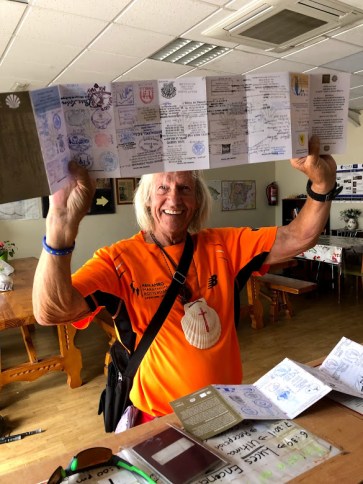
An 85-year old Dutch guy arrived here at the pilgrims’ hostel in Najera, northwestern Spain, pulling a 100-kilogram cart. While all the other arriving pilgrims were walking toward Santiago, Johannes van der Pas was going the other direction back home.

Johannes celebrated his 100th day on the Camino and has become quite a celebrity. Passing motorists have been seen waving to him. Strangers are inviting him to stay overnight after he was featured on Portuguese television while on his way to the famous pilgrimage town of Fatima.

He started walking from Eindhoven, Netherlands, then stopped in Lourdes and from there walked via Santiago to Fatima.

Pilgrim-najera1

Johannes van der Pas with his credential or pilgrim’s pass displaying all the stamps from the towns he has visited along the way.

It’s a remarkable achievement for any person, but this guy is not letting the old man in and is in better physical shape than most men half his age. He has according to my calculation, so far walked 3,340 kilometers, averaging 33.4 kilometers a day.

On occasions, he has walked all night in the rain in the remote areas of France where, in contrast to Spain, there are hardly any pilgrims hostels.

Johannes is living proof that it’s possible to remain mentally and physically active up to a high age. His recipe is simply doing a good walk every day, and shakes his head at the many people starting their walk on the Camino with little training and then complaining about sore knees and feet.

It’s my fourth day serving as a voluntary hospitalero in this town. The hostel is run by the local municipality and pilgrims are just asked to provide a donation to offset electricity and water costs. Locals living along the Camino have for centuries been generous hosts to pilgrims walking to Santiago de Compostela. The marker stones with yellow arrows on the path are almost entirely put up by local volunteers, paying for them with their own money. It is therefore sad to see that some of these markers are defaced by “Killroy was bere”  ego-minded “bypassing tourists.”

We voluntary hospitaleros are being greeted here with exceptional kindness. Restaurants have refused taking money for meals. Entry to the local museum and monastery is free of charge.

On the third day, we registered 58 pilgrims including seven from South Korea, one from Taiwan, two from South Africa, two from Bulgaria, one from Hungary, one from Venezuela, three from Japan and six from the United States and Canada. Most people are from Spain, Italy, and France as this is the main vacation period in these countries.

And, just as I’m finishing the Blog for the day two women from Greenland arrive at the door, saying that they will stay for the night as they are not used to the warm temperatures.
Reino Gevers – Author, Mentor, and Consultant

https://www.reinogevers.com

                                             applepodcast         

Leave a comment

Filed under Camino de Santiago, lifestyle management, longevity, psychology, self-development, spirituality, Uncategorized

Lessons from the Camino: Winding down

Many a pilgrim doing a walk for the first time on the Camino in northwestern Spain underestimates the physical and emotional challenges.

Most hikers start on the French Route, or Camino Frances, from Saint Jean Pied Le Port, the small French town straddling the Spanish border.  It’s a steep walk up the Pyrenees mountains. For the inexperienced hiker, this in itself can be challenging.

pilgrim_najeriaBut in the last few days, summer temperatures were touching 40 degrees Celcius in much of southwestern Europe.  A walk in the midday sun can be life-threatening and some albergues, or pilgrims’ hostels, have put up signboards, warning pilgrims not to walk between 11.00 and 3 p.m.

A path of crucifixtion?

A few pilgrims in the Albergue of Najera, where I’m serving as a volunteer for the next two weeks, are arriving with blistered feet, swollen knees and other body ailments. I always tell them that this is not a path of the crucifixion and that nobody will chop their head off if they take a break, a taxi or a bus to the next destination if their body is clearly telling them: “Slow down, take a rest, go easy.”

Subtle whispers from the universe

The Camino has so many life lessons to tell the pilgrim. Walking is an ideal way of reconnecting with body, mind, and soul. In the rat-race of day-to-day distractions, we often ignore the body’s subtle whispers telling us to slow down, to recuperate and take a time-out. If we fail to listen, these whispers will get louder, and if we still fail to heed that inner voice, the body will at some point force you to stop. It’s very much the same when we reach a deadlock during a particular life situation when the universe is telling us with obstacle after obstacle to change something.

The higher perspective

Reaching a destination should not be the objective. The real miracles happen in opening the senses to the here and now while walking. This morning I took a walk with two of my fellow volunteers, Ebi from Argentina and Carmen from Spain to the next village, Azofra.

A beautiful bird of prey took flight from a tree in the vineyard nearby, circling overhead. This animal messenger from the spirit world appeared to tell us to remain focused on the task at hand and to keep the higher perspective in mind.

Reino Gevers – Author, Mentor, and Consultant

https://www.reinogevers.com

                                             applepodcast         

Leave a comment

Filed under Camino de Santiago, lifestyle management, spirituality, Uncategorized

The walk alone

The ancient masters of all the great religions recommended time alone as a crucial means of discovering authentic self.

It was the 40 days that Jesus took for time alone in the desert to confront his own shadow and the demons of temptation.  Moses removed himself alone to Mount Sinai to receive the ten commandments from God.

Before his enlightenment the Buddha retreated for an extended time in the forests, and often went into silent retreats during his lifetime. He however cautioned that “one who goes into solitude will either sink to the bottom or rise to the top,” meaning you have to do it for the right reasons.

It is in the time spent alone that we come closest to the divine and our life purpose, especially if it is time alone in nature.

maik-fischer-522657-unsplash

The Chinese masters of the body arts such as Tai Chi and Qi Gong called the empty space between the spokes of the wheel more important than the spoke itself.

It is in that empty dark space between the stars where you can touch the divine.

Confronting distraction

We as a society are obsessed with what the wise ancients called the distractions of the 10,000 things. Countless things pull at our attention every day in this digital age:

The news media feed on negative news, the constant subliminal messages working our emotions instill a need for material things we mostly don’t need. There is confusion between necessity and want.

It is no coincidence that with the addiction to distraction there are very few people who can truly bear to spend time alone, and be without the constant chatter.

There is such a great quote from Robin Williams that really sums it up nicely:

 “I used to think the worst thing in life was to end up all alone. It’s not. The worst thing in life is ending up with people who make you feel all alone.”

We are thus constantly seeking the accolades through social media as a reassurance. But it will seldom lead you onto the path of deeper spiritual experience.

Discover self by being alone

It is during the walk alone, the time-out during a silent retreat and the alone time in nature where the gateway to the soul opens and you begin to realize who you truly are.

It is the  time when we confront our own shadow, explore the world within, and find out where we need to take the next step.

It is during the alone time that we discover the heart, the love and the divine within. It is who we truly are and that which soul wants to illuminate.

Reino Gevers – Author, Mentor and Consultant

https://www.reinogevers.com

                            applepodcast         

Leave a comment

Filed under happiness, humanity, lifestyle management, mental-health, nature, purpose, self-development, Uncategorized

Finding purpose with deep walking

My next book “Deep Walking – for Body, Mind and Soul” will soon be on the market.  It is about finding purpose during that void of inner silence that comes with deep walking.

We need to listen to nature

While writing the book I so often came to a point of writer’s block or procrastination. A new inspiration always came after going for a walk in nature. I think this is a dilemma most of us face in the modern world. We are spending too much time indoors, and it’s making us sick and moody.

IMG_0188

The disconnect from nature and the wisdom of the universe, has separated our species from the web of creation. This is why we are treating ourselves and the environment with such disrespect. What is happening within reflects what is happening in the outer world.

At the crossroads – depression and suicides have reached epidemic proportions

Humans are creative and exceptional beings. But we are very much at the crossroads where decisions made today will determine the future of our species in the next half century. I’ve said it often on these pages: The Western mind has sacrificed its soul to the golden calf of immediate external material gratification.  The result: Depression and mental illnesses have reached epidemic proportions. Something is out of order when one person commits suicide every 40 seconds. It is the second leading cause of death in the age group 15-24 in the United States!

Religious dogma from the past is not giving answers

A growing number of people are feeling this intuitively and are searching for new meaning and purpose. They are not finding the answers in the religious dogma of old that is telling us to believe in this or that. The new spiritual consciousness comes from an individual experience. It is why more than 300,000 people from all walks of life, different nationalities and faith, walk the pilgrimage path in Spain, the Camino, every year.  You can get my tips on preparing  for the Camino here: Preparation Camino.

The difference between a hike and a pilgrimage

It is a phenomenon I came across the very first time I walked the Camino in 2007. There  is a huge difference between just taking a hike for exercise purposes and going on a deep walking experience lasting several weeks, especially on a pilgrimage path walked by pilgrims for centuries.  Get my tips on preparing for the Camino here:

Nobody who walks the Camino with serious and mindful intent, comes back the same. As you walk from day to day through rain, mud and hot sun, passing village after village and climbing mountain top after mountain top, a mystery unfolds from within. When the many external distractions fall away, the empty space where we stop thinking opens and the universe, or God, can finally speak to us.

We can find this experience in meditation and other spiritual practices. I’ve found that deep walking in nature to be an exceptionally meditative experience, taking time out from the rat-race that has become our world, aligning with the above and the below with every mindful step.

Reino Gevers – Author, Mentor and Consultant

https://www.reinogevers.com

                            applepodcast         

Leave a comment

Filed under environment, happiness, humanity, lifestyle management, meditation, mental-health, psychology, self-development, Uncategorized

Are you living in a tribal bubble?

Our world is becoming dangerously fractured into tribal bubbles and we are losing our sense of a common humanity along the way.

As our world becomes more globally connected on a digital level, there is a growing tendency to align with a “tribe” that thinks, dresses, talks and believes in the same things that we do.

surya-prakosa-306484-unsplash

Photo by Surya Prakosa on Unsplash

Tribes have a tendency to build defensive walls against all those who are not members of the same community.  It is then only a small step away to see them as the enemy targeting our watering holes.

The divisive narrative on both sides of the political spectrum in the current politics is symptomatic. Extremist leaders whose narrative is threatening the very fabric of societies are being democratically elected.

We desperately need such wise leaders as Nelson Mandela, Mahatma Gandhi , Theodore Roosevelt and Dag Hammarskjöld who were multi-lateral and holistic in their thinking. Their narrative was one of serving a common humanity rather than a political ideology.

When wise leaders are at the helm,  the rest follow and an immense sense for the common good and higher purpose can result.

The western mind has very much lost its way. When there is a spiritual vacuum, loss of purpose and direction, it is fertile ground for demagogues. They fill the void in playing the “angst” game with nationalist or tribal rhetoric. Its us against them!  Political ideology has all the trappings of a pseudo-religion. Its black or white. A religious cult has the philosophy of either you believe what we tell you to or you will suffer eternal damnation.

An innate spirituality is liberated from belief.  It intuitively feels rather than believes itself connected to what is the fabric and the web that holds everything together on a different level.

When you live in a tribal bubble you will listen only to those people, and media outlets that share your opinion. You have a fixed belief and it becomes part of the ego and the self. Different opinions, irrefutable evidence and scientific fact are slated as “fake news” because they might threaten the image of a false identity that has been created.

If there is no willingness to even listen or to discern between the opinion and the humanity of the other, the inevitable result is confusion about those root cohesive and common values that solidify society.

Reino Gevers – Author, Mentor and Consultant

https://www.reinogevers.com


Leave a comment

Filed under ideology, lifestyle management, meditation, nature, psychology, purpose, self-development, Uncategorized

Nature and the Respect of the Sacred

Respect for that which is holy and sacred is closely aligned to respect for the self and self-love.

It is telling for humanity that the sacred house in which we live is being treated with such lack of mindfulness.

When you hike for hours along a country road you soon begin to notice the huge amount of trash such as plastic bags, tin cans, plastic bottles and cigarette butts that are carelessly thrown out of car windows by passing motorists.

IMG_2135It has a devastating effect on other living beings. I’ve seen cows munch plastic bags and hedgehogs trapped in rubbish.

Much can be attributed to the disconnect of modern man to his natural surroundings. Nature is a manifestation of God and not without reason have the wise teachers of old described time spent in nature as our best healer.

Any person who has spent alone time in the African bush or hiked alone for hours in pristine nature will soon become aware of the awesome marvel of creation and the interconnection of all living beings. God can be seen live and working in slow motion.

But never before in the history of mankind are we seeing such a rate of extinction of biological and animal species. The ocean waters are being polluted with plastics and the atmosphere brought into imbalance with excess burning of fossil fuels.

Humanity will only survive when we recognize that the sacred within is also the sacred without.

For centuries Christianity has had a false understanding of man’s role in nature based on misinterpretation of the old testament of the bible in Genesis 1:28 in which man is given the cultural mandate to subdue and rule over the earth.

The lost gospel of St. Thomas, that was discovered in Egypt in the 1940s, has a far more mystical interpretation of many of the biblical interpretations. Rather waiting for the Second Coming of the Christ, the lesson espoused here is all about nurturing and discovering the Christ Within−closely resembling what is described in Buddhism as discovering the Buddha Nature.

The Medieval interpretation of Nature was that of a harsh alien environment, that needed to be conquered. Paradise and a life of bliss could only be expected after death and resurrection.

In contrast the eastern Daoist tradition is all about the yielding to the laws of nature. The philosophy of the Five Elements in essence is about the right timing in accordance with the laws of nature. The harmony of objects and things in Feng Shui, the cultivation of the life-force energy of Chi in the body with nutrition, Qi Gong and Tai Chi and the ancient Book of Wisdom, the I Qing, all are built on these foundations.

We desperately need to revive the sacred places of old to help realign human consciousness. We need places of solitude, and places for meditation to quieten the mind. These also includes saving the sacred buildings of old that were often built at places with a high natural energy frequency.

Maps of medieval towns show how mindful our ancestors went about in planning their cities. The place of worship was always built on the highest plateau or center with all the other buildings in circular form around it. Shamans and geomancers were consulted so that the buildings conformed to the harmony principles of the universe.

We seem to have lost something elementary in sacrificing so much on the altar of materialism.

Reino Gevers – Author, Mentor and Consultant

https://www.reinogevers.com


Leave a comment

Filed under lifestyle management, meditation, nature, outdoor coaching, psychology, self-development, spirituality, Uncategorized