Category Archives: meditation

Defining your authentic purpose

“Each of us is an artist of our days; the greater our integrity and awareness, the more original and creative our time will become.” – John O’Donohue

Being successful and living a purposeful life is not the same thing. Success is often counted in the external trappings of wealth, fame, and youth but you could still miss the mark of what you were destined to become when you were born.

The disconnect between external and internal needs will inevitably trigger a pain often drowned in the addiction to short-lived gratifications and distractions. This is why taking time to reflect, digest, and reassess personal values and needs is so important.

Humanity is collectively transitioning to higher consciousness

The meaning of life and purpose differs for every individual but at the same time, humanity is collectively transitioning to an ever-changing evolution of consciousness. The global crisis situations we are experiencing at the moment are the very nature of the transition between the old and the new.

Austrian psychiatrist and Holocaust survivor Viktor Frankl describes the journey of creating and doing, experiencing and encountering, and cultivating a different perspective on pain and suffering. 

For eons, the largest part of humanity has essentially struggled to provide basic needs such as food, shelter, and reproduction. Our ability to walk on two legs and use our hands to shape, mold, and exploit our environment has honed exceptional survival skills, even in the harshest environments.

As social beings, humans have in communities, villages, and cities made major technological advances through division of labor. Individuals were able to specialize in skills such as carpentry, clothing manufacturing, or food production while others could spend their time studying or working on new inventions.

Moving from a culture of exploitation to one of restoration and sustainability

The downside is that we have become so successful that we are threatening the foundations not only of our own future but of most other species on Earth. Since the incremental industrialization of the 19th century natural resources have been extracted, exploited, and destroyed. The burning of fossil fuels is the foundation of our transportation and manufacturing industries but it has heated the atmosphere to such an extent that if nothing is done, life on earth will become uninhabitable for humans.

We should not be nostalgic about outmoded structures and institutions but work on new initiatives which reconnect us in search of common goals and help restore the natural balance of nature.

There is no silver arrow in finding a life of meaning and purpose. One stage of life often is a training ground for the next stage. The skillset acquired in one discipline serves another but in a different way. Growth and meaning are found where we perceive the flow of where we can engage actively with our unique abilities and creativity.

The pain and trauma of the past can either be a burden pulling you back or it was that “walk over the hot coals” that instilled the burning desire, providing the fuel that catapulted you forward into a new future.

In a spiritual context, we as individuals have been bestowed with Grace by a divine entity. We have been given unique individual talents and were born into circumstances that have put us on the trajectory of becoming who we really are.

The soul path is always edging toward fulfillment but often this path is clouded, confused, and distracted. Yet in those most extreme moments of pain and joy, there is alignment with soul purpose. You become aware that the universe is minding your back and that you are being guided into your authenticity.

Life is a constant process of learning, adapting, realigning, and ultimately growing as spiritual beings in human form. While deep walking through life, the soul is harvesting from all of life’s experiences and becoming whole.

Reino Gevers – Author – Mentor – Speaker

P.S. In my new book “The Turning of the Circle: Embracing Nature’s Wisdom for Purposeful Living” I go into more detail on this topic. It is available on Amazon and where all good books are sold. You might also find my other books “Deep Walking for Body, Mind and Soul” and “Walking on Edge: A Pilgrimage to Santiago” of interest.

Leave a comment

Filed under meditation, mental health

Nature and purposeful living

“No man ever steps in the same river twice, for it’s not the same river and he’s not the same man. Time is a game played beautifully by children.”—Heraclitus.

The seasons of life are in a constant state of expansion and contraction. Like the systolic and diastolic beating of a heart, we cannot escape the impermanence of life. During spring there is birth, growth in the summer, harvest in fall, and withdrawal in winter.

The notion that we are an integral part of nature and its natural laws was never questioned by the hunter and gatherer societies, and even so-called “primitive” societies today.

The ancient Chinese teaching of the Five Elements is very much about yielding to and synchronizing with the natural cycle of the seasons. The tenets of this philosophy is rooted in Taoist philosophy, dating back thousands of years when humanity did not see the world around us as a separate entity.

Timing with nature’s seasonal cycles

Great respect was given to the timing and expressed in elaborate ritual. There was a time to plant, a time to harvest, and a time to rest. This is still applicable today even though the necessity is clouded by the demands of modern life and its luring distractions.

Modern man has severed his ties to the natural order of things in his mad striving for material wealth and prosperity. Cut off from his spiritual roots and the natural order of things, he is filled with a deep sense of loneliness and fear, which seeks compensation for that void in boundless greed and substance abuse.

We know from numerous neurological studies that the sounds of nature, green meadows, and trees, or the gentle sound of waves breaking on the shore calm the mind.

The permanent hum of traffic noise in cities and crowded living conditions in the concrete jungles of an urban environment is alien to the human condition.

So what has led us to today’s disconnect? Paradoxically, religion, which is meant to align us with God or the universal intelligence has been abused in large parts by the institutions.

The Role of concept-based religion

A misunderstood Christianity has played a huge role in the estrangement of man from the natural world. The mystical part of Christianity was exorcised in the Council of Nicaea in AD 325. Roman Emperor Constantine I presided over the Council which defined the Christian belief and doctrine. While the mystical part of early Christianity left much room for individual spiritual experience, the doctrine clearly defined what had to be believed and what religious rules had to be followed. One of the consequences is that for centuries Christianity has had a false understanding of man’s role in nature based on the misinterpretation of the Old Testament in Genesis 1:28, in which man is given the cultural mandate to subdue and rule over the earth.

As in ancient Chinese philosophy, the old Greek, Egyptian, and Roman worlds, applied nature’s golden rule in the arts, architecture, and many other endeavors, striving to create synchronicity with nature.

On a collective level, we have to face the question of whether we have enough time to transform a system based on greed and exploitation, where only a small minority reap the rewards, into a value-based restorative nature-based system that serves the betterment of all living beings.

Reino Gevers – Author – Mentor – Speaker

One more thing...This article is an extract from my new book “The Turning of the Circle: Embracing Nature’s Wisdom for Purposeful Living”. You can preorder a Kindle edition on Amazon. Both Kindle and Paperback versions will be available in July 2023.

Leave a comment

Filed under meditation, mental health, mental-health, Uncategorized

The biggest threat to humanity is not what you think

In terms of the public narrative humanity is very much threatened by external threats such as the environmental crisis and a potential nuclear war, failing to pinpoint the major underlying cause why the vast number of human beings appear to be unaware and unable to solve the problems threatening our species.

Stress lies at the core of many relationship breakdowns, health problems, financial woes, and preoccupation with drama. The weight of past and current emotional stress is preventing millions of people from living their full potential and elevating human consciousness to another level.

Grievance culture spread by mass media is amplifying the twin shadows of anger and melancholy sadness. A person under mental and physical stress with emotions running out of control has literally lost his mind. This is what happens:

The oldest part of the brain the Amygdala, also known as the reptilian brain, is responsible for the fight or flight response that is triggered immediately when we are under duress. We feel increased anxiety, fear, or anger. Impulse control or rational thinking that we find in the prefrontal cortex of the brain is shut down.

Elevated levels of stress hormones in the body such as cortisol can further impair emotional response. Trauma from the past can be triggered by a mere thought if we have not learned how to transmute that thought.

How many adults in the world are living in the bodies of the hurt inner child?

Carl Gustav Jung, the notable Swiss psychiatrist, and psychoanalyst, often referred to these unconscious aspects of the human psyche that collectively posed the greatest threat to humanity. A repressed hurt or denied aspect of the “shadow” of the human personality could manifest in destructive behaviors on a larger scale.

A repressed feeling or hurt can be a boiling cauldron just waiting to explode as we have seen and are seeing in many tyrants and authoritarian rulers.

Many historians believe that the roots of Adolf Hitler’s cruelty were buried in his childhood. An abusive father and several other personal humiliations following Germany’s defeat in World War I may have contributed to Hitler’s deep-seated anger, resentment, and desire for power and control.

But while some abused children end up being angry and resentful adults others manage to transmute such trauma into something positive. A mind at peace has learned to reconcile itself with the past.

How do you create peace of mind?

It is still somewhat of a mystery why some people learn and grow from adversity while others succumb to the blame game and stay stuck in the quagmire of grievance culture.

One of the key factors appears to be the capacity of self-reflection and willingness to engage in personal growth. Persons willing to examine their thoughts, beliefs, and behaviors gain valuable insights into their patterns and make necessary changes. It involves the humility of taking responsibility for one’s actions, and actively seeking out personal development resources, such as therapy, counseling or mentoring.

You are never done in the self-healing and self-development process. The higher you develop your spiritual consciousness and leadership skills, the higher will be your challenges but also your opportunity for further growth. Zen masters encourage practitioners to embrace adversity as an essential part of life’s journey. They teach that difficult circumstances provide opportunities for growth, self-discovery, and spiritual development. Adversity can be a catalyst to dig deep into inner resources and wisdom.

Take a walk in nature

Some of the world’s greatest writers, philosophers, and musicians spent alone time walking in nature to realign and stimulate their creativity. Meanwhile, several studies conclude that natural sounds such as the flowing waters of a creek, bird song, and the blue and green spaces significantly help reduce stress hormones in the body, lowers blood pressure, and improve heart variability.

The mere act of walking can release endorphins, reduce stress, and improve your mood, which can, in turn, enhance cognitive function and creative thinking. By stepping away from the distractions and demands of daily life, you can enjoy a sense of freedom and foster a deeper connection to the higher self.

Henry David Thoreau, the renowned American writer, philosopher, and naturalist said: “In wildness is the preservation of the world. Every tree sends its fibers forth in search of the wild. The cities import it at any price. Men plow and sail for it. From the forest and wilderness come the tonics and barks which brace mankind.”

Reino Gevers – Author – Mentor – Speaker

One more thing...If you have found this article interesting you might want to subscribe with the “follow” button above or recommend my FREE weekly Blog to friends and family. My books can be ordered at all places that sell good books in both paperback and kindle.

Leave a comment

Filed under meditation, mental health, mental-health

Moving beyond religion

One of the greatest obstacles to the elevation of consciousness is a mindset cemented into the “isms” of fixed belief, ideology, religion, or philosophy. It has been the root cause of much human suffering over the centuries.

With much of traditional religions having succumbed to the practice of empty rituals, the spiritual vacuum is being filled by political preachers and ideologues fanning the flames of fanaticism.

If the shutters to the mind remain closed there is no sunlight that can penetrate the inner room. The mind is captured in the conceptual prison of a one-sided truth. All the others are wrong, belong to the wrong crowd, the wrong tribe, and the wrong race, gender, or religion. There is a disconnect with soul authenticity.

Yet, innately we are spiritual beings living in a human form.

In a famous 1959 BBC interview, Carl Gustav Jung was asked whether he believed in God. The pioneering psychiatrist and psychoanalyst responded: “I don’t need to believe, I know.”

At the time the remark caused some controversy because Jung did not subscribe to a particular religion or doctrine but viewed spirituality as a fundamental aspect of human nature that could be explored through personal experience.

In a similar vein, the great scientist Albert Einstein was skeptical of organized religion and the concept of a personal God, but had great respect nevertheless for the ethical teachings of especially Buddhism and Judaism.

In Ideas and Opinions Einstein stated, “In their struggle for the ethical good, teachers of religion must have the stature to give up the doctrine of a personal God, that is, give up that source of fear and hope which in the past placed such vast power in the hands of priests.”

The human mind is too small to grasp the universe

According to Einstein, the universe is vastly complex and the concept of “God”, as explained by religion, far too simplistic.

“The human mind, no matter how highly trained, cannot grasp the universe. We are in the position of a little child, entering a huge library whose walls are covered to the ceiling with books in many different tongues. The child knows that someone must have written those books. It does not know who or how. It does not understand the languages in which they are written.

“The child notes a definite plan in the arrangement of the books, a mysterious order, which it does not comprehend, but only dimly suspects. That, it seems to me, is the attitude of the human mind, even the greatest and most cultured, toward God. We see a universe marvelously arranged, obeying certain laws, but we understand the laws only dimly. Our limited minds cannot grasp the mysterious force that sways the constellations.”

Einstein was convinced that everything was determined by forces over which we have no control, all of creation from the insect, to the human being and the stars dancing “to a mysterious tune, intoned in the distance by an invisible piper.”

Religion has for eons imposed it’s view of God and creation on humanity, most often using it as an instrument of control and manipulation. Those who did not conform to conventional doctrine and dogma were at times and still today in some countries are brutally persecuted.

A unifying force permeating creation

Many of the Mystic teachers tend to avoid using the term “God” because of the many misunderstandings this has caused.

Instead of a judgmental deity, they rather speak of a unifying force that permeates all of creation. Rather than believing in dogma or theology imposed externally by a religion they believe that “God” can be experienced through contemplative practices such as meditation, prayer, and mindfulness practices such as deep encounters with nature, art, and music.

Einstein’s hope was that the “religion” of the future would be “a cosmic religion” liberated from dogma and theology.

“Everything is energy and that is all there is to it. Match the frequency of the reality you want and you cannot help but get that reality. It can be no other way. This is not philosophy. This is physics.”

The parallels between the thinking of physicists such as Einstein and the Mystics of the early Middle Ages is profound.

The 13th-century Mystic Meister Eckart believed that God was beyond all form and creation and that the ultimate goal of the spiritual path was to transcend the limitations of the physical world and attain union with the divine. God was present in all things, and everything in creation was a reflection of the divine, the physical world an expression of the spiritual realm.

To put it simply creation is constantly changing form in an endless cycle of birth, life, death, and rebirth. Our purpose in life is to grow and evolve into ever higher consciousness.

The spiritual teacher and author Richard Rohr emphasizes the importance of recognizing the divine in all people, regardless of their background or beliefs. He believes that love and compassion are the most important aspects of spirituality and that they should be expressed through service to others and a commitment to social justice.

The Irish, poet, philosopher, and priest John O’Donohue describes the beautiful complexity of growth in consciousness within the human soul:

“It is helpful to visualize the mind as a tower of windows. Sadly, many people remain trapped at the one window, looking out every day at the same scene in the same way. Real growth is experienced when we draw back from that one window, turn, and walk around the inner tower of the soul and see all the different windows that await your gaze. Through these different windows, you can see new vistas of possibility, presence, and creativity. Complacency, habit, and blindness often prevent you from feeling your life.”

Reino Gevers – Author – Mentor – Speaker

One more thing...If you have found this article interesting you might want to subscribe with the “follow” button above or recommend my FREE weekly Blog to friends and family. My books can be ordered at all places that sell good books in both paperback and kindle.

Leave a comment

Filed under meditation, mental health, mental-health, spirituality

Realigning with the heavenly ladder

The sages of old teach that every individual latently can achieve the heights of mental and spiritual capacity but that most people impose limitations upon themselves that prevent them from living their full potential.

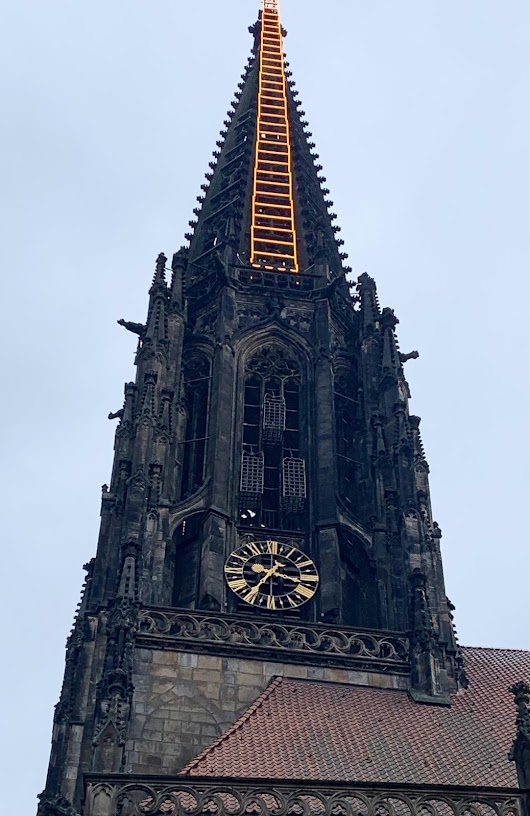
Last week I visited the northwestern German town of Münster, famous for the Peace of Westphalia treaty of 1648 ending the 30-year war. It closed a terrible chapter in European history of warfare between not only nations but between Protestants and Catholics, claiming the lives of about eight million people.

The artist Billi Tanner aptly chose the Lamberti Church in the center of the city to install a golden-lit “heavenly ladder” extending from within the church to the spire on the exterior.

She says about her work: “During these times the heavenly ladder (from Jacob‘s dream in Genesis 28,12) stands primarily for the three divine values hope, faith, and love. If all people were to live by that wouldn‘t that be wonderful? “ The biblical story tells us that while fleeing from his brother Esau, Jacob saw in a dream Jacob a ladder, or staircase, reaching into heaven with angels going up and down it.

The heavenly ladder has become a powerful symbol connecting the heavenly realm with our earth-bound purpose. It can be interpreted as the step-by-step ascent to spiritual growth in becoming who you were meant to become from the day you were born but also as a symbol of the descent from heaven of angels who guide us on this path.

A firm base as a precondition to higher experience

The steps on the ladder are passages of initiation as we progress and grow through life. Alignment with both heaven and earth, our mental and physical capabilities is essential. If you learn to understand yourself you can basically accomplish everything.

A ladder not rooted to earth will fall, meaning that you need first and foremost to have a firm foundation as a precondition to higher experience. The Jewish Mystics were very aware of this, teaching their scholars to master a basic trade to earn a living. Work was seen as an important tool of training for higher consciousness. Taking a proper attitude to whatever we are practicing as a craft was seen as decisive in training inner traits such as clarity of thought, reliability, and self-discipline. Earning a livelihood was seen as central to finding a divine purpose.

While the base of the ladder was firmly grounded the pinnacle of the ladder stretched all the way to heaven and paradise. But action is necessary by taking each step up the rung. Symbolically all that you experience in life is a school for the elevation of consciousness and the precondition to taking the next step. You have to go through a new period of apprenticeship each time.

The ascent up the ladder is ultimately an ascent to another dimension as we walk through the path of life. We are called upon to climb the celestial ladder with growing awareness, and not to be pulled downward by the forces of distraction. What we are experiencing on an individual level is also experienced by humanity on a collective level. During these times of renewed talk of war and confrontation between nations, we should never lose our capacity for faith, hope, and love.

Reino Gevers – Author – Mentor – Speaker

One more thing...If you have found this article interesting you might want to subscribe with the “follow” button above or recommend my FREE weekly Blog to friends and family. My books can be ordered at all places that sell good books in both paperback and kindle.

Leave a comment

Filed under meditation, mental health, mental-health

The power of self-love

The first principle is that you must not fool yourself and you are the easiest person to fool.”

Richard P. Feynman

The need for self-love as the precondition to giving love is a key to many spiritual teachings. At the heart of much self-destructive behavior, and the addiction problems we see in the world today are the rejection and contempt of self.

You cannot love and accept yourself without unconditionally accepting the shadows within. You have to learn to accept that you are an incomplete human being.


The hypocrisy that often underlies institutionalized religion stems from the notion that those who don’t believe and behave the same way that we do are in some way inferior and lesser human beings. When you are in denial of your own inadequacies and weaknesses you will see them more pronounced in others.

The beginning of forgiveness


The beginning of forgiveness begins with the forgiving of self. The seeds of inadequacy and lack of self-esteem are planted early in life by social norms or misguided parental pressure.


Failure and missteps are part of the human condition. As the sages and Mystics teach us: They are the stepping stones to self-awareness and self-love. By learning to forgive yourself you can accept and learn to forgive others.

The scriptures teach us that “If you forgive others their sins, they are indeed forgiven. If you withhold forgiveness from one another, they are held bound.” (John 20:23).

Photo by cottonbro studio on Pexels.com


The more addicted we become to a preferred self-image the more judgemental we become. But it is precisely the relationship difficulties, conflict situations, failures, and disappointments of life that mirror the shadow aspects within. These are the aspects in need of acceptance or transformation that help elevate you to a higher vibrational energy, your inner power, and strength.

Surrendering to life


Surrendering to life is complete surrender to that which is greater than any image of self and the essence of what is the vulnerability of body, mind, and soul. It is what Paula D’Arcy describes as “God comes to us disguised as our life.”


As the spiritual teacher, priest, and author Richard Rohr explains: “Surrender is not giving up, as we tend to think, nearly as much as it is a giving to the moment, the event, the person, and the situation.”

Life happens. You cannot change what has happened in the past. Taking a different perspective can transmute feelings of pain and guilt. A personal mantra of forgiveness could be:

“I release at this moment the attachment to the pain and the melancholy sadness to that which was and is no more. I love and accept myself the way I am. I love and accept my true soul nature. I am in loving care and kindness to myself and others.

Reino Gevers – Author – Mentor – Speaker

One more thing...If you have found this article interesting you might want to subscribe with the “follow” button above or recommend my FREE weekly Blog to friends and family. My books can be ordered at all places that sell good books in both paperback and kindle.

Leave a comment

Filed under meditation, mental health, mental-health, spirituality, Uncategorized

Improve your life with this daily habit

What the ancient spiritual teachers and sages knew all along is being confirmed by modern research. Meditation and mindfulness training has a major positive impact on brain health in helping to lower stress hormones and reducing fear and anxiety.

Tragic events in the external world are magnified by mass media which in turn amplifies a general atmosphere of fear and anxiety. We can easily have the feeling that we are losing control. Whole societies and nations can fall into fear and flight mode.

In contrast, a calm mind remains focused, putting events into realistic perspective. It is solution orientated rather than being tugged into all directions by the emotions of fear, hate, and anxiety.

Harvard researcher Gaelle Desbordes has performed functional magnetic resonance imaging scans on persons before and after an eight-week course in mindfulness-based cognitive therapy.

Desbordes’ interest in the topic stems from her personal experience when she began meditating in seeking respite from stress. Her experience convinced her that something real was happening and prompted her to study the subject more closely, in the hope of shedding enough light to underpin therapy that might help others.

Other researchers, including Sara Lazar, in 2012 used MRI to show that the brains of subjects thickened after an eight-week meditation course.

Especially those meditation techniques incorporating breathing, prayer and the humming of mantras measurably reduce stress hormones such as cortisol and adrenaline.

I interviewed for my Podcast Kara Goodwin, who has made the transition from the stressful corporate IT world, into becoming a meditation teacher. She says that we cannot hope to find solutions to the problems in the external world if we don’t do the work within at the same time.

You can check out her work and courses at http://www.karagoodwin.com

Buddhist teacher Thich Nath Hanh said: “Meditation is not evasion. It is serene encounter with reality.”

And, according to Amit Ray: “Suffering is due to our disconnection with the inner soul. Meditation is establishing that connection.”

Every person obviously has different needs and expectations from practicing meditation. Mostly people starting off with the practice give-up in frustration because their expectations are too high.

We can do the traditional sitting meditation, slow movement meditation in yoga and qi gong or deep walking in nature. However, the big changes don’t come overnight, It’s the small little steps practiced as a daily habit that have the compound effect that brings the change long-term.

Jim Rohn once said: “Success is nothing more than a few simple disciplines, practiced every day.”

Check out also the following Podcasts on the power of meditation:

Kara Goodwin: Healing the inner and outer world

Cassandra Bodzak: Designing your life with meditation

Breathing into health and wellbeing

Power meditating into your day with this guided meditation

Reino Gevers – Author – Mentor – Speaker

One more thing...If you have found this article interesting you might want to subscribe or recommend my FREE weekly Blog to friends and family. My books can be ordered at all places that sell good books in both paperback and kindle.

2 Comments

Filed under meditation, mental health, mental-health

The biggest obstacle to personal growth

“Sometimes success needs interruption to regain focus and shake off complacency”

– Lennox Lewis-

If there is one positive outcome of the pandemic it is that a growing number of people are seeking spiritual meaning and truth with the specter of death serving as a daily reminder of the impermanence of life.

A culture, feeding on the need for immediate gratification and the addiction to more of everything, is inherently disconnected from the spiritual. Complacency and familiarization are the enemy of spiritual growth and raised consciousness.

Success inevitably breeds complacency

It is a dangerous time when the ego shines in its glory and becomes immune to any type of criticism or alternative suggestion. I was recently told the story of a very successful young stockbroker who earned millions but then through a string of bad decisions ended up broke, losing his wife, home, Ferrari sports car, and all the other trappings of wealth. He had failed to foresee market changes, hear the warnings, and adapt accordingly.

Familiarization and relationship decay

In relationships, we fall into the trap of familiarization where we become blind to the positive attributes of our partner and take everything for granted. There is that initial high in the romantic phase where everything is seen through rosy eyes. Then reality starts to set in. The nuances of change, beauty, and preciousness are being taken for granted. A negative cloud of boredom, unhappiness, and familiar routine stifles all creativity and growth. Both partners fail to adapt to inevitable changes in personal needs each blaming the other for their unhappiness.

We take friends, family, colleagues, and long-term business partners for granted, forgetting to give them the validation that every human being yearns for until they are no longer there and we ask ourselves why we didn’t find the time to show them mindful appreciation.

Photo by Pixabay on Pexels.com

What comes after reaching the pinnacle of success?

We see it time and again with highly successful athletes, movie stars, politicians, and entrepreneurs. Once they have reached the pinnacle of success it doesn’t get any better. Popstar Michael Jackson became deeply unhappy, losing his vast fortune when he realized that he would never again repeat the success of his single “Thriller” that topped the charts in 13 countries and sold more than seven million copies in the US alone.

Life purpose and meaning change several times during a lifetime. Impermanence is the seed that is sown by the universe to keep us inflow and to prevent us from falling into the trap of complacency that is defined as a feeling of smugness or uncritical satisfaction with oneself or one’s achievements.

It is our destiny to constantly grow, adapt, change, and learn to be alert and curious

It is a recipe for unhappiness when you start losing your curiosity and the willingness to learn. We are living in an age when we have all the knowledge of the world at our fingertips. Isn’t it time to start a new hobby, learn a new language, or build something? Check out even simple courses of learning that you can download for a cheap fee here.

How many people that you know are saving all their energy for the day when they retire and can finally start living the life of their dreams. When the day comes they discover that they have all the time chased an illusion. The body decides that it is no longer needed and succumbs to illness and decay.

The biggest myth about our daily lives of “stressful living” is that stress is inherently bad. A more or less permanent emotional and physical stress situation indeed is very unhealthy and will inevitably lead to serious mental and physical illness.

But when we are in a healthy sprint and recovery cycle short bouts of stress trigger those energies that we need to overcome a challenge. We sometimes need that extra burst of adrenaline to score a goal and to focus all our intention on a victory.

Facing a global challenge such as the pandemic is also a huge chance for humanity to grow both on a collective and individual level. Our world will never be the same again. The great Buddhist master of mindfulness teaching Thich Nhat Hanh, who died last week at the age of 95, once said: “It is not impermanence that makes us suffer. What makes us suffer is wanting things to be permanent when they are not.”

Reino Gevers – Author – Mentor – Speaker

One more thing...If you have found this article interesting you might want to check out our courses, retreats and books and ask others to also subscribe to this Blog.

Leave a comment

Filed under meditation, mental health, mental-health

A lifetime wasted on the treadmill?

With only a few weeks left to the end of another year you might once again have thoughts of how “time flies” and feel a little melancholy sadness about the things you had on your to-do-list and have had to postpone.

Our culture is obsessed with time as we rush from one appointment to another or try to squash as much activity as possible into leisure hours.

During this week I did a workshop with participants from diverse establishments ranging from public service to production with some of the companies registering absenteeism due to illness of up to twenty per cent. Our hurried and just-in-time economies are not only unsustainable but are having a major impact on physical and mental health.

A life spent in haste is a wasted life

In Germany alone the number of mental illnesses, mainly job-burnout, has doubled in the past decade. In the United States a study revealed that a frighteningly high number of employees are experiencing symptoms of fatigue and burn-out. It is seldom talked about but many victims of the pandemic have been people with an already weakened immune system caused by work stress and other factors.

When your body is flooded with stress hormones such as cortisol and adrenaline you will have difficulty slowing down, relaxing and spending time alone in solitude.  Moreover if stress hormones remain at a constantly high level over months and even years your body’s natural defense systems and key body organs are being steadily weakened.

I know people who feel extremely uneasy if they don’t have the television in the house switched on 24-7 or don’t have loud music playing in the background. On a subliminal level the body senses never have time to recuperate.

Time for the soul to catch up

You think you might just google a quick question and already you have been hooked and sidetracked into  spending hours of precious “lifetime” on social media.

During my childhood my grandfather, a farmer in South Africa, loved to tell the story when he gave a lift  to an elderly Zulu man. After sitting quietly next to my grandfather in the pickup truck the Zulu man asked my grandfather to stop for a minute to help his soul catch up as it had been left behind by the speed at which they had been travelling.

The Zulu people at the time lived with their senses closely attuned to the laws of nature, getting up at sunrise and retiring for sleep soon after sunset. They often joked about the ways of the white man and why he always seemed  to be in a hurry and living life according to the clock.

Hurried people make mistakes

It’s an old wisdom. When we are in a hurry we are more likely to make mistakes. We miss important way markers along the road when we go into a stressed-out tunnel vision. We fail to hear the whispers from the universe telling us that we have placed our ladder against the wrong wall.

It brings to mind that in the pre-industrial era the main mode of transport for most people was walking from A to B with the body finding its natural rhythm during walking. The advances of technology have given mankind the possibility of flying from one continent to another within hours. We can cover a journey by car that took our ancestors weeks or months on horseback or carriage. The downside is that our mode of travel is contributing to the warming of the earth’s atmosphere and that the speed at which we are travelling is giving us less time to reflect and internalize the experience of the immediate surroundings.

Eternity lies in the full experience of the here-and now

The great spiritual masters throughout the ages teach us that eternity lies in the experience of the “here-and-now.” It is when we are aligned completely with the activity we are doing and time somehow seems to have become irrelevant. It is when we find peace in meditation and feel the immediacy of each in and out breath. Or, when we feel at one and in synchronicity with a natural sound of nature.

Photo by Mike van Schoonderwalt on Pexels.com

One of the blessings of the pandemic lockdowns is that it has forced millions of people to slow down and reflect. What do I want to do with the rest of the days of my life that I have left? Do I really want to spend a good portion of my day stressing in a commute to an unfulfilling job while I’m not  seeing my children growing up? What contribution can I make to make a positive impact on the world?  What is depleting my mental and physical energy  and what is boosting my energy on all levels?

Life is too short to be wasted with things unimportant on the journey that is life.  More and more people are realizing the importance of slowing down, realigning and just enjoying the beauty of autumn colors reflected in a stream or the sound of migrating geese flying above.  Priorities are starting to shift and it’s a good thing.

Reino Gevers – Author – Mentor – Speaker

One more thing...If you have found this article interesting you might want to check out our courses, retreats and books and ask others to also subscribe to this Blog.

Leave a comment

Filed under meditation, mental health, mental-health

Food for thought

„Walk as if you are kissing the Earth with your feet.” – Thich Nath Hanh

Day  2 on the Via Francigena – Gambassi Terme to San Gimignano

On a hilltop between the medieval Tuscan towns of Gambassi Terme and San Gimignano the pilgrim enters the village of Pancole famous for the 15th century painting by Pier Francesco Fiorentino of the “Virgin feeding her Son.”

The original sanctuary was built in 1668 on the site where the sacred image originally stood along a country road where it had been abandoned and covered by undergrowth. Several miracles were attributed to the Madonna.

One of the miracles is the survival of the painting itself after the Nazis destroyed the original sanctuary in an act of indiscriminate vandalism in a bid to destroy the very soul and ancestral roots of a nation.

The sanctuary was reconstructed in 1949 and along with the nearby Monastero di Bose offer wonderful spaces for quiet  contemplation.

Landscapes that inspired poets and artists throughout the ages

It is no surprise that spectacular landscapes and the quiet pathways throughout the centuries inspired poets, musicians and religious orders

Spending hours in the heart of nature after only a few days of walking opens the heart and mind to the whispers from the universe.

You are forced to go slow up the steep inclines and then you begin to notice the small creatures on the ground such as the lizards, beetles, ants, and butterflies.  When in a hurry it is easy to mindlessly trample on these small creatures who are all fighting for survival when perceiving the heavy boots of an oncoming pilgrim.

St. Francis – the original ecologist

There are numerous stories of St. Francis, the patron saint of the animals, communicating and preaching to the animals as fellow creatures of God.  The saint was well known to walk long distances to spread his message and there are no numerous shrines on the Camino in Spain and along the Via Francigena dedicated to him.

St. Francis can be described as the original ecologist and his central message of social justice and greed causing harm to both the victim and the perpetrator ringing more true than ever.

Spending time in nature creates awareness on how complex the interaction of plant, insect, bird and mammal are intertwined and co-dependent on each other.  Nature starts tilting into imbalance when one species gains dominance and threatens the livelihood of all others. It is offers much food for thought.

Reino Gevers – Author. Mentor. Speaker

One more thing…

You might want to check out my new book “Deep Walking for Body, Mind and Soul” released as a paperback by Morgan James Publishing on August 11, 2020. It has some valuable tips on creating happiness and boosting your vibrational energy on many levels. You can order it at all major outlets such as Amazon, Barnes and Noble or in my own store.  Check out the latest five-star reviews on Goodreads.

This image has an empty alt attribute; its file name is bookcovers_sideview.jpg

“A breathtaking, captivating, transformative walk,” – Tom Dutta, Canada

“The book reminded me of my own journey in life I am walking and how bringing stillness to my busy life and mind is essential.” – Karin, France

“The book compresses on its slim 190 pages an extreme density of life wisdom.” Christina Germany

Leave a comment

Filed under Camino de Santiago, environment, meditation, Pilgrimage, self-development, spirituality