
There is a single man standing with his arms crossed in defiance while surrounded by a sea of German dockworkers raising their arms in the Nazi salute. The image was taken on 13 June 1936 in the port of Hamburg and rediscovered decades later, in 1991, when it quickly spread around the world.
The man was later identified as August Landmesser.
The occasion was the launch of a naval training vessel attended by Adolf Hitler—a ceremony designed to project unity, obedience, and ideological conformity. Against this backdrop, Landmesser’s refusal to salute stands out as an act of rare moral clarity. It was a small gesture, almost understated, yet it carried immense personal risk—and ultimately, tragic consequences.
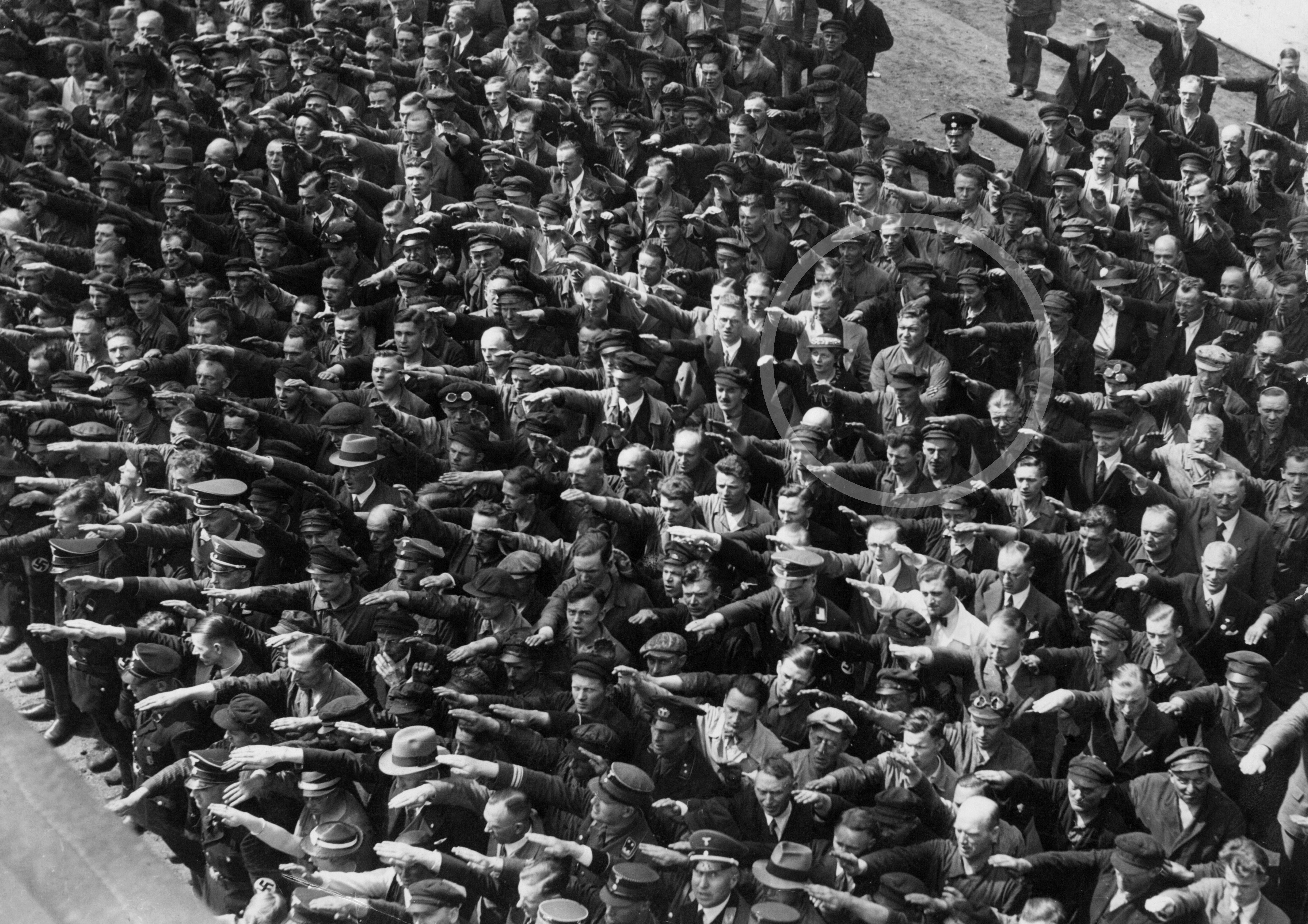
The individual who stood against the crowd
Landmesser’s story is not one of abstract heroism but of lived contradiction. He had joined the Nazi Party in 1931, reportedly to secure employment. Yet his life took a decisive turn when he fell in love with Irma Eckler, a Jewish woman.
Under the racial laws of the regime, their relationship was forbidden. He was expelled from the party. Still, they remained together and had a daughter in 1935. Their refusal to separate led to their arrest in 1938. Landmesser was imprisoned, later conscripted into a penal military unit, and is believed to have died in action. Eckler was deported and murdered in the Ravensbrück concentration camp in 1942.
Seen in this light, the photograph is no longer simply symbolic—it is deeply personal. Landmesser’s defiance was not ideological theatre. It was the visible expression of a man whose life had already been shattered by the system he refused to endorse.
The individual mind versus the herd mind
The image endures because it captures a perennial tension: the individual conscience set against the force of the collective.
Crowds possess psychological gravity. Individuals who, in isolation, might act with restraint and judgment can become unrecognizable when absorbed into a mass. We have seen modern echoes of this dynamic in events such as the January 6 United States Capitol attack, where ordinary citizens were swept into a collective surge that overrode personal responsibility.
Western societies place a high value on individual freedom and self-expression. Yet beneath this, there often lies a spiritual disconnect that makes the pull of belonging all the more powerful. Identification with political movements, brands, cultural tribes, or even sports teams can take on a “religious” intensity. The need to belong can, under certain conditions, eclipse the capacity to think.
When consciousness gives way to the collective
The Swiss psychiatrist Carl Gustav Jung, who studied the psychological undercurrents of totalitarianism, drew a sharp distinction between the individuated mind and what he termed the collective unconscious.
He warned that as groups enlarge, consciousness tends to diminish. The ethical and reflective capacities of the individual are diluted, replaced by something more primitive, more reactive. In his words, the psychology of large crowds tends to descend to a more instinctual, even “animal” level. What emerges is not an elevation of shared wisdom, but often a regression into emotional contagion.
This is not merely a historical observation. It is a recurring human pattern.
The modern amplification of the herd
We are living through a period of accelerated change where vigilance and discernment are no longer optional—they are essential.
The digital ecosystem has intensified the dynamics Jung described. Large segments of mass media and social platforms no longer function primarily as vehicles of information, but as engines of emotional activation. Content is optimized not for truth, but for engagement—often by triggering fear, outrage, or tribal loyalty.
Distortion, simplification, and conspiracy narratives thrive in such environments. The line between information and manipulation has become increasingly blurred.
There are early indications that major platforms are beginning to acknowledge their role in this landscape. But structural incentives remain largely unchanged.
A practical line of resistance
Landmesser’s gesture invites a question that is as relevant now as it was then: what does it take to remain inwardly independent in the face of collective pressure?
A useful starting point is deceptively simple:
When you encounter a piece of information that provokes an immediate emotional reaction—pause.
Ask yourself:
- What is the source of this reaction?
- What intention might the communicator be pursuing?
- Does this information serve clarity—or does it seek to agitate?
These questions create a small but decisive space between stimulus and response. In that space, the individual mind can reassert itself.
Sometimes it simply takes courage to refuse to roar like the crowd, to stand still, and refuse to follow.
Reino Gevers – Host of the LivingToBe podcast
P.S: If you enjoyed this article you might be interested in reading more in “Deep Walking for Body, Mind and Soul” published by Morgan James, New York. Get it today on Amazon, Barnes & Noble and where all good books are sold.


 ReinosBlog