“Be willing to be a beginner every single morning.” — Meister Eckhart
There was a time in my life when I believed I had to hold everything together by sheer work and effort. If I paused, I feared I would disappear. Only later did I begin to understand that disappearing was not the danger I imagined. It was, in fact, the return.
Life is something like a ripple on the ocean, momentarily appearing, briefly defined, then gently dissolving back into the vastness from which it came. The ripple feels separate while it lasts, yet it has never been anything other than the ocean. This simple image has accompanied me through many seasons of exhaustion, loss, and quiet awakening.
The mystics gave language to what I was slowly learning through experience. The 13th-century Mystic Meister Eckhart puts it into words: “The eye with which I see God is the same eye with which God sees me.” If this is true, then separation is not the final truth of a lifetime.
When Separation Feels Real
For many years, separation felt very real to me. I lived on the surface—busy, capable, outwardly functional—while something deeper waited patiently. I now recognize how easily we mistake movement and activity for meaning. Eckhart’s warning feels almost tender in hindsight: “As long as you are seeking God, you are not yet aware that you have found Him.” I was always seeking, rarely resting.
The poet-mystic Rumi names this restlessness with compassion: “Why are you so busy with this or that or good or bad; pay attention to how things blend.” When you allow things to blend, you surrender to strength, vulnerability, certainty, and doubt, faith and the unknowing.
The Descent That Saved Me
My own turning point came not through achievement, but through fatigue. I had reached a place where distraction no longer worked. What emerged instead was a quiet invitation to walk—both literally and inwardly. An annual pilgrimage became my way of consenting to descent.
One day, on the Camino Primitivo in northwestern Spain, I found myself struggling up a steep mountain path amid darkness and driving rain. Each step felt heavy. The trail seemed endless, and my inner landscape matched the weather—tight, effortful, and discouraged.
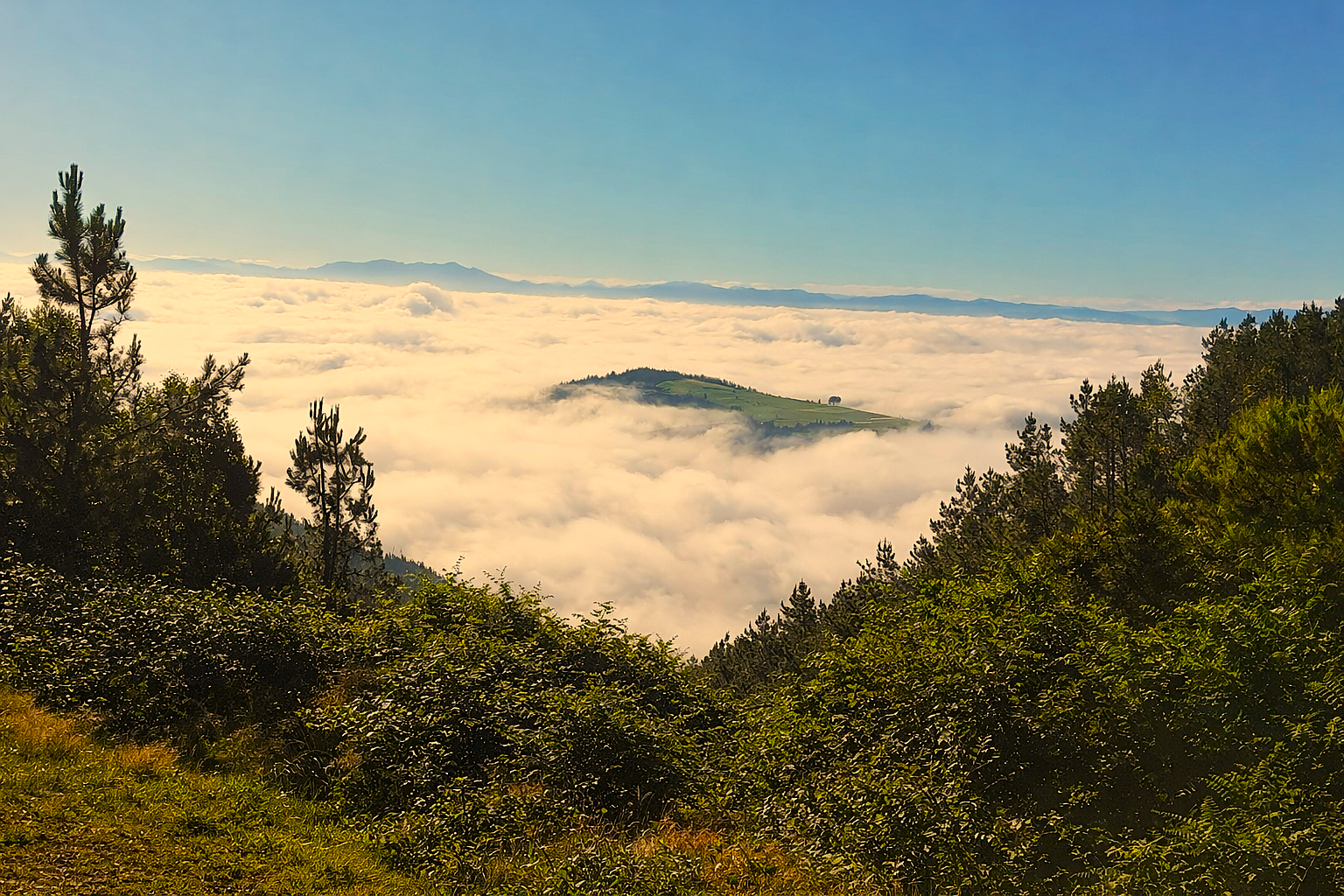
Then, without warning, the heavens opened. The rain softened, the clouds lifted, and beneath me appeared a vast sea of clouds stretching all the way to the horizon. The shift was almost instantaneous. Within seconds, my mood changed completely. Where there had been struggle, there was awe. Where there had been resistance, there was gratitude.
I stood there, soaked and breathless, perceiving not only the incredible beauty of that moment, but the beauty of life itself. I felt truly blessed—not because anything had been solved, but because something had been revealed. I had crossed a threshold without even realizing it.
The Christian mystics speak of this movement without sentimentality. John of the Cross calls it “the dark night,” a phrase that once frightened me. Now I hear it differently: as a stripping away of the onion layers of what no longer carries life. What felt like loss was actually a clearing.
Living Lightly on the Surface
It is so easy to confuse your ripple with your worth. There is a deep need to be seen, to be heard, and to be validated. But it can create much pressure. Accept who you are with loving kindness, and the old burden of control is no longer that important. Meister Eckhart’s invitation is simply: “Let go of yourself and you will find yourself.” This letting go is a daily practice rather than a single event.
To live as a ripple is to accept impermanence without fear. To rest as the ocean is to trust belonging without proof. Somewhere between the two, a quieter wisdom emerges.
A Gentle Invitation
A Pilgrimage to New Beginnings grew out of this lived knowing. It is not about fixing what is broken, but about remembering what has never been lost. If these reflections echo something in your own life, you are warmly welcome to join.
The reservation window remains open for ten more days—not as an urgency, but as an invitation to step across a threshold.
The ripple does not need to earn its place in the ocean.
Reino Gevers – Host of the LivingToBe podcast
P.S. For those who feel drawn to explore this in-between season more intentionally, I am offering a six-week online course, Pilgrimage into New Beginnings. It is a quiet, reflective journey for times of transition, starting March 4th.






 ReinosBlog