Category Archives: psychology

Mindful walking

Najera, northwestern Spain – Preparation for a lengthy pilgrimage walk is essential.  After eight days of walking many pilgrims are arriving at the Municipal Albergue in Najera with badly blistered feet and hurting knees.


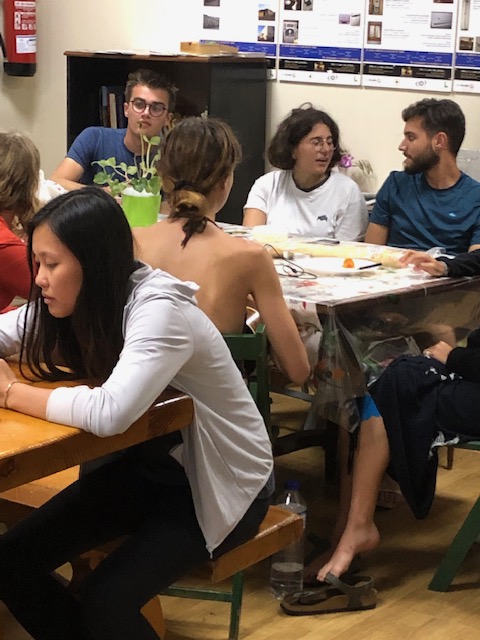
bunkbeds

Bunk beds for 90 pilgrims in the Municipal Albergue in Najera 

Most people, who walk the Camino Frances to Santiago de Compostela, start in the French town of Saint-Jean-Pied-de-Port.  It takes the hiker up a steep climb of the Pyrenees mountains to the Spanish town of Roncesvalles.  It is a good 24 kilometer or seven to nine-hour walk. Even for trained hikers, this is no mean feat.


However, if you are wearing new boots and carrying a backpack full of unnecessary clutter, your walk will soon become a chore. The Camino is not only a physical challenge but even more so an emotional challenge. Much of the first few days of walking can rekindle old stuff you thought you had dealt with years ago. It is then comforting to know that there will always be other pilgrims walking with you, going through much of the same process.

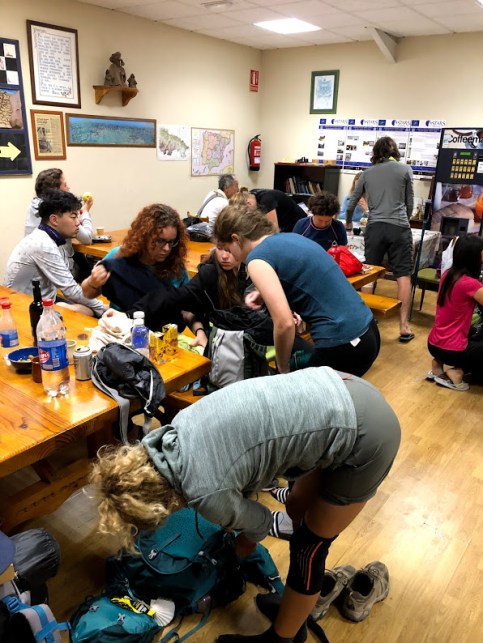
bunkbeds.2

Getting ready for the day’s walk. The hostel has to be empty by 7.30 am latest

Three parts of the Camino

Some hikers describe the first stage of the Camino as the “path of crucifixion”, the second as the transition or the walk through the “valley of death” in the heat and dust of the Meseta between Burgos and Leon.  Several guide books describe this section as boring and recommend that the hiker skip the section by taking a bus. Most people who have walked it, however, describe it as a crucial part of the Camino that they would want to have missed. A absolutely agree.

A path of rebirth

I would describe the first two sections as the mindful preparation for the last section-the “path of rebirth or resurrection”.  It is when the pilgrim has moments of absolute euphoria, gratitude, and joy. It is the feeling of accomplishment after transmuting the old stuff into revived energy.  The three parts of the Camino however, can be experienced in some form or other each day. Getting up early in the morning after a bad night’s sleep in a crowded Albergue is a challenge where the mood can be at rock bottom.  This could all change an hour later when experiencing a beautiful sunrise on a mountain top with a bird of prey circling overhead.

Having walked the Camino more than a dozen times, I decided this year to give something back in serving as a volunteer in an Albergue or pilgrims’ hostel for two weeks.  There are between 50-70 pilgrims arriving here each day. It is an enormous privilege to hear the stories of why and how they are doing the Camino. Some are doing the path the third, fourth or fifth time. Most are walking the Camino for the first time.

It is a joy to observe people from many different nationalities and cultural backgrounds bond in this shared experience of the Camino. They mostly don’t understand each other’s language. But the language of shared experience shared meals, and shared emotional ups-and-downs are universal.

Reino Gevers – Author, Mentor, and Consultant

https://www.reinogevers.com

                                             applepodcast         

Leave a comment

Filed under Camino de Santiago, lifestyle management, meditation, Pilgrimage, psychology, Uncategorized

Tales from a pilgrims’ hostel

An 85-year old Dutch guy arrived here at the pilgrims’ hostel in Najera, northwestern Spain, pulling a 100-kilogram cart. While all the other arriving pilgrims were walking toward Santiago, Johannes van der Pas was going the other direction back home.

Johannes celebrated his 100th day on the Camino and has become quite a celebrity. Passing motorists have been seen waving to him. Strangers are inviting him to stay overnight after he was featured on Portuguese television while on his way to the famous pilgrimage town of Fatima.

He started walking from Eindhoven, Netherlands, then stopped in Lourdes and from there walked via Santiago to Fatima.

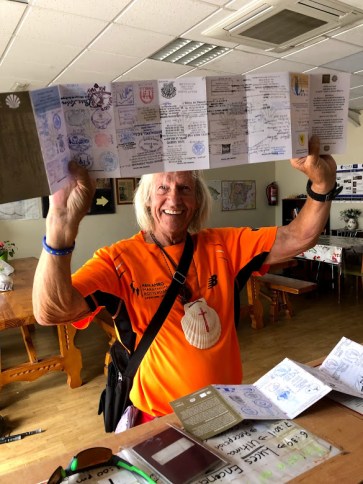
Pilgrim-najera1

Johannes van der Pas with his credential or pilgrim’s pass displaying all the stamps from the towns he has visited along the way.

It’s a remarkable achievement for any person, but this guy is not letting the old man in and is in better physical shape than most men half his age. He has according to my calculation, so far walked 3,340 kilometers, averaging 33.4 kilometers a day.

On occasions, he has walked all night in the rain in the remote areas of France where, in contrast to Spain, there are hardly any pilgrims hostels.

Johannes is living proof that it’s possible to remain mentally and physically active up to a high age. His recipe is simply doing a good walk every day, and shakes his head at the many people starting their walk on the Camino with little training and then complaining about sore knees and feet.

It’s my fourth day serving as a voluntary hospitalero in this town. The hostel is run by the local municipality and pilgrims are just asked to provide a donation to offset electricity and water costs. Locals living along the Camino have for centuries been generous hosts to pilgrims walking to Santiago de Compostela. The marker stones with yellow arrows on the path are almost entirely put up by local volunteers, paying for them with their own money. It is therefore sad to see that some of these markers are defaced by “Killroy was bere”  ego-minded “bypassing tourists.”

We voluntary hospitaleros are being greeted here with exceptional kindness. Restaurants have refused taking money for meals. Entry to the local museum and monastery is free of charge.

On the third day, we registered 58 pilgrims including seven from South Korea, one from Taiwan, two from South Africa, two from Bulgaria, one from Hungary, one from Venezuela, three from Japan and six from the United States and Canada. Most people are from Spain, Italy, and France as this is the main vacation period in these countries.

And, just as I’m finishing the Blog for the day two women from Greenland arrive at the door, saying that they will stay for the night as they are not used to the warm temperatures.
Reino Gevers – Author, Mentor, and Consultant

https://www.reinogevers.com

                                             applepodcast         

Leave a comment

Filed under Camino de Santiago, lifestyle management, longevity, psychology, self-development, spirituality, Uncategorized

Finding purpose with deep walking

My next book “Deep Walking – for Body, Mind and Soul” will soon be on the market.  It is about finding purpose during that void of inner silence that comes with deep walking.

We need to listen to nature

While writing the book I so often came to a point of writer’s block or procrastination. A new inspiration always came after going for a walk in nature. I think this is a dilemma most of us face in the modern world. We are spending too much time indoors, and it’s making us sick and moody.

IMG_0188

The disconnect from nature and the wisdom of the universe, has separated our species from the web of creation. This is why we are treating ourselves and the environment with such disrespect. What is happening within reflects what is happening in the outer world.

At the crossroads – depression and suicides have reached epidemic proportions

Humans are creative and exceptional beings. But we are very much at the crossroads where decisions made today will determine the future of our species in the next half century. I’ve said it often on these pages: The Western mind has sacrificed its soul to the golden calf of immediate external material gratification.  The result: Depression and mental illnesses have reached epidemic proportions. Something is out of order when one person commits suicide every 40 seconds. It is the second leading cause of death in the age group 15-24 in the United States!

Religious dogma from the past is not giving answers

A growing number of people are feeling this intuitively and are searching for new meaning and purpose. They are not finding the answers in the religious dogma of old that is telling us to believe in this or that. The new spiritual consciousness comes from an individual experience. It is why more than 300,000 people from all walks of life, different nationalities and faith, walk the pilgrimage path in Spain, the Camino, every year.  You can get my tips on preparing  for the Camino here: Preparation Camino.

The difference between a hike and a pilgrimage

It is a phenomenon I came across the very first time I walked the Camino in 2007. There  is a huge difference between just taking a hike for exercise purposes and going on a deep walking experience lasting several weeks, especially on a pilgrimage path walked by pilgrims for centuries.  Get my tips on preparing for the Camino here:

Nobody who walks the Camino with serious and mindful intent, comes back the same. As you walk from day to day through rain, mud and hot sun, passing village after village and climbing mountain top after mountain top, a mystery unfolds from within. When the many external distractions fall away, the empty space where we stop thinking opens and the universe, or God, can finally speak to us.

We can find this experience in meditation and other spiritual practices. I’ve found that deep walking in nature to be an exceptionally meditative experience, taking time out from the rat-race that has become our world, aligning with the above and the below with every mindful step.

Reino Gevers – Author, Mentor and Consultant

https://www.reinogevers.com

                            applepodcast         

Leave a comment

Filed under environment, happiness, humanity, lifestyle management, meditation, mental-health, psychology, self-development, Uncategorized

Are you living in a tribal bubble?

Our world is becoming dangerously fractured into tribal bubbles and we are losing our sense of a common humanity along the way.

As our world becomes more globally connected on a digital level, there is a growing tendency to align with a “tribe” that thinks, dresses, talks and believes in the same things that we do.

surya-prakosa-306484-unsplash

Photo by Surya Prakosa on Unsplash

Tribes have a tendency to build defensive walls against all those who are not members of the same community.  It is then only a small step away to see them as the enemy targeting our watering holes.

The divisive narrative on both sides of the political spectrum in the current politics is symptomatic. Extremist leaders whose narrative is threatening the very fabric of societies are being democratically elected.

We desperately need such wise leaders as Nelson Mandela, Mahatma Gandhi , Theodore Roosevelt and Dag Hammarskjöld who were multi-lateral and holistic in their thinking. Their narrative was one of serving a common humanity rather than a political ideology.

When wise leaders are at the helm,  the rest follow and an immense sense for the common good and higher purpose can result.

The western mind has very much lost its way. When there is a spiritual vacuum, loss of purpose and direction, it is fertile ground for demagogues. They fill the void in playing the “angst” game with nationalist or tribal rhetoric. Its us against them!  Political ideology has all the trappings of a pseudo-religion. Its black or white. A religious cult has the philosophy of either you believe what we tell you to or you will suffer eternal damnation.

An innate spirituality is liberated from belief.  It intuitively feels rather than believes itself connected to what is the fabric and the web that holds everything together on a different level.

When you live in a tribal bubble you will listen only to those people, and media outlets that share your opinion. You have a fixed belief and it becomes part of the ego and the self. Different opinions, irrefutable evidence and scientific fact are slated as “fake news” because they might threaten the image of a false identity that has been created.

If there is no willingness to even listen or to discern between the opinion and the humanity of the other, the inevitable result is confusion about those root cohesive and common values that solidify society.

Reino Gevers – Author, Mentor and Consultant

https://www.reinogevers.com


Leave a comment

Filed under ideology, lifestyle management, meditation, nature, psychology, purpose, self-development, Uncategorized

Nature and the Respect of the Sacred

Respect for that which is holy and sacred is closely aligned to respect for the self and self-love.

It is telling for humanity that the sacred house in which we live is being treated with such lack of mindfulness.

When you hike for hours along a country road you soon begin to notice the huge amount of trash such as plastic bags, tin cans, plastic bottles and cigarette butts that are carelessly thrown out of car windows by passing motorists.

IMG_2135It has a devastating effect on other living beings. I’ve seen cows munch plastic bags and hedgehogs trapped in rubbish.
Much can be attributed to the disconnect of modern man to his natural surroundings. Nature is a manifestation of God and not without reason have the wise teachers of old described time spent in nature as our best healer.

Any person who has spent alone time in the African bush or hiked alone for hours in pristine nature will soon become aware of the awesome marvel of creation and the interconnection of all living beings. God can be seen live and working in slow motion.

But never before in the history of mankind are we seeing such a rate of extinction of biological and animal species. The ocean waters are being polluted with plastics and the atmosphere brought into imbalance with excess burning of fossil fuels.

Humanity will only survive when we recognize that the sacred within is also the sacred without.

For centuries Christianity has had a false understanding of man’s role in nature based on misinterpretation of the old testament of the bible in Genesis 1:28 in which man is given the cultural mandate to subdue and rule over the earth.

The lost gospel of St. Thomas, that was discovered in Egypt in the 1940s, has a far more mystical interpretation of many of the biblical interpretations. Rather waiting for the Second Coming of the Christ, the lesson espoused here is all about nurturing and discovering the Christ Within−closely resembling what is described in Buddhism as discovering the Buddha Nature.

The Medieval interpretation of Nature was that of a harsh alien environment, that needed to be conquered. Paradise and a life of bliss could only be expected after death and resurrection.

In contrast the eastern Daoist tradition is all about the yielding to the laws of nature. The philosophy of the Five Elements in essence is about the right timing in accordance with the laws of nature. The harmony of objects and things in Feng Shui, the cultivation of the life-force energy of Chi in the body with nutrition, Qi Gong and Tai Chi and the ancient Book of Wisdom, the I Qing, all are built on these foundations.

We desperately need to revive the sacred places of old to help realign human consciousness. We need places of solitude, and places for meditation to quieten the mind. These also includes saving the sacred buildings of old that were often built at places with a high natural energy frequency.

Maps of medieval towns show how mindful our ancestors went about in planning their cities. The place of worship was always built on the highest plateau or center with all the other buildings in circular form around it. Shamans and geomancers were consulted so that the buildings conformed to the harmony principles of the universe.

We seem to have lost something elementary in sacrificing so much on the altar of materialism.

Reino Gevers – Author, Mentor and Consultant

https://www.reinogevers.com


Leave a comment

Filed under lifestyle management, meditation, nature, outdoor coaching, psychology, self-development, spirituality, Uncategorized

Walking alone

The ancient masters of all the great religions recommended time alone as a crucial means of discovering true self.

It was the 40 days that Jesus took for time alone in the desert to confront his own shadow and the demons of temptation.  Moses removed himself alone to Mount Sinai to receive the ten commandments from God.

It is in the time spent alone that we come closest to the divine and our life purpose, especially if it is time alone in nature.

IMG_1676 (1)

The Chinese masters of the body arts such as Tai Chi and Qi Gong called the empty space between the spokes of the wheel more important than the spoke itself.

It is in that empty dark space between the stars where you touch the divine.

We as a society are obsessed with what the wise ancients called the distractions of the 10,000 things.

The news media feed on negative news, the constant subliminal messages working our emotions instill a need for material things we mostly don’t need. There is confusion between necessity and want.

It is no coincidence that with the addiction to distraction there are very few people who can truly bear to spend time alone.

We are thus constantly seeking the accolades through social media as a reassurance. But it will seldom lead you onto the path of deeper spiritual experience.

It is during the walk alone, the time-out during a silent retreat and the alone time in nature where the gateway to the soul opens and you begin to realize who you truly are.

It is during the alone time that we discover the heart, the love and the divine within. It is who we truly are and that which soul wants to illuminate.

Reino Gevers – Author, Mentor and Consultant

https://www.reinogevers.com


Leave a comment

Filed under gratitude, happiness, lifestyle management, psychology, raised consciousness, self-development, spirituality, Uncategorized

Hate or Love: The language we speak

Much of social media has become a global ghetto-blaster of hate speech and vile language. We should not be surprised that deranged minds run amok with assault weapons in mosques, synagogues, churches and schools.
The language we speak can either unite or divide. A thought brings forth words and words trigger action. It is a frightening reality that there is a thin line between language that stirs toxic emotions and the violence on innocent people. Masses can be manipulated at will by fear-mongering demagogues.
jon-tyson-1402406-unsplash

Hate speech is dividing communities across the globe. It is the downside of the digital revolution. The seeds of genocide are planted by the seeds of hate speech. Psychology has determined seven stages of hate speech leading to the final stage of killing. The boundary has been crossed in several countries with scapegoating of refugees, racial groups, religious minorities and ethnic minorities.
History has taught us lessons that cannot be repeated. There is an old black and white news documentary film of chief Nazi propagandist Josef Goebbels stirring the masses in Berlin with fanatical screams of, “we want total war!” that cost the lives of about 50 million people in World War II.
The Nazi party in Germany was initially seen as a joke when it started parading through the streets of German cities in the 1920s, blaming the Jews for the economic ills of the country. But the hate speech escalated. Jewish shops were ransacked, then synagogues were torched before the mass-killing started at an unprecedented industrial scale.
Negative language not only spreads the fans of hate. It also does something to those who utter vile language. We can and should defuse hate language with words that have a healing energy.
In differential language analysis psychologists have found a correlation between language in social media and general well-being and health. Words such as “human, beings, nature, spiritual” suggested something larger than oneself and an important determinant of psychological well-being.” Happiness is contagious:
There is a stronger feeling of happiness living in a community with people who influence each other in their general feeling of well-being. Through geolocation researchers also determined a link between cardiovascular disease and language used in tweets. https.aaai.org/ocs/index
Negative words associated with disengagement and a feeling of lack of meaning and purpose in life were defined as “sick, hate, bored, chill, wtf, bored, soooo, freakin…” The karmic effect of hate language is that it will eventually trigger serious mental and health issues in the body of the perpetrator.
We know from our own experience that words with a harmonious ring such as love, harmony, beauty and light trigger an expansive energy, especially if they find expression in a choir sung with other people.
Humming the syllable OM has a particularly strong vibrational power. Many of the ancient Sanskrit, Aramaic and Latin syllables are known to have immense healing power across time and space. They also create a matrix of positive neuronal links in the brain and the vital body functions.
Hate language divides, separates and destroys. Positive language unites, heals and transforms.

Reino Gevers – Author, Mentor and Consultant

https://www.reinogevers.com


Leave a comment

Filed under happiness research, humanity, lifestyle management, psychology, self-development, Uncategorized

Beyond control

In one of my recent leadership workshops it soon became apparent that several participants were highly stressed out by external matters in their institution beyond their control.

The result is a general feeling of helplessness, that, if not addressed, can lead to a life of silent misery and frustration that is the root cause of most depression.

During a stress situation we fall into tunnel vision, unable to see or perceive things from a different perspective.

Stress starts with a thought as much as opening the gate to a hallway of bliss starts with a positive emotional shift.

rawpixel-611119-unsplash (1)

Emotional shifting is replacing the negative thought with an inner memory, image, or event where we recall a deeply positive feeling.

Negative thought attracts negative people and situations. Becoming a magnet of higher energy frequency get to be a challenge when we are bombarded with a “ghetto blaster” of negative media.

Training the mind with thought discipline is like training the body for a marathon run. You start with small baby steps and take it from there. Awareness is the first step.

Reino Gevers – Author, Mentor and Consultant

https://www.reinogevers.com


Leave a comment

Filed under happiness, Job satisfaction, lifestyle management, psychology, self-development, stress, Uncategorized

Walls again?

I was one of the fortunate people to have witnessed the fall of the iron curtain when the wall came down between East and West Germany in 1989 and some months later saw the abolishing of apartheid in South Africa and the release of Nelson Mandela.

It was an epic and optimistic time in history when the “isms” of ideology seemed history. We seemed on the verge of creating a new world order of peace and a common humanity sharing the values of tolerance beyond ethnic and national boundaries.

patrick-tomasso-208114-unsplash

Photo by Patrick Tomasso on Unsplash

The current political narrative however seems a gigantic step backward with nations walling themselves off and politicians running a rhetoric that reminds dangerously of the 1930s when minorities like the Jews were blamed for all the economic ills. And, we only know too well where that led to.

For too long have we been complacent, enjoying one of the most prosperous and peaceful periods in human history.  There have been wars and there are still wars going on but its nothing compared to the two world wars, and the civil wars and religious conflicts of the dark Middle Ages that wrought havoc in Europe.

What transpires in the outer world is very much a reflection of the collective unconscious mind. We are at the moment at the crossroads where on the one side we have the future-orientated globally thinking, broad-minded part of society espousing  mutual tolerance of diverse races, cultures and religions.

On the other side is the backward orientated “me-and-my-nation first” culture of bigots and nationalists, who have not understood that the very basis of our current prosperity is rooted in close trade and cooperation between nations. The losers of globalization are told their jobs have been taken by immigrants.  The truth is that robotics and technology has been responsible for job losses. There is a perceived feeling of loss of culture and identity, interestingly enough often in areas that hardly have any foreigners.

Culture and identity is never static and always in flux . We pick up food, music, and clothing habits from many cultures. Even the major religions have integrated a mix of different beliefs and traditions.

Building walls is not the answer. The real challenge is to confront the inner walls built with the bricks of fear, the very distorted and colored perspective of the past and underlying prejudice.
Reino Gevers – Author, Mentor and Consultant

https://www.reinogevers.com

      Yield_and_Overcome_Cover_for_Kindle (2)


Leave a comment

Filed under environment, lifestyle management, psychology, self-development, Uncategorized

Yielding to Nature

Our ancestors and the ancient tribes were firmly entrenched in the philosophy of the yielding to the forces of nature as opposed to the modern mindset of conquering and extracting from the earth.

img_1685

On some of my lengthy hikes on the Camino in Spain, the routes inevitably take you along busy country roads. Tons of rubbish including plastic bags, tin cans, plastic bottles and cigarette butts are carelessly thrown out of car windows by passing motorists.

It has a devastating effect on other living beings. I’ve seen cows and goats munch plastic bags and hedgehogs trapped in rubbish. More disturbingly sacred crosses and way markers are defaced by graffiti.

Much can be attributed to the disconnect of modern man to his natural surroundings. Nature is a manifestation of God and not without reason have the wise teachers of old described time spent in nature as our best healer.

Any person who has spent alone time in the African bush or hiked alone for hours in pristine nature will soon become aware of the awesome marvel of creation and the inter-connectedness of all living beings. God can be seen live working in slow motion.

Humanity will only survive when we recognize that the sacred within is also the sacred without.

For centuries Christianity has had a false understanding of man’s role in nature based on misinterpretation of the old testament of the bible in Genesis 1:28 in which man is given the cultural mandate to subdue and rule over the earth:

“And God blessed them, and God said unto them, be fruitful, and multiply, and replenish the earth, and subdue it: and have dominion over the fish of the sea, and over the fowl of the air, and over every living thing that (Heb. creepeth)  moveth upon the earth.”

Especially the translations of “subdue” and “dominion” from the Hebrew have different meanings. Rather than exploitation and domination the call to humanity by God is like that to a king to take care of the weak and poor in his kingdom. Man is called to preserve the natural beauty of the environment entrusted to him and to restore those places that have been harshly affected by force and hardness of rule.

The lost gospel of St. Thomas, that was discovered in Egypt in the 1940s, has a far more mystical interpretation of many of the biblical interpretations. Rather waiting for the Second Coming of the Christ, the lesson espoused here is all about nurturing and discovering the Christ Within−closely resembling what is described in Buddhism as discovering the Buddha Nature.

The Medieval interpretation of Nature was that of a harsh alien environment, that needed to be conquered. Paradise and a life of bliss could only be expected after death and resurrection.

In contrast the eastern Daoist tradition is all about the yielding to the laws of nature. The philosophy of the Five Elements in essence is about the right timing in accordance with the laws of nature. The harmony of objects and things in Feng Shui, the cultivation of the life-force energy of Chi in the body with nutrition, Qi Gong and Tai Chi and the ancient Book of Wisdom, the I Qing, all are built on the foundations of the Elements.

Likewise the Greek, Roman and Medieval cultures placed great emphasis on building their temples and cities in harmony with the natural environment. These cultures were still steeped in myth and legend while the modern world is dominated by the economic.

Modern man’s environment−often in an urban concrete jungle, is very much a contributing factor to the alienation from nature and the loss of soul purpose. It is beginning to change. As humanity moves to a raised consciousness we rediscover old teachings that were anything but primitive.

Reino Gevers – Author, Mentor and Consultant

https://www.reinogevers.com

      Yield_and_Overcome_Cover_for_Kindle (2)


Leave a comment

Filed under Camino de Santiago, environment, happiness, lifestyle management, plastic, psychology, raised consciousness, Uncategorized