Tag Archives: nature

Divine Whispers and the Pursuit of Happiness

In a world plagued by anger and fear, the pursuit of happiness is primarily directed toward external gratification and distractions, causing much pain. Now, more than ever, it is crucial to seek quiet moments of solitude to rediscover true meaning, purpose, and a life of bliss.

The ancient Mystics often interpret the voice of the divine as coming in a whisper, a still voice within the soul, giving guidance and instructions on the spiritual journey, especially when reconnecting with the beauty and harmony found in nature.

Evil draws to what is other

As opposed to the wholeness and beauty of divine creation, the 13th-century Mystic Meister Eckart describes evil as essentially “accidental in its nature: it stands outside, draws and directs things outwards, distracts from inner things, draws to what is other, smacks of otherness of division, withdrawal or falling away. Evil, therefore is nothing but a defect or shortcoming.”

In experiential spirituality the divine is perceived through silent contemplation or in a state of presence and being that transcends concept and language. The Mystics understood divine truth as direct experience rather than surrender to the fixed belief and dogma of religion.

After walking the Camino de Santiago for the first time in 2006 I sensed this “something” of a mystery beyond concept and religion. I have meanwhile walked more than a dozen Caminos, which has for me become an annual retreat of inner reflection. I’ve spoken to hundreds of pilgrims on the Camino who have had a profound transformation in reconnecting with their inner voice whilst walking on this magical path.

But there are also many other ways including the creation of a “quiet space” amid the turmoil of a busy and noisy life.

Between time and eternity

Meister Eckhart describes the soul as created in a place between time and eternity:

“With its highest powers it touches Eternity, with its lower Time. To the extent that the soul is able to withdraw from Time and its concerns, the more God is revealed in it and the more God is speaking in it and by it.”

The whispers from the universe or God can be heard most clearly when the soul transcends the temporal and focuses on the eternal, turning contemplatively inward.

A life of bliss, according to Eckart, is closely aligned to living a “virtuous life” in seeking connection with the divine. Every person has a divine spark within them—a part of God that resides in the soul. A virtuous life involves living in awareness of this divine presence within and allowing it to guide one’s actions.

Eckhart emphasizes the importance of inner purity and detachment from worldly desires and attachments. For him, a virtuous life involves freeing oneself from ego, selfishness, and the distractions of the material world. This detachment allows the soul to be more receptive to God’s presence and to act from a place of divine inspiration rather than personal will.

The famous Sufi poet Rumi describes in one of his lines:

“The breeze at dawn has secrets to tell you. Don’t go back to sleep.”

The subtle, quiet communication from the divine comes in moments of stillness when all the senses are sharpened to full presence.

Reino Gevers – Author – Mentor – Speaker

P.S. If you enjoyed this article you will be interested in my books available where all good books are sold.

Check out also the latest episode on the Living to BE podcast and Youtube with our special guest Matt O’Neill. The topic: Happiness is a Choice

Leave a comment

Filed under meditation, mental health, mental-health, spirituality

AI and social media: A generational challenge

Every era faces different challenges, defined by the changing landscapes of society, technology, and geopolitical events, and we have not even begun to understand the current impact of social media and Artificial Intelligence (AI) on mental health and social cohesion.

It was telling that in the U.S. presidential debate, both candidates not only made a devastatingly poor impression but that one of the biggest challenges of our time such as the impact of social media and AI on every facet of our lives was not even mentioned.

The pervasive effect of social media on mental health

Studies have shown an alarming increase in suicide rates, especially among teenage girls in recent years coinciding with the widespread adoption of social media platforms like Instagram, Snapchat, and TikTok. Girls are at greater risk of cyberbullying, facilitating bullying behavior that can be relentless and pervasive. Unrealistic beauty standards are perpetuated, leading to body dissatisfaction and low self-esteem.

Among teenage boys, the dangers of addiction to online gaming and porn are leading to growing isolation and a breakdown in social skills.

AI is changing our world

We are just at the cusp of rapid technological changes triggered by AI with positive as well as negative effects. The technology is already proving to be most effective in medicine. At the Institute of Cancer Research, for example, researchers have developed a unique canSAR database that can combine patients’ clinical and genetic data with independent chemistry, biology, patient, and disease information. It i likely to revolutionize transportation with self-driving cars, buses, and drones.

But many jobs, especially those involving routine and repetitive tasks, are at risk of being automated. Sectors such as manufacturing, logistics, and retail are particularly vulnerable to automation, potentially leading to significant job losses. The rapid pace of AI development requires workers to continuously update their skills, which can be challenging for many.

The rapid technological changes we are seeing inevitably lead to a growing gap between the cultural and mental capacities of societies to adapt to these changes and the legal frameworks to prevent the abuse of such technology. It creates fear and anxiety among those individuals who have particular difficulty in adapting to changes.

The use of AI and other new technologies have to be designed in ways that respect human rights, privacy, and autonomy, and do not dehumanize users. Human capabilities need to be augmented rather than replacing the human touch in critical areas like customer service, healthcare, and creative fields.

A holistic approach needs to be made recognizing and valuing the unique identity, experiences, and needs of each person rather than treating them as anonymous entities. Every individual has different
emotional, psychological, and social needs.

With all our senses becoming over-stimulated by technology and threatening our mental and physical well-being it becomes all the more essential to reconnect with nature and our primal roots and senses.

Taking time out for a deep walk in nature is becoming a crucial pillar of survival in the digital world. Here are just some ways how we can rehumanize our senses:

Immersing in the green and blue spaces

Immersing yourself in the blue and green spaces of natural landscapes such as forests, mountains, oceans, and streams plays a major part in reducing freeze, flight and fight stress hormones such as cortisol. Auditory engagement with natural sounds such as the rustling of leaves, flowing water and birdsong contrast with the constant noise of an urban environment, providing a peaceful respite to help clear the mind.

Sensory Stimulation

The clean, fresh air of natural environments, free from pollutants and artificial smells, invigorates and refreshes your senses with the diverse scents from natural herbs, flowers and trees. They can positively evoke memories and emotions. Feeling and touching natural elements such as a tree, rock, sand or water provides direct physical connection with the natural world and the present moment.

Deep walking

Walking in nature is one of the most beneficial and underestimated ways of boosting your immune system, and preventing cardiovascular and metabolic disease. At the same time, exposure to sunlight helps your body produce vitamin D which is essential for bone health and overall mental well-being. Walking less than 5,000 steps per day is generally considered to be a sedentary lifestyle. Anything between 8,000 and 10,000 steps a day will significantly improve your health.

Reino Gevers – Author – Mentor – Speaker

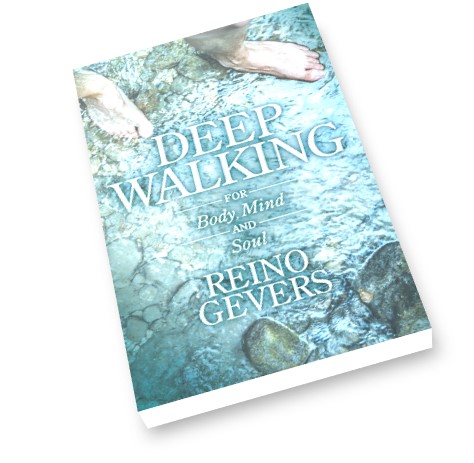
P.S. I’m excited to announce the release of my latest book, “The Turning of the Circle: Embracing Nature’s Wisdom for Purposeful Living.” If you enjoy it, you might also be interested in my previous works, “Deep Walking for Body, Mind and Soul” and “Walking on Edge: A Pilgrimage to Santiago.” You can find all of these titles at reputable bookstores near you.

Leave a comment

Filed under mental health, mental-health

Hardened body, hardened mind

After spending several weeks on my annual pilgrimage retreat along the Camino in northwestern Spain, I have had ample time to reflect on some pressing issues affecting our collective state of mind. I’m increasingly concerned about humanity’s tendency to retreat into tribal bubbles, becoming addicted to fixed concepts and thoughts.

Here is my theory on why the world is at real risk of tipping back into authoritarianism, intolerance, and the cult-like idealization of the “strongman” leader.

Social media thrives on toxic culture

We live in an age where any person in a dark cellar with a deranged mind can get millions of views by posting the most outlandish conspiracy theories, extremism, and anger. There are no real filters or control mechanisms in place to prevent the algorithms from blocking obviously false, distorted, and hateful information. And, there are no legal consequences for those responsible.

A preoccupation with fear, anxiety, and negativity will inevitably impact your mental and physical health. The eyes, brain, and spinal cord are intricately connected through the central nervous system (CNS), facilitating vision, sensory processing, and motor control.

The interconnection of body and mind

The eyes capture visual information and convert it into electrical signals. The optic nerve then transmits these signals to the brain which processes and interprets this information, coordinating with other sensory inputs and cognitive functions The spinal cord transmits these motor commands from the brain to the eyes and other body parts, integrating visual information to coordinate body movements.

Stress starts with negative thought

Stress hormones responsible for flight, fight, and freeze responses of the body are triggered by chronic negative thoughts. Constant worry, fear, and tension will inevitably negatively impact your daily functioning and decision-making. In extreme cases, it leads to depression, hopelessness, and loss of self-esteem.

People preoccupied with negative thoughts may resort to unhealthy coping mechanisms, such as overeating, smoking, substance abuse, or addiction to simplistic thoughts and concepts to numb their emotional pain.

Cognitive distortions, such as catastrophizing (expecting the worst), overgeneralization (viewing a single negative event as a never-ending pattern), and black-and-white thinking (seeing things as all good or all bad).

It is an open door for cult leaders, and extremist political movements offering simple solutions for complex global problems.

What is the antidote?

You have the power to make lifestyle choices, that determine whether you become a tool in the hands of manipulators or take back control over your own mental and physical health. Here are some tips:

  • What you feed your brain with that you become. Monitor your time spent on social media and the consumption of negative news.
  • Physical activity, a balanced diet, and adequate sleep can help mitigate the effects of stress and improve your overall feeling of well-being.
  • How are you talking to yourself? Are your thoughts mainly negative or positive?
  • Mindfulness practices including meditation, deep walking, yoga, tai chi, qi gong reduce the impact of negative thinking and improve awareness. These exercises also impact your body posture and how you feel about yourself.
  • Techniques such as deep breathing, progressive muscle relaxation, and Cognitive Behavioral Therapy (CBT) can help identify negative thought patterns.
  • Choose your friends wisely. Don’t waste your time arguing with people addicted to fixed concepts and illusions. Positively-minded and supportive friends, family, and community make all the difference.

Reino Gevers – Author – Mentor – Speaker

P.S. I’m excited to announce the release of my latest book, “The Turning of the Circle: Embracing Nature’s Wisdom for Purposeful Living.” If you enjoy it, you might also be interested in my previous works, “Deep Walking for Body, Mind and Soul” and “Walking on Edge: A Pilgrimage to Santiago.” You can find all of these titles at reputable bookstores near you.

Leave a comment

Filed under mental health

Autumn and the time to let go

Here in the northern hemisphere, autumn unfolds its colorful spectacle. Trees shed their leaves as a brisk breeze weaves through bare branches. A nimble squirrel gracefully navigates from one tree to another, scouting for the optimal spot to hibernate through the coming winter.

Autumn marks a period of natural slowdown, where the vibrancy of summer yields to the quieter preparation for the colder months ahead. Yet, within this apparent tranquility, there exists a wild and unpredictable quality. A gentle, warm wing might whisper promises of impending spring, only to be followed by tempestuous storms.

In observing autumn’s dichotomy, we find a reflection of our own complexities. It teaches you the art of conserving energy for the inevitable challenges, mirroring nature’s rhythmic dance between repose and upheaval.

In studying nature you inevitably embark on a journey of self-discovery, unraveling the intricacies of your own existence in the ever-changing seasons of life.

We often forget that we are part of the bigger matrix. Your entire body is a composition of the elements around you. In the ancient Chinese philosophy of the Five Elements, autumn is associated with the element of metal. By getting into alignment with nature, you will recognize your innate and authentic nature.

Thus autumn is a time for introspection. These are questions you could ask:

What was really good this year?

What was a mistake and should be avoided in the future?

Life can be hard in teaching you the lessons you need to learn, especially when you fail to heed the whispers from the universe that tell you where to walk. It could be the advice from a total stranger, a sentence you coincidentally pick up in a conversation. A sudden inclination or feeling, a strong symbol from a dream, or a work of art you are observing.

Like the falling leaves of autumn, this is a time to let go of relationships, beliefs, and concepts that no longer serve you.

Harmonizing the inner and outer worlds is a major challenge in a world where attention is constantly being pulled at by external distractions.

Your breathing pattern is a reflection of your inner state of mind

Being aware of your breathing pattern plays a key role in relaxing your mind. Shamans and yogis have for centuries used breathing techniques to explore new realms of consciousness. In studying your breathing and improving on it, you become aware of hidden emotions and feelings. Fear, for instance, expresses itself with a flat breathing pattern and clogged feeling in the throat. A symptom of stress is strained breathlessness coming from shallow breathing from the upper chest.

A tense and stressed body finds no solace. Worries, fears, and other emotions create an imbalance that makes it susceptible to illness.

Recognizing the shadow aspect, such as your fears, your anger, your hurt, your shame, envy, or greed, is the first step in transmuting those negative emotions.

In a reflection of the metal aspect of the personality, we would look at the following questions:

Is there an old melancholy sadness that binds my spirit from making a move forward? Can I really admit to that sadness that is still there? Could it be that I should set a boundary toward certain people and make a healthy separation? Are my immediate surroundings, like my home and job, still fulfilling?

Are there too many superficial distractions in my life that prevent me from going on the path of my true destiny? Am I in the position of letting go of old concepts, ideas, or other so-called truths that have outlived their value for me?

Is my basic outlook on life of a positive or negative nature? Do I perceive tension and looming conflict situations in my immediate surroundings before they actually erupt? Do I have enough room to breathe? What is preventing me from exploring new avenues? Where are the boundaries set by myself or others? Could it be that I am also crossing the boundaries of others without realizing this?

The unique, authentic self only manifests itself when you liberate yourself from the magnetic pull of countless distractions, selling images, wants, and needs.

We need a truly strong metal element to preserve that space of true authenticity. When we are authentic with the true self, we are immune to mental and physical exhaustion that mostly comes from playing with the images of the false self.

Reino Gevers – Author – Mentor – Speaker

P.S. I’m excited to announce the release of my latest book, “The Turning of the Circle: Embracing Nature’s Wisdom for Purposeful Living.” If you enjoy it, you might also be interested in my previous works, “Deep Walking for Body, Mind and Soul” and “Walking on Edge: A Pilgrimage to Santiago.” You can find all of these titles at reputable bookstores near you.

Leave a comment

Filed under mental health, mental-health, spirituality, Uncategorized

Walking the earth with reverence

On one of my walks on the Camino de Santiago in northwestern Spain, I met a woman who was on the pilgrimage to deal with the grief of just having lost her husband to whom she had been happily married for many years.

Like her many people walking the Camino are at an inflection point in their life, walking off their grief from the loss of a loved one, the trauma of a divorce, or the fears of dealing with a life-threatening illness.

The shared community experience of doing an 800-kilometer walk over many weeks is one reason why some pilgrims come back every year to walk the entire route or some sections. There are few places in the world where complete strangers would exchange some of their most intimate experiences only minutes after meeting each other.

The sacred path

One morning, as we continued our journey, the woman I had been walking alongside for several days seemed unusually introspective. Eventually, she shared a vivid dream she had experienced the previous night.

In her dream, she found herself before the iconic burning bush, a scene drawn straight from the pages of the Bible’s Book of Exodus. In this powerful vision, God revealed Himself to her through the flames, just as he had to Moses centuries ago. But in her unique version of the story, a gentle voice emanated from the fiery foliage, urging her to tread the path ahead with reverence. The encounter left her awestruck, marking our journey with an undeniable sense of divine purpose.

The universe, or God, has many ways of whispering to your innermost soul, particularly in dreams. Treading the Camino path with reverence has led to a profound transformational shift in people who have walked this ancient path. It is a crash course in the lessons of life.

When traversing the earth with reverence, the senses awaken to the profound beauty of God’s creation. In the presence of mindfulness, enchantment permeates every moment. Conversely, when the mind is agitated and in haste, there is disconnection. Life’s wonders appear fleeting and superficial. A stressed mind remains trapped in the tunnel vision of flight, missing the intricate magic that weaves through existence.

The magic of the moment

Magic reveals itself in the tiniest of moments. Just a few days ago, I ventured into a rocky cove for some snorkeling. In the midst of the tranquil turquoise water, a pair of fish glided past, their scales aglow with a rainbow of colors, a mesmerizing effect created by the angle of sunlight filtering through the water’s surface.

It was a fleeting encounter, but within those brief seconds lay an astounding beauty. I would have entirely missed the moment had I not chosen to pause in stillness at one particular spot for a few precious minutes. In that space of quiet connection, the universe unfolded its secrets, reminding me that the most extraordinary experiences often come from the simplest acts of presence.

Serenity unfurls its wings in unhurried slow, deliberate breaths. It whispers through the silence of the mountains and echoes in the steady, gentle cadence of the waves.

Nature, in its eternal wisdom, guides you inward with each inhalation and exhalation, inviting you to rediscover the tranquility within. Amidst the clamor of the external world and the cacophony of maddening crowds, respite can be in the simplicity of aligning your breath with the rhythm of the natural world. Chaos fades, and solace is found in the gentle embrace of the universe.

Reino Gevers – Author – Mentor – Speaker

P.S. I’m excited to announce the release of my latest book, “The Turning of the Circle: Embracing Nature’s Wisdom for Purposeful Living.” If you enjoy it, you might also be interested in my previous works, “Deep Walking for Body, Mind and Soul” and “Walking on Edge: A Pilgrimage to Santiago.” You can find all of these titles at reputable bookstores near you.

Leave a comment

Filed under Camino de Santiago, mental health, mental-health, Uncategorized

Liberating the mind from attachment

Go into your own ground and learn to know yourself there. The outward man is the swinging door; the inner man is the still hinge – Meister Eckhart

Life is a rollercoaster of natural and spontaneous changes constantly forcing us to tread unknown paths. While some people may excitedly embrace a new beginning others retreat into fixed belief and ideology, providing the illusion of a safety cacoon in a world of “turmoil.”

But resistance to the natural flow of life and attachment to fixed thoughts, beliefs, and things is one of the greatest causes of human suffering and misery. Staying in the moment and finding peace in the acceptance of reality is thus at the core of the Taoist and Mystic teachings.

Throughout history, wise prophets have faced vilification and persecution for their courage in exposing the hypocrisy of religions based on firm behavior rules, fearlessly shedding light on the discrepancies and contradictions inherent in entrenched beliefs. They especially questioned the existence of an authoritarian Father God figure “out there in heaven” who, like a strict parent, would punish his children for bad behavior. All natural or personal calamities were attributed to punishment by God “for sinful behavior.”

Meister Eckhart, a 14th-century Dominican monk whose writings are more topical today than ever, had to answer charges of heresy before an Inquisition in 1326. He barely escaped a death sentence. His writings were banned. Other Mystics of the time like Giordano Bruno and Marguerite Poret were not so lucky. They were executed or burned at the stake.

Straying from religious doctrine and liberating the mind from externally imposed belief was a dangerous undertaking in the Middle Ages. In modern times political beliefs, sometimes using religion as a cover, tend to vilify opposing beliefs as a threat to justify all means in destroying the “enemy.”

Fanaticists of the political and religious nature see the world only in black and white. The belief becomes closely intertwined with the Ego mind and identity. A different or multi-layered interpretation is perceived as a direct threat to the self.

Words in ancient languages such as Aramaic, the lingua franca during the time of Jesus, allowed much room for individual interpretation. The word for God “Abwun” could mean “Our Father” but also the absolute, pure oneness, creation, source of all power and flow of blessing.

One of the most powerful messages in the Bible is found in the Gospel of John 1:1. “In the beginning was the Word, and the Word was with God, and the Word was God”. When replacing the “word” with “consciousness” the text is filled with a much broader meaning.

“In the beginning was Consciousness, and Consciousness was with God, and Consciousness was God”.

Eckart describes a process of spiritual transformation when the divine spark within transcends its individuality or Ego and enters into a state of divine consciousness.

It’s a moment of pure presence when the soul feels at One with something much greater than the self.

Aligning with divine consciousness is opening the heart to the universe and detaching from worldly attachments. It is beyond conceptualized thinking and complete immersion in a state of oneness.

“You should know that true detachment is nothing else but a mind that stands unmoved by all accidents of joy or sorrow, honor, shame or disgrace, as a mountain of lead stands unmoved by a breath of wind. This immovable detachment brings a man into the greatest likeness to God,” according to Eckart.

In a world feeding on the messaging of negativity, it becomes a challenge to train the mind to stay the course of positivity. We can easily be pulled into the abyss of grievance culture when emotions such as anger, anxiety, and fear can be triggered in millions of people by one message on social media.

Modern man has largely been disconnected from what can be described as the divine expression through nature of which he is an essential part. Places worshipped as sacred by ancient peoples have been conceptualized as things that could be harvested, exploited, and destroyed. The void is trying to be filled with the addiction to short-term gratifications: Accumulating more things, more food, more kinky sex, and more substance abuse.

Where is your passion?

Is it a surprise that depression has reached epidemic levels on a global level? But in the pain of suffering more and more people are searching for new meaning and purpose. Where do I come from and where am I going? What excites me and drives my passion? What elevates my consciousness and boosts my vibrational energy.

The author Michael Gladwell describes in his book “The Tipping Point” that it takes only a small number of people to initiate social change. We are currently experiencing both a global environmental and mental health crisis. History has proven that such crisis situations can galvanize people into action.

We are at the tipping point of realizing on a spiritual level that the crisis we are finding ourselves in has not been created by a punishing external father God figure for bad behavior. It is a direct result of our own actions and behaviors and we have the power to change those actions and behaviors.

We as a collective humanity have dug our own rabbit hole. We need to liberate the mind from fixated false belief structures and start doing the inner work. More and more people are awakening to awareness through meditation and other disciplines of the mind. There is a growing realization that every thought comes from a state of consciousness, turns into a thought, a word, and then into an action.

When you are no longer at war with yourself you will emanate compassion, love, empathy, and trust, aligning with divine consciousness.

The “word” in John 1:1 refers to the union with the Inner Christ or what the Buddhists call “Buddha Nature” – the inherent, untainted “seed” that resides in all things. Seeking the Inner Christ or Buddha Nature is the path of the spiritual seeker.

Reino Gevers – Author – Mentor – Speaker

P.S. I’m excited to announce the release of my latest book, “The Turning of the Circle: Embracing Nature’s Wisdom for Purposeful Living.” If you enjoy it, you might also be interested in my previous works, “Deep Walking for Body, Mind and Soul” and “Walking on Edge: A Pilgrimage to Santiago.” You can find all of these titles at reputable bookstores near you.

Leave a comment

Filed under mental health, mental-health, self-development, spirituality

A time to reap your rewards

If you want to enjoy the rainbow you must be prepared to take the journey through pain

In our culture, there is a festering poison of feeling entitled to special benefits or privileges without having made any effort to attain them. If you haven’t invested in the pain and walked the burn that brought you success you will never fully appreciate what you have and risk losing all.

In the ancient Taoist philosophy of the Five Element late summer is associated with the Element Earth. Using the analogy from farming: If you have invested wisely in seeds and fertilizer to plant your crop in spring, and diligently irrigated and weeded your fields in the summer, you will most likely be in the fortunate position of reaping a good crop in late summer.

Every sports star knows that you have to be disciplined and train for several hours every day for several years to reach the top league. Learning a new language requires learning on a regular basis. If you start a new business you have to invest money first, risk failure and maybe start all over again before finally making it.

Investing more than the average

The most successful people constantly push their boundaries and do much more than the average. It not only demands thinking creatively, breaking free from self-imposed limitations, and pursuing ambitious dreams, but putting in the work and the effort.

An entitled person will only see the rewards and compare. “Why can’t I have the same? I’m after all more beautiful, more intelligent …” It is the mindset that spends more than it earns. It is reaping the crop before it has ripened. There is an old English proverb: “Cheat the earth and it will cheat you.”

Falling into the trap of the blame game

Unconscious people are in the blame game and weak because they are victims of everything. Instead of taking complete responsibility as the captain, they think everyone else is responsible for their unhappy condition.

It’s so easy then to accuse the government, other nations, other races, business competitors, parents, siblings, and other people of the situation we find ourselves in. Few people are capable of taking full responsibility for whatever happens in their lives.

The crop will never bear fruit and grow to its full potential if the field is overgrown with weeds. Bugs only thrive in an unbalanced environment.

We subconsciously accumulate customs, habits, and opinions from the people we surround ourselves with and the information with which we feed our brains.

In the book of Wisdom, the I Ging, the earth is described as the receptive, receiving, and softer energy of the female or yin. It is the counterpart, but not the opposing force of the creative Yang. The enormous and receptive force of Yin needs the Yang force to exert and channel the force.

In much the same way, the heroic leader studies the situation at hand, responding accordingly. Action is never taken without a clear grounding and the realization of what path needs to be taken.

Mother Earth provides life. She provides nutrition and room for all beings, be they of a good or bad predisposition. To illustrate this particular importance in comparison to the other elements, many of the ancient writings and drawings have the earth element positioned centrally with the other elements around it. It also emphasizes the importance that at the end of each change cycle, we go full circle back to earth—to the source.

We need thought processes and thinking to accomplish tasks and to give room to our ideas and creativity. The challenge is to get a feeling about when we cross our own boundaries and those of others.

Do I have enough resources to go ahead with plans? Do I make provision for more or for less? Do I have enough in reserve? Or do I live from too much-borrowed energy, becoming indebted to other people and borrowing money?

These are the questions that need to be asked in almost any life situation where the need for change or turnaround is called for, especially if we are feeling constant fatigue after surrounding ourselves with certain people or are met with constant obstacles.

The balanced earth person is trustworthy, generous, and of a stable temperament. They sometimes are slow to respond, but will be thinking things over carefully before giving you a reply. This could be very irritating for an imbalanced pumped-up person expecting a machine-gun reply.

Symbolically, he would be the plump, pot-bellied, sitting Buddha at peace with himself, centered with the universe, and observing calmly while everything around him is falling into loud chaos. They are the steadfast rock in the ocean storm.

In the philosophy of the Five Elements, the Earth is described as being gracious and filled with abundance for all that life has to offer. On the other hand, it demands respect and the absolute maintenance of ethical standards that encompass all living beings. If these are violated, the consequences can be merciless. What is my true motivation? What effect does it have on others? Am I orientated to fulfilling my own greedy needs, or do I have a broader picture in mind?

Reino Gevers – Author – Mentor – Speaker

P.S. This is an extract from “The Turning of the Circle: Embracing Nature’s Wisdom for Purposeful Living” which has just been published. You might also find my other books “Deep Walking for Body, Mind and Soul” and “Walking on Edge: A Pilgrimage to Santiago” of interest – available where all good books are sold.

2 Comments

Filed under mental health, mental-health, Uncategorized

The dragnet of regret

How often have you caught yourself going back into the past with the feeling of regret on the opportunities missed, the words you wished you had never said, and the things you would do differently if you could turn back the clock?

At times the feeling of regret can be so overwhelming that it’s like a dragnet pulling you down into a dark abyss of unhappiness. But according to author Daniel H. Pink regret is a fundamental part of our lives and can help us make smarter and better decisions in the future.

Based on the World Regret Survey, Pink has identified four core regrets.

Foundation regrets. These are regrets on the human need for some form of stability. Pink quotes Jason who says: “I regret not saving money diligently ever since I started working. It’s nearly crushing every day to think about how hard I’ve worked for the last twenty-five years or so, but financially I have nothing to show for it.”

Boldness regrets. Over time we are much more likely to regret the chances we didn’t take than the chances we did, whether its work choices, education or the choice of a partner. Foregone opportunities can be especially haunting during times of stress and pain.

Moral regrets. Most people wish to be seen as good people. But over time morally dubious decisions can be gnawing such as swindling in a business or cheating on a spouse.

Connection regrets. According to Pink fractured or unrealized relationships with spouses, partners, parents, friends, and all other close relationships constitute the largest deep structure category of regret.

Photo by Liza Summer on Pexels.com

We can set very high standards to the self and are at times our own worst critic. The melancholy sadness and regret over that which was and is no more is not only debilitating but prevents you from moving forward. Many of our regrets can in fact be undone by making amends, reversing bad choices, and taking a different perspective by posing the questions: What did I need to learn and how can I make a better choice in moving forward? If I’ve harmed others, can I make amends through an apology or some form of emotional or material restitution?

Was the regret merely an unpleasant incident in your life or does it define your life? Practicing self-care and self-compassion can neutralize some of those feelings if you treat yourself like you would be treating your best friend.

You forge your identity with the story that you tell yourself. The first step is acceptance of that feeling or emotion of regret and replacing it with a positive thought moving forward. “I made a bad decision. I feel terrible about it. But I lovingly accept myself the way I am. I am harvesting from the rich experience and moving positively forward.”

In loving yourself you build the ability to nurture and better serve your relationships. The lesson of a door slammed shut is to do better next time.

Reino Gevers – Author – Mentor – Speaker

P.S. If you’ve found this article of interest you might want to read more in my books. “The Turning of the Circle: Embracing Nature’s Wisdom for Purposeful Living” has just been published. You might also find my other books “Deep Walking for Body, Mind and Soul” and “Walking on Edge: A Pilgrimage to Santiago” of interest – available where all good books are sold.

Leave a comment

Filed under mental health, mental-health, Uncategorized

Fire out of control: A lesson from nature

A warrior finds a sharp stone, which he uses to sharpen the tip of an arrow. The stone slips hits another stone, and causes a spark that ignites the dry grass around. The warrior stares in fascination at the stone in his hand, then at the fire.

Like many inventions that heralded a new dawn in the evolution of mankind, the art of making fire probably resulted by accident.

Those people who could use stones to make fire made enormous headway. They could migrate to colder and darker areas of the world. Some developed a communication system with smoke signals, enabling them to control large tracts of land.

The art of making fire, at any place and time, and the smelting of iron, triggered numerous other inventions. Woodland was burned to make way for agricultural land.

Other people let the fire burn uncontrolled, destroying everything in their wake. Numerous myths, legends, and stories originated around fire. If left to its own devices, fire could indeed become a dangerous demon indeed.

In the Chinese teaching of the Five Elements, the fire element is where the heart, perikard, and small intestine are at play on both the physical and mental levels. People with balanced fire energy are good communicators and express themselves with vitality.

Inspirational leaders with heart energy

Some of the world’s great personalities stand out with a balanced heart energy, serving the greater whole and ideal rather than selfish needs: Jeanne d’Arc, Mahatma Gandhi, Florence Nightingale, Nelson Mandela, and the Dalai Lama, just to mention a few.

Much more mundane is constant irritability, disappointment with life, and apportioning blame to everyone else but the self for the miserable condition one feels. People who are unaware of their heart wish, because they are bombarded with the noise of the external world, often have an imbalanced heart element.

The fire element is much in imbalance when we see the rocketing numbers of people falling into mental and physical exhaustion with burnout. Stress starts with a thought and is a flight-or-fight survival mechanism ingrained in our DNA. It is indicative also of the epidemic numbers in cardiac diseases.

Humans are responsible for heating the atmosphere

On the macro level, we are depleting our natural resources as if there is no tomorrow. At the same time, we are putting the body and mind under constant stress, and robbing it of vital nutrients.

Looking at the broader macroscopic level, the fire element has, in the recent past, brought huge changes to our planet. Extracting fossil fuels that have been in the ground for millions of years and “burning” them in an unprecedented scale over the past two centuries has led to a massive increase of carbon dioxide concentration in the atmosphere. The science is sobering and will make the planet uninhabitable for humans within a generation if nothing is done.

Photo by Pixabay on Pexels.com

Today’s global warming is happening at a much faster rate today than it did in the warm periods between ice ages over the last million years. The massive forest fires in northern America and in southern Europe with summer temperatures averaging over 40 degrees Celcius this year is telling. The Fire Element is out of balance. In terms of the Five Element Philosophy nature always seeks a balance between the elements of wood, fire, earth, metal, and water. Interestingly we are experiencing flash flooding in other parts of the world at the same as the heat waves. Water is the balancing and controlling element of fire.

In Chinese mythology, the god of fire is called Hu Shun. Shu and Hu are the lightning. When it strikes, creating light amid chaos, new life is created. Images of the god of fire paint him with flowing long red hair and a beard, sweeping through the streets at night and seeking out the next house to be burned.

Because this God of fire is rather forgetful, he carries a list in his left hand of all the houses that are to be burned. In his right hand, he bears a fiery ball that unleashes the flaming terror. Picturing such an awesome figure, there was only one thing left to do. This god had to be pacified, come what may.

The scientist James Lovelock described our planet as a complex interacting and living organism in his Gaia hypothesis. In his book, A New Look at Life on Earth, Lovelock explores the theory that the Earth’s living matter—air, ocean, and land surfaces—forms a complex system that has the capacity to keep Earth a place fit for life.

“The self-regulation of climate and chemical composition is a process that emerges from the rightly coupled evolution of rocks, air, and the ocean—in addition to that of organisms. Such interlocking self-regulation, while rarely optimal—consider the cold and hot places of the earth, the wet and the dry—nevertheless keeps the Earth a place fit for life,” he writes. Lovelock argues that “if we see the world as a super organism of which we are a part—not the owner, nor the tenant, not even a passenger—we could have a long time ahead of us and our species might survive for its ‘allotted span’

Reino Gevers – Author – Mentor – Speaker

P.S. This is an extract from “The Turning of the Circle: Embracing Nature’s Wisdom for Purposeful Living” which has just been published. You might also find my other books “Deep Walking for Body, Mind and Soul” and “Walking on Edge: A Pilgrimage to Santiago” of interest – available where all good books are sold.

Leave a comment

Filed under mental health, mental-health

Celebrating community on a pilgrimage

One of the reasons I‘m hooked on making an annual pilgrimage walk on the Camino de Santiago is the wonderful people you meet on the way and the celebration of community with people from very different cultures, and religious backgrounds.

It is one of the few places left on earth where you meet individuals who open their hearts, discussing intimate details of their life with you, at times only minutes after meeting for the first time.

The hospitality of the locals on the Camino plays a role. Much of rural Spain still has healthy supportive communities where people meet in cafes and bars on a daily basis to have a chat.

The owner of a bar-hotel and restaurant business confided to me that the cafe part of his business was not really profitable but „closing this place for the winter months would be like closing the local church.“

A sense of belonging

While talking to fellow pilgrims in Santiago we agreed that many spiritual seekers on the Camino were finding a community and sense of belonging on this ancient path they were no longer finding in traditional religions.

As humans, we are hard-wired as social beings. Our relationships and social connections determine who we are. Strong connections and relationships are created when we share our feelings, inner wounds, and vulnerabilities.

Many people walking the Camino have seen their lives come apart on some level. Relationships that have broken down, the death of a loved one, financial loss, or having to deal with the diagnosis of a life-threatening disease. In sharing their stories pilgrims no longer feel “alone.”

Photo by Pavel Danilyuk on Pexels.com

There is experiential spirituality felt in a healthy community that emanates empathy, love, and kindness. Community is not only felt in a relationship with others, a higher deity but also in a commune with nature and the world around you.

It is walking in nature and bonding with people at the same time that makes the Camino such a magnet for spiritual seekers. This year will again register a record number of pilgrims on the path.

The celebration of the communal ritual

For this reason since ancient times humanity has embedded the celebration of community in religious rituals. Communal meals or rituals involving the sharing of food and drink can be found in ancient Greek and Roman religions, where a communal meal with the gods was seen as a means of establishing a bond or connection.

The Jewish Passover festival and the holy communion ceremony in Roman Catholic, Protestant, and Orthodox religions are celebrated as rituals of sacrifice.

The word “commune” has its roots in Latin, derived from the word “communis,” meaning “common” or “shared.”

In our modern era, we are seeing an explosion of “sharing” and “connection” on social media across continents – the result of a human yearning. Urban lifestyle without connection to natural surroundings and friendly neighbors increasingly leads to individuation, self-isolation, loneliness, and mental health issues.

Online “tribes or families” can never be a replacement for the physical community where there is unconditional physical contact – the holding of hands, a hug, and a kiss on the cheek. This became acutely obvious during the recent pandemic.

Ultimately we all yearn to be seen, to be heard, and to be validated in a positive sense. We want to belong and in that belonging, we find purpose and meaning.

Reino Gevers – Author – Mentor – Speaker

One more thing...My new book “The Turning of the Circle: Embracing Nature’s Wisdom for Purposeful Living” can now be ordered on Amazon and where all good books are sold. You might also find my other books “Deep Walking for Body, Mind and Soul” and “Walking on Edge: A pilgrimage to Santiago” of interest.

Leave a comment

Filed under Camino de Santiago, mental health, mental-health, Uncategorized