
Author Archives: Reino Gevers

Reino Gevers's avatar

About Reino Gevers

Author, mentor and trainer

How do you start your day?

How you start your day determines how you end your day.

A typical start of the day for many people in the modern digital age is stumbling out of bed, grabbing the i-Phone to check for important emails with the news channels blaring negativity in the background.

Are you in control of your own agenda?

It means external forces are setting the agenda. You are not in control. Your thoughts and emotions are running the rollercoaster of stressful thoughts and fears. Without a set anchor point or agenda for the day you will be bouncing around like a cork in the ocean.

Pebbles

Learning from the monastic traditions

The monastic traditions were very much aware of the inner demons and had set rituals for the day. In the Benedectine Order, the monastery rule dating back to about 500 AD, prayer, service, study, and physical labor were all essential parts of spiritual growth.

The monk Benedict was convinced that God had given Man the freedom of choice with the heart a constant battleground of choosing between good and evil.  To avoid the temptation of evil the monks committed themselves to four hours of prayer, four hours of studying scripture, and manual labor. In the Order there are fixed times for rising in the morning, prayer, study, work,  break times, and recuperation.

Such a disciplined life made the monasteries the research laboratories and centers of learning for hundreds of years. We know from modern neurological research that such structures teach the brain from falling into procrastination and the pitfalls of dark thought. It in the quiet moments that we have the “aha” inspirations.

Determining your own agenda

What is your first thought of the day? Are you being overwhelmed by all the negativity and external conditions caused by the pandemic? Be aware that no matter how bad your personal situation might be, there are always at least three things a day you can be grateful for. There will always be persons better off and worse off than you are. Meditate and concentrate on inhaling and exhaling. By focusing on your breathing you are bringing yourself back to the present moment. What are you feeling? Anger, sadness or fear? Accept that feeling. It is the way it is. Once you have accepted how you feel you can start emotionally shifting to another emotional level: Joy, abundance, confidence, courage, and trust.

We live in a world of polarity. The forces of yin and yang are in constant flux with the universal force moving in a cycle comparable to the seasonal changes. There is a time for expansion and growth and there is a time for withdrawal and recuperation. COVID-19 is teaching mankind to take a pause. It is a time of introspection and realignment, comparable to the “winter of the soul”.

It is a good time to realign your own personal agenda, starting by creating a structure for your day. It will make a huge difference on your stress-coping strategy during this time of crisis.

Reino Gevers – Author. Mentor. Speaker
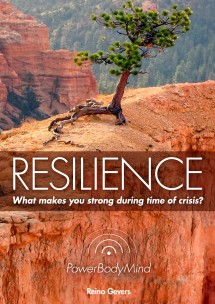
Resiliencepic

Subscribe and get my FREE Booklet:

“Resilience: What makes you strong during times of crisis?


Leave a comment

Filed under mental health, mental-health, Uncategorized

Can God be believed?

There is an ancient Chinese proverb, “better to see something once than to hear about it 1,000 times.” Its something I had to think a lot about during and after my walks on the pilgrimage routes of northwestern Spain.

It was on the Camino that I had an epiphany that God cannot be believed.  God, the universe, or whichever term you would like to give it can only be experienced. With every step on these ancient paths walked by pilgrims for past centuries the conviction grew that there is a force so much greater than the human mind can comprehend.

Words skimming the surface of meaning

As a teenager, I grappled with traditional Christian dogma that takes the Bible teachings literally. “You must just believe and not doubt,” the pastor scolded. The human mind tends to simplify, label, dissect, and rationalize over that which cannot be explained by words alone.

fresco2blog

The ancient languages such as Aramaic, the language spoken by Jesus, Sanskrit,  Egyptian, and Irish Gaelic have retained the richness of imagery and multi-lateral meaning. The ancient cathedrals and monasteries along the Camino are filled with precious works of art from an era where the observer found his/her truth in the contemplation thereof.  The emphasis was not on “preaching” but in singing and chanting of liturgy.

The divide between religion and the spiritual

There is a deep divide between religious dogma and the spiritual. Religion is embedded mostly within an external theology while the spiritual is experiential and rooted in the mysticism of the ancients. The tradition survives in the Christian mystical teachings, Sufism, the Jewish Kabbalah, and Buddhist mysticism.  Practise of certain rituals, meditation and the “mystical experience” through higher consciousness creates the connection to God or the Universe.

Find your own inner truth 

Finding your own truth and reconnecting to your own natural rhythm is the big challenge of our times.  With the pull of the monkey mind with its 10000 distractions flickering from every digital screen, and pulling the mind into many different directions, we are left with a feeling of emptiness and spiritual hunger that is often compensated with addictive behavior.

Happiness is a state of “Being” and not something to be achieved, found in the silence on holy ground, in the green and blue spaces of nature, the opening of the senses to the magic of the moment.

In becoming mindful for the subtle messages of the universe transmitted in dreams, images and symbols, life takes on an entirely different meaning.
Reino Gevers – Author. Mentor. Speaker

https://www.reinogevers.com

Gevers-DeepWalking CVR.indd               paperback_cover_1

Order here

Leave a comment

Filed under spirituality

Building resilience during times of crisis

I’ve just been on my first trip since the lockdown that was imposed in Spain March 14th, walking through an almost empty airport terminal in Palma that would normally be bustling with people during the main summer vacation season.

Different pandemic responses

While in Germany I had the opportunity to speak to people from very different business sectors, and how they are dealing with the pandemic. Germany was one of the few countries that have managed to bring the virus under control with a widespread testing and track and trace system. The death toll has been kept under 10,000 compared to 28,000 in Spain, 35,000 in Italy, and 55,000 in the United Kingdom. Compare this to the United States with more than 130,000 dead!

Germany is a wealthy country with an excellent health care system but almost every business sector is feeling the pinch. The economy is hugely dependent on exports and all the country’s major trading partners have economies in freefall. This means job cutbacks, and less pay for most people.

The US has abdicated leadership 

The pandemic has illustrated vividly how interconnected our world has become. This is no time for insular thinking. The pandemic can only be brought under control by a global, and coordinated response. In the past, the United States has always taken a leadership role in an international crisis. This time around the U.S. administration is dismantling rather than strengthening international institutions like the WHO. It has abdicated leadership and alienated most of its friends and allies.

With many friends and family in the United States, I am very concerned to see how poor leadership, denialism, fanaticism, and political polarization are literally costing the lives of tens of thousands of people. We can only hope and pray that wise leadership will come to the fore.

A time to build body and mind resilience

With cataclysmic external events out of our control disrupting individual lives on so many levels, it is more important than ever to look after your personal physical and mental well-being. Building resilience is key. A resilient mind and body are immune from the blasts of negative distractions.  This is why I’m such a firm believer in taking time out by taking walks in nature to realign with the senses. The blue and green spaces in nature play a crucial part in reducing stress hormones. It even makes a difference when you listen to a tape with the sounds of nature.img_1685

Solutions come at unexpected moments within the stillness and quiet spaces of nature. This is the time for introspection rather than falling into a hectic activity driven by fear of the unknown.
Reino Gevers – Author. Mentor. Speaker

https://www.reinogevers.com

Gevers-DeepWalking CVR.indd               paperback_cover_1

Order here

Leave a comment

Filed under mental health, mental-health

Heart mind

We, humans, are hard-wired to walk on paths we know.  We choose friends, partners jobs, and geographical locations according to familiar patterns deeply ingrained in our past. When lives are so completely turned upside down by a pandemic the emotional stress is, particularly hard on the heart.

The heart is the “seat of the soul”

The heart is not merely an organ of the cardiovascular system that transports nutrients, oxygen, and hormones throughout the body and removes metabolic waste.  In the spiritual sense, the heart is described as the “seat of the soul.”  It is the first organ that develops in the fetus and is the connection between our physical and non-physical (soul) selves.

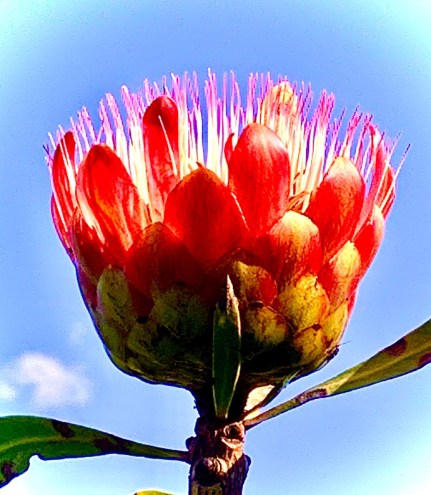
Protea


Impulses or thoughts flow first from the heart and then to the brain. The brain dissects, rationalizes, and analyzes. The heart is authentic and closest to the true self or soul purpose.

Cardiovascular disease is stress-related

Our body is constantly sending us signals about what we need to hear and work on. The problem is that we are so caught up in the world of distraction that we mostly fail to listen until the body calls a time-out with some illness or malady. It is no surprise that cardiovascular diseases top the list in much of the Western world.

Regaining that connection to the “heart-mind” comes during times of stillness. Becoming still is particularly needed during these times of emotional turmoil fed by the fear monsters.

Toxic emotions, stress, trauma, and procrastination can be transmuted very well with the ancient body arts of tai chi, qi gong, and yoga that were all developed and refined by spiritual masters over many generations. Cutting-edge research from Harvard Medical School supports the long-standing claims that Tai Chi also has a beneficial impact on the health of the heart.

The deep walking experience

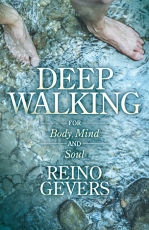
Tai Chi is also described as meditation in motion. For me, I have found a combination of Tai Chi and deep walking as particularly beneficial. Many of you might also currently not have the energy to find a good Tai Chi teacher or to attend regular classes. So why not just take a walk in nature. Even if you live in a big city there are places where you can find stillness in green spaces. The green and blue spaces of nature have an immediate positive effect on reducing stress hormones such as adrenaline and cortisol. Deep walking is not simply a hike for exercise purposes. It is finding a connection with your deeper self while walking. If you want to find out more I really recommend reading my new book Deep Walking for Body, Mind and Soul.

Stress starts with a thought

A really simple method of finding a connection to your heart-mind or your intuition is by concentrating on your breathing while you are walking. Stress starts with a thought. That thought is then compounded by follow-up thoughts and you soon find yourself in that stress maelstrom if you don’t consciously put on the brakes.  If you find it difficult you can count your in- and out breaths, as you are walking.  It is also helpful to focus the mind on a natural sound such as a bird singing or the distant bleating of a sheep.

The events of the past few weeks are teaching us more than ever to look after our mental and physical well-being. It is all about creating resilience and having the energy for the good times that will again come.

Reino Gevers – Author. Mentor. Speaker

Resiliencepic

Subscribe and get my FREE Booklet:

“Resilience: What makes you strong during times of crisis?


Leave a comment

Filed under meditation, mental health, mental-health

Be kind to yourself

A key measurement of your stress-coping strategy or resilience level during times of crisis is how kind you are to yourself. It is an ancient wisdom that is often confused with narcissism and vanity.

In our performance-driven society success is mostly defined in material terms. Those personalities held up as high-flying examples in the yellow press are often deeply-flawed and unhappy characters.

Are you living your own life or the life of another?

Yet so many people consume every snippet of information from other people’s lives, forgetting to live their own life.

self_love

Being kind to yourself is accepting yourself with all your negative and positive traits. Much of the high expectations you put onto yourself in “wanting to be perfect” stems from a childhood where parents with overly high expectations gave love in return for “good behavior”.

If you have the feeling that “nobody loves me” then start loving yourself.  A healing mantra could be: “I love and accept myself the way I am.” Whisper or say it aloud to yourself whenever you have self-doubts and feelings of recrimination toward yourself.

The high-achieving perfectionist waiting for a reward

Among the various types of “burnout” personalities is the high-achieving perfectionist. There is an almost obsessive drive to achieve a goal. But when that goal is achieved there is a general feeling of emptiness. It is never enough and the subconscious wish for the “reward” never comes. It can eventually lead to complete mental and physical exhaustion.

A simple exercise to boost your self-worth

One of the simplest exercises in being kind to yourself is the gratitude ritual. It is the first thing you can do after getting up in the morning: Find just three things that you can be grateful for from the events of the past 24 hours.

This immediately leads to an emotional shift. There will always be humans in your vicinity who will be better off and worse off than you. It is just a fact of life.

The difference between self-love and narcissism

But what is the difference between self-love, kindness, and compassion towards yourself and narcissism?  Narcissists primarily revolve around their own needs and have an inflated sense of their own importance. They are in constant need of attention and validation from the world around them but often themselves completely lack compassion. Social media has unfortunately provided a perfect platform for this type of personality disorder.

Joy and grief are part of the human condition

The resilient personality is well aware that joy and grief, abundance, and loss are part of the human conditions that can and should both be lived.  From this grows authenticity, compassion, and love.

The saying “Love they neighbor as yourself”, first found in the Old Testament of the Bible, and amplified by Jesus in the New Testament defines God as love. But the precondition to doing good unto others is the kindness and acceptance of self. Without self-reflection comes projection and condition. It is also an acceptance that you are part of a bigger whole and that kindness to self is transmuted into kindness for others and mindfulness toward all living beings.

Reino Gevers – Author. Mentor. Speaker

Resiliencepic

Subscribe and get my FREE Booklet:

“Resilience: What makes you strong during times of crisis?

     

Leave a comment

Filed under mental health, mental-health, Uncategorized

Walking through the pain

But nothing is solid and permanent. Our lives are raised on the shakiest foundations. You don’t need to read history books to know that. You only have to know the history of your own life.” ― Ron Rash 

One of the misconceptions of the booming self-development industry and self-help literature is the implication that something is wrong with you if you have a “low moment.”

“How are you?” is the first thing you get asked by a friend or acquaintance when you meet after some absence. You are expected to respond: “I’m very fine thank you. And how are you?”

perchek-industrie-wY7AeHia2v4-unsplash

Photo by Perchek Industrie on Unsplash

Life is never a happy cruise

There is an entirely different reaction when you open up and tell the other person how you are really feeling. It’s either an uncomfortable silence or the other person will show empathy and maybe even tell you about their own challenge they are currently going through. Those are real moments of authenticity.

Life is not meant to be an easy cruise. We go through moments of happiness, then moments of grief and sadness. There might be current health or relationship challenges. While you are carefully laying out your plans God has a different agenda. Life is living on the edge with constant surprises and detours. But its the challenges and the low moments that force us into introspection. The current Covid-19 crisis and its ripple effects are a typical example.

One of the first lessons pilgrims learn when walking the Camino is humility. If you don’t walk the path with humility the path will teach you humility. Physical and emotional pain is part of the process that starts in the early stages of the walk.

This too shall pass

I’ve gotten hopelessly lost just when I felt too sure of myself or did not accept physical boundaries. You plan to walk a certain distance for the day then the weather changes and you have to make different plans or you have to keep on walking because there is no accommodation in the town you had planned to stay for the night.

In the acceptance of life’s ups-and-downs comes the confidence that even in these times of turmoil and great uncertainty is also the certainty that “this too shall pass!”

We know from our own biography that health and financial security can be very fickle. There is no such thing as safe ground. A risk can be reduced but it will not insure you against life’s surprises.

Living through pain and uncertainty 

The challenge is to transmute that pain and to move on. Procrastinating in the sadness on that which has passed and is irrevocably gone prevents you from living the moment and fulfilling your soul purpose.

In accepting and walking through the pain comes the elevation of consciousness. Accepting the setbacks, failures, and mistakes in life is being authentically human. Change and uncertainty are part of LIVING. We aren’t meant to be perfect.  We are mortal beings. As the soul moves on to the next dimension it takes with it new perception and the recognition that everything is Grace.

As the famous German lyric, Rainer Maria Rilke wrote there is not always a solution. It’s living within the question and being patient with everything that remains unresolved in your heart.
Reino Gevers – Author. Mentor. Speaker

Resiliencepic

Subscribe and get my FREE Booklet:

“Resilience: What makes you strong during times of crisis?
     

Leave a comment

Filed under mental health, mental-health

Accepting the enemy within

Societal divisions along cultural, racial, gender, financial, political, and religious friction points become particularly pronounced during times of crisis when the fear demon gets stoked by the professional deceiver.

In the confrontation with the opposite, identity and belief are defined. There is good and bad, black and white, rich and poor, Christian and Muslim. Reality is far more complex and in myriad colors and shades of grey.

Neither yin or yang is absolute 

This is why the yin and yang symbol from the Daoist/Taoist tradition is such a beautiful concept of two halves forming the whole. Neither yin or yang is absolute. Each contains the beginning aspect of the other in a constant flow like night turning into day and day turning into night. The female aspect also has male aspects and the male aspect something of the female.

Too much yin or too much yang in any system creates an imbalance, whether in nature, body functions, or economic or political structures.

Accepting the shadow

Swiss psychiatrist Carl Gustav Jung wrote, “Unfortunately, there can be no doubt that man is, on the whole, less good than he imagines himself or wants himself to be.  Everyone carries a shadow, and the less it is embodied in the individual’s conscious life, the blacker and denser it is.”

We are all susceptible to burying parts of our character that we find unacceptable in the subconscious mind. The problem is that if we don’t face the shadow aspect at the doorway to our mind, it becomes too big to control.

For millennia the question arises: “If there is a God, why does he allow evil?”  Defining evil and recognizing evil can also be a difficult undertaking where the lie is sold as truth and truth gets turned into a lie.

Self-love and the acceptance of the human condition

When going into a meditation on the self you will soon find at least half a dozen positive as well as negative attributes of your own character. This is why it is so dangerous to fall into the trap of labeling an individual, a nation, a race, or a religious grouping. What Jung tried to tell us is that if you don’t accept this duality of light and shadow within, you will soon find yourself on a path of much self-created pain and suffering.

Only in unconditional acceptance of the imperfect human condition, and self-love of all aspects of the personality can grow the seeds of forgiveness, tolerance, and compassion.  This is at the heart of the teachings of Jesus and the ancient Mystics. The fundamentalist Christian concept of original sin meanwhile has been distorted into a culture of guilt and self-mortification. It is the perfect breeding ground for hypocrisy and intolerance.

The enemy is also the teacher 

In the pull between the identity of the opposites, spiritual growth and the evolution of character takes place. Are you kind, generous, compassionate, and loving?  Or are you rude, greedy, inconsiderate, spewing hate and anger? The decisions and habits we make on a daily and hourly basis can tip the scales in either direction.

We need the enemy, and the opposite perspective to gain clarity on our own core values and choices. Humankind has been given the power of choice. Are you falling into the shadow or going with the light?

The tragedy is that the character once held by the stranglehold of the shadow finds himself incapable of self-reflection. The phenomenon is widespread in some of the populist leaders of our time, trapped by their own ego and narcissism.

The image of self has become so clouded that the narrative is turned into its own truth. The deception of the emperor’s new clothes is revealed when it’s too late, and tragedy is upon us. At times it can be useful to turn the pages of that old history book to understand the events of recent months.

Reino Gevers – Author, Mentor, and Consultant

Resiliencepic

Subscribe and get my FREE Booklet:

“Resilience: What makes you strong during times of crisis?
     

Leave a comment

Filed under mental health, mental-health, Uncategorized

Why I despise racism

“No one is born hating another person because of the color of his skin or his background or his religion. People must learn to hate, and if they can learn to hate, they can be taught to love, for love comes more naturally to the human heart than its opposite.”

– Nelson Mandela – 

The image of a white policeman pressing his knee against the neck of a black man pleading for his life has triggered many emotions and memories from my own childhood growing up in apartheid South Africa.

To put it bluntly. Racism is wrong. It is evil and it comes from the lowest depths of human behavior.

Blog_June2020

Photo by Josh Hild on Unsplash

Born as a white person, I never questioned why blacks did not attend the same good schools that I attended, why blacks were refused entry to restaurants, had a different entrance at the post office, were arrested for breaking a night curfew in white areas or could not sit on the same benches as white people in the parks.

But some things happened where even as a child I started questioning the world in which I lived. I witnessed a farmer whipping one of his laborers. He showed no mercy as the man screamed in pain. This was the same man who only hours earlier attended holy communion in church and made a point of emphasizing how good a Christian he was.

Some years later the Lutheran pastor of our white church invited his fellow black pastor and his brass band choir to play in the white church. Despite the pleas from the pastor that this was not the apocalypse and that Jesus would not tolerate racism, the choir was met with extreme antagonism by white congregation members. I never understood the hatred spewing from the mouths of these people who all called themselves Christian.

Years later while working as a reporter for a newspaper in Durban,  I attended a court case where two black politicians, detained under the country’s emergency laws, explained in great detail how the white security policemen sitting in the same court meted out electroshock and other torture methods on them. I will never forget the smug grins of those stocky policemen who seemed very sure of themselves that they would never be investigated for their crimes.

I remember the sad and resigned expressions in the faces of the aged black women and men forced to leave their ancestral lands because a government had designated their luscious agricultural land as a “white” area.

I recall the terrible rage of a white shopkeeper when I walked into the black entrance of his shop.

Years later after returning to my home country for a visit, I drove through what I remember as a staunch white-only community.  The children were out in the playground. There were white, black, mixed-race, and Asian children playing together in what would have been unheard of in my childhood.

And, I remembered Nelson Mandela’s famous quote that nobody is born to hate. It is what the societies in which we live make of us. They can fuel the flames of the worst part of human character or sow the seeds of compassion, love, empathy, and the meeting of hearts that recognize the humanity within beyond the pigmentation of a man’s skin.

Reino Gevers – Author, Mentor, and Consultant

Resiliencepic

Subscribe and get my FREE Booklet:

“Resilience: What makes you strong during times of crisis?


1 Comment

Filed under mental health, mental-health, Uncategorized

Have we lost the ability to communicate?

The current wave of protests against lockdown regulations is indicative of how deeply divided our societies have become. There is a dangerous groundswell of anger easily manipulated by professional deceivers and political demagogues.

Donna parla con lettere su sfondo biancoWith a presidential election coming up in the United States the dividing lines between Democrats and Republicans have never been bigger and more dangerous. If even the wearing of masks becomes a political issue there is a problem.  Be prepared for a very dirty election with global implications.

The trigger words that end “communication”

A normal conversation quickly gets out of hand when trigger words such as “vaccination”, “Trump”, “climate change”, “migrants”, or “Bill Gates” are thrown in. One of the side-effects of lockdown has been that millions of people have not only been locked in their homes but also in their belief systems in scouring the Internet to confirm existing beliefs.

Conventional religion and other institutions formed for a long time the cornerstones and value systems of societies. These have steadily lost influence in the competition for instant gratification. The hypocrisy of institutionalized religion has not helped either with millions of faithful turning either to fundamentalism or pseudo-religion.

Pseudo-beliefs filling the void of religion 

The search for meaning and soul purpose has never been greater. But as humanity moves to higher consciousness, the walk over the hot coals has also become very painful. We are at the crossroads with humankind either falling back into the spiral of fear-based radicalism or moving forward into a restorative, sustainable future where diversity is respected and tolerated.

We will have to learn to communicate again. Communication is not a one-way street of blasting a tweet, or an Instagram post.  Social media has become the rocket fuel of narcissism.  Somewhere along the process of transmission the concept of real  “sharing” of ideas, opinions, facts, and values has been left by the wayside.

We have become so obsessed with our ego-centered own opinion and “belief” that we have lost the ability to listen.  Narcissists are masters in denialism and creating their own truth. They will never admit to human fallibility.

But it is only through the admission of vulnerability and fallibility that we open the realm to listening, asking the who, what, where, when, and why? This is where we learn, adapt, revise, and grow as human beings.

Reino Gevers – Author, Mentor, and Consultant

Resiliencepic

Subscribe and get my FREE Booklet:

“Resilience: What makes you strong during times of crisis?
     

Leave a comment

Filed under spirituality

Joseph and the power of forgiveness

Are you struggling to forgive yourself and others? The biblical story of Joseph is one of the most powerful teachings of how the ways of the universe or God can be very different from the plans we often make in life.

Joseph was slandered, beaten, and sold into slavery by his own brothers because of jealousy. Joseph could have easily succumbed to his fate but he never lost faith that everything in life had purpose and meaning.

slavery

Photo by Hussain Badshah on Unsplash

The trap of the blame game

Only from such a perspective could he forgive his brothers and move out of the trap of the blame game. He made the best out of his situation to such an extent that Potiphar, the man who bought him on the slave market in Egypt, soon promoted him to a higher position. Later he was put in charge of managing Potiphar’s huge estate.

Potiphar had taken a liking to Joseph and must have been impressed by his kindness, wisdom, and humility. For all intents and purposes, Joseph had made it. But Potiphar’s bored wife had taken just as much a liking to the handsome young Joseph. Realizing that he would betray his master who had done so much for him, Joseph avoided the advances of Potiphar’s wife who became so upset that she accused him of rape. Joseph was thrown into prison losing everything. He could again have succumbed to despondency.

But it so happens that he meets in prison two of the Pharaoh’s ministers who had lost favor with the ruler. One of them was eventually released from prison and restored to his old position. Only when the Pharaoh had a strange dream did the minister remember the time in prison with Joseph who had impressed him as an interpreter of dreams. Long story short, Joseph gets released from prison to interpret the Pharaoh’s dream. The essence of the dream was that the ruler had to prepare the country for seven years of drought. Amazingly Joseph’s fortune changed in an instant when the Pharaoh recognized the wisdom of the man he was dealing with.  Joseph gets made viceroy of all of Egypt as the righthand man of the most powerful ruler of the world at the time.

Life comes in strange twists and turns

True to the dream interpretation the drought did come and only by wise management of the food and grain resources could countless lives be saved including those of Joseph’s brother and aging father Jacob.

Life comes often in strange twists and turns. Fortunes can be earned and lost overnight. High positions of political power and influence may be gone tomorrow. The amazing story of Joseph is that he never lost trust and faith. By forgiving his brothers and Potiphar’s wife for falsely accusing him, he made peace with himself and could go into trust and humility. From that energy grew his wisdom and incredible foresight to prevent a catastrophe.

Forgiving does not mean approval of wrongdoing

Forgiving does not mean that you are approving of wrongdoing, of abuse, and all the terrible things that humans do to each other. It is making peace with the past in the knowledge that you are the person today because of all of that which you have experienced. The famous Austrian psychiatrist Victor Frankl only survived the Nazi death camps by telling himself that “everything can be taken from a man but one thing: the last of human freedoms – to choose one’s attitude in any given set of circumstances, to choose one’s one way.”

Nelson Mandela was often asked why he did not seek retribution from the white apartheid rulers who imprisoned him for 27 years. His answer: “Forgiveness liberates the soul, it removes fear. That’s why it’s such a powerful weapon.”

Reino Gevers – Author, Mentor, and Consultant

Resiliencepic

Subscribe and get my FREE Booklet:

“Resilience: What makes you strong during times of crisis?

     

Leave a comment

Filed under spirituality, Uncategorized