Walking the Camino is a spiritual journey that mirrors the journey of life, unfolding in three profound stages: a beginning, a middle, and an end. Kierkegaard describes these three stages of life as the aesthetic, the ethical, and the religious.
The first stage—the crucifixion—represents the struggle and hardship of making mistakes, forcing the boat upstream, and losing your way on the wrong path. During the first stage in life we face trial and error, effort often feels futile. You sometimes engage in aimless wandering and deviations. You may easily lose your way with countless distractions in the monkey mind.
The middle stage, symbolized by the Valley of Death or the Meseta, is a surrender of the ego to a higher purpose and deeper meaning. Here, the ego must die for the soul to awaken to its inner truth, allowing for transformation and clarity.
According to Kierkegaard the appeal during this “ethical stage” lies in walking the path with confidence, even though it may be monotonous and exhausting at times.
The final stage—the resurrection—is a state of flow, where you align with the current of life and begin to see that every experience, even the challenges, has been an expression of divine grace, sculpting you into the BEING you were always meant to become.
You feel the ecstasy in the dance of life. Your walk is a gentle surfing of the path without a sense of gravity. There is an unspoken faith in the journey that drives you forward, and quickens your pace.
Reaching the Cathedral of Santiago is a celebration of joy and homecoming, marking the soul’s return to its true essence. Ultimately, the Camino is a journey of the soul, finding its way back home.
Reino Gevers – Author – Mentor – Speaker
P.S. If you enjoyed this article you will be interested in my books available where all good books are sold.
In ancient oral traditions saints and prophets are often said to return as angels in disguise after departing from their earthly existence, assisting those in desperate need of help, but sometimes unwittingly you too can become a divine messenger by imparting one word or deed that can completely change the trajectory of a person’s life.
Several stories reflect the universal theme of saints and prophets in the afterlife intervening in human affairs, in unexpected and unassuming forms.
Guidance and healing at crucial junctions
In ancient Greek mythology, the deity Asclepius is associated with healing and is said to have returned to the mortal world in disguise offering healing and guidance.
In the Islamic tradition, Khizr is often associated with the archetype of a wise and immortal figure who appears in challenging times, disguised as an ordinary person.
In Slavic folklore, the supernatural being Baba Yaga comes in disguise to test individuals and those who treat her kindly are well rewarded.
According to Jewish-Christian legend the Prophet Elijah intervened at several crucial junctions of human history. During the Battle of Las Navas de Tolosa in 1212 the Christian forces in Spain faced a formidable opponent against the soldiers of the Almohad Caliphate. The Christian army was about to be defeated when a mysterious knight wielding a white banner with a red cross appeared on the battlefield, believed to have been Elijah in disguise, and providing the crucial assistance that turned the tide.
The red cross against a white background is today a familiar symbol on the scallop shell worn by pilgrims walking the Camino de Santiago, many of them probably unaware of its origins. In my novel “Walking on Edge” I refer to several mysterious encounters with strangers that the main character Jake has on the Camino. Some of these accounts are based on real stories that I came across on my own pilgrimage walks.
It is common for pilgrims to have a really low moment while on the Camino, where they are at the point of giving up. I’ve met several people who reported having an epiphany after overhearing a conversation or having a chance encounter with a stranger, giving them the courage to continue.
You should never underestimate the impact your words and deeds could have on a fellow human being. Sometimes you also need to be cruel to be kind.
A teacher or parent might implement a policy of no-nonsense adherence to deadlines and assignments to prepare the student for the obstacles they might encounter in future professional environments, instilling a sense of responsibility and discipline, even though momentarily demanding.
If you have a family member or friend suffering from an addiction problem, the only way you are going to help them is by setting clear boundaries and deadlines where they can get professional help.
But sometimes a simple gesture or act of kindness can leave an everlasting imprint on a person’s memory.
In Charles Dickens’ novella “A Christmas Carol,” the miserly and bitter old man Scrooge is transformed with a child’s kindness that serves as a catalyst for his redemption, reminding him of the joy and warmth associated with Christmas and the importance of human connection.
It costs absolutely nothing to be kind. You never know what impact that could have on a fellow human being. The exact right words and actions might resonate with another person more than you realize.
Reino Gevers – Author – Mentor – Speaker
P.S. I’m excited to announce the release of my latest book, “The Turning of the Circle: Embracing Nature’s Wisdom for Purposeful Living.” If you enjoy it, you might also be interested in my previous works, “Deep Walking for Body, Mind and Soul” and “Walking on Edge: A Pilgrimage to Santiago.” You can find all of these titles at reputable bookstores near you.
Days 8-9 on the Via Francigena – from Ponte d’Arbia to Radicofani
Walking through the valley D’Orca creates a sense of how much the Tuscan landscape here has been shaped over the centuries for the aesthetic eye that inspired writers and painters over the centuries.
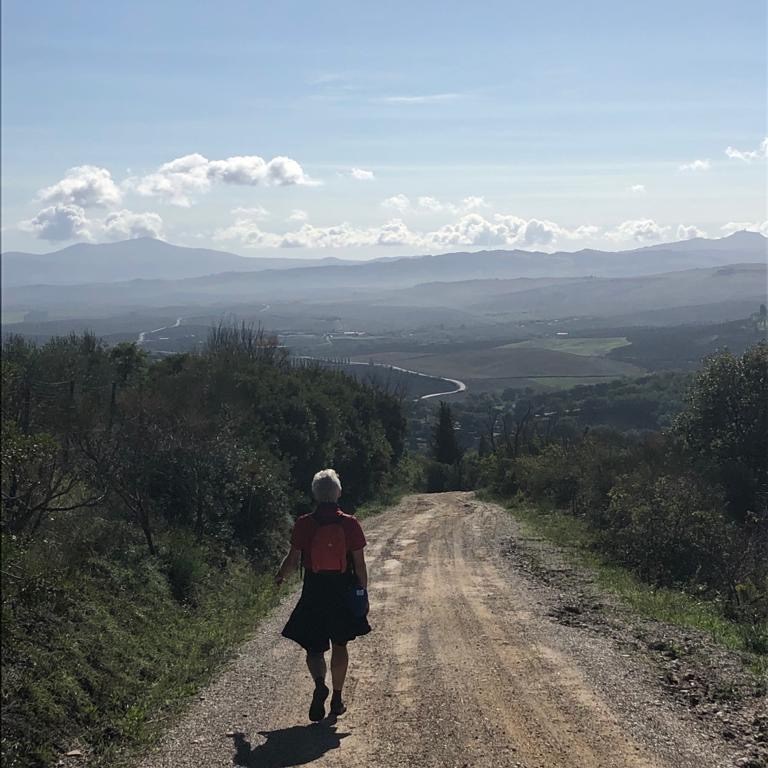
Castles and fortress towers have been positioned on hilltops with the Via Francigena taking the pilgrim on a path over gently rolling hills, past vineyards, and bridges over meandering streams.
Pheasants fly over harvested fields as if surfing on invisible ocean waves. A bird sings. There is a brief pause and then another bird replies on the far end of the valley. In the typical Mediterranean cypress trees bird choirs entertain.
Walking in peace and solitude
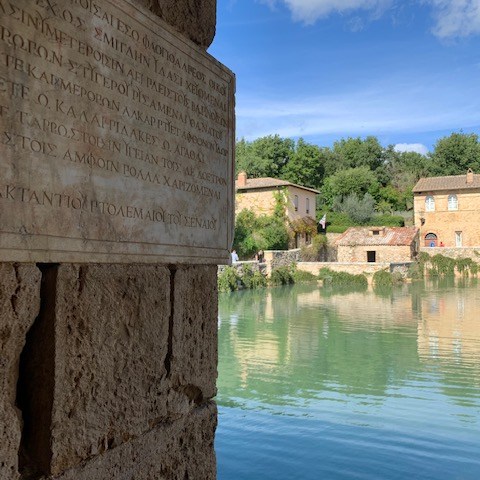
The walk from Siena has been one of particular solitude. Famed towns such as Buenconvento, San Quirico and Bagno Vignoni with its famous thermal pool are virtually devoid of tourists as a result of Covid-19 travel restrictions. Since leaving Siena we have met just one fellow pilgrim, a German woman outside San Quirico, who started her walk from Tuebingen.
From San Quirico the first major attraction is the village of Vignoni Alto that appears almost frozen in time. Like in so many places along the route the chapels are open, offering a quiet space for solitude and meditation for the pilgrim. On the Camino de Santiago in Spain the pilgrim will find many such chapels closed. The reason is that these places often contain precious work of art with criminal gangs having specialized in stealing them.
Near the altar of the chapel in Vignoni Alto I find a dedication to St. Biagio the throat protector. A first reference to the saint is found in writings dated AD 500. He is not only venerated as the saint protecting ailments of the throat but cured many physical and mental ails. He is also said to have healed and been assisted by many animals.
What are you inhaling and exhaling?
During these times healing and protection of the throat and breathing systems is particularly important. The Chinese philosophy of the Five Elements tells us that the Metal Element (lung and large intestine) is largely related to an imbalance on the inhaling and exhaling, the setting of healthy mental and physical boundaries. It is telling for our times that the professional deceivers and crackpot conspiracy theorists are bombarding the public sphere with darkness.
Even here on the Via Francigena comes the reach of toxic energy from American politics. At a nearby table in a café a guest watches a replay of the debate on his tablet with a very concerned frown on his face. I was unable to listen to the rants for more than a few minutes. What we inhale and digest physically, and emotionally affects our well-being on so many levels. We cannot avoid the events in the external world but the real test is in realigning with the positive energies of healing, unity, peace, reconciliation between the races, and healing of our natural ecosystems.
There is light and darkness, goodness and evil, compassion, kindness and Narcissistic self-aggrandizement. Walking along a roadside there was a stream of cooling, calm, clear river waters on the left and a noisy road to the right. What do you focus on mentally? After my first frustration, I no longer hear the traffic, just the gentle, rushing waters of the river.
Reino Gevers – Author. Mentor. Speaker
One more thing…
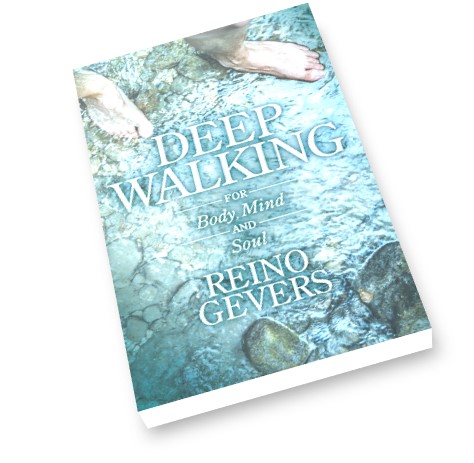
You might want to check out my new book “Deep Walking for Body, Mind and Soul” released as a paperback by Morgan James Publishing on August 11, 2020. It has some valuable tips on creating happiness and boosting your vibrational energy on many levels. You can order it at all major outlets such as Amazon, Barnes and Noble or in my own store. Check out the latest five-star reviews on Goodreads.
“A breathtaking, captivating, transformative walk,” – Tom Dutta, Canada
“The book reminded me of my own journey in life I am walking and how bringing stillness to my busy life and mind is essential.” – Karin, France
“The book compresses on its slim 190 pages an extreme density of life wisdom.” Christina Germany
The Camino in Spain has in many respects been a life-changing experience for me. The lessons learned on the pilgrimage are in so many ways an analogy of life. My book “Walking on Edge”, a work of fiction, takes up many autobiographical cues and is dedicated to some of the most amazing people I have met on the Path.
For many centuries Christian pilgrims walked thousands of kilometres from the doorstep of their homes throughout Europe to the Spanish city of Santiago de Compostela, where according to legend lie the remains of one of Jesus apostles St. James. Fear of landing in the fires of hell after death was deeply entrenched in the minds of the people of the Middle Ages. The church at the time promised those folk that they and their families would be cleansed of all sin and have a wonderful afterlife in heaven if they did the pilgrimage at least once in their lifetime.
Today hundreds of thousands of people are rediscovering this ancient route as a wonderful way of self discovery and through that deep look inside, finding their own inner spirituality and soul purpose.
In my book I have changed the characters but some of those modern day miracles are based on true experience. Yes, I am convinced that miracles are still happening, if we open our senses and look around us. For me the Camino was not one massive bolt of enlightenment striking on a hill, but the sum of many exceptional experiences over a period of several walks on different paths in Spain and France.
Since the days of my childhood I have agonised over the teachings of religion telling us to believe this or that or to follow this or that teaching. It’s all external. One major lesson I have taken from the Camino is that there is a major difference between religion and personal spiritual experience. In my book the pilgrim Chuck calls it the difference between head and heart mind. The soul path cannot be understood with rational thought and can only be felt with the heart. And, a growing number of people are saying: “Let me go out and seek an answer to why I am here and who I really am.” Through this self-recognition comes what I will call “God recognition” and what is a very personal and individual experience.
Suffering inevitably leads us to go out looking for answers. A lot of people are getting lost and feeling left behind in the digital revolution. In some ways mankind is facing a similar dilemma as the people in the Middle Ages. Its no longer the church that rules over our lives but the information overload of countless distractions polluting our minds with clutter we don’t need.
Ronaldo was one of those pilgrims “walking things off” by going at a pace most others could not keep up with, avoiding all conversation as the emotional clutter gradually released itself, opening up space for new experience.
And it was that space, as Chuck called it “that can then be nourished with inner peace, forgiveness and compassion. You in fact are working on becoming a better human being.”
Reino Gevers – Mentor for Leaders and Achievers – Your Health Matters
Its been some weeks since we returned from our hike on the Spanish Camino and I’m still astounded at how much the experience still resonates in our lives.
We have just heard from Jim who walked the entire Camino Frances from Jean Pied de Port, arriving in Santiago last week after 40 days of walking.
The many interesting and fascinating people you meet on the Camino is part of part of what I would describe as one of the most precious gifts of the Camino. This is why many Peregrinos decide to give something back in volunteering to work a summer in one of the pilgrims’ hostels.
Many people walk the Camino to find an answer to a life-important question they are dealing with. Mostly they find the answer, sometimes after weeks or months after the walk, with the answer to a question needing time to ripen.
On my first Camino I was somewhat disappointed at not having found “my answer”. The lesson to learn was patience and to open the mind to the so many of the mysteries and lessons of the Path.
The first lesson I learned was that it needs time to “walk things off” and get rid of the old emotional baggage that you often carry with you for years. My theory is that the body has an “emotional memory” just like the emotional mind in holding onto “traumatic” experiences on a cellular level. This is why the first days of walking are so hard, even for people who have prepared well physically.
When this “emotional garbage” comes to the surface on the “path of crucifixion” that often comes during the first week of arduous walking through blisters, sore knees and back pain, the transformation process can begin. Then walking, even through difficult terrain, becomes an easy ride and you can actually start enjoying daily walks of 25-30 kilometres and more.
There were so many images, smells and meetings of mind on this centuries old path that this space is too short to fill them.
There was the father walking the path with two mules in fulfilling a dream that his daughter had on her death bed when dying of cancer. There are the brave young folk in the Aragon province fighting a dam project that will flood a pristine valley and one of the oldest parts of the Camino. There are the faces of people you look at where you know they have just gone through a very hard time in their lives and that they have come through, stronger.
On a physical level, I feel much fitter. My skin seems smoother and my senses of smell and hearing different. In my dreams I am still walking and when I wake up I know that I will soon be making plans for the next walk on the Camino.
Humanity’s disconnect to the web of life, the lack of respect and awareness for the many parts of the bigger whole, has got us into a pretty dire predicament.
Some theorists would argue that man is a predator by nature and that it is all about the survival of the fittest, falsely quoting Darwin who was in reality very much aware of the intricate inter-connection of all living things.
Any species which fails to find its niche in the web of life becomes extinct because the earth or “creation intelligence” always finds a means of discarding that which becomes a threat to everything else. It is something you become acutely aware of by spending alone time in nature or in the wilds.
I’ve had some of my deepest spiritual experiences while hiking alone in the Pyrenees mountains, the Spanish Camino and the African bush where simply by observation you begin to realize that every plant, beetle, bird, antelope or predator is there for a reason and plays its small part in sustaining life as a whole.
My theory is that humanity’s disconnect from the web of life is partly the result of alienation from nature and the “materialist-theoretical” approach to religion rather than intuitive spirituality that our forebears practised in the mystic traditions.
As hundreds of millions of people continue to move to urban areas there is a real danger that the alienation from our true destiny will continue. A growing number of people in the wealthier countries are living alone in apartments and getting lonelier and lonelier as they grow older and their already fragile support network of friends starts falling away.
In my previous blog I mentioned how much we are influenced and shaped by the people around us. Our health, our happiness and our lifespan depend on how well we are accepted, integrated and valued in that community we cherish. Loneliness is perceived as physical pain and is responsible for many psychological disorders. Read this interesting report on what people in Sardinia seem to be getting just right and why many of them stay healthy well over the age of a 100.
The biggest challenge faced by humanity is to rediscover that bond to the web of life and to make the switch from predator to custodian, protector and nurturer. Here are just some ways of reconnecting:
Sitting meditation with emphasis on the natural breathing sequence of inhaling and exhaling
Walking “things off” and reconnecting with your natural rhythm on a longer hike, preferably for several days. Its a wonderful way of detoxing your mind and body.
Any of the body arts such as yoga, taiji and qi gong have been practised and perfected over many generations as a way of reconnecting with your mind and body.
When outdoors in nature find just one sound to concentrate your mind on. It could be a bird chirping or the wind blowing through the trees. You will feel very relaxed after only a few minutes.
I had an amazing experience on one of my walks when I connected to a blackbird singing in a tree nearby. It responded by following me for several kilometres, hopping from tree to tree and on the track ahead. It was an amazing experience of connection.
All across western Europe a network of ancient trails used by pilgrims for centuries are being re-discovered as a growing number of people are realising that taking a long walk is one of the best ways to get your stress level down.
During the Middle Ages it was common practise for at least one member of the family to walk by foot to Santiago de Compostela in Spain to pay homage to what is believed to be the burial place of St. James – one of the Apostles of Jesus. Many did not survive the hazards of disease, bandit attacks and other accidents.
Following a series of recent best-selling books on the Camino including “The Pilgrimage” by Paulo Coelho and “I’m Off Then: Losing and Finding Myself on the Camino de Santiago” by the German entertainer Harpe Kerkeling, tens of thousands of people are again walking the Camino every year.
The main route, the Camino Frances, from Roncesvalles to Santiago is 737 kilometres long and will take the hiker several weeks to complete. The route is well signposted and the “peregrino” or hiker will find a pilgrims hostel in almost every village on the way where he/she can stay at a cheap price overnight. It is a far cry to the hazardous route from the days of yore.
After taking my first “small” 120 kilometre walk from Saria to Santiago several years ago I have literally become hooked to these ancient paths. Since then I have understood why many a wise teacher has pronounced that getting back into sync with nature “is your best healer”. Walking helps you find your natural rhythm, relaxes your breathing and has many other positive health effects.
On one of my longest trails lasting more than four weeks, which I walked with my good friend Tom, we took the more rugged Camino del Norte along the coast from Urquera to Santiago. It was an exhilarating experience, off the main route frequented by most other peregrinos. The landscape is spectacular with mountains, a rugged coastline and remote villages.
This year my wife Alyce, our Dalmatian dog Klara and I did a short stretch from St. Gallen to Einsiedeln in Switzerland. During the Middle Ages most pilgrims from northern Europe walked the same route, gathering at the famous monastery in Einsiedeln before commencing on the long route through France and Spain. Walking slowly by foot through a country makes you see so many things you would never see when travelling by car, bus, train or even bicycle.
After a long afternoon walk up an Alpine hill during summer temperatures of well over 30 degrees Celsius we found a hut next to the road and a fridge filled with cold drinks and ice cream. You merely put into a bottle the money for the drinks you consumed. I couldn’t help but wonder what such a gesture of trust in one’s fellow man would have meant in my home country South Africa with its spiralling crime rate. Camping sites in the Swiss Alps are spotlessly clean and equipped with all the necessary utensils with obviously no danger of theft and vandalism. People had warned us not to take a dog on the walk but we were positively surprised how accommodating and dog-friendly the Swiss really are.
True, Switzerland also has its problems, but somehow the Swiss for centuries have managed to stay on track with a grass roots democracy based on mutual tolerance for different religious, language and cultural affiliations with a broad consensus on this common value system. A general scepticism in big government is deeply embedded with the cantons or regions having wide legislative freedoms. The result: A healthy and vibrantly affluent society.






 The Camino in Spain has in many respects been a life-changing experience for me. The lessons learned on the pilgrimage are in so many ways an analogy of life. My book “


 ReinosBlog