Nelson Mandela once reflected that one of the most difficult things is not to change society but to change yourself.
I’ve given much thought these days on why my home country South Africa is falling apart.
Fortunately, Mandela was spared from witnessing the complete erosion of moral integrity among his successors. Essential components of infrastructure, including harbors, roads, railways, hospitals, schools, and electricity supply, are deteriorating due to incompetence, crime, and corruption.
A government-funded food scheme, which feeds over 9 million schoolchildren countrywide of which the majority come from poor households, has been thrown into disarray by funds gone missing. Transparency International‘s 2022 Corruption Perceptions Index scored South Africa at 43 on a scale from 0 (“highly corrupt”) to 100 (“very clean”).
Present-day leaders, ensconced in a cocoon of privilege sustained by nepotism and political favoritism, adamantly deny accountability for their shortcomings. Astonishingly, they continue to attribute their catastrophic failures to a regime ousted from power three decades ago.
It appears that they are replicating the very behavior they once decried, abandoning the principles they once championed. Instead of serving society, they exploit their positions for personal gratification, echoing the very actions of those they once decried as the enemy.
Meanwhile, America and many other Western democracies are being torn apart by divisiveness, and political extremism.
The political landscape serves as a mirror reflecting the intricacies of society and individual behavior. Regardless of the adversities presented by the external world, the onus lies squarely on every individual for their response, attitude, actions, and overall sense of happiness.
In my latest Living to BE podcast, Scott White tells of his mission in planting one seed of positivity at a time. Every good day can be made into an even better day by changing the perspective with the antidote of gratitude, kindness, and self-deprecating humor.
How many of us are stuck in regret, pain, hurt, and anger toward an ex-partner, parent, employer, or neighbor.
When unaware it‘s easy to be pulled into the maelstrom of the same fear and anger you are exposed to.
Grievance culture complains about everything from the weather to the postman coming late. It is the lowest vibrational energy that feeds on scarcity, limitation, and neediness.
Even the best solution you offer to these people is met with a „but…“, „that will never work“ or „can‘t do that.“
You literally feel the energy sucked out of you as they go into their rant, making everyone else responsible for their misery.
When a person radiating on a high vibrational frequency enters a room, a transformative shift occurs. You sense your own energy expanding, drawn by a magnetic power that not only inspires but also generates positive change. This influence becomes the defining factor between fear and courage, scarcity and abundance, love versus hate, and kindness prevailing over moody grumpiness.
From this elevated plane of consciousness emerges creativity, inspiration, and confidence. It is from this heightened state that even the most entrenched problems of humanity can find solutions.
There are no shortcuts to the inner work.
Cutting through the veil of adversity, toxic emotions and the monkey mind of dancing thoughts is the spiritual exercise, the gateway to happiness.
Quoting the spiritual teacher Ram Dass:
„One consciousness. That is the way the world could right itself. Start with your peace, your love. your compassion, and go from there … walk each other home.“
Reino Gevers – Author – Mentor – Speaker
P.S. I’m excited to announce the release of my latest book, “The Turning of the Circle: Embracing Nature’s Wisdom for Purposeful Living.” If you enjoy it, you might also be interested in my previous works, “Deep Walking for Body, Mind and Soul” and “Walking on Edge: A Pilgrimage to Santiago.” You can find all of these titles at reputable bookstores near you.
Here in the northern hemisphere, autumn unfolds its colorful spectacle. Trees shed their leaves as a brisk breeze weaves through bare branches. A nimble squirrel gracefully navigates from one tree to another, scouting for the optimal spot to hibernate through the coming winter.
Autumn marks a period of natural slowdown, where the vibrancy of summer yields to the quieter preparation for the colder months ahead. Yet, within this apparent tranquility, there exists a wild and unpredictable quality. A gentle, warm wing might whisper promises of impending spring, only to be followed by tempestuous storms.
In observing autumn’s dichotomy, we find a reflection of our own complexities. It teaches you the art of conserving energy for the inevitable challenges, mirroring nature’s rhythmic dance between repose and upheaval.
In studying nature you inevitably embark on a journey of self-discovery, unraveling the intricacies of your own existence in the ever-changing seasons of life.
We often forget that we are part of the bigger matrix. Your entire body is a composition of the elements around you. In the ancient Chinese philosophy of the Five Elements, autumn is associated with the element of metal. By getting into alignment with nature, you will recognize your innate and authentic nature.
Thus autumn is a time for introspection. These are questions you could ask:
What was really good this year?
What was a mistake and should be avoided in the future?
Life can be hard in teaching you the lessons you need to learn, especially when you fail to heed the whispers from the universe that tell you where to walk. It could be the advice from a total stranger, a sentence you coincidentally pick up in a conversation. A sudden inclination or feeling, a strong symbol from a dream, or a work of art you are observing.
Like the falling leaves of autumn, this is a time to let go of relationships, beliefs, and concepts that no longer serve you.
Harmonizing the inner and outer worlds is a major challenge in a world where attention is constantly being pulled at by external distractions.
Your breathing pattern is a reflection of your inner state of mind
Being aware of your breathing pattern plays a key role in relaxing your mind. Shamans and yogis have for centuries used breathing techniques to explore new realms of consciousness. In studying your breathing and improving on it, you become aware of hidden emotions and feelings. Fear, for instance, expresses itself with a flat breathing pattern and clogged feeling in the throat. A symptom of stress is strained breathlessness coming from shallow breathing from the upper chest.
A tense and stressed body finds no solace. Worries, fears, and other emotions create an imbalance that makes it susceptible to illness.
Recognizing the shadow aspect, such as your fears, your anger, your hurt, your shame, envy, or greed, is the first step in transmuting those negative emotions.
In a reflection of the metal aspect of the personality, we would look at the following questions:
Is there an old melancholy sadness that binds my spirit from making a move forward? Can I really admit to that sadness that is still there? Could it be that I should set a boundary toward certain people and make a healthy separation? Are my immediate surroundings, like my home and job, still fulfilling?
Are there too many superficial distractions in my life that prevent me from going on the path of my true destiny? Am I in the position of letting go of old concepts, ideas, or other so-called truths that have outlived their value for me?
Is my basic outlook on life of a positive or negative nature? Do I perceive tension and looming conflict situations in my immediate surroundings before they actually erupt? Do I have enough room to breathe? What is preventing me from exploring new avenues? Where are the boundaries set by myself or others? Could it be that I am also crossing the boundaries of others without realizing this?
The unique, authentic self only manifests itself when you liberate yourself from the magnetic pull of countless distractions, selling images, wants, and needs.
We need a truly strong metal element to preserve that space of true authenticity. When we are authentic with the true self, we are immune to mental and physical exhaustion that mostly comes from playing with the images of the false self.
Reino Gevers – Author – Mentor – Speaker
P.S. I’m excited to announce the release of my latest book, “The Turning of the Circle: Embracing Nature’s Wisdom for Purposeful Living.” If you enjoy it, you might also be interested in my previous works, “Deep Walking for Body, Mind and Soul” and “Walking on Edge: A Pilgrimage to Santiago.” You can find all of these titles at reputable bookstores near you.
As the major battlefronts in Ukraine find themselves in a protracted stalemate, the conflict in Gaza has been readily embraced by mass media as an alternative, offering a boundless supply of dramatic narratives of bombings, injured children, and distraught mothers.
On-the-ground reporters emphasize the tragic unfolding events with a flair for dramatic language, often neglecting to furnish the essential context and nuanced analysis that might otherwise prove less sensational but more informative.
Stirring a potent mix of toxic emotions
Intricate details and complexities of geopolitical situations risk being overshadowed, as the media opts for a continuous stream of emotionally charged visuals, skillfully crafting a narrative that stirs a potent blend of anger, disgust, and fear among its audience.
It is prudent to contemplate the underlying origins of wars, which often revolve around mythical concepts of land ownership. Fundamental rights of those actually living on the land are callously disregarded in the name of religious ideologies and historical claims that, upon closer scrutiny are tenuous at best.
The land belongs to those who live on it
A world characterized by broader acceptance of the principle that land belongs to its inhabitants could pave the way for greater global peace. Human history reveals a nomadic evolutionary journey, where migration has consistently been an intrinsic human inclination. However, substantial population shifts have frequently been involuntarily, triggered by natural catastrophes and conflicts, disrupting the harmonious coexistence that a more inclusive understanding of land ownership might foster.
Do we really want to open a debate on who rightfully owns Australia, New Zealand, the United States, or South Africa? Take back all the land from who owns it now and give it back to the indigenous people? We could also go back to when the earliest homo sapiens started migrating from Africa to Europe and conflicted with the Neanderthals on hunting grounds? If Vladimir Putin gives history “lectures” on why Russia has the “right” to annex Ukraine, we can ask why Austria doesn’t have the right to recreate the Austro-Hungarian Empire and why not recreate the Holy Roman Empire, a complex political structure that existed from the Middle Ages until 1806.
Redrawing history maps for ideological and empire-building purposes is a mindset from the last century that triggered countless wars, especially in Europe. It was the reason why the founding fathers of the European Union had the vision of creating an alliance of nations, some of whom had fought each other for centuries, in an interdependent union of equals with open borders and the free flow of peoples and goods. It has ensured the longest era of peace and prosperity in central Europe and is the reason why most countries in eastern Europe, including Ukraine, are clamoring to join.
In antiquity, the Middle East was predominantly inhabited by nomadic tribes, whose dwellings were dictated by the grazing needs of their livestock. The concept of national boundaries is a relatively recent historical development. They were often the result of indiscriminate colonial map makers sitting in European capitals.
The debate over historical claims to Palestine by either the Jews or the Arabs becomes somewhat mooted when acknowledging that we have a modern reality where approximately 20 percent of Israel’s citizenry is Arab. Within the self-identified Jewish population we have a rich tapestry of diversity, encompassing Ashkenazi, Sephardic, Mizrahi, and other Jewish ethnicities. Beyond this, Israel is home to a mosaic of minorities, including the Druze, Bedouins, Circassians, and various Christian groups.
The primary objective of the Hamas terrorist organization is to establish an Islamic state. Dozens of foreigners from across the globe were among the victims of the October massacre this year. It was a callous and brutal demonstration of the organization’s complete disregard for human life. Innocent children, babies, fathers, mothers, and the old and frail were often shot at point-blank range. The trauma, horror, and rage in Israeli society is understandable but can never warrant a response that likewise causes massive civilian casualties.
The Hamas attack was planned in horrific detail to provoke the Israeli response. It was to be expected that Israel’s most rightwing leader ever, Benjamin Netanyahu, would react the way he did by ordering an invasion to “eradicate Hamas.” By using civilians as cover Hamas is callously taking into account the casualties as part of its greater global strategy, and it appears they are having much success:
The global landscape is witnessing the troubling aftermath with a surge in anti-Semitism and Islamophobia. The voices of moderation find themselves overshadowed by extremists who vehemently advocate an ultimatum: a stark choice between good and evil “Palestine” or “Israel.” The polarizing narrative fosters an atmosphere of divisiveness and conflict, the breeding ground for extremists and demagogues eager to recruit new followers.
We have to connect the dots to understand why Hamas launched its attack on innocent Israeli civilians in the first place.
It is no coincidence that the attack came after Israel was having some diplomatic success in improving relations with moderate Arab countries.
Was Hamas instigated to launch the attack by Russia’s ally Iran to deflect attention and military resources from Ukraine? There is some evidence, though not confirmed, that Russian mercenaries were involved in the training of Hamas.
If Israel had a wiser leader, other options in response to the invasion of Gaza would have been the better choice. In the wake of massive Israeli bombings and civilian casualties in Gaza, Israel has lost the moral high ground.
The wiser option
Indian Prime Minister Manmohan Singh faced a similar dilemma when Pakistani terrorists carried out in November 2008 a series of coordinated attacks including on the Taj Mahal Palace Hotel. It was one of the deadliest attacks in Indian history claiming the lives of an estimated 166 people with 300 others injured. Singh was under great pressure to launch an attack on Pakistan but urged caution. Later European and American analysts pinpointed rogue elements within Pakistani intelligence as having planned the attack to draw international attention to the India-Pakistan conflict by provoking an Indian military response.
By not escalating in 2008, India created a policy option to employ legal methods against the attack’s perpetrators and retained the moral high ground. If it had gone to war with Pakistan the result would probably have been a stalemate with the world sharing the blame 50:50.
After the 9/11 terrorist attacks, the United States received an outpouring of sympathy from all parts of the world. Instead of carefully considering its options, President George Bush ordered the invasion of Iraq, not having a real plan of what would come afterward. It was by all means a mistake of historical dimensions with many lives unnecessarily lost.
Evil can never be fought with a simplistic “eye for an eye” concept. Violence breeds more violence. The children traumatized by the bombings in Gaza are likely to be eager recruits for the next terror organization.
What does this all mean for you and me on a personal level?
Political conflicts are a reflection of the collective state of mind of the state or the nation. We will never eradicate war or conflict. It is part of the human condition that we are incomplete beings prone to irrational behavior.
Being pulled into the rabbit hole of daily images of disaster and conflict does something with your mindset and your emotions. It can numb the senses to real feelings of empathy and compassion and trigger anger, frustration, and melancholy sadness. You are not in control of external events but you are in control of how you perceive and react to these events.
During these times of conflict in the external world, it takes discipline to set boundaries to over-exposure to negative news without ignoring what is happening in the external world. A good antidote to grievance culture, negativity, and pain is the ability to find meaning, grace and beauty in every moment.
No matter how challenging these times may be, practicing the discipline of thought, taking a different perspective, and shifting your focus, will bring you into a higher vibrational field. A kind word here, compassion and a smile there, and being grateful for the smallest of things. Gratitude, love, empathy, peace,and kindness are the threads that weave together humanity.
Reino Gevers – Author – Mentor – Speaker
P.S. I’m excited to announce the release of my latest book, “The Turning of the Circle: Embracing Nature’s Wisdom for Purposeful Living.” If you enjoy it, you might also be interested in my previous works, “Deep Walking for Body, Mind and Soul” and “Walking on Edge: A Pilgrimage to Santiago.” You can find all of these titles at reputable bookstores near you.
Humanity is about to embark on a journey marked by monumental shifts and unprecedented disruptions, unlike anything we have seen before. It will impact every aspect of our lives, creating a ripple effect that will affect us on multiple levels.
This is the conclusion reached in a workshop we had recently in a German monastery. The participants included experts from finance, research, health, and education – all of them having delved deeply into philosophy, religion, and spirituality.
A tumultuous shift into a new era inevitably comes with disruptions in the form of wars, breakdown of institutions and industries, extremism, and social changes. Some notable examples of the past include the industrial revolutions of the 18th and 19th centuries, the Great Depression of the 1930s, the two world wars, the end of the Cold War in the early 1990s, and the digital revolution of the late 20th century.
We can expect in the next five years an unprecedented leap in quantum computing, biotechnology, genetic engineering, robotics, and artificial intelligence automation. The ability to enhance, alter, or transfer consciousness raises profound existential and ethical questions about identity, mortality, and the human experience.
During times of uncertainty, we are seeing a retreat into political extremism and religious fanaticism. Fear is what fuels the radicals, exploiting emotions to sow discord and chaos. Millions will find themselves on the losing end, navigating the turbulent waters of change.
The winners who embrace change
Yet, amidst these challenges, there will emerge a resilient group of individuals and communities who seize the opportunity. Winners not only adapt to change but have the innate ability of turning adversity into an advantage. They embody the human spirit’s ability to innovate and flourish during times of uncertainty.
Building resilience
The more you build your mental, spiritual, and physical resilience at this point in time the easier it will be for you to navigate the disruptions of the future.
In my new book “The Turning of the Circle: Embracing Nature’s Wisdom for Purposeful Living”, I emphasize the point that all of life underlies a seasonal principle of natural and spontaneous changes. Evolutionary change, sometimes disruptive, is an elementary aspect of the universal intelligence, of God, or the divine.
Embedded within the fabric of all things lies a divine essence, a source that intricately connects us all within a vast and intricate cosmic matrix. This profound interconnectedness is in perpetual motion, constantly evolving, adapting, and striving toward refinement. Within this intricate tapestry, God finds expression through the awe-inspiring wonders of nature.
Creation, in all its diverse and manifold forms, is a testament to the boundless creativity of the divine. It is a dynamic masterpiece, never at a standstill, but rather, continuously in motion and unfolding in the exquisite dance of creation.
The purpose of life is life itself
With the sunrise of another day, the delicate bloom and aroma of a flower, the melodious song of a bird, and the fleeting touch of the wind, you hear the divine whispering to the soul. The everyday miracles of nature serve as reminders of the eternal dance of existence, illuminating the path of endless growth and the limitless opportunities that dwell within the universe’s vast and loving embrace.
While the external world will continue to focus on the distractions of the 10,000 things and short-term material and sensory gratification, the spiritual teachings of the ancient Mystic teachers become more relevant than ever, providing a haven of comfort and resilience during times of uncertainty.
Happiness and contentment can ultimately only be found in alignment with the vertical dimension of the spiritual.
The term “spiritual” traces its roots back to the Greek word “pneumatikos,” later translated to “spiritualis” in Latin. Unlike religion, it stands apart from rigid doctrines and defined systems of belief. Instead, it inherently signifies an exploration of the inner essence, a journey towards the core or spark of the “holy spirit,” integrating the life force in connection with divine energy. It embodies a sacred communion that transcends the boundaries of organized faith, emphasizing the personal and transformative relationship between the individual and the divine.
Lifting the veil to fulfillment and life purpose entails uncovering your individual creative niche within the vast tapestry of God’s creation. The purpose of life is life itself.
The choice is between embracing a bright future of hope and purpose or heading for the pitfalls of negativity laid by the forces of darkness.
Reino Gevers – Author – Mentor – Speaker
P.S. I’m excited to announce the release of my latest book, “The Turning of the Circle: Embracing Nature’s Wisdom for Purposeful Living.” If you enjoy it, you might also be interested in my previous works, “Deep Walking for Body, Mind and Soul” and “Walking on Edge: A Pilgrimage to Santiago.” You can find all of these titles at reputable bookstores near you.
A deluge of negative news from atmospheric disasters, economic meltdowns, and wars is collectively inundating the minds of humanity. It not only corrodes our trust in the future, but also frays the delicate fabric of communities, and nurtures grievance culture.
Without ignoring the real and tangible threats that our world faces, the fears and anxieties of a collapsing future are just thoughts. Stress always begins in the mind and triggers the reptilian part of the brain.
Freeze, flight or fight
We are hindered from discovering genuine solutions as humanity collectively remains ensnared in the primal instincts of freeze, flight, or fight. In this state, the very essence of our creative minds lies dormant. Our potential for innovation and problem-solving remains untapped, buried beneath the weight of instinctual responses.
Mass media, especially the social media variant feeds on toxic emotions. It exaggerates, inflates, inflames, distorts, and falsifies reality.
Here are some questions you can ask yourself when your emotions have been triggered, and you are stressed out or feel that you are losing control.
Is it true or is it just my perception? Who said it with what motivation?
How can I adjust to new circumstances without letting emotions seize control over my mind?
Is it really important in the bigger picture of things?
Is it a problem or just a difficulty?
This too shall pass?
One of the most powerful books of our time is “The Search for Meaning” by Victor Frankl. It was based on his experiences in a concentration camp during World War II. He found that those people who kept their minds focused on a compelling future, despite the most horrific circumstances of the present moment, had a far greater chance of survival.
Frankl argued that even in the most dire circumstances, some of the prisoners who survived the Holocaust identified a deeper reason to live such as the pursuit of a higher purpose or calling.
How is your response to pain and suffering
While you cannot always control external circumstances, you have the power to choose how to respond to those circumstances. By finding meaning in suffering and adversity, you maintain human dignity and inner strength.
In moments of deepest despair, those contemplating suicide often feel utterly bereft of hope, their minds consumed by a relentlessly bleak vision of the future. Yet, just as a single thought can plunge someone into darkness, it holds the power to reshape their destiny into one of brightness, joy, and well-being.
Life’s journey inevitably leads us all toward our ultimate destination—the cessation of our physical existence. However, amidst the uncertainties of this voyage, there lies an opportunity to embrace the present and celebrate every moment.
Rather than succumbing to despair, why not choose to savor the journey, finding solace in the beauty that surrounds you, and in doing so, discovering a profound sense of purpose and contentment?
Keeping the monkey mind under control
Nobody knows what the future might bring. We therefore should keep that monkey mind under control that is jumping incessantly from branch to branch. Keep your feet firmly planted to the ground and focus your mind on your breathing.
By inhaling I know that I am inhaling. Exhaling I’m aware that I’m exhaling. Breathe and focus your mind on the present moment. The present moment is the only reality. It is the only truth.
Life is seasonal and choreographed like an intricate dance between opposing forces. We sway between night and day, navigating through darkness and light, embracing both happiness and sadness, tasting the bitter tang of scarcity and sweet abundance. Dancing between the opposites without attachment is what gives life purpose and meaning.
When you invite the light to penetrate the depths of your shame, and the wounds of your fear, and anxiety, life becomes a transformational ritual. Illuminating the shadows of your unconscious mind serves as the sacred trailhead, guiding you into the divine plan of your soul purpose.
Reino Gevers – Author – Mentor – Speaker
P.S. I’m excited to announce the release of my latest book, “The Turning of the Circle: Embracing Nature’s Wisdom for Purposeful Living.” If you enjoy it, you might also be interested in my previous works, “Deep Walking for Body, Mind and Soul” and “Walking on Edge: A Pilgrimage to Santiago.” You can find all of these titles at reputable bookstores near you.
In recent weeks, we have witnessed a troubling surge in violent conflicts, ranging from devastating civil wars in Africa to appalling human rights violations in the Middle East and Ukraine. In the face of such blatant disregard for the fundamental principles of humanity, we are compelled to reaffirm and fortify our own core values and principles.
The great Swiss psychiatrist Carl Gustav Jung, often referred to the lack of self-awareness and understanding of one’s own dark demons as possibly the greatest threat to humanity.
Jung wrote, “that it is not famine, not earthquakes, not microbes, not cancer but man himself who is man’s greatest danger to man, for the simple reason that there is no adequate protection against psychic epidemics, which are infinitely more devastating than the worst of natural catastrophes.”
When mass madness takes entire societies into a stranglehold
There are several historical precedents where “mass madness” in the form of fanaticism gripped entire populations such as in Nazi Germany and in the witchhunts and inquisitions of the Middle Ages. Some villages in Europe literally had their entire female populations wiped out by the frenzy of “witch burning”.
Jung described the rise of fascism in Germany “as nothing less than [an] outbreak of epidemic insanity. . . No one knew what was happening to him, least of all of the Germans, who allowed themselves to be driven to the slaughterhouse by their leading psychopaths like hypnotized sheep.
There is a thin veneer between civilized, decent behavior and the tipping point into the darkest shadows of human nature.
Radical fanaticism and the change in brain patterns
Radical fanaticism by definition is the unquestioning devotion to a particular belief, ideology, or cause. When a person becomes a radical fanatic, their behavior and thought patterns can significantly change, and these changes can also be reflected in brain activity:
Exposure to extremist ideologies and constant reinforcement of such beliefs can reshape neural pathways, strengthening connections related to those beliefs. This is especially the case when individuals are exposed to repeated propaganda or information silos, mentally blending out all alternative views or perspectives.
Fanaticism involves heightened emotions such as fear, anger, and a sense of righteousness. Such intense emotions shut off the prefrontal cortex responsible for logic and thought, activating instead the brain’s “animal” reptilian region responsible for fight or flight. You are literally in “automatic” mode and no longer in charge of your thoughts and behavior.
Radical fanatics generally exhibit confirmation bias, interpreting information in a way that confirms their existing beliefs, favoring their own group, and dehumanizing those outside their group and belief.
Being part of a radical group can trigger the release of neurotransmitters like dopamine, creating a sense of reward and belonging, that reinforces the behavior and beliefs associated with the group.
The emergence of radical behavior and extremist ideologies in societies has historically been a gradual process, often taking decades to fully manifest. However, the advent of social media, particularly those lacking stringent checks and balances to curb fake news and disinformation, has injected a particularly potent accelerant into an already poisonous mix.
Standing guard at the gateway to the mind
Social media is providing the platform to dangerous individuals with psychopathic tendencies, malignant narcissism, and fanatical beliefs, allowing their toxic ideologies to spread far and wide at an alarming speed.
In the face of the escalating peril posed by contemporary political narratives, it is imperative for us to act as vigilant guardians of the mind. We must exercise heightened caution, particularly regarding politicians and news outlets that propagate messages of hatred, division, anger, fear, and discontent in fanning the flames of grievance culture. These forces are driven by a sinister agenda and are actively seeking to manipulate you.
Genuine freedom and happiness spring from the bedrock of inner tranquility, gratitude, tolerance, and kindness. True self-love embraces inclusivity, recognizes the inherent worth of all individuals, and eschews exclusivity. In nurturing these qualities within you and in your community, you will be fortifying your mind against the corrosive influences of animosity and discord, fostering a more compassionate and harmonious world for all.
Reino Gevers – Author – Mentor – Speaker
P.S. I’m excited to announce the release of my latest book, “The Turning of the Circle: Embracing Nature’s Wisdom for Purposeful Living.” If you enjoy it, you might also be interested in my previous works, “Deep Walking for Body, Mind and Soul” and “Walking on Edge: A Pilgrimage to Santiago.” You can find all of these titles at reputable bookstores near you.
When confronted with the question of belief in God, many people respond with discomfort, embarrassment, or confusion. The term “God” has become so heavily laden with emotions and misconceptions that even those who identify as “spiritual” or “religious” shy away from openly discussing the concept.
Navigating an authentic discussion about God, spirituality, and beliefs has become especially challenging in a world that is progressively secularized, marked by feelings of isolation, and a sense of disconnection.
As a child, I had a fixed image of “God”. I was told he was the father residing in heaven and imagined him to be an old man with a long flowing beard, like the Gandalf character in “Lord of the Rings”. Some churches and medieval paintings portray him as a stern figure in the sky who punished bad behavior.
Atheists therefore gain much traction when they deny the existence of a “God” based on empirical evidence and science. They would also argue that if there is a Creator, or an all-powerful, all-knowing “God,” why does he allow wars, natural calamities, and all the cruelties that humans commit on fellow humans?
“The world has gone crazy,” a man in my local post office lamented recently. He was having a bad day with “crazy” customers but he was not entirely wrong. Much of the dysfunctional and crazy behavior we observe on a daily basis can be attributed to a separation from the inner core or what the mysticists would call the “inner spark” where the soul resides.
In our modern world humanity has become alienated from the natural world. All things are seen predominantly through commercial eyes where nature is exploited, destroyed, and harvested. It is far removed from the animism belief structure of the ancient peoples who believed that everything in nature, including plants, animals, rocks, rivers, and other natural phenomena, possessed a spiritual essence or soul.
“God”, or the universal intelligence, the higher deity, expresses herself/himself in everything that we see around us. The Franciscan friar and author Richard Rohr defines God as a universal presence that permeates all things.
In experiential spirituality “God” can be directly experienced through contemplative practice and inner transformation by emphasizing love, compassion, and the interconnectedness of all life. The experience is beyond externally imposed conceptual thinking that tells the individual what to believe, and how to behave.
Meister Eckart, the 13th-century Dominican monk, and Mystic, spoke of the “inner spark” or the direct experience of God’s presence within the human soul.
Ultimately, the term “God” arises from humanity’s inherent desire to rationalize and conceptualize the ineffable, a concept that mystics assert is beyond the realms of both conceptualization and rational thought.
A deep personal spiritual experience defies linguistic expression, transcending the limitations of words and explanation. It is what Albert Einstein essentially defined as the “cosmic religion” of the future.
We have been given the power of choice
In some religions, evil is seen as part of the dualistic existence. Man has been given the power of free choice and the two opposing forces of good and evil are in constant struggle. Evil behavior can generally be described as actions with conscious intent to cause harm, destruction, and suffering to others. Murder, torture, genocide, and extreme forms of violence are universally condemned by most cultures and belief systems.
Evil occurs where there is complete separation from the “inner spark” or from the interconnected matrix of divine purpose. The presence of evil, according to some religions, also provides an opportunity for a greater purpose, such as the development of virtues such as love, courage, compassion, and resilience.
We are imperfect beings. In the acceptance and understanding of that dark side within, our inconsistencies, our shame, and failings we become empowered to make a shift in consciousness by choosing the light. Reino Gevers – Author – Mentor – Speaker
P.S. I’m excited to announce the release of my latest book, “The Turning of the Circle: Embracing Nature’s Wisdom for Purposeful Living.” If you enjoy it, you might also be interested in my previous works, “Deep Walking for Body, Mind and Soul” and “Walking on Edge: A Pilgrimage to Santiago.” You can find all of these titles at reputable bookstores near you.
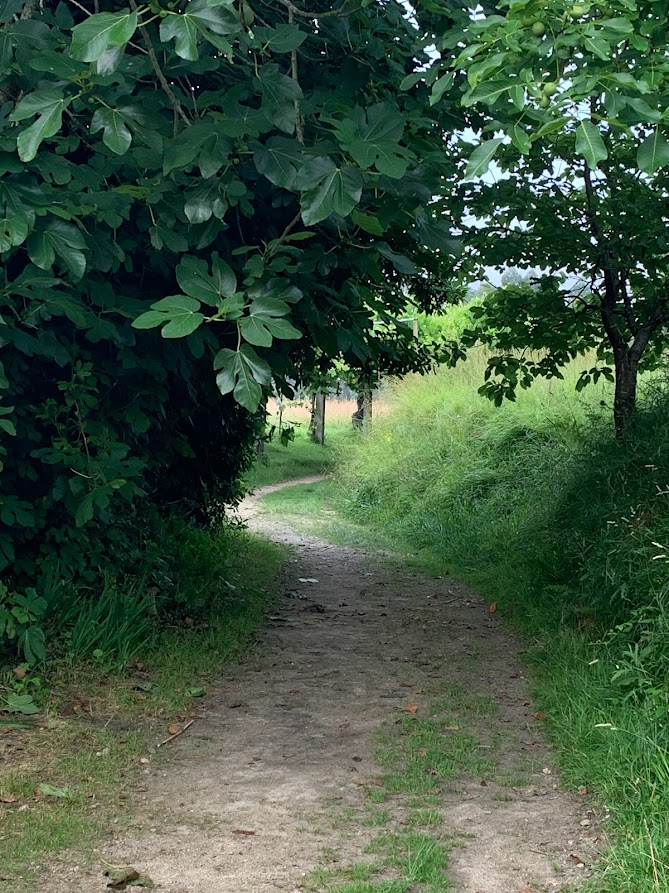
On one of my walks on the Camino de Santiago in northwestern Spain, I met a woman who was on the pilgrimage to deal with the grief of just having lost her husband to whom she had been happily married for many years.
Like her many people walking the Camino are at an inflection point in their life, walking off their grief from the loss of a loved one, the trauma of a divorce, or the fears of dealing with a life-threatening illness.
The shared community experience of doing an 800-kilometer walk over many weeks is one reason why some pilgrims come back every year to walk the entire route or some sections. There are few places in the world where complete strangers would exchange some of their most intimate experiences only minutes after meeting each other.
The sacred path
One morning, as we continued our journey, the woman I had been walking alongside for several days seemed unusually introspective. Eventually, she shared a vivid dream she had experienced the previous night.
In her dream, she found herself before the iconic burning bush, a scene drawn straight from the pages of the Bible’s Book of Exodus. In this powerful vision, God revealed Himself to her through the flames, just as he had to Moses centuries ago. But in her unique version of the story, a gentle voice emanated from the fiery foliage, urging her to tread the path ahead with reverence. The encounter left her awestruck, marking our journey with an undeniable sense of divine purpose.
The universe, or God, has many ways of whispering to your innermost soul, particularly in dreams. Treading the Camino path with reverence has led to a profound transformational shift in people who have walked this ancient path. It is a crash course in the lessons of life.
When traversing the earth with reverence, the senses awaken to the profound beauty of God’s creation. In the presence of mindfulness, enchantment permeates every moment. Conversely, when the mind is agitated and in haste, there is disconnection. Life’s wonders appear fleeting and superficial. A stressed mind remains trapped in the tunnel vision of flight, missing the intricate magic that weaves through existence.
The magic of the moment
Magic reveals itself in the tiniest of moments. Just a few days ago, I ventured into a rocky cove for some snorkeling. In the midst of the tranquil turquoise water, a pair of fish glided past, their scales aglow with a rainbow of colors, a mesmerizing effect created by the angle of sunlight filtering through the water’s surface.
It was a fleeting encounter, but within those brief seconds lay an astounding beauty. I would have entirely missed the moment had I not chosen to pause in stillness at one particular spot for a few precious minutes. In that space of quiet connection, the universe unfolded its secrets, reminding me that the most extraordinary experiences often come from the simplest acts of presence.
Serenity unfurls its wings in unhurried slow, deliberate breaths. It whispers through the silence of the mountains and echoes in the steady, gentle cadence of the waves.
Nature, in its eternal wisdom, guides you inward with each inhalation and exhalation, inviting you to rediscover the tranquility within. Amidst the clamor of the external world and the cacophony of maddening crowds, respite can be in the simplicity of aligning your breath with the rhythm of the natural world. Chaos fades, and solace is found in the gentle embrace of the universe.
Reino Gevers – Author – Mentor – Speaker
P.S. I’m excited to announce the release of my latest book, “The Turning of the Circle: Embracing Nature’s Wisdom for Purposeful Living.” If you enjoy it, you might also be interested in my previous works, “Deep Walking for Body, Mind and Soul” and “Walking on Edge: A Pilgrimage to Santiago.” You can find all of these titles at reputable bookstores near you.
Go into your own ground and learn to know yourself there. The outward man is the swinging door; the inner man is the still hinge – Meister Eckhart
Life is a rollercoaster of natural and spontaneous changes constantly forcing us to tread unknown paths. While some people may excitedly embrace a new beginning others retreat into fixed belief and ideology, providing the illusion of a safety cacoon in a world of “turmoil.”
But resistance to the natural flow of life and attachment to fixed thoughts, beliefs, and things is one of the greatest causes of human suffering and misery. Staying in the moment and finding peace in the acceptance of reality is thus at the core of the Taoist and Mystic teachings.
Throughout history, wise prophets have faced vilification and persecution for their courage in exposing the hypocrisy of religions based on firm behavior rules, fearlessly shedding light on the discrepancies and contradictions inherent in entrenched beliefs. They especially questioned the existence of an authoritarian Father God figure “out there in heaven” who, like a strict parent, would punish his children for bad behavior. All natural or personal calamities were attributed to punishment by God “for sinful behavior.”
Meister Eckhart, a 14th-century Dominican monk whose writings are more topical today than ever, had to answer charges of heresy before an Inquisition in 1326. He barely escaped a death sentence. His writings were banned. Other Mystics of the time like Giordano Bruno and Marguerite Poret were not so lucky. They were executed or burned at the stake.
Straying from religious doctrine and liberating the mind from externally imposed belief was a dangerous undertaking in the Middle Ages. In modern times political beliefs, sometimes using religion as a cover, tend to vilify opposing beliefs as a threat to justify all means in destroying the “enemy.”
Fanaticists of the political and religious nature see the world only in black and white. The belief becomes closely intertwined with the Ego mind and identity. A different or multi-layered interpretation is perceived as a direct threat to the self.
Words in ancient languages such as Aramaic, the lingua franca during the time of Jesus, allowed much room for individual interpretation. The word for God “Abwun” could mean “Our Father” but also the absolute, pure oneness, creation, source of all power and flow of blessing.
One of the most powerful messages in the Bible is found in the Gospel of John 1:1. “In the beginning was the Word, and the Word was with God, and the Word was God”. When replacing the “word” with “consciousness” the text is filled with a much broader meaning.
“In the beginning was Consciousness, and Consciousness was with God, and Consciousness was God”.
Eckart describes a process of spiritual transformation when the divine spark within transcends its individuality or Ego and enters into a state of divine consciousness.
It’s a moment of pure presence when the soul feels at One with something much greater than the self.
Aligning with divine consciousness is opening the heart to the universe and detaching from worldly attachments. It is beyond conceptualized thinking and complete immersion in a state of oneness.
“You should know that true detachment is nothing else but a mind that stands unmoved by all accidents of joy or sorrow, honor, shame or disgrace, as a mountain of lead stands unmoved by a breath of wind. This immovable detachment brings a man into the greatest likeness to God,” according to Eckart.
In a world feeding on the messaging of negativity, it becomes a challenge to train the mind to stay the course of positivity. We can easily be pulled into the abyss of grievance culture when emotions such as anger, anxiety, and fear can be triggered in millions of people by one message on social media.
Modern man has largely been disconnected from what can be described as the divine expression through nature of which he is an essential part. Places worshipped as sacred by ancient peoples have been conceptualized as things that could be harvested, exploited, and destroyed. The void is trying to be filled with the addiction to short-term gratifications: Accumulating more things, more food, more kinky sex, and more substance abuse.
Where is your passion?
Is it a surprise that depression has reached epidemic levels on a global level? But in the pain of suffering more and more people are searching for new meaning and purpose. Where do I come from and where am I going? What excites me and drives my passion? What elevates my consciousness and boosts my vibrational energy.
The author Michael Gladwell describes in his book “The Tipping Point” that it takes only a small number of people to initiate social change. We are currently experiencing both a global environmental and mental health crisis. History has proven that such crisis situations can galvanize people into action.
We are at the tipping point of realizing on a spiritual level that the crisis we are finding ourselves in has not been created by a punishing external father God figure for bad behavior. It is a direct result of our own actions and behaviors and we have the power to change those actions and behaviors.
We as a collective humanity have dug our own rabbit hole. We need to liberate the mind from fixated false belief structures and start doing the inner work. More and more people are awakening to awareness through meditation and other disciplines of the mind. There is a growing realization that every thought comes from a state of consciousness, turns into a thought, a word, and then into an action.
When you are no longer at war with yourself you will emanate compassion, love, empathy, and trust, aligning with divine consciousness.
The “word” in John 1:1 refers to the union with the Inner Christ or what the Buddhists call “Buddha Nature” – the inherent, untainted “seed” that resides in all things. Seeking the Inner Christ or Buddha Nature is the path of the spiritual seeker.
Reino Gevers – Author – Mentor – Speaker
P.S. I’m excited to announce the release of my latest book, “The Turning of the Circle: Embracing Nature’s Wisdom for Purposeful Living.” If you enjoy it, you might also be interested in my previous works, “Deep Walking for Body, Mind and Soul” and “Walking on Edge: A Pilgrimage to Santiago.” You can find all of these titles at reputable bookstores near you.
Walking the Camino pilgrimage route in northwestern Spain is an analogy of life and a fast-track course in self-development and soul elevation. It is why many people who start this 800-kilometer walk as a sporting endeavor end it as a pilgrim.
A fellow pilgrim once said to me: „If you don‘t walk this path with humility, it will force you to become humble.“ It is a mantra that has remained etched in my mind as one of the many life lessons learned on the Camino.
Life gets in the way of a plan
Life inevitably gets in the way of a meticulous plan or agenda. This doesn’t mean you shouldn’t have a financial plan or pension savings scheme. You should simply be aware that even the best of plans can be scuttled by external events out of your control. You should therefore be prepared all the time to adapt, amend, and surrender to the flow of change.
On the journey of the soul, the pursuit of knowledge is an endless path of discovery. However, within various religious communities, there exists a phenomenon often referred to as the “spiritual ego.” This tendency can manifest as individuals within a group belittling those outside their faith or belief system, portraying them as less enlightened or unaware of profound truths, while they remain blind to their own hypocrisy and failings.
The universe has its own sense of humor in bringing us back to humility if we denigrate others with our inflated pride.
The Ego-Throne
The Achilles heel of the high achievers who have phenomenal success and then come crashing down is the illusion they created it all by themselves while seated on the golden throne. Their decisions are always infallible. Criticism by underlings is seen as disloyalty so they are eventually surrounded by sycophants and boot lickers.
History is full of examples of captains of industry, emperors, presidents, and superstars who lost everything because they withdrew into a cocoon far removed from the real world and the lives of ordinary people.
The challenges of good leadership
Aware of the temptations of power, the Stoic Roman philosopher emperor Marcus Aurelius (161 to 180 AD) had a servant follow him through the streets of Rome whispering in his ear: “You’re just a man… just a man,” to keep him humble. He is remembered to this day as one of the “Five Good Emperors” of the Roman Empire. His “Meditations” continue to be studied and revered for their insights into Stoic philosophy and the challenges of leadership.
During my more than a dozen walks on the Camino I’ve met some extremely wealthy people walking the path with a simple backpack and sleeping by choice on a bunk bed in a pilgrims hostel rather than spending the night in a luxury hotel.
It was an eye-opener to hear their stories of how they had transitioned from grief, financial ruin, and other obstacles that life had thrown at them. They all shared the same traits: Kindness, humility, and wisdom embedded in the knowledge that nothing can be taken for granted. The most precious things in life are free, and happiness can be found in the smallest of things.
Reino Gevers – Author – Mentor – Speaker
P.S. I’m excited to announce the release of my latest book, “The Turning of the Circle: Embracing Nature’s Wisdom for Purposeful Living.” If you enjoy it, you might also be interested in my previous works, “Deep Walking for Body, Mind and Soul” and “Walking on Edge: A Pilgrimage to Santiago.” You can find all of these titles at reputable bookstores near you.














 ReinosBlog