Walking the Camino is a spiritual journey that mirrors the journey of life, unfolding in three profound stages: a beginning, a middle, and an end. Kierkegaard describes these three stages of life as the aesthetic, the ethical, and the religious.
The first stage—the crucifixion—represents the struggle and hardship of making mistakes, forcing the boat upstream, and losing your way on the wrong path. During the first stage in life we face trial and error, effort often feels futile. You sometimes engage in aimless wandering and deviations. You may easily lose your way with countless distractions in the monkey mind.
The middle stage, symbolized by the Valley of Death or the Meseta, is a surrender of the ego to a higher purpose and deeper meaning. Here, the ego must die for the soul to awaken to its inner truth, allowing for transformation and clarity.
According to Kierkegaard the appeal during this “ethical stage” lies in walking the path with confidence, even though it may be monotonous and exhausting at times.
The final stage—the resurrection—is a state of flow, where you align with the current of life and begin to see that every experience, even the challenges, has been an expression of divine grace, sculpting you into the BEING you were always meant to become.
You feel the ecstasy in the dance of life. Your walk is a gentle surfing of the path without a sense of gravity. There is an unspoken faith in the journey that drives you forward, and quickens your pace.
Reaching the Cathedral of Santiago is a celebration of joy and homecoming, marking the soul’s return to its true essence. Ultimately, the Camino is a journey of the soul, finding its way back home.
Reino Gevers – Author – Mentor – Speaker
P.S. If you enjoyed this article you will be interested in my books available where all good books are sold.
In London’s Westminster Cathedral stands a strikingly beautiful statue of Our Lady of Walsingham, emanating timeless grace, peace, and compassion.
The Marian shrine of Our Lady of Walsingham, located in Norfolk, England, traces its origins back to the early 11th century. Known as “England’s Nazareth,” it became one of the most significant and ancient pilgrimage sites in the country.
Known as the „Walsingham Way,” countless pilgrims visited the Holy House with a wooden statue of the Virgin Mary as a focal point of contemplation. It was a time when monasteries and shrines connected medieval pathways in a powerful matrix throughout Europe.
But in 1538 Henry VIII ordered the Walsingham statue to be taken to London and destroyed. As part of his break from Catholicism, monasteries were dissolved, pillaged and pilgrimages prohibited.
Only in recent times, the Walsingham pilgrimage path has been revived now officially forming part of the network of pilgrimage paths to Santiago de Compostela in Spain.
The shrine in Walsingham has regained its medieval significance, often referred to as the “English Lourdes” because of its central place in Catholic and Anglican devotion in England.
Pilgrims to Walsingham seek healing, spiritual guidance, and a deepened relationship with the Virgin Mary. It remains a place of great spiritual renewal for many, with visitors walking the Holy Mile, a traditional part of the pilgrimage route.
The beautiful statue of the Walsingham Lady in Westminster Cathedral was commissioned by Cardinal Griffin in 1954 and sculpted by Pius Dapre. For many years it remained hidden and almost unknown in the Cathedral Crypt until it was recovered.
Mystery still surrounds the original wooden shrine which may have never been burned and destroyed as ordered by Henry VIII.
An article recently published in The Catholic Herald quoted art historians as saying that The Langham Madonna, a battered 13th-century English statue in London’s Victoria and Albert Museum, is in fact the original statue of Our Lady of Walsingham.
There were no eyewitness accounts that the statue was actually destroyed in London, according to the historians but hidden by Catholic loyalists until it reappeared centuries later in the museum.
Throughout history, countless myths, legends, and mysteries have surrounded the figure of the Goddess—whether Mary, Brigid, Kali, Isis or others—appearing and reappearing in various forms. At times, she has been revealed as a beautiful statue, carved from wood, stone, or marble, inspiring the creation of shrines, monasteries, or cathedrals at the place of her discovery.
Mary, in particular, has been known to appear in sacred apparitions at sites like Walsingham, Lourdes, and Fatima—places where the veil between worlds seems thin. Regardless of whether one is a believer, agnostic, or of another faith, her presence has been tied to stories of miracles that defy logic. Yet, time and again, she has brought comfort, solace, and peace to those facing pain and confusion.
Reino Gevers – Author – Mentor – Speaker
P.S. If you enjoyed this article you will be interested in my books available where all good books are sold.
Check out also the recent episode on the Living to BE podcast and Youtube with our special guest Matt O’Neill. The topic: Happiness is a Choice.
Just having completed the Camino Aragonese pilgrimage route in northwestern Spain, I was deeply inspired by the diverse landscapes, rich vegetation, and the symphony of nature that emerges when human noise recedes.
Immersing oneself in nature reveals the interconnectedness of all living beings. Nature is an expression of the divine, with diversity as a fundamental principle of creation.
In times when external voices grow increasingly loud with hate-filled tribalism and ethnocentricity, the truth of the heart becomes paramount.
Monoculture is lifeless
Compare a lifeless monoculture with a meadow buzzing with the sound of birds, insects and the aroma of wild herbs and a multitude of flowers.
Thoughts and beliefs – religious, philosophical or political – have become so much part of tribalist identity that some people would rather die than admit that they have all along placed the ladder against the wrong wall.
Attachment to fanaticism in all shape and form hardens mind and body, and is one of the biggest obstacles to personal growth and elevation of consciousness.
One humanity or chaotic tribalism
Currently humanity is at the cusp of an elevation of consciousness of a one humanity or regressing into another chaotic age of divisive tribalism, nationalism, and intolerance.
There have been brief periods of enlightenment in the past when faith was more experiential in nature, with individuals gaining higher insight through contemplation, art and music.
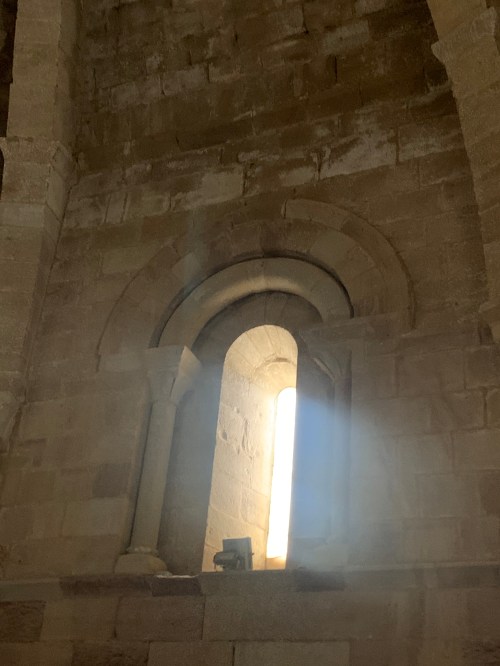
Beautifully restored Romanesque cathedrals, especially in Jaca and Sanguesa, on the Aragonese route provided sanctuary in medieval times for quiet contemplation and inspiration from sculpture at a time when most people were illiterate.
Divinely inspired music and art
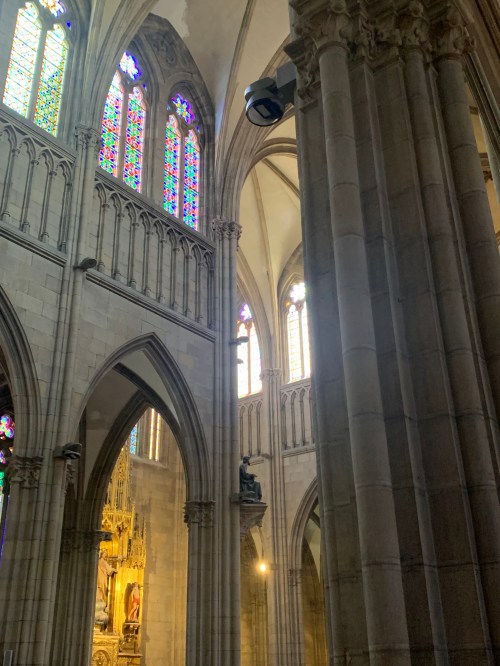
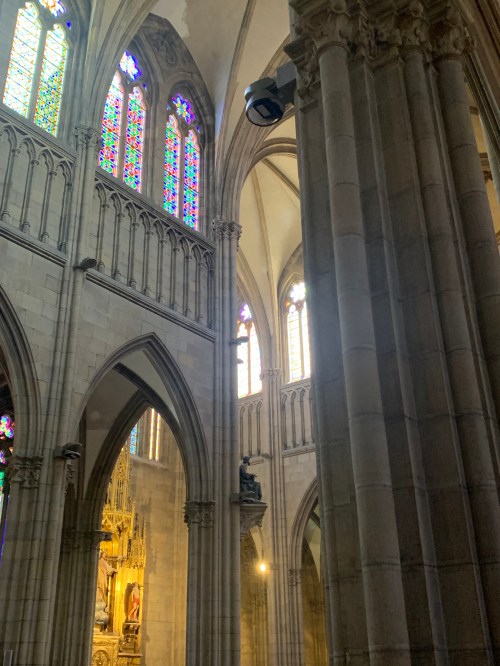
Later construction of the grand cathedrals such as Notre-Dame in Paris and Chartres, with their stunning stained glass windows inspired awe and devotion.
During the Renaissance era religious art with masterpieces by artists such as Michelangelo, Leonardo da Vinci, and Raphael communicated complex theological ideas through visual means.
Sacred music by composers such as Johann Sebastian Bach, and Beethoven created elaborate musical compositions elevating the liturgical experience and deepening the spiritual experience, connecting with the divine in profound sensory-rich ways.
When a religion degenerates into claiming the ultimate truth, subjugating its members into what to believe and how to behave, there is empty ritual and stagnation. The head-mind closes the door to the heart-mind and the whispers to the soul.
Reino Gevers – Author – Mentor – Speaker
P.S. I’m excited to announce the release of my latest book, “The Turning of the Circle: Embracing Nature’s Wisdom for Purposeful Living.” If you enjoy it, you might also be interested in my previous works, “Deep Walking for Body, Mind and Soul” and “Walking on Edge: A Pilgrimage to Santiago.” You can find all of these titles at reputable bookstores near you.
In ancient oral traditions saints and prophets are often said to return as angels in disguise after departing from their earthly existence, assisting those in desperate need of help, but sometimes unwittingly you too can become a divine messenger by imparting one word or deed that can completely change the trajectory of a person’s life.
Several stories reflect the universal theme of saints and prophets in the afterlife intervening in human affairs, in unexpected and unassuming forms.
Guidance and healing at crucial junctions
In ancient Greek mythology, the deity Asclepius is associated with healing and is said to have returned to the mortal world in disguise offering healing and guidance.
In the Islamic tradition, Khizr is often associated with the archetype of a wise and immortal figure who appears in challenging times, disguised as an ordinary person.
In Slavic folklore, the supernatural being Baba Yaga comes in disguise to test individuals and those who treat her kindly are well rewarded.
According to Jewish-Christian legend the Prophet Elijah intervened at several crucial junctions of human history. During the Battle of Las Navas de Tolosa in 1212 the Christian forces in Spain faced a formidable opponent against the soldiers of the Almohad Caliphate. The Christian army was about to be defeated when a mysterious knight wielding a white banner with a red cross appeared on the battlefield, believed to have been Elijah in disguise, and providing the crucial assistance that turned the tide.
The red cross against a white background is today a familiar symbol on the scallop shell worn by pilgrims walking the Camino de Santiago, many of them probably unaware of its origins. In my novel “Walking on Edge” I refer to several mysterious encounters with strangers that the main character Jake has on the Camino. Some of these accounts are based on real stories that I came across on my own pilgrimage walks.
It is common for pilgrims to have a really low moment while on the Camino, where they are at the point of giving up. I’ve met several people who reported having an epiphany after overhearing a conversation or having a chance encounter with a stranger, giving them the courage to continue.
You should never underestimate the impact your words and deeds could have on a fellow human being. Sometimes you also need to be cruel to be kind.
A teacher or parent might implement a policy of no-nonsense adherence to deadlines and assignments to prepare the student for the obstacles they might encounter in future professional environments, instilling a sense of responsibility and discipline, even though momentarily demanding.
If you have a family member or friend suffering from an addiction problem, the only way you are going to help them is by setting clear boundaries and deadlines where they can get professional help.
But sometimes a simple gesture or act of kindness can leave an everlasting imprint on a person’s memory.
In Charles Dickens’ novella “A Christmas Carol,” the miserly and bitter old man Scrooge is transformed with a child’s kindness that serves as a catalyst for his redemption, reminding him of the joy and warmth associated with Christmas and the importance of human connection.
It costs absolutely nothing to be kind. You never know what impact that could have on a fellow human being. The exact right words and actions might resonate with another person more than you realize.
Reino Gevers – Author – Mentor – Speaker
P.S. I’m excited to announce the release of my latest book, “The Turning of the Circle: Embracing Nature’s Wisdom for Purposeful Living.” If you enjoy it, you might also be interested in my previous works, “Deep Walking for Body, Mind and Soul” and “Walking on Edge: A Pilgrimage to Santiago.” You can find all of these titles at reputable bookstores near you.
Living a modern sedentary lifestyle glued to a screen rebels against our very human nature that is designed from the dawn of mankind to walk. Homo Sapiens has populated the planet walking, which is today one of the most underrated, yet most effective ways of keeping body, mind, and soul healthy.
A body of research has meanwhile confirmed the many positive effects only a moderate amount of walking per day can positively impact your health.
The Harvard Nurses’ Health Study, which has been tracking the health behaviors of more than 200,000 women for more than three decades, has revealed that walking for an average of 30 minutes a day can lower the risk of heart disease, stroke, and diabetes by 30 to 40 percent.
Walking at this rate can also lower the risk of breast cancer by 20 to 30 percent.
The researchers did brain scans of 35 people aged 45 to 75, finding that those who sat the most had more thinning in an area of the brain involved with memory, a change that may be linked to cognitive decline and dementia.
Living a sedentary lifestyle surrounded by things created by the “head mind” will never make you feel the same sense of aliveness and awareness that you will feel through the intuitive “heart-mind” when walking in nature. The universe, or God, finds expression through nature.
In my latest “Living to BE” podcast I discussed with my pilgrim friend Kevin Considine the many life lessons deep pilgrimage walking has to offer. Kevin has walked more than 14,000 kilometers on ancient pilgrimage paths since he retired eight years ago.
Scientists have found that exposure to blue spaces such as lakes, rivers, and the sea are particularly beneficial to mental health.
A team from the Barcelona Institute for Global Health (ISGlobal) undertook the first international review of 35 studies on “blue spaces.” They concluded that outdoor blue spaces not only reduce stress levels, but also improve general well-being.
Crossing the Pyrenees mountains from France to Spain on one of my pilgrimage walks
The difference between a hike and a deep-walking pilgrimage experience
One of the most popular paths is the Camino de Santiago in northwestern Spain, which has been traversed by pilgrims for centuries. In recent years, it has been rediscovered by tens of thousands of people from all walks of life as a path of healing and self-discovery.
Some of the world’s most creative and talented artists, including Johann Sebastian Bach, William Blake, and Jean-Jacques Rousseau explored their inner worlds on long walks, acutely aware of the positive effects in opening the senses to nature.
The conservationist John Muir, tormented by nightmares and anxiety after nearly going blind in a work accident, immersed himself in nature on a 1,000-mile journey on foot from the banks of the Ohio River to the Gulf of Mexico.
On my first pilgrimage walk to Santiago, I too was tormented by a dysfunctional relationship, a stressed-out job and childhood trauma that I had suppressed for many years. Any amount of therapy did not have the same effect as facing those inner demons on long, lonely walks of solitude in nature. I have described in detail my journey in my two books: Walking on Edge and Deep Walking for Body, Mind and Soul.
Experiential spirituality at its best
The universe speaks to us in many ways but nowhere more than with such clarity when body, mind, and soul are completely immersed in nature and not distracted by the pull of countless things in our daily, modern lives. It is experiential spirituality at its best.
A particular fascination with the Camino de Santiago in northwestern Spain is that these ancient pilgrimage paths have been walked by pilgrims for many centuries. It is marked by numerous crosses and symbols left by the pilgrims of old, many of whom did not survive the long trip. I would concur with my pilgrim friend Kevin that the route is filled with the spirits of pilgrims who have gone before, who guide us on the way.
Many a person has started the more than 800-kilometer walk from Jean Pied de Port in France to Santiago de Compostela as a hiking or sporting endeavor but ended the walk as a pilgrim. It is a part of the Camino mystery. It has a different impact on every individual, awakening channels to the soul that you had never dreamed possible.
Reino Gevers – Author – Mentor – Speaker
One more thing...If you have found this article interesting you might want to subscribe with the “follow” button above or recommend my FREE weekly Blog to friends and family. My books can be ordered at all places that sell good books in both paperback and kindle.
It was a “dark age” in the western Europe of the 13th century when pandemics, population decline and economic degradation prevailed. Most people had moved into villages and towns sharing crowded rooms with family members and livestock. With little or no sanitation or semblance of hygiene the stench would have been unbearable for sensitive modern noses.
The exodus from the countryside was exacerbated by repeated crop failures caused by the Little Ice Age triggered by volcanic eruptions and changes in Arctic ice cover. With temperatures dropping for centuries this meant that the winters were particularly long and harsh.
Periods of crisis and challenging external circumstances sometimes force humanity into introspection with the dark ages having brought forth some of the greatest Mystics at the forefront of an individual inward-looking spirituality. The popes and bishops were meanwhile offering little comfort to ordinary people, preoccupied with political power struggles and worldly pleasures.
Pilgrimage walks to Santiago de Compostela
During these times pilgrimages to Santiago de Compostela became popular as an inner journey of penance, spiritual rebirth and renewal. The modern-day pilgrim on the Camino is in many respects no different. Spirituality as opposed to religious doctrine is by far the primary motivation, based on my own research and conversations with hundreds of pilgrims on my more than dozen walks on pilgrimage routes in northwestern Spain.
The wise teachings of the 13th-century Dominican monk Meister Eckart (1260-1328), Catherine of Genoa (1447-1510) and Hildegard of Bingen (1098-1179) are timeless and more topical than ever during these pandemic times. They were the eco-warriors and holistic healers of their time, addressing issues of personal health, nutrition and the environment.
It took the disruption of a global pandemic to remind us that we can be exposed overnight to entirely new circumstances beyond our control. Life can be extremely fragile and uncertain. The mental health repercussions resulting from isolation and lockdowns are only gradually coming to the fore.
A formula for a life of bliss
The Mystics are clear on how to lead a life of bliss. Meister Eckart describes at least five stages of evolution in elevation of consciousness to the “new” man – the “birth of the son” or “birth of God” in the soul. The entire purpose of life he describes as the journey to self-realization and meaning:
Contemplation and meditation
Doing what is right and acting accordingly
Dedication and Love of God
Recognition and Differentiation
Alignment and surrender of ego
All these Mystics did not retreat to an isolated monastic lifestyle but were engaged in the world. Catherine of Genoa gave selfless service to the sick while at the same time serving as director and treasurer of a hospital. Hildegard of Bingen was engaged in many fields including religion, medicine, music and cosmology, At the same time she was a mentor for many famous personalities of her time.
The common thread is that we are one humanity and that a life of service and dedication for the betterment of all provides solace to inner turmoil during times of crisis.
Reino Gevers – Author – Mentor – Speaker
One more thing…
If you have found this article useful please share to spread the message. I’ve also recently compiled brand new online courses that you can download onto your computer or smartphone on ways of how you can transform your life on multiple levels. Also check out the recent reviews of my book “Deep Walking for Body, Mind and Soul.
A young Augustinian monk was sent on a pilgrimage to Rome by his monastery in the year 1510 in the hope that he would be healed from his inner demons. The visit to Rome would turn out to be one of the key events that led to major upheavel of the medieval world.
Although the historical records are scant the 30-year-old monk, Martin Luther, must have walked from Erfurt in Germany to Rome on the Via Francigena on a journey lasting many weeks, accompanied by an unnamed elderly monk from the same religious order.
A pilgrimage to Rome, Santiago de Compostela or Jerusalem at the time was wrought with danger with many pilgrims dying on the way from disease or injury. The pilgrimage routes are dotted with the ruins of ancient hospitals where caring nuns and monks once nursed the weary pilgrims.
One such abandoned ancient hospital can be seen at Le Briccole on the Via Francigena on the leg between San Quirico and Radicofani. According to some records Luther too had to undergo medical treatment for a serious health conditon before reaching Rome.
The expectation of receiving some divine healing or enlightenment on arrival in Rome must have been enormous. But the monk from Erfurt was shattered by what he saw in Rome. The opulent lifestyle displayed by the clergy in Rome with money provided in tithes by the poor stood in sharp contrast to the teachings of the gospels calling for humility and service to the needy. Prostitution was rampant along with venereal and other diseases.
Having been brought up in the Lutheran tradition I was fascinated by the journey on foot by the reformator Martin Luther. The journey to Rome turned out to be one of the key events that fired up the young monk to break from the Catholic church and start the protestant revolution.
Even today we see that religion is often being abused to gain political or financial influence. The hypocrisy displayed by some of these institutions has shocked many believers into leaving the church in disgust, especially after the sexual abuse revelations. Religion has the habit of stifling experiential spirituality through “belief” and “conduct” rules but it gets absurd when the leaders themselves cannot abide by the rules they preach.
At its best religion can offer a platform for spiritual experience and community, offering the individual the freedom to find expression to inner soul truth.
But the whispers from the universe, or God, can be so different with every individual. For me the quiet spaces in nature on long pilgrimage walks have provided answers to many burning soul questions. For others it could be in the contemplation of a work of art, sitting meditation, singing a mantra or even attending a religious ceremony.
“When you hear someone telling you that you need to follow their “truth” that is the only path to “salvation” you need to run the other way! It might well be their path but is it really yours?
The lure of the 10,000 distractions that are primarily aimed at gratifying short-term external, physical needs stand in stark contrast to soul need and purpose. But once on the path of the inner adventure you will not want to turn back. The journey into the unknown offers new insights at every turn.
After having to cut short this year’s pilgrimage walk on the Via Francigena because of looming further travel restrictions and other obligations, the entry into Rome was something of a low climax. The arrival in Santiago de Compostela by contrast is celebrated with a colorful mass attended by hundreds of pilgrims.
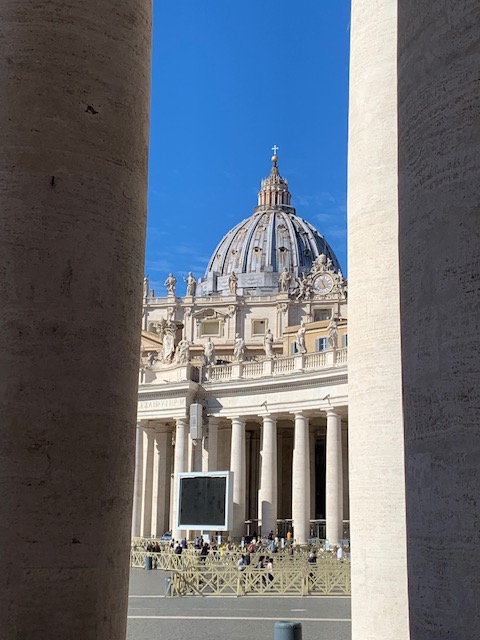
During these pandemic times Rome displays nothing of the same international vibrancy felt here during a visit a year ago. Only a handful of visitors can be seen at the famous sites including St. Peters’ Square, the Spanish Steps and the Trevi fountain. The restaurants, bars and cafes in the old part of the city are mostly empty.
On arrival in the city the Italian government had declared new restrictions making the wearing of masks mandatory in all public areas both indoors and outdoors. Temperature checks are made at key entry points such as the main rail station and entering Vatican City. There is a spike in Covid-19 infections in most European countries. Italy was the first country to be hit hard by the virus in Europe and went into a strict lockdown lasting several weeks. The economic repercussions and anxiety can palpably be felt everywhere.
Reino Gevers – Author. Mentor. Speaker
One more thing…
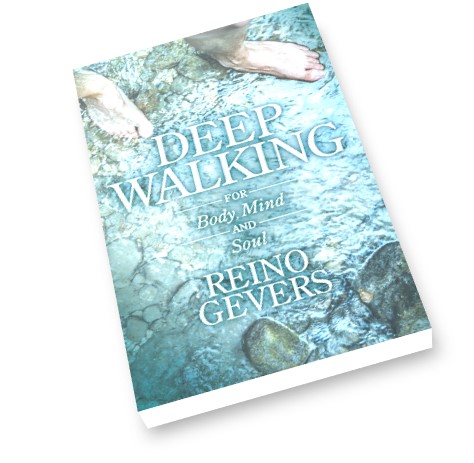
You might want to check out my new book “Deep Walking for Body, Mind and Soul” released as a paperback by Morgan James Publishing on August 11, 2020. It has some valuable tips on creating happiness and boosting your vibrational energy on many levels. You can order it at all major outlets such as Amazon, Barnes and Noble or in my own store. Check out the latest five-star reviews on Goodreads.
“A breathtaking, captivating, transformative walk,” – Tom Dutta, Canada
“The book reminded me of my own journey in life I am walking and how bringing stillness to my busy life and mind is essential.” – Karin, France
“The book compresses on its slim 190 pages an extreme density of life wisdom.” Christina Germany
Days 8-9 on the Via Francigena – from Ponte d’Arbia to Radicofani
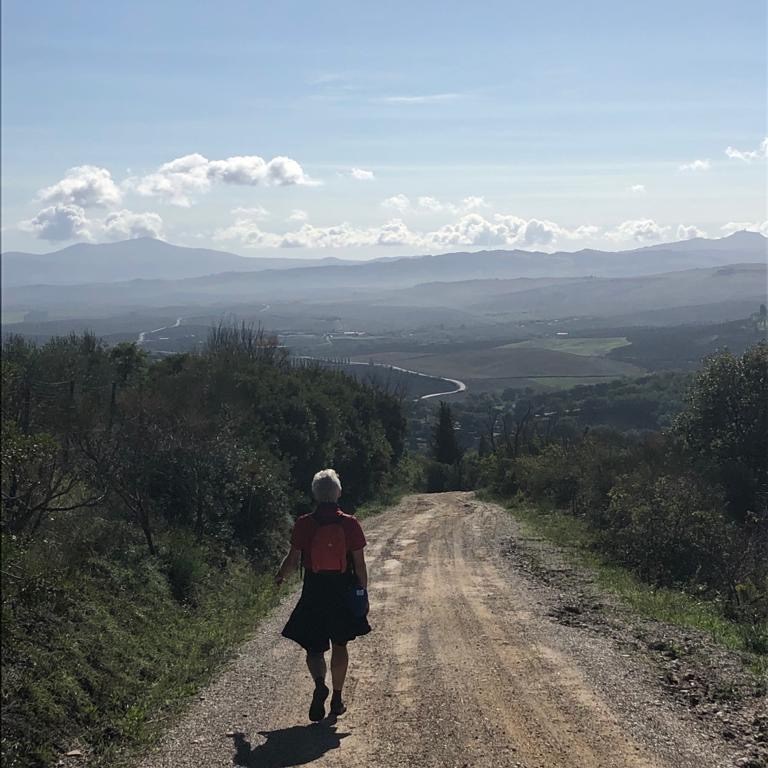
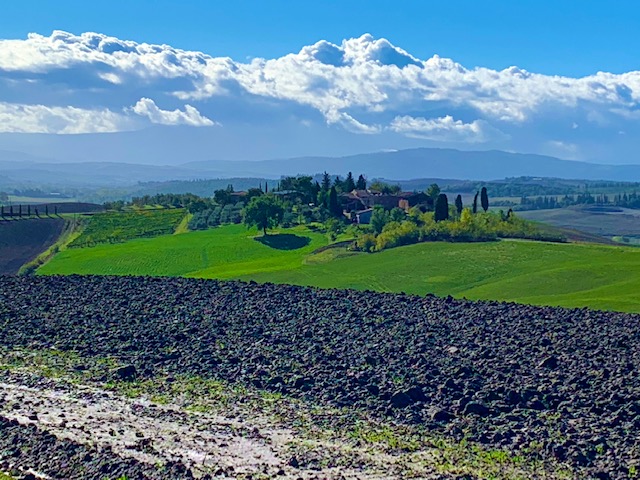
Walking through the valley D’Orca creates a sense of how much the Tuscan landscape here has been shaped over the centuries for the aesthetic eye that inspired writers and painters over the centuries.
Castles and fortress towers have been positioned on hilltops with the Via Francigena taking the pilgrim on a path over gently rolling hills, past vineyards, and bridges over meandering streams.
Pheasants fly over harvested fields as if surfing on invisible ocean waves. A bird sings. There is a brief pause and then another bird replies on the far end of the valley. In the typical Mediterranean cypress trees bird choirs entertain.
Walking in peace and solitude
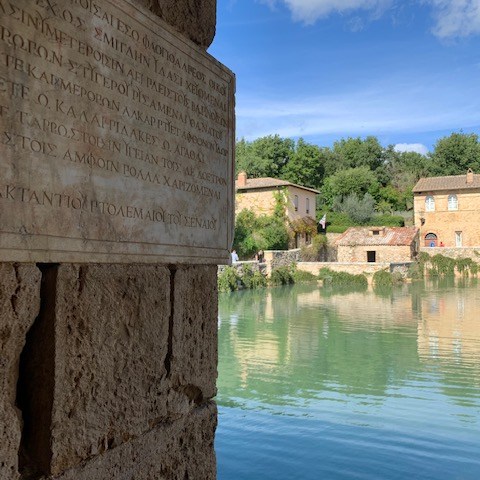
The walk from Siena has been one of particular solitude. Famed towns such as Buenconvento, San Quirico and Bagno Vignoni with its famous thermal pool are virtually devoid of tourists as a result of Covid-19 travel restrictions. Since leaving Siena we have met just one fellow pilgrim, a German woman outside San Quirico, who started her walk from Tuebingen.
From San Quirico the first major attraction is the village of Vignoni Alto that appears almost frozen in time. Like in so many places along the route the chapels are open, offering a quiet space for solitude and meditation for the pilgrim. On the Camino de Santiago in Spain the pilgrim will find many such chapels closed. The reason is that these places often contain precious work of art with criminal gangs having specialized in stealing them.
Near the altar of the chapel in Vignoni Alto I find a dedication to St. Biagio the throat protector. A first reference to the saint is found in writings dated AD 500. He is not only venerated as the saint protecting ailments of the throat but cured many physical and mental ails. He is also said to have healed and been assisted by many animals.
What are you inhaling and exhaling?
During these times healing and protection of the throat and breathing systems is particularly important. The Chinese philosophy of the Five Elements tells us that the Metal Element (lung and large intestine) is largely related to an imbalance on the inhaling and exhaling, the setting of healthy mental and physical boundaries. It is telling for our times that the professional deceivers and crackpot conspiracy theorists are bombarding the public sphere with darkness.
Even here on the Via Francigena comes the reach of toxic energy from American politics. At a nearby table in a café a guest watches a replay of the debate on his tablet with a very concerned frown on his face. I was unable to listen to the rants for more than a few minutes. What we inhale and digest physically, and emotionally affects our well-being on so many levels. We cannot avoid the events in the external world but the real test is in realigning with the positive energies of healing, unity, peace, reconciliation between the races, and healing of our natural ecosystems.
There is light and darkness, goodness and evil, compassion, kindness and Narcissistic self-aggrandizement. Walking along a roadside there was a stream of cooling, calm, clear river waters on the left and a noisy road to the right. What do you focus on mentally? After my first frustration, I no longer hear the traffic, just the gentle, rushing waters of the river.
Reino Gevers – Author. Mentor. Speaker
One more thing…
You might want to check out my new book “Deep Walking for Body, Mind and Soul” released as a paperback by Morgan James Publishing on August 11, 2020. It has some valuable tips on creating happiness and boosting your vibrational energy on many levels. You can order it at all major outlets such as Amazon, Barnes and Noble or in my own store. Check out the latest five-star reviews on Goodreads.
“A breathtaking, captivating, transformative walk,” – Tom Dutta, Canada
“The book reminded me of my own journey in life I am walking and how bringing stillness to my busy life and mind is essential.” – Karin, France
“The book compresses on its slim 190 pages an extreme density of life wisdom.” Christina Germany
Tuscany, Italy: Day 6 on the Via Francigena – Monteroni to Ponte d’Arbia
A deep walking pilgrimage experience is an analogy of life. The last leg prior to reaching a destination is often the hardest.
I was again reminded of this on the steep winding path toward the medieval fortress village of Monteriggioni which is positioned on a hilltop, dominating the rolling hills of the Tuscany landscape.
After spending most of my life in a safe job and earning a good salary, the ripple effects of the digital revolution in the media industry forced me to move from journalism into my own health consultancy business ten years ago. I had no idea how difficult it would be to generate enough income to even keep paying for running mortgages and other expenses.
I started off doing “cold calls” just to win over a few clients. I took part in pitches and tenders that looked very promising, then collapsed at the last minute. In addition the taxman refused by even one-day to extend the deadline for a massive payment. During the first years there was far more expenditure than income. It is the reason why most people starting off on their own business give-up during the first three years. Very often a specific target is set by when a certain income has to be achieved. When this doesn’t work out the frustration is huge and the surrender even more.
When you reach the top there is yet another hill to climb
“You reach the top of a hill and then you realize there is yet another hill to climb,” one of my mentors said to me in encouraging me never to give up. The wheel did turn eventually and much more than I had anticipated. If I had given up at the time I would never have forgiven myself.
There is no easy road to success. It boils down to consistently doing the right thing over a long period of time, and not to stay too fixated on the long-term goal. Sometimes you have to readjust on the way. So often I had to learn that my intention was not in synchronicity with what the universe had in mind.
When you have everything just nicely set-up and planned God comes with a different script.
Just when you think you have mastered all the teachings, you have to be particularly watchful of the ego-traps. It is when you start telling yourself: “Oh, I know it now. I’ve heard that before: Other people don’t get it because they aren’t that far yet.”
Life is a learning journey which stops when your soul enters a different dimension. When you think you have understood it, the listening and the learning stops. You will fail to perceive what the universe is trying to whisper into your ear.
Leaving Siena on a rainy morning yesterday we have had to make several adjustments to our plans, cutting the long route to Ponte di’ Abria into two shorter 13 kilometer sections. Changing weather conditions, lack of accommodation and walking untrodden paths are inevitably part of the experience. One of the lessons learned on this day is patience in accepting the things that cannot be changed and to react accordingly.
After a heavy thunderstorm during the night the air had cleared with beautiful blue sky on the short walk to Buenoconvento, another medieval town with a beautiful old gateway at the entrance.
Reino Gevers – Author. Mentor. Speaker
One more thing…
You might want to check out my new book “Deep Walking for Body, Mind and Soul” released as a paperback by Morgan James Publishing on August 11, 2020. It has some valuable tips on creating happiness and boosting your vibrational energy on many levels. You can order it at all major outlets such as Amazon, Barnes and Noble or in my own store. Check out the latest five-star reviews on Goodreads.
“A breathtaking, captivating, transformative walk,” – Tom Dutta, Canada
“The book reminded me of my own journey in life I am walking and how bringing stillness to my busy life and mind is essential.” – Karin, France
“The book compresses on its slim 190 pages an extreme density of life wisdom.” Christina Germany
Day 5: Via Francigena – Siena to Monteroni d’Arbia
When observing the Siena Cathedral and other architectural highlights of the 12th and 13th centuries on the Via Francigena it comes to mind that people in medieval times felt a strong connection between the physical and the spiritual.
The cathedrals were an expression of faith with everyday life closely intertwined with religion.
Records from the Siena Cathedral show that construction started around 1226 with the transportation of black and white marble, probably for the construction of the façade and the bell tower. The craftsmen who started the intricate works of art inside and outside the building often did not see their masterpieces completed during their lifetimes, yet put all their energy and creativity into the project.
Head mind and heart mind
Along the path to industrialization and the material comforts of modernity something has gotten lost with the disconnect from physical and soul needs.
The head mind is preoccupied with the distractions of the 10,000 things of short-term gratification, and emphasis on youthful vigor and performance-driven culture. It is the breeding ground for greed and egocentric behavior, the results of which we can see in the destruction of natural ecosystems, irrespective of the consequences for future generations.
The heart-mind is timeless and rooted within a multi-dimensional perspective of unity between the physical and the spiritual. It is restorative rather than exploitative. There is mindful awareness of life within a complex matrix of interdependency.
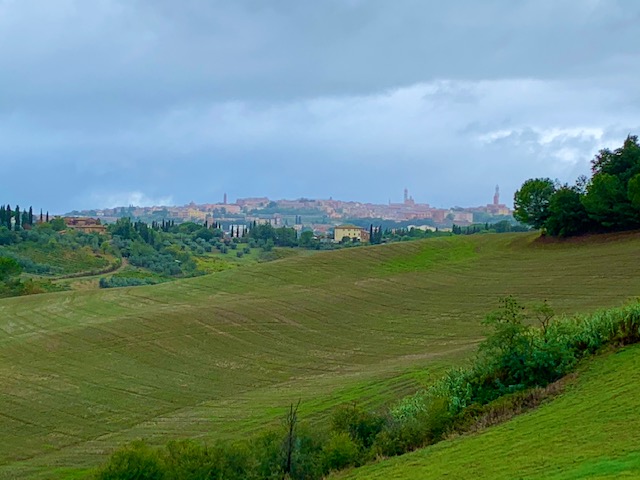
Leaving Siena and looking back the skyline is still dominated by the Cathedral on the hill. The walk itself takes the pilgrim through open, expansive countryside with unlimited views, especially of the old walled barn complex in La Grancia di Cuna, one of the most impressive agricultural buildings in the Tuscany landscape. From the 12th century it offered pilgrims and merchants on the Via Francigena accommodation and food.
The entire installation is walled with two towers facing the southern entrance. The main entrance leads to an L-shaped square from where mule packs could reach the upper floors of the barn.
Reino Gevers – Author. Mentor. Speaker
One more thing…
You might want to check out my new book “Deep Walking for Body, Mind and Soul” released as a paperback by Morgan James Publishing on August 11, 2020. It has some valuable tips on creating happiness and boosting your vibrational energy on many levels. You can order it at all major outlets such as Amazon, Barnes and Noble or in my own store. Check out the latest five-star reviews on Goodreads.
“A breathtaking, captivating, transformative walk,” – Tom Dutta, Canada
“The book reminded me of my own journey in life I am walking and how bringing stillness to my busy life and mind is essential.” – Karin, France
“The book compresses on its slim 190 pages an extreme density of life wisdom.” Christina Germany















 ReinosBlog