Tag Archives: nature

The COVID-19 Legacy: Social Fragmentation and Healing

Two years ago, the World Health Organization (WHO) declared that the COVID-19 pandemic was no longer a public health emergency. Yet its psychological and social aftershocks continue to ripple through societies, fragmenting communities once gripped by fear and fueling political extremism.

Several studies have now confirmed what many suspected: the pandemic and ensuing lockdowns had a profound impact on mental health worldwide. For the first time in history, scientists were able to observe the effects of collective fear on a truly global scale.

The Emotional Toll

While experiences varied across regions and communities, several broad patterns emerged:

  • Prolonged uncertainty, isolation, and fear led to widespread anxiety, depression, and burnout.
  • Eroding trust became a defining feature, as people grew confused and skeptical toward governments, media, and even science amid rapidly shifting information.
  • Collective grief settled over the world, a mourning not only for lost lives, but also for lost time, normalcy, and connection.

Shifting Social Landscapes

Communities fractured along new fault lines with differing views on vaccines, lockdowns, and mask mandates dividing families, friends, and neighbors.
Technology became both a lifeline and a liability: it kept people connected yet deepened isolation, fatigue, and exposure to misinformation and conspiracy theories.

The Mind–Body Connection

Emotional stress is one of the most significant threats to both mental and physical health. Neuroscience and medical research have long shown that chronic activation of the body’s stress response can harm nearly every system, especially the immune and cardiovascular systems.

  • The Whitehall Studies in the U.K. found that chronic job stress increases the risk of heart disease.
  • The Adverse Childhood Experiences (ACE) Study revealed that early-life emotional trauma elevates the risk of chronic illness in adulthood.

The link between mind and body is undeniable—but so too is our capacity for resilience.

Cultivating Resilience

Research shows that stress resilience or the ability to recover from emotional adversity can buffer these effects. Protective factors include:

  • Strong social connections
  • Spiritual or faith practices
  • Mindfulness and meditation
  • Regular exercise and restorative sleep
  • A deep sense of purpose or meaning

A Shared Awakening

The pandemic also ignited a global period of reflection on mortality, interdependence, and renewal. Many rediscovered spirituality, nature, and the quiet power of mindfulness. For perhaps the first time in modern memory, humanity was united by a shared awareness of its own fragility.

A Creative Rebirth

For me personally, the lockdown became a period of unexpected inspiration. It was during this time that I began writing my novel Sages, Saints and Sinners. In my research, I discovered haunting parallels between our modern experience and the Black Death of medieval times, echoing the same fear, isolation, and uncertainty, followed ultimately by rebirth.

Reino Gevers – Host of the LivingToBe podcast

P.S.: If you enjoyed this article, you might be interested in my latest book, Sages, Saints, and Sinners. Get it today on Amazon, Barnes & Noble, and wherever good books are sold.

Leave a comment

Filed under mental health, mental-health, powerbodymind, psychology, spirituality

Walking the Camino: A Pilgrimage of Body, Mind and Soul

I walked my first pilgrimage on the Camino de Santiago in the summer of 2006. I set out from Sarria, unfit and unprepared, with too much in my backpack and bad hiking boots. After just three days, my feet were blistered, my shoulders sore, and my backpack was slowly coming apart at the seams. And yet, every aching step felt like a quiet reclaiming of body and mind and soul.

It was in those early days, as I rested in pilgrim hostels and listened to the stories of fellow walkers of grief, hope, and longing, that I began to understand that the Camino was far more than a physical trail. It was a journey into presence, patience, and the sacredness of ordinary life.

Stripping Away Excess Baggage

On the Camino, I quickly realized how little I truly needed. Every unnecessary item in my backpack felt heavier with each step, and gradually I learned to let go of what wasn’t essential. This outer shedding mirrored an inner process, the release of a thousand thoughts of the head-mind. What remained was a raw encounter with myself. In that stripped-down honesty, I began to feel space open for the divine to enter.


Experiential Spirituality

The Camino taught me a prayer of movement, unlike anything I had experienced before. Each step became a rhythm of surrender: inhaling with gratitude, exhaling with release.

Spirituality rarely comes in dramatic revelations. Instead, it appears in nuanced whispers, in small, ordinary moments: the sound of church bells echoing across a valley, the scent from a forest on a misty morning, a shared meal with strangers who quickly feel like old friends. These moments shimmered with presence, reminded me that the divine was not elsewhere. I just hadn’t noticed or seen it before.


Rediscovering Communion with Humanity

Walking alongside pilgrims from all corners of the world, I began to see the sacred thread that connects all of humanity. I listened to stories of grief, hope, and longing shared on dusty trails and over bowls of soup. In hearing their experiences, I discovered that spirituality is not just an inward journey. It is also found in the recognition of our shared humanity and the ways we reflect the divine in one another.


Whispers from the Universe

There were long stretches of silence, hours with nothing but the sound of my footsteps, birdsong, and the slow turning of my own thoughts. Over time, my inner chatter began to fade, leaving a spaciousness that felt like prayer. In that quiet, I realized the divine was not distant. It was a subtle certainty within, present with every heartbeat.


The Real Camino Begins After the Camino

Reaching Santiago is both an ending and a beginning for me. The true journey is never about arriving. It is about awakening to the sacredness of each step along the way. The Camino becomes less a trail across Spain and more a way of living: to walk with presence, to notice the divine in the ordinary, and to live as though every breath were part of a pilgrimage.

The Camino has rekindled my spirituality in unexpected ways by simplifying, grounding, and embodying the divine. It has taken faith out of abstraction and placed it into the rhythm of footsteps, the ache of muscles, the beauty of landscapes, and the kindness of strangers. For me, it has become not just a journey across Europe—but a way of walking through life itself.

Reino Gevers – Host of the LivingToBe podcast

P.S.: If you enjoyed this article, you might be interested in the two books I wrote on the Camino: Walking on Edge – a Pilgrimage to Santiago and Deep Walking for Body, Mind and Soul my latest book,  Get it today on Amazon, Barnes & Noble, and wherever good books are sold.

Leave a comment

Filed under Camino de Santiago

Cycles of Renewal: Embracing Life’s Challenges

“A human being is a part of the whole called by us ‘universe,’ a part limited in time and space. He experiences himself, his thoughts and feelings, as something separated from the rest — a kind of optical delusion of his consciousness.”
Albert Einstein

For millennia, ancient sages and saints taught that a sacred order underlies all of creation with a divine intelligence woven into the fabric of life itself. Today, modern science is beginning to echo this timeless wisdom, recognizing patterns of evolution and interconnection that hint at a universal consciousness at work.

When we begin to see that there may be a higher purpose behind life’s chaos, pain, and obstacles, we are invited into a deeper surrender, trusting that the challenges are shaping us into the fullness of who we are meant to become.

At the heart of this understanding lies a universal truth: The Law of the Seasons.

Life, like nature, moves in cycles in an eternal rhythm of growth, shedding, rest, and rebirth.

This rhythm is beautifully expressed in the Chinese philosophy of the Five Elements: Wood, Fire, Earth, Metal, and Water. Rooted in ancient Taoist and Buddhist traditions, these elements reflect the dynamic forces of nature and the continuous flow of transformation that is the secret of life. The sages who developed this framework were not only spiritual teachers but also profound observers of the natural world, recognizing that every season, every phase of life, mirrors a deeper cosmic order.

Spring, the season of the Wood element, marks the beginning of life’s great unfolding. It is the time of birth — when we take our first breath with a cry, entering the world with raw vitality. Just as a newborn deer rises and leaps within moments of birth, life itself surges forward with energy and possibility. In nature, it is the season of sowing: farmers plant seeds, trees awaken with tender blossoms, and birds gather twigs to build their nests. Everything is in motion, fueled by the vision of youth, growth, and a sense of new beginnings.

Summer, aligned with the element of Fire, is the season of full expression. What was planted in spring now bursts into bloom, radiating color, energy, and vibrancy. Fire represents passion, joy, and connection. It is the time of reaching outward into the world and celebrating life’s fullness. Like the sun at its peak, we shine our light most brightly, engaging with others, forging relationships, and expressing our true essence. In this season, nature is alive with movement, with bees humming between blossoms, fruits ripening, and long days inviting us to dance with life.

Late summer ushers in the Earth element. This is the stabilizing force that grounds and nourishes. It is the season of ripening and harvest, when the fruits of earlier seasons are gathered and shared. Earth represents balance, care, and sustenance. It is a time of reflection and integration, when we pause to absorb, digest, and appreciate what has come to fruition. In nature, the fields are golden, the air thick with the scent of abundance, and the pace begins to soften. Earth reminds us of the importance of centering ourselves of being rooted, generous, and in harmony with the rhythms of life. It is time to give gratitude for all the blessings and opportunities that life has provided.

Autumn, governed by the element of Metal, is the season of refinement and release. As the trees let go of their leaves, we too are called to surrender what no longer serves us. Metal represents clarity, value, and the distillation of wisdom, the process of turning experience into insight. It is a time of letting go with grace, making space for what is essential. The air grows crisp, the light softens, and the world becomes quieter, more reflective. In this sacred shedding, we reconnect with our inner worth and recognize the beauty in simplicity and stillness.

Winter, the domain of the Water element, draws us inward to the depths of stillness and rest. It is the season of restoration, of returning to the source. Water symbolizes wisdom, intuition, and the unseen currents of life. Beneath the frozen surface, life is quietly gathering strength. Just as seeds lie dormant beneath the soil, preparing for rebirth, we are invited to pause, reflect, and reconnect with our inner truth. This is a time for dreaming, for listening deeply, and for trusting the mystery of the unknown. Water teaches us that even in darkness, life continues, silently, powerfully, and with purpose. As in life, there is a season to pause, to withdraw, and to hold still.

Together, the Five Elements offer more than a framework for understanding nature. They mirror the unfolding journey of life. Each season calls forth a different quality within you: the courage to begin, the joy of full expression, the grounding of nourishment, the wisdom of release, and the depth of renewal. When you attune yourself to these rhythms, you begin to see that life is not a straight line but a sacred cycle.

It fills me with hope, and I can affirm this from my own experience, when looking back and connecting the dots to life-changing events, that even in times of struggle or uncertainty, you can trust that everything is always in motion, evolving, becoming, and returning again to the truest self. There is a great truth to the saying, attributed to Abraham Lincoln at the height of the American Civil War: This too shall pass!

Reino Gevers – Host of the LivingToBe podcast

P.S.: If you enjoyed this article, you might be interested in my latest book, Sages, Saints, and Sinners. Get it today on Amazon, Barnes & Noble, and wherever good books are sold.

Leave a comment

Filed under gratitude, happiness, mental health

Art as a Lens: Exploring History and Human Experience

Great artists possess the rare ability to pierce through the veil of the ordinary, revealing the deeper truths that lie beneath life’s surface. In times when power distorts reality and fear stifles truth, their work becomes a courageous act of revelation.

A few days ago, I was vividly reminded of this while visiting the Tate Britain gallery in London. Entrance to most of London’s famous galleries is free, and it’s a great way to spend a few quiet hours in a big city.

I was particularly struck by the works of the late 17th and 18th centuries. The expanding British Empire was marked by conflict, built by the sacrifices of soldiers and the toil of slaves and factory workers. Child labour was common, and women were condemned to giving birth and running the household.

Subtle hints beneath the surface

Artists were often commissioned to glorify the king and the empire, yet beneath the surface of landscape paintings, market scenes, and depictions of mixed-status couples, subtle traces of class divisions and social tensions quietly emerge.

The tumultuous times of the late 18th and 19th centuries, along with global wars, came at a huge cost, marked by massive taxation for ordinary people, widening wealth gaps, poverty, and unemployment. Artists responded by painting dramatic battle scenes or images that either evoke a Romantic past or feelings of awe and terror.

Art and spirituality

Much of religious art was commissioned by monasteries in medieval times to convey the gospel because most people were illiterate. In contemplation of the art, the individual had a unique gateway to experiential spirituality.

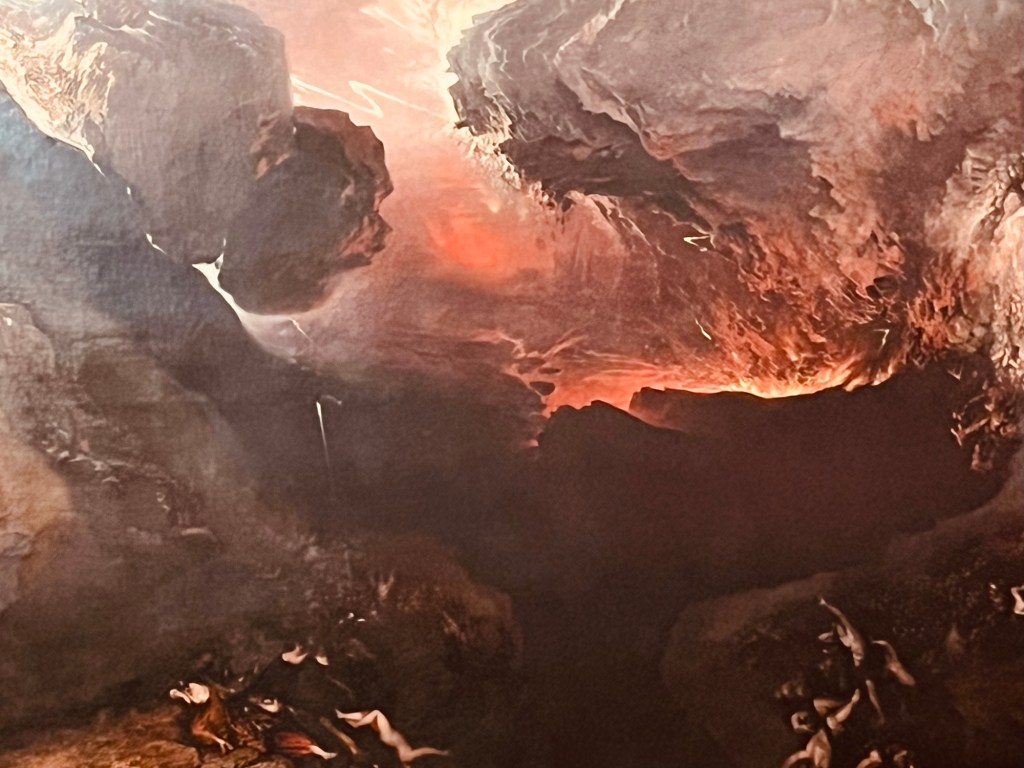
Apocalyptic imagery from the Book of Revelation reflects the deep anxieties of a time when rapid technological and social upheaval left many feeling unmoored. Long-held certainties, norms, and values were beginning to crumble. In many ways, these ancient fears echo our own and mirror the disruptions in today’s world.

Artists sensing underlying tensions

Major social and political shifts are often preceded by conflict and upheaval. Artists sense these underlying tensions long before they burst into the open ,but also give some cues to a brighter future.

Art offers us a unique lens through which to view the past, revealing not just historical waymarkers but the deeper rhythms of human experience.

History moves in cycles. Out of hardship and resilience emerges renewal and growth, only to give way once more to seasons of disruption and decline. Yet, from each winter of decay, a new spring is born, reminding us that regeneration is woven into the very fabric of life.

Reino Gevers – Author – Mentor –Speaker

P.S: If you enjoyed this article you might be interested in my very latest book: Sages, Saints and Sinners Get it today on Amazon, Barnes & Noble and where all good books are sold.

Leave a comment

Filed under art, Uncategorized

Finding Purpose: Know Thyself

The meaning of life is to find your gift. The purpose of life is to give it away.” — Pablo Picasso

Every soul incarnates with a unique purpose, and life itself is a journey of becoming who you truly are. Yet, from an early age, societal conditioning often obscures the soul’s inner calling, leading to discontent and unhappiness.

The Oracle of Delphi, inscribed at the Temple of Apollo, imparted the timeless wisdom: “Know Thyself.” This maxim reminds us that true purpose and wisdom emerge through deep self-reflection—by peeling away illusions, pretenses, and the false identities imposed by the world, we uncover our authentic essence.

Several sages have expanded on the maxim of Delphi by adding: “Know who you are not”, aligning with the practice of Neti Neti (“not this, not that”) in Advaita Vedanta, a Hindu philosophy. It seeks to understand the self by negating all that is not the true self. Perceiving the divine comes after self-reflection of “knowing thyself” and then “knowing who you are not”. The Islamic hadith states, “He who knows himself knows his Lord.”

From early childhood, we are subtly shaped by influences that can obscure our true nature and pull us away from our unique path in life. The hidden traps come in the form of societal norms, expectations, and fears.

Social Conditioning & External Expectations

  • From early childhood, we absorb the values, beliefs, and expectations of the family we were born into. Parents often make the mistake of carving out a career path for their child without sensing its deeper yearning. Many realize only later in life that the ladder has been placed against the wrong wall. This often occurs during a midlife crisis.

Self-Deception & Ego

  • Through self-talk, we often construct identities based on what we want in life rather than who we truly are. Uncomfortable truths are avoided with the ego protecting itself with rational justifications. The mind creates stories, but identifying too much with them keeps us trapped in illusions.

Fear of Change or Truth

  • Human beings are creatures of habit. Making fundamental changes like creating distance to family members or friends pulling us down to a lower vibrational level requires brave decisions and honest self-reflection.

Seeking Validation from Others

  • When we rely on external approval, we shape our identity based on how others perceive us rather than our own inner truth. Social media amplifies certain images of “success” and “happiness” mostly by encouraging consumerism.

Finding Stillness

To truly discover who you are, you must create space for stillness. In quiet moments, especially in nature, your senses open to the whispers of the soul. Here, you can seek guidance from God, a higher intelligence, or your higher self. Yet, these answers can only reach your heart when you free yourself from the endless noise of external distractions.

Without solitude, self-awareness remains shallow. Cultivating a meditation practice can help deepen your connection to your inner self. There is no single perfect way to meditate—it might be sitting in stillness, walking mindfully in nature, listening to spiritual music, or engaging in slow, flowing movements like Tai Chi or Qi Gong. The key is to find what brings you into presence and alignment with your true essence and purpose.

Reino Gevers – Author – Mentor – Speaker

If you enjoyed this article you will be interested in my books available where all good books are sold.

Leave a comment

Filed under raised consciousness, religion, social media, spirituality

This too shall pass

“Like river tides and autumn leaves,
All things must drift, all things must weave.
No hand can hold the fleeting dawn,
For what is here will soon be gone.”
— Unknown

External events, such as elections and economic cycles, can easily consume all your attention, pulling you away from your true purpose and inner joy. You may perceive the world as chaotic, making it harder to focus on the person you are meant to become.

If recent political events have left you feeling disheartened, powerless, or overwhelmed, know that you are not alone. Take comfort in the timeless wisdom: “This too shall pass.” Challenges are temporary, and no moment—good or bad—lasts forever. Stay grounded, keep perspective, and trust in your resilience.

The origins of the expression are unclear. According to Jewish folklore, King Solomon is said to have asked his advisors for something that would keep him grounded. They presented him with a ring inscribed with “Gam zeh ya’avor” (גם זה יעבור), which translates as “This too shall pass.”

The phrase has also been linked to several other traditions and later gained popularity in Western culture, and was famously quoted by Abraham Lincoln in a speech in 1859.

Lincoln made his remarks at the Wisconsin State Fair in Milwaukee, at a time of looming civil war, and rising political divisions over the slavery issue. He referenced an Eastern monarch who sought a phrase from advisors that would always be true in both good and bad times.

The answer he received was “This too shall pass away.” Lincoln used this phrase to highlight the idea that all circumstances—whether good or bad—are temporary.

The phrase serves as a powerful reminder to the wealthy, the powerful, and the arrogant that humility is essential, and success can be fleeting.

Just as nature moves through its cycles, life is impermanent, with good and bad times constantly shifting. Those who remain attached to power and wealth are especially vulnerable to these unpredictable forces, much like the changing seasons. They cannot be controlled.

Seizing back control when life becomes challenging

In the winter season of life, external events can at times be very challenging. But there are ways of how you can seize back control by focusing on those things that you can control:

  • Accepting a reality does not mean that you approve of it
  • You can control your response and your emotions to external events
  • Remind yourself that nothing lasts forever including challenging times

You can reframe your perspective into a question:

What can I learn from this and what opportunity may arise from this situation?

This is a time to build resilience by strengthening body, mind, and spirit. Falling into despondency and negativity will not serve you well. Try limiting your exposure to negativity such as negative social media and news events. Surround yourself with positive people and do things that boost your vibrational energy.

Practicing Gratitude

Being grateful for those things that are going well in your life can be a powerful tool of reframing emotions and feelings. Write down every day three things you can be truly grateful for.

Letting go of attachments to beliefs, perspectives, and emotions is a journey. Realigning with the rhythms of nature—listening to the wind, the rustling leaves, birds singing or the gentle flow of water—can be profoundly healing.

A deep walking meditation in nature allows for a reset, grounding yourself in the present moment. Whenever you feel weighed down, shift your focus to your breath. With each inhale, reconnect to your true self; with each exhale, release what no longer serves you.

Reino Gevers – Author – Mentor – Speaker

P.S. If you enjoyed this article you will be interested in my books available where all good books are sold.

Leave a comment

Filed under happiness, meditation, mental health, mental-health, purpose, self-development, Uncategorized

Home: Reflections on Place and Belonging

The landscape that you inhabit shapes you in profound ways, prompting the question: Where is home, and what environment truly nurtures your joy, energy, and zest for life?

Recently, I returned to South Africa, revisiting the places that defined my childhood. The journey was deeply reflective, stirring memories and a realization: home is no longer where it once was.

While timeless landmarks like the mountains and rivers of the Drakensberg endure, everything shaped by human hands changes—and often, tragically, deteriorates.

In rural South Africa, essential infrastructure like roads, sanitation, water, and electricity has largely collapsed or is on the brink of failure. Political corruption has turned state institutions into feeding troughs for party loyalists, leaving what was once the pride of Africa’s railways and roads in disrepair.

The place of home can shift

Circumstances led me to leave my birthplace at a young age. For years, I lived and worked in Germany—a land tied to my ancestral roots but one I could never truly call home. The long, cold, and wet winters left me battling colds and flu for weeks, an unmistakable signal that my well-being needed a different environment.

At times I was terribly homesick, longing for the blue skies, expansive landscapes, sounds and smells of my African homeland. It is easy to fall into the trap of melancholy sadness of what once was and is no more, the past becoming an idealized and distorted image.

Finding the place in the sun

Seven years ago, I found my place under the sun in Mallorca, Spain. It wasn’t until then that I fully understood how deeply geography, culture, and community impacts not just physical health but mental vibrancy and energy.

Sometimes, choosing to live someplace else does change everything for the better, notwithstanding that you always take yourself with you. Home is ultimately within. Home is what creates a sense of belonging and purpose.

Feeling at home sometimes shifts as you grow, adapt, and explore the world. At times, it’s where you were born or raised, rooted in childhood memories and traditions. At other times, it’s where you feel most alive, inspired, and at peace—a place or state of mind that aligns with your values, dreams, and well-being.

Recently the most renowned South African writer and poet Breyten Breytenbach passed away in his home in Paris. In his prose, Breytenbach frequently explored how the home one remembers rarely aligns with the home one finds upon return. The landscapes may remain familiar, but the social, political, and personal contexts often shift dramatically.

Returning home can evoke a profound sense of loss—of the self that once belonged fully to that place and the home that no longer exists as it was. Returning to childhood landscapes can be a complex, bittersweet experience, marked by both longing and alienation.

In a poignant in his book “Return to Paradise”, Breytenbach reflects:

We carry our homes within us,
shaped by the stories of our scars.
The land may hold its silence,
but the roads remember our footsteps.

Where is the place where you can truly breathe and thrive?

What does home mean to you?

Reino Gevers – Author – Mentor – Speaker

P.S. If you enjoyed this article you will be interested in my books available where all good books are sold.

Leave a comment

Filed under happiness, psychology, purpose, spirituality, Uncategorized

Understanding Loneliness vs. Solitude

Loneliness and solitude are often confused, but they are fundamentally different. Loneliness is not merely the absence of human relationships. It reflects a deeper sense of inner emptiness, signifying a lack of meaning and a disconnect from purpose.

Loneliness is a place of pain where the void often manifests in addictions, especially to external distractions that ultimately create more suffering.

Solitude is an intentional choice

Solitude, on the other hand, is the intentional choice to spend time alone. It is a self-created space for recalibration and mental detox.

In solitude, the mind is given the opportunity to quiet itself, creating a fertile ground for personal growth, self-discovery, and creativity.

While loneliness drains, solitude replenishes.

Meditation, yoga, tai chi, and deep walking in nature are only some of the useful tools in training the monkey mind to be really present and appreciative of the magic of the moment.

img_6521

But what if the pain is so deep that every moment alone is a place of torture?

Anyone who has experienced the pain of losing a loved one, the trauma of a break-up or divorce, financial disaster, the loss of a job or a life-threatening diagnosis will know that during such moments you need more than ever stable relationships and community to help navigate the crisis. Sometimes it is just important for another being to be present, holding a hand in silent compassion.

Human connection is fundamental

Human connection is fundamental to your well-being. It’s easier to transform pain when you feel seen, heard, and acknowledged by others. Yet, modern society’s focus on individualism—liberty, personal expression, and the pursuit of a singular life purpose—has often come at the expense of community.

 A study on “Social Relationships and Health” by Julianne Holt-Lunstad, Timothy B. Smith, and J. Bradley Layton (published in PLoS Medicine, 2010) revealed that that loneliness and social isolation significantly increase the risk of poor mental health and mortality. On the other hand the effects of social connections on health were found to be comparable to or greater than well-known risk factors such as smoking cessation, physical activity, and obesity management.

As social beings, we thrive in connection and falter in isolation, both mentally and physically. Yet, we find ourselves increasingly divided into opposing camps of “us” versus “them.” Strong religious and political ideologies—sometimes addictive in their nature—further deepen these divides, often fueled by external influences with hidden agendas. The rise of religious orthodoxy and political extremism underscores this growing fragmentation, creating artificial “tribal” communities that exclude rather than include.

The innate universal human quality for compassion, is frequently sacrificed on the altar of rigid beliefs and superficial differences. They are amplified by external forces, clouding the ability to see a shared humanity.

Yet there is a path back to serving both the true self and community – solitude. Taking even a few minutes each day to disconnect from the noise can ground you, fostering self-compassion, and reignite your capacity for love.

When you cultivate self-love, you naturally extend that same compassion and energy outward, treating others with greater understanding and kindness.

True connection begins within. By rediscovering our compassionate nature, we can bridge the divides and reclaim the value of community.

Reino Gevers – Author – Mentor – Speaker

P.S. If you enjoyed this article you will be interested in my books available where all good books are sold.

Leave a comment

Filed under gratitude, happiness, lifestyle management, meditation, nature, self-development, spirituality

What makes you happy?

“Gratitude is the antidote to the weight of regret”

In an uncertain and sometimes chaotic world, the constant stream of negative news can feel overwhelming, often overshadowing the positive moments. Unfortunately, the mind tends to focus more on negativity, making it essential to intentionally cultivate a mindset that embraces joy and positivity.

Throughout each day, we all face both positive and negative experiences. But have you ever wondered why the negative ones linger in your mind longer and why the negative message is more powerful than the positive?

Conditioning the mind to joy involves rewiring the brain to focus more on positive experiences, feelings, and thoughts while managing stress and challenges more effectively. Here are several practices that can help with this:

Gratitude

  • Daily Reflection: Spend a few minutes each day reflecting on things you’re grateful for, even small things. Writing them down can amplify the effect, as it reinforces positive neural pathways.
  • Reframe Challenges: When facing difficulties, try to focus on any lessons or positives that can come from them. What do I need to learn from this experience? I there a positive side to this?

Meditation and Deep Walking

  • Stay Present: Mindfulness teaches you to focus on the present, reducing tendencies to dwell on the past or worry about the future, both of which can detract from joy.
  • Deep Walking in nature is a great way of reconnecting and alignment. Spending time in the green and blue spaces of nature and opening the senses to sound, smell and feeling will noticeable reduce your stress levels. If you want to find out more, check out my book: Deep Walking for Body, Mind and Soul.

Positive Visualization

  • Imagine Joyful Outcomes: Regularly visualizing positive experiences can help the brain become more attuned to them. Picture moments that bring you happiness and success, even small ones, and try to evoke the emotions you’d feel in those scenarios.
  • Future Gratitude: Think about things you’re looking forward to or would like to happen, and imagine how grateful you’ll feel when they do.

Self-Love

  • Speak Kindly to Yourself: The way you talk to yourself affects how you feel about yourself. Practicing self-compassion means addressing your thoughts with kindness and patience, which fosters a more joyful and supportive inner world.
  • Forgive Yourself: Mistakes happen, and letting go of self-criticism can bring immediate relief and joy.

Acts of Kindness

  • Give to Others: Helping others releases oxytocin and other “feel-good” hormones, creating a sense of connection and joy.
  • Practice Appreciation: Show gratitude to those around you, which can increase your own sense of happiness and fulfillment.

Flow Activities

  • Find a Passion or Hobby: Activities that fully absorb your attention—like art, sports, or music—can create “flow” states, which are deeply satisfying and joyful.
  • Focus on Progress: Rather than aiming for perfection, celebrate small wins and improvements, which can help you appreciate your journey.

Cultivate Optimism

  • Challenge Negative Thoughts: When you notice negative thoughts, ask yourself if they’re realistic or if there’s a more positive perspective you could consider.
  • Practice Positive Affirmations: Regularly affirming positive beliefs about yourself and your future can build a mindset that gravitates toward joy.

Physical Exercise

  • Exercise Regularly: Physical activity releases endorphins, boosts mood, and reduces stress, all of which contribute to a happier space.
  • Smile Often: Even forcing a smile can trigger a small release of dopamine, making the brain associate smiling with joy.

Building positive habits and cultivating a resilient mindset takes time, especially if you’ve spent years dwelling in negativity. It’s a gradual process, but starting small can make a big impact. Begin with simple actions, like writing down three things you’re grateful for each day. Or take a few minutes each day to walk in nature or meditate. Over time, these small steps add up, creating a powerful, lasting effect.

In my village, there’s a Moroccan fruit and vegetable vendor who greets each customer with a big smile and a warm, friendly remark. Recently, I told him how his kindness radiates positivity to everyone he meets. Just think of the hundreds of people he uplifts, day after day, week after week, year after year. For me he is a reminder of how just one person can have a profoundly positive effect.

Reino Gevers – Author – Mentor – Speaker

P.S. If you enjoyed this article you will be interested in my books available where all good books are sold.

Leave a comment

Filed under gratitude, happiness, meditation, Uncategorized

Rediscover Calm: The Benefits of Trees

I often wonder why a walk in the forest quickly awakens my senses. It sharpens the sounds and smells around me. It also leaves me feeling peaceful and calm. This serenity has sparked much of the imagination behind my latest book. Science now supports what many of us have intuitively known: trees have a profound ability to put us in a positive state of mind.

The Japanese practice of Shinrin-yoku, or “forest bathing,” introduced in 1982 by Japan’s Ministry of Agriculture, Forestry, and Fisheries, was designed specifically to counter rising stress and mental health issues by encouraging people to spend time in forests.

The concept is simple: take a slow, mindful walk among the trees, engage your senses, and breathe deeply.

Recent research confirms that trees emit aromatic compounds called phytoncides, which have measurable health benefits. Dr. Qing Li, a leading figure in forest medicine and associate professor at Nippon Medical School, conducted a groundbreaking study published in 2007.

The findings revealed that time spent in forests significantly boosts natural killer (NK) cell activity, which plays a crucial role in the immune system’s ability to fight cancer and infections.

Moreover, the study showed a marked reduction in the stress hormone cortisol following forest immersion, leading to a drop in stress and anxiety. Participants reported improved mood, reduced anxiety, and an overwhelming sense of calm and relaxation after time spent in the woods. These lower stress levels improve sleep, reduce blood pressure, and, in the long run, support longevity.

The human brain is wired to negative bias

In today’s world, where our minds are constantly bombarded with negative messages that fuel anxiety and fear, this connection to nature becomes even more crucial. The human brain is wired with a negativity bias, a survival mechanism that our ancestors developed to remain alert to potential threats in their environment. If two hunters crossed paths, the first instinct would be to ask about dangers ahead.

This bias is embedded in the amygdala, the part of the brain responsible for emotional processing. It reacts more strongly to negative stimuli, triggering the body’s fight-or-flight response.

Stress shuts down vital body organs

In moments of perceived danger, stress hormones like adrenaline and cortisol flood the body. They shut down non-essential functions like digestion. They also concentrate all resources on immediate action. This intense focus on survival overshadows positive experiences, making negative emotions like fear, anger, or sadness more memorable and impactful than joy or calm.

This is why negative narratives—particularly in politics and media—are so powerful. They tap into our primal wiring, skewing our perception of reality to appear far more dangerous and threatening than it often is. It’s essential, now more than ever, to guard the mind against this bombardment and create space for healing and rejuvenation.

You can actively counter the negativity bias by practicing gratitude, and mindfulness. When was the last time you went for a walk in the park or in a forest?

A walk amid trees in nature will help retrain the brain to focus on positive experiences, strengthening emotional resilience and fostering a greater sense of happiness.

Reino Gevers – Author – Mentor – Speaker

P.S. If you enjoyed this article you will be interested in my books available where all good books are sold.

Leave a comment

Filed under meditation, mental health, mental-health