Tag Archives: Camino de Santiago

Day One on the Camino

Today is my first day as a volunteer in a pilgrim’s hostel on the famous Spanish pilgrimage route – the Camino de Santiago.

Pilgrims have walked this path for centuries. In modern times its being rediscovered by thousands of people as a modern-day route to self-discovery.

img_2410

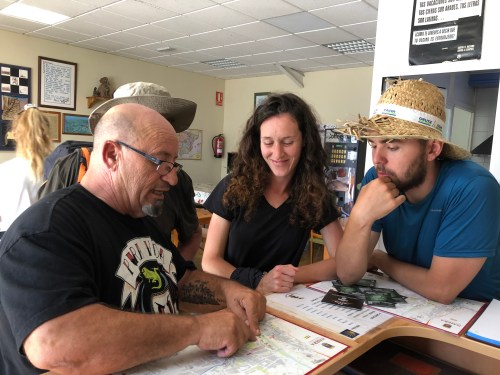
Pilgrims checking out the next day’s route in the pilgrim’s hostel, or albergue, in the town of Najera on the Camino Frances

Giving back to the Camino what the Camino has given to me over the years is an enormous privilege.

I arrived in Najera, northwestern Spain, in the valley known for its famous Rioja wines last night. As a volunteer hospitalero I am one of four people who serve in a pilgrims’ hostel for two weeks. We register the arriving pilgrims who come from places as far as South Korea, Colombia, Japan, Canada, Australia, and Kazakhstan. In the mornings we clean the rooms, toilets and prepare the hostel for the next group of pilgrims.

Every pilgrim has a story

Every pilgrim comes with a story and is happy to share some experience while on the way. Last night Darko from Croatia told me how he met a Swedish couple celebrating their 50th wedding anniversary walking the Camino. They were sitting on a bench looking at the vineyards in the valley below. “So has someone hugged you today, ” he asked. “No, they replied. You are the first one who asks.”

“Well, then can I give you a hug then?” he responded to the beaming couple.

My fellow volunteers are from France, Argentina and Spain. We converse in a mixture of pigeon Spanish and French. It always works out. All of us have walked the Camino several times and it doesn’t need much vocabulary to understand what needs to be done.

Reino Gevers – Author, Mentor and Consultant

https://www.reinogevers.com

                                             applepodcast         

Leave a comment

Filed under Uncategorized

Finding purpose with deep walking

My next book “Deep Walking – for Body, Mind and Soul” will soon be on the market.  It is about finding purpose during that void of inner silence that comes with deep walking.

We need to listen to nature

While writing the book I so often came to a point of writer’s block or procrastination. A new inspiration always came after going for a walk in nature. I think this is a dilemma most of us face in the modern world. We are spending too much time indoors, and it’s making us sick and moody.

IMG_0188

The disconnect from nature and the wisdom of the universe, has separated our species from the web of creation. This is why we are treating ourselves and the environment with such disrespect. What is happening within reflects what is happening in the outer world.

At the crossroads – depression and suicides have reached epidemic proportions

Humans are creative and exceptional beings. But we are very much at the crossroads where decisions made today will determine the future of our species in the next half century. I’ve said it often on these pages: The Western mind has sacrificed its soul to the golden calf of immediate external material gratification.  The result: Depression and mental illnesses have reached epidemic proportions. Something is out of order when one person commits suicide every 40 seconds. It is the second leading cause of death in the age group 15-24 in the United States!

Religious dogma from the past is not giving answers

A growing number of people are feeling this intuitively and are searching for new meaning and purpose. They are not finding the answers in the religious dogma of old that is telling us to believe in this or that. The new spiritual consciousness comes from an individual experience. It is why more than 300,000 people from all walks of life, different nationalities and faith, walk the pilgrimage path in Spain, the Camino, every year.  You can get my tips on preparing  for the Camino here: Preparation Camino.

The difference between a hike and a pilgrimage

It is a phenomenon I came across the very first time I walked the Camino in 2007. There  is a huge difference between just taking a hike for exercise purposes and going on a deep walking experience lasting several weeks, especially on a pilgrimage path walked by pilgrims for centuries.  Get my tips on preparing for the Camino here:

Nobody who walks the Camino with serious and mindful intent, comes back the same. As you walk from day to day through rain, mud and hot sun, passing village after village and climbing mountain top after mountain top, a mystery unfolds from within. When the many external distractions fall away, the empty space where we stop thinking opens and the universe, or God, can finally speak to us.

We can find this experience in meditation and other spiritual practices. I’ve found that deep walking in nature to be an exceptionally meditative experience, taking time out from the rat-race that has become our world, aligning with the above and the below with every mindful step.

Reino Gevers – Author, Mentor and Consultant

https://www.reinogevers.com

                            applepodcast         

Leave a comment

Filed under environment, happiness, humanity, lifestyle management, meditation, mental-health, psychology, self-development, Uncategorized

Reconnecting with ancestral roots

Our ancestors from centuries ago might be influencing our lives in more ways than we might be aware of.

Cultures steeped in tradition and ritual, place great value on their history and ancestral roots. Much of this has been lost in the modern materialist world−which then finds an unhealthy avenue in extreme nationalism.

IMG_0757

There is a long tradition on the Camino in Spain that reminded me a lot of the Zulu culture in South Africa.

The Zulu greeting “sawbona” means “I see you” to which the fellow being greeted responds with “yebo”, or yes and I see you too.

In the rural Zululand of my childhood the conversation would then continue with strangers exchanging their names and asking each other the names of their parents and grandparents and from what village they came from so that the ancestral tree to the tribe or clan could be recognized.

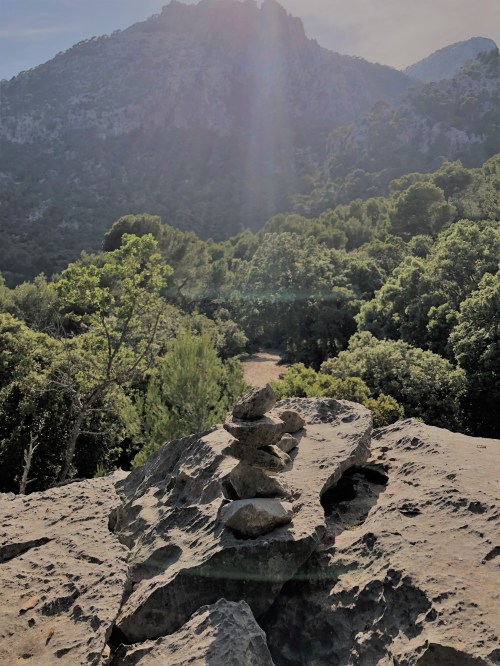
The Zulus journeyed mostly on foot, and would pile stone cairns at key junctions as a mark of respect to the ancestors and asking them for a safe journey. In the Umfolozi Game Reserve in KwaZulu-Natal there is a massive stone cairn that dates back to the stone ages.

I was surprised to find this tradition also on the Camino and learned that similar rituals also exist in other cultures such as the Inuit, American Indians and Celts from which the practice probably came in Spain.

In medieval times it was common for one member of a family to walk the Camino to atone for the sins of the entire clan. The family would in return collect funds to finance the pilgrimage.

The pilgrimage began after crossing the threshold of his front door, and after being granted permission to leave by his local religious authorities. Before leaving he had attended mass where his staff and scrip were blessed by the priest.

It would be months, sometimes more than a year before he returned−if he was lucky. Many pilgrims did not survive the journey, making the ultimate sacrifice.

Along the Camino, the pilgrim would add a rock to the cairns at the wayside, saying a prayer for a member of the family going down the line of the family tree, starting with the parents, siblings, grandparents, great-grandparents, and all the other members of the clan.

Today the tradition continues and many of the cairns have rocks with prayer inscriptions for a deceased loved one, someone going through a serious illness or a special wish.

Genetic research is still a young science but some scientists believe that some of our habits, traumas, memories and survival instincts are imprinted in our genes from our ancestors. An ancestor born centuries ago could still be impacting your life. Ancestral memories could be passed on for 14 generations, according to one body of research.

We are who we are not only because of the influences from our immediate friends and the environment in which we live but it also appears, that some of our habits, fears and talents are inherited from our ancestors.

Reino Gevers – Author, Mentor and Consultant 

https://www.reinogevers.com


Leave a comment

Filed under Camino de Santiago, happiness, humanity, mental-health, psychology, raised consciousness, spirituality, Uncategorized

States of transition

The public discourse in much of social media currently seems to alternate between two extremes with a fall-back to the nationalist hysteria of the 1930s to views expounding a free-for all liberalism. It is typical of a collective consciousness in transition and lacking direction and grounding.

Much of the western world appears to have lost its soul to the hungry ghosts seeking immediate gratification. At the same time we are seeing the outlines of an emerging Renaissance in human consciousness. Every crisis carries within it the seeds of transition and change to a new order.

mountain

A growing number of people are unhappy with the current state of things, and seekers of a new truth transmuting the dogmatism that has been imposed by rigid philosophies and religion during past generations.

Theologian and writer Richard Rohr pointedly describes religion has having brought forth the worst and the best in mankind.  Organised religion has the power of fueling the flames of fanaticism, hate and war or it can open hearts in collective prayer and ritual for the betterment of humankind.

When extreme opposites face each other off, as we are currently seeing along party political lines in the United States, each side becomes blind to the shades of grey and the humanness in the other. We stamp off people along party lines and belief systems preventing a real discourse. In a way it has become “a religious war” between opposites.

In the heated exchange between the opposites the voices of the silent masses go unheard. I do believe that most people are by nature tolerant and can intuitively distinguish between the lie and the truth – a reason  why a growing number of people are refusing to vote and are becoming alienated from organized politics and religion.

Some of the outlines of change can be seen in the fast-growing self-development industry with individual change gradually becoming collective change on a global scale.

In recent years I have met hundreds of people from all walks of life and many different countries on the Camino pilgrimage route in Spain.  About 200,000 people are now walking this ancient medieval pilgrimage route each year. I would describe many of them as spiritual seekers asking the age-old questions: Where do I come from and where am I going?

Reino Gevers – Author, Mentor and Consultant 

http://www.reinogevers.com


Leave a comment

Filed under happiness, humanity, lifestyle management, Pilgrimage, psychology, spirituality, Uncategorized

Walk your path

I’ve just released the second edition of my book “Walking on Edge: A Pilgrimage to Santiago”  – a novel based on firsthand conversations and insights with many fellow hikers on the Camino. For some people the Camino can be a life-changing experience – for others it is disappointing.

IMG_0156

What Camino you walk depends very much on your expectations and your frame of mind.  After months, sometimes even years, of preparation and planning, and reading some of the many books on the Camino, you are finally on the road.

If you start your walk in Saint-Jean-Pied-de-Port, in southwestern France, in the summer months from June to August you will be disappointed by the masses of people walking the Camino Frances – the most common route.

You will be staying in crowded hostels and sleeping on bunk beds. You might have to stand in a long line for a shower and have to cope with blisters and other aches and pains in your body.  You will be frightened by cyclists coming from behind you at breakneck speed, and sometimes even pushing you off the road.

The first days of walking on the Camino are a real test of mind and body. It is also called the path of crucifixion. A fellow pilgrim once said to me: “Be humble on the path, or the path with humble you.”

On one of my walks I met a very frustrated pilgrim, who had refused advice from fellow walkers, to take it slow during the first days. He was going on and on about his disappointment, criticizing the “boring” landscape of the Camino and lamenting why he had not chosen a holiday on the Canary islands instead.  A lot of people are obviously walking the same route and coming home with very different perceptions and experiences, judging by the comments in many of the social media forums.

My advice is: Don’t be duped by other people’s opinions and what you read. If you liberate your mind from preconceived images and expectations, you will have your very own Camino experience – that can be magical in many ways.

Call it the the Universe, God or just the “magic of the path” has been life-transforming for me and so many people I’ve met on the Camino.  If you walk alone and confront those emotional demons along the way, you will make extraordinary discoveries both within and without. The Camino is certainly not everyone’s cup-of-tea. It can be a hard, uncomfortable, excruciating slog in mud, rain and heat.

At the same time the Camino is exceptionally rewarding on many subtle levels that sometimes only make themselves felt, months after the pilgrimage. The walk is an analogy of life as you deal with the daily ups-and-downs.

Reino Gevers – Mentor and Author – Your Health Matters

 “Walking on Edge – A Pilgrimage to Santiago” available both in Kindle and paperback.

http://www.reinogevers.com


Leave a comment

Filed under Camino de Santiago, spirituality, Uncategorized

Home and the heart of things

In the past few days I have dissolved a home of 21 years in northern Germany and moved to the Spanish island of Majorca. It poses the question of what we define as home and where to let go of meaningless material attachment.

One of the key lessons of walking the Camino is that the less you carry in your back pack the easier your walk.  You have to go lean to go far. Essentially there is not much we need to feel contentment of heart.

There is not much that remains of those things we clutter our homes with when it comes to downsizing. A rule of thumb is what you haven’t worn or used during the past six months is no longer of value to you.

img_0405Within the word Home, is one of the most powerful mantras OM.  In the Sanskrit origin  it translates as the vibrational Source and connection to the Supreme.  Peace of mind and contentment can only be found With-In. You always take yourself with you wherever you are and with all that with which your mind is preoccupied with.
The bottom line: If you are a grumpy old scrooge at the place where you are now, chances are good that you will remain a grumpy old scrooge wherever you choose to go.

Its an illusion to think that everything will change for the better if you change your wife, your house, your job and your country, if you don’t change your mindset as well.

But its not the whole story.  Who you are is determined largely by your associations and the environment you live in. We are social beings who interact and need to interact with each other all the time.

If the people you surround yourself with and your immediate surroundings are no longer conducive to your further development, then its time to move.

Yet, attachments mainly in the form of material things and emotional baggage of the past subconsciously hinder us from taking a big step forward to new things, new perspectives, new relationships and in the end more lessons learned on the path to a raised consciousness.

Reino Gevers – Mentor for Leaders and Achievers – Your Health Matters

Awakening the Fire Within – key principles of health and success. Enrolling now will give you a 25 per cent discount.

NEW RELEASE: “Walking on Edge – A Pilgrimage to Santiago” available both in Kindle and paperback.

http://www.reinogevers.com


Leave a comment

Filed under happiness, lifestyle management, meditation, om, raised consciousness, spirituality, Uncategorized

Your friend the obstacle

IMG_0117 (1)When walking the Camino you will be confronted by obstacles.  The first biggest challenge is mental. You are thirsty, exhausted and your feet are hurting. You push yourself to the summit of that mountain only to find that you have an even steeper hill to climb further ahead. Your mood sinks to rock bottom.

We have those moments of walking through the valley of death every day. An unexpected tax bill in the post. An unpleasant meeting or other disappointment.  Life is cyclical, like the seasons with periods of winter darkness followed by the joys of spring and warm summer days.

Take a  look at some of the great personalities of our time. Nelson Mandela, Oprah Winfrey and Albert Einstein transmuted the suffering in  those pits of darkness in their youth, honing their qualities of character and emerging stronger than ever before.

What you perceive as an obstacle is a “teacher” telling you where you have to learn and refine your personality in overcoming your greatest fears which can be anything from the fear of death, ill-health, loss of material wealth and the shame that can go with it.

We need only to observe nature to see how all plant and animal life is in a continuous process of evolutionary refinement in the adaption to challenges that come with changing circumstances.

Without an obstacle, without a challenge, you can’t grow. You will remain stagnant and there is the danger of falling into procrastination and lethargy. So next time you have to deal with a major disappointment or challenge it might just be the universe telling you to take a different turn.

Reino Gevers – Mentor for Leaders and Achievers – Your Health Matters

Awakening the Fire Within – key principles of health and success. Enrolling now will give you a 25 per cent discount.

NEW RELEASE: “Walking on Edge – A Pilgrimage to Santiago” available both in Kindle and paperback.

http://www.reinogevers.com


Leave a comment

Filed under happiness, lifestyle management, psychology, raised consciousness, Uncategorized

Time out: Why a pilgrimage?

Next week I will be leaving for my ninth walk on the Camino de Santiago. Its become an annual must-do-event because I am convinced that such a time-out period is essential in boosting my energy, my creativity and general feeling of well-being.

IMG_3577In our modern world our energies are constantly being depleted by countless distractions that make us forget who we are and what soul purpose we have. Worse still: We imitate “role models” hyped by mass media, making us look foolishly unauthentic.

The tradition of walking the Camino is many centuries old. In the Middle Ages, when life was cheap and short, people had a deeply ingrained fear of burning in the fires of hell in the after life. The best possible way of gaining redemption was in walking the Camino.

Today thousands of people are rediscovering the Camino as a perfect analogy of life and a fast-track course in self-development.  Here are only some of the lessons I learned on the Camino:

  • The less weight you carry, the easier your walk
  • The ups-and-downs are cyclical like the ups and downs of life
  • If you get lost you always find someone to help you
  • Be open for the miraculous often hidden in the common

Never mind the enormous health benefits. I’ve noticed that walking between 20-25 kilometers a day not only detoxes the body but also the mind. It is truly “walking things off” and getting rid of the clutter, opening the channels and the senses of hearing, smell, touch and sight.

I will keep you posted on this site.

Reino Gevers – Mentor for Leaders and Achievers – Your Health Matters

Awakening the Fire Within – key principles of health and success. Enrolling now will give you a 25 per cent discount.

NEW RELEASE: “Walking on Edge – A Pilgrimage to Santiago” available both in Kindle and paperback.

http://www.reinogevers.com

Leave a comment

Filed under exercise mental health, happiness, happiness research, Pilgrimage, psychology, raised consciousness, Uncategorized

Walking on Edge

Walking_on_Edge_Cover_for_Kindle The Camino in Spain has in many respects been a life-changing experience for me.  The lessons learned on the pilgrimage are in so many ways an analogy of life. My book “Walking on Edge”, a work of fiction, takes up many autobiographical cues and is dedicated to some of the most amazing people I have met on the Path.

For many centuries Christian pilgrims walked thousands of kilometres from the doorstep of their homes throughout Europe to the Spanish city of Santiago de Compostela, where according to legend lie the remains of one of Jesus apostles St. James. Fear of landing in the fires of hell after death was deeply entrenched in the minds of the people of the Middle Ages. The church at the time promised those folk that they and their families would be cleansed of all sin and have a wonderful afterlife in heaven if they did the pilgrimage at least once in their lifetime.

Today hundreds of thousands of people are rediscovering this ancient route as a wonderful way of self discovery and through that deep look inside, finding their own inner spirituality and soul purpose.

In my book I have changed the characters but some of those modern day miracles are based on true experience.  Yes, I am convinced that miracles are still happening, if we open our senses and look around us. For me the Camino was not one massive bolt of enlightenment striking on a hill, but the sum of many exceptional experiences over a period of several walks on different paths in Spain and France.

Since the days of my childhood I have agonised over the teachings of religion telling us to believe this or that or to follow this or that teaching. It’s all external. One major lesson I have taken from the Camino is that there is a major difference between religion and personal spiritual experience. In my book the pilgrim Chuck calls it the difference between head and heart mind. The soul path cannot be understood with rational thought and can only be felt with the heart. And, a growing number of people are saying: “Let me go out and seek an answer to why I am here and who I really am.” Through this self-recognition comes what I will call “God recognition” and what  is a very personal and individual experience.

Suffering inevitably leads us to go out looking for answers. A lot of people are getting lost and feeling left behind in the digital revolution. In some ways mankind is facing a similar dilemma as the people in the Middle Ages. Its no longer the church that rules over our lives but the information overload of countless distractions polluting our minds with clutter we don’t need.

Ronaldo was one of those pilgrims “walking things off” by going at a pace most others could not keep up with, avoiding all conversation as the emotional clutter gradually released itself, opening up space for new experience.

And it was that space, as Chuck called it “that can then be nourished with inner peace, forgiveness and compassion. You in fact are working on becoming a better human being.”

Reino Gevers – Mentor for Leaders and Achievers – Your Health Matters

http://www.reinogevers.com

“Walking on Edge – A Pilgrimage to Santiago” available both in Kindle and paperback.


Leave a comment

Filed under gratitude, happiness, meditation, Pilgrimage, spirituality, Uncategorized

Following the path of the Holy Grail

Nestled in a rock face near the Spanish city of Jaca is the ancient monastery of San Juan de la Pena. It dates back to the ninth century and by the 11th century became the spiritual and intellectual centre of the Kingdom of Aragon. According to legend the Holy Grail was kept here until the 14th century.

There is no final proof but It was believed to be the chalice used by Jesus during the Last Supper and the cup in which Joseph of Arimathea collected the Blood of Jesus on the Cross. Today the original is kept in the Cathedral of Valencia with a copy displayed on a stone altar in the old monastery.


Whether true or not, the monastery San Juan de la Pena is a mysterious and unique place. While on our recent walk on the Camino, I took a day to explore the area on the mountain from which there are spectacular views of the Pyrenees mountains in the distance.


The Monasterio Nuevo, or new monastery, further up the mountain is a much bigger complex. Its exterior has been rebuilt with a modern museum interior giving much insight on how the monks lived according to the Benedictine Order

The monastery had enormous influence not only in the ancient Kingdom of Aragon but throughout Europe of the early Middle Ages. The monks lived disciplined lives, following a daily routine of contemplation, work and study. Silence was highly cherished. The monks took a vow of silence and were only allowed to speak if it was absolutely necessary or when it was a good thought or blessing. It was obviously an atmosphere that was conducive to highly-focused study and inner spiritual work.

The exhibition in the new monastery illustrates a colorful history of rise and decay. The influence and success of this monastery in the early Middle Ages can be attributed to several factors that are good lessons for today’s corporates:

  • The monks were absolutely focused, disciplined and dedicated to their task
  • At the same time they did not exclude themselves from the outside world, honing the art of networking and relationship-building with the rulers and decision-makers of the time.
  • A charismatic abbot, or leader, was crucial in maintaining cohesion, discipline and respect
  • Basic material needs were catered for by the Kingdom with at times generous grants and donations

Its a mute point on whether the decay started in the year 1399 when the Aragonese King Martino V took the Holy Grail  to his palace in Zaragoza and when the monks asked for it back he tricked them with a replica. There were several fires that destroyed much of the monastery complex in the 17th century. Decay came in line with infighting and power struggles. Grants and privileges from the king were reduced and at times completely stopped. Loss of focus and purpose came in line with vows being broken and poor leadership.

An organisation is only as successful as long as its members are motivated to abide by the internal codes and ethics which always reflects on how it is perceived by those outside. There will always be circumstances that cannot be controlled, such as political change or upheavel. But it is how adaptable and flexible that organisation is to unpredictable changes, that will ultimately determine its survival.

Leave a comment

Filed under connection, energy, healing nature, life vision, meditation, monasteries, monks, organisational structure, powerbodymind, psychology, spirituality