Many people who walk the Camino de Santiago for the first time are entering a new chapter after personal pain or loss. They hope the pilgrimage will help them find answers to some of life’s biggest mysteries.
It was much the same for me on my first Camino. I was in a dysfunctional relationship, my job no longer fulfilled me and I had several health problems. Early on, I met a fellow pilgrim who explained that the walk divides into three parts, something most pilgrims work out for themselves by about the second week.
The first part is the crucifixion, the second is the long burial of the Meseta, and the third is the resurrection. Nobody planned it that way. The route simply produces that shape in people, and after walking it you start to suspect the mystics were describing the same road.
The first part: pain
There are several routes. The most popular is the Camino Francés, which begins at St-Jean-Pied-de-Port, on the French side of the Pyrenees. On the first day you climb more than a thousand metres with a backpack. By the time you reach Roncesvalles your knees have opinions and your shoulders have stopped speaking to you. Then come the blisters, and every step hurts.
Something happens to the mind in those first days. The usual noise of work, plans and opinions fades into the background, and one question takes over: how am I going to survive this walk if it is already so hard? Many pilgrims surrender at this point and buy a ticket home. Those who continue slowly begin to let go.
This is when people start sending things home. The Spanish post office does a steady trade in parcels from pilgrims who have discovered that the second jumper, the hardback book and the spare shoes are weight they cannot carry. Nobody has to explain the metaphor.
John of the Cross, the sixteenth-century Spanish mystic, described a stage of the spiritual life he called the dark night. In the first part, the night of the senses, the comforts that used to sustain a person stop working. Prayer goes dry, pleasure fades and the old props give way. He did not treat this as a failure. He wrote that the night was the work of grace, the removal of whatever stood between a person and what they were looking for.
The first week on the Camino feels like that. The pain is the only teacher in the room, and it is not gentle. It strips you down to someone who can only put one foot in front of the other, and without that stripping the rest of the walk would not be possible. As a fellow pilgrim said to me: “If you haven’t learned humility by now, the Path certainly will teach you to be humble.”
The second part: the Meseta
After Burgos the landscape changes. The green hills and village bars give way to the Meseta, a high plateau of wheat fields that runs for roughly 180 kilometres to León. There is almost no shade. The tracks run dead straight to a horizon that never seems to arrive, and the wind is constant. Many pilgrims take the bus to skip it. The scenery, they say, is boring.
It is boring, and that is the point.
Once the body has settled into its pain and the first-week drama has passed, the mind has nothing to hold on to. It is used to being fed: conversation, screens, scenery, tasks. On the Meseta it gets none of that, so it starts to feed on itself.
Doubt comes first. What am I doing here? Who walks 800 kilometres for no reason? Then come the tears, usually on a mundane late morning in the middle of a field. A long-forgotten childhood pain, a dream from a restless night: whatever the trigger, what rises is the grief you filed away, the argument you never finished, the person you let down, the person who let you down. It has been waiting for years for a space quiet enough to surface.
This is where the Camino stops being a walking holiday. Pilgrims sit by the side of the path and cry for an hour. They ring home and say things they could not say before. Others walk in silence for days, fighting a battle within that nobody else can see.
The Desert Fathers of fourth-century Egypt knew this terrain. They went into the wilderness expecting peace and met their own minds instead. Evagrius wrote about the demon of acedia, the restless boredom and despair that comes at noon and tells you to leave your cell. A saying attributed to Abba Moses gave the answer: sit in your cell, and your cell will teach you everything. The Meseta is a cell with a very large window.
Carl Jung gave this experience a modern name when he wrote about the shadow, the part of ourselves we refuse to look at. He held that enlightenment comes from making the darkness conscious, not from imagining figures of light. What we avoid does not go away. It runs the show from behind the curtain until we turn and face it.
The anonymous author of The Cloud of Unknowing, an English mystic of the fourteenth century, described the limit of thinking. Analysis will take a person only so far. Beyond that lies a cloud, a place where the mind cannot grasp what it is looking for, and his advice was to stay there and keep reaching with love instead of thought. Pilgrims on the Meseta do this without knowing it. They cannot think their way out, so they keep walking.
The Tao Te Ching has a line for this part of the road: know the light, keep to the dark. It does not ask you to prefer darkness. It says that a person who has only ever known the light is incomplete, and that the dark has something to give.
The third part: the walk becomes easy
Beyond León, at the Cruz de Ferro, many pilgrims leave a stone they have carried from home, a small weight handed over at last. Then, somewhere before the hills of Galicia, a shift comes. There is no announcement and no single moment you can point to. One morning you notice that your body has stopped complaining. The blisters have healed and the pack has become part of you. You wake before dawn without an alarm and your legs are already moving.
The mind has gone quiet too, but this quiet is different from the numbness of the first week. It is spacious. Thoughts come and pass without sticking. The doubts of the Meseta have not been answered so much as walked through and outlived. You stop asking why you are walking, because the walking has become its own answer.
Pilgrims in this stage often describe a feeling of alignment. Body, mind and soul move in the same direction at the same pace, and nothing in you pulls the other way. The walk costs almost no effort. Days pass in a kind of light.
This is the resurrection, and it comes before Santiago. People are sometimes surprised by that. They expect the cathedral to be the moment. By the time they reach it, the thing they came for has already happened on the road, days back, on an unremarkable morning among eucalyptus trees.
Julian of Norwich knew something about this. She was gravely ill at thirty and lived through the plague years in Norwich, one of the hardest-hit cities in England. She wrote that all shall be well from inside the experience, not from a safe distance, which is why it carries weight.
What the mystics and the road agree on
The three parts of the Camino follow an old pattern, and the pattern is not a punishment. The pain of the first week strips away what is unnecessary. The emptiness of the Meseta brings up what has been buried. Only then does the ease of the third part become possible. Skip either of the first two and the third does not arrive in the same way.
This is why we need the dark. The light we find at the end was not missing the whole time. We simply could not see it with the eyes we started with. The old self, with its defences and its stories, had to be worn down before anything else could come through.
A word of caution. Suffering does not transform everyone who passes through it. Some people are broken by it, and no one should be told that their pain is a gift. The mystics did not walk alone. They had teachers, communities and long practice, and pilgrims on the Camino have each other, a bed each night and a clear direction. A dark time without that support can simply be dark. If you are in one now, find someone to walk with and to talk to.
A question to take with you
You do not need to fly to Spain to meet your own Meseta. Most of us are crossing one right now: a flat, featureless stretch when the old comforts have stopped working and old pain is rising. We prefer life to be easy, and we avoid pain and conflict where we can. Yet we grow through all of it, the joy and abundance as much as the loss and pain.
Here is a question to sit with this week. What am I carrying that I no longer need, and what is waiting to be felt in the quiet?
You do not have to answer it quickly. The Meseta takes about a week to cross. Buen Camino.
Reino Gevers – Host of the LivingToBe podcast
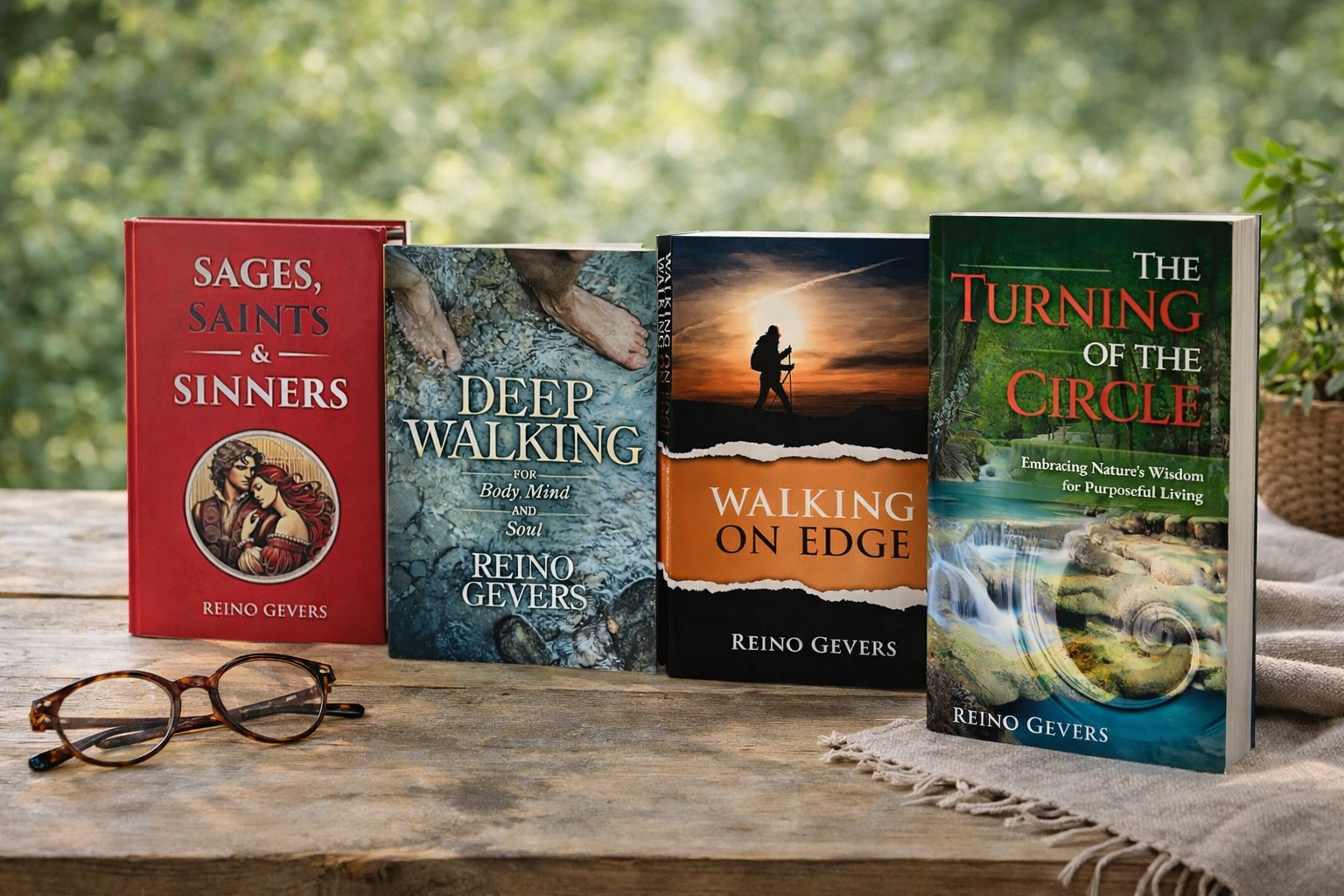
P.S: If you enjoyed this article, you might be interested in reading one of my four books, available where all good books are sold.