Tag Archives: health

Building resilience during tough times

You might be one of the many people currently feeling overwhelmed by the war images from Ukraine or the fears associated with the pandemic. It’s a general feeling of helplessness when external circumstances out of your control impact the quality of your life.

Stress always starts with a thought. During these times it’s more important than ever to build a bubble of resilience against the pull of negative distractions from the external world. We cannot individually change external events but we can control how we react to them.

Byron Katie has a wonderful method of how we discern between our business and someone else’s business. She writes:

“Whose business is it if an earthquake happens? God’s business.

Whose business is it if your neighbor down the street has an ugly lawn? Your neighbor’s business.

Whose business is it if you are angry at your neighbor down the street because he has an ugly lawn? Your business.”

What if your neighbour is abusing a child? It’s your business because you know about an injustice. You have the responsibility by calling the police. If Russia invades a sovereign country and committing war crimes we should rightly be outraged. We can support governments imposing sanctions against Moscow.

You should not be unaware of what is happening in the external world. You must care and do something, like donating or volunteering for a charity helping the Ukrainian refugees. It is what humanity is all about. At the same time, you should be aware of what is happening to your emotional state when the dosage of negative news media is taking up a large portion of your day or your thoughts.

A person said to me the other day, that he couldn’t with a good conscience go to a music concert while aware that people are suffering in a war. Should I enjoy myself while other people are suffering? Am I allowed to create a “feel good” bubble around myself?

Yes, you certainly should and must. If you want to help others and help change the world, you can and should look after yourself and do things that improve your vibrational energy. If you have a strong and resilient mind and body, you will have the strength to be proactive.

You can change the world

On a collective level we can change the world if we can get more individuals to elevate themselves to higher consciousness. These are the individuals who see their time on earth as a valuable serving contribution.

How you respond emotionally to external circumstances depends on how well you are aligned on a mental and physical level. Are you being pulled out of your space by an incident that then ruins your day? Are you feeling constantly fatigued and in need of recuperation?

Setting healthy boundaries and building a bubble are crucial in boosting your resilience. But it takes practice. Research has shown that once you get started on building positive habits and keep at it for at least six weeks, the chance of success is very much higher.

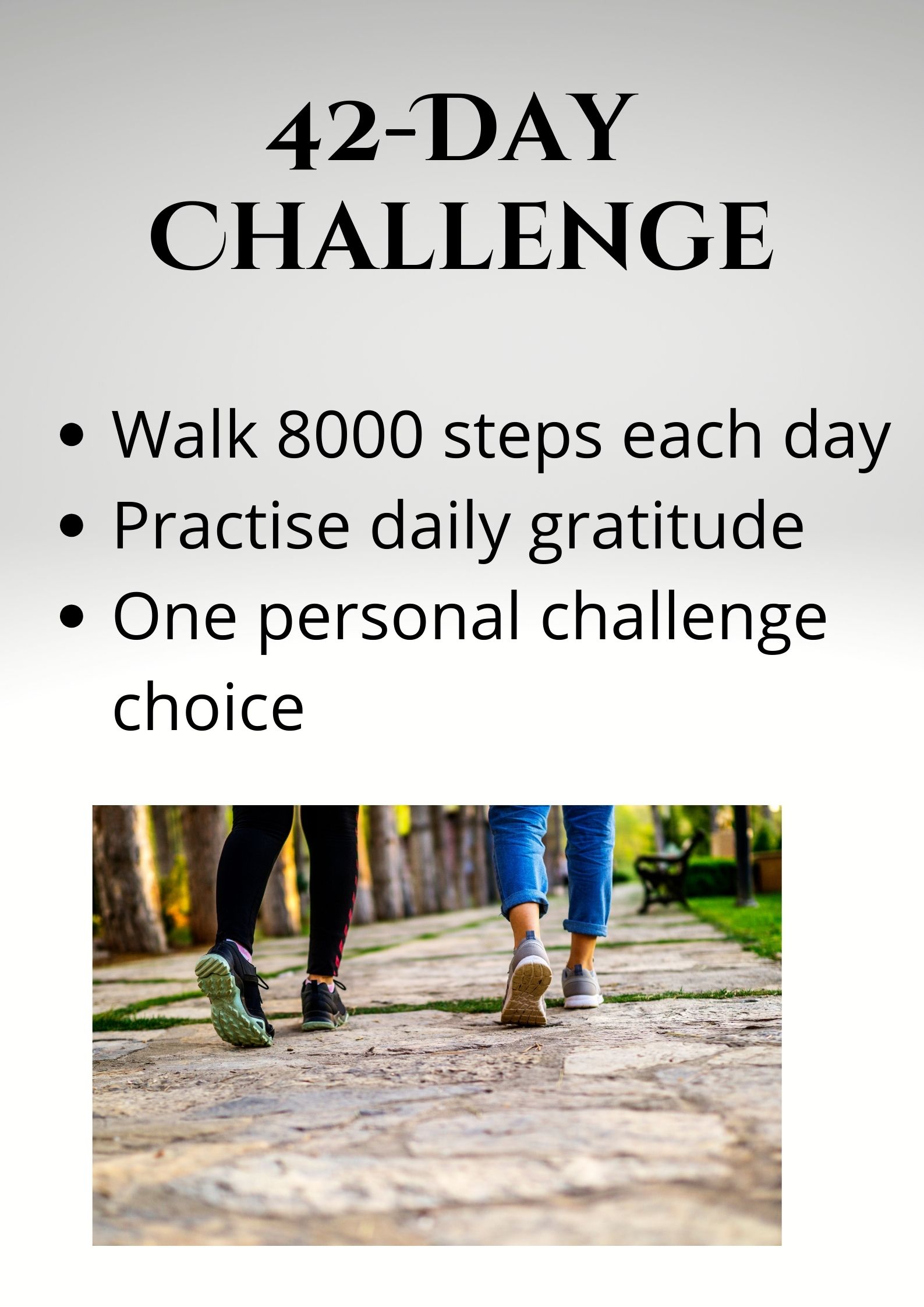
As you are a regular subscriber to my weekly Blog I’m inviting you to participate in a 42-day challenge, starting on 11th May to 21st June.

  • Walking at least 8000 steps or six kilometers each day.
  • Writing down at least three positive things for which you are truly grateful during the past 24 hours
  • Choose one more positive habit of personal choice. (This can be anything from a ten-minute meditation each day, abstaining from alcohol or processed foods, or reading at least three good self-help books)

Why walk each day?

Just taking a walk is one of the easiest ways of boosting your mental and physical health. You don’t need an instructor or have to go to the gym. Moderate exercise of at least 8,000 steps per day reduces the risk of heart disease and stroke, you will lose body fat and increase your muscle strength and overall vitality. You might find yourself also feeling better emotionally and finding creative solutions to problem-solving. Some of the world’s greatest artists, musicians, and writers got their best inspiration while walking. You can read how I got addicted to walking and the many positive lessons learned while walking in my latest book: Deep Walking for Body, Mind and Soul.

Practising a gratitude ritual

Reframing your mind from a negative to a positive emotional state mostly starts in the morning soon after getting up. If you have had a bad dream or have slept badly it’s important to remember what good things are happening to you at the same time. Life is never only black and white. Sometimes you simply don’t see the good things happening in your life because you have been programmed with negativity and find yourself in a spiral of negative self-talk. Keeping a gratitude journal by writing down the three most positive things that happened to you during the past 24 hours does wonders.

There are not many people who are willing to commit and hold themselves accountable. If you are one of these special individuals, and I believe that you are, then I invite you to participate in this Challenge. It costs nothing except your willingness to commit.

All you have to do is apply to join my special private Mastermind Facebook Group: Living to Be.

You will be doing your training in your own time but all of us motivating each other to do this practice every day, will make this Challenge so much easier.

One more thing: At the end of this challenge we will be choosing five winners from all participants. They will be granted full FREE access to all my online courses on Mastermind.com worth over 1000 dollars (950 € or 795 pounds).

Reino Gevers – Author – Mentor – Speaker

P.S. If you have a friend or family member who might find this challenge interesting, please feel free to share this Challenge with them. By practicing self-care you are helping to heal not only yourself but others and the world around you.

Leave a comment

Filed under mental health, mental-health, Uncategorized

Happiness is building strong relationships

People are lonely because they build walls instead of bridges.”
— Joseph F. Newton Men

Nature is our greatest healer and our greatest teacher. When immersing in the natural world the senses awaken and go into synchronicity. From observing a bee pollinating a flower to mushrooms growing in the special moisture of soil in a shady forest, every living thing is interconnected.

God or the universe find expression in nature and we are one part and inextricably bound to its structure and underlying order. Ancient cultures were well aware of the divine within, seeing the sacred in landscape features, plants, and animals. Modern man’s disconnect from the soul nature and the spiritual has come with rapid urbanization and the disconnect from nature.

The mental health crisis that modern culture is currently experiencing can in part be attributed to the broken relationship with the self, estrangement from the community, and a “relational” crisis on all levels.

Narcissism contradicts the essence of human nature

Our culture of narcissism contradicts the very essence of human need. It over-emphasizes the needs of the individual over the collective. When we are born, we are completely helpless beings, totally dependent on a nurturing family environment. Our primary family shapes and determines how we think and behave.

Photo by Pixabay on Pexels.com

Our beliefs, habits, and actions are shaped by our closest associations and the relationship we have with our immediate surroundings. It is foundational.

The resurgence of nationalism and tribalism, the emphasis on one’s own culture and belonging, while denouncing that of the other is just a perverted expression of the loss of belonging and the disconnect from the higher self that is universal in its humanity.

Desmond Tutu, Nobel Peace Prize winner and anti-apartheid activist, explained the African “relational” concept of Ubuntu as the essence of being human.

We are made for complementarity

“It speaks of how my humanity is caught up and bound up inextricably with yours. It says, not as Descartes did, “I think, therefore I am” but rather, “I am because I belong.” I need other human beings in order to be human. The completely self-sufficient human being is subhuman. I can be me only if you are fully you. I am because we are, for we are made for togetherness, for family. We are made for complementarity. We are created for a delicate network of relationships, of interdependence with our fellow human beings, with the rest of creation.”

Bonding with your fellow human being and building your relationships ultimately means that you will live a life of bliss and happiness. The more you adopt the mindset of serving your fellow human being rather than what my friend, parent, employer, government, business association, and marriage partner can give to me the more connected you will begin to feel.

It is a recipe for building resilience against mental and physical exhaustion that we find in job burnout. Typical symptoms of the burnout patient are the complete withdrawal from connection to family members, interaction with colleagues, and participation in community events.

We become stronger and more resilient the more we build the bonds of our associations with those people that give us positive feedback, that nurture us with positive energy, and who care with kindness and love.

Reino Gevers – Author – Mentor – Speaker

One more thing...If you have found this article interesting you might want to read more in my books that can be ordered at all places that sell good books in both paperback and kindle.

Leave a comment

Filed under mental health, mental-health, Uncategorized

Unhappiness and the worship of false gods

The sole meaning of life is to serve humanity” – Leo Tolstoy

The meaning of life is to find your gift. The purpose of life is to give it away.” Pablo Picasso

The famous Swiss psychiatrist Carl Gustav Jung was once asked by a BBC journalist whether he believed in God. Pausing for a moment, Jung answered: “I don’t need to believe I know.”

While institutionalized religion is essentially a doctrine of what to believe, and how to behave, Jung was referring to experiential spirituality that has been embedded in the collective consciousness of mankind for eons.

Humans have always instinctually felt that there is a creative force within and beyond transcending the self. Derided as a Mystic, Jung is today regarded as a pioneer in bringing together science and religion.

For the Mystics, spirituality cannot be defined as a theology. We all have those precious few moments where we feel a sudden clarity of mind, have an epiphany, or when everything suddenly falls into place. These are rare occasions when consciousness touches authentic soul nature.

When we are disciples in service of the greater good, we will perceive that driving force within that some describe as a real feeling of happiness, contentment, and satisfaction.

Worshipping the false Gods

In the spiritual vacuum of much of our materialistic culture, we are however taught that happiness comes from the worship of things. It is all about HAVING instead of BEING. We are sold an illusion.

Self-worth is defined by what we own and what status we have in society. It is about feeling significant rather than BEING happy. Individualization, personal needs, and wants take precedence over the holistic needs of community and society at large.

We have seen to what extremes individuals took what they perceived as their “personal freedom” during the pandemic and the culture wars over issues such as environmental protection. An entitlement culture will always be at odds with collective responsibility.

The more attention we focus on the external the more disconnected we become from our divine nature within. The “selfie-culture” in the form of self-worship and narcissism inevitably leads to unhappiness, disappointment, and ultimately depression. The ego appetite to be significant, to be seen, and to be heard is insatiable. A preoccupation with the self compares and is never grateful for what is.

There is compelling evidence that the secret of happiness begins when we begin to transmute the needs of self in service of the bigger whole. It is at the root of all the great religions. Matthew 6:21 tells us: “For where your treasure is, there your heart will be also.”

In Taoist and Buddhist teachings the worship of the 10,000 things is the root cause of unhappiness and one of the biggest obstacles to spiritual transformation. It refers to the human tendency in getting stuck to concepts, thoughts, beliefs, concepts, and idol worship.

Numerous studies have found that when we help and serve others the brain releases happy hormones such as dopamine,  oxytocin, and serotonin. It can help us feel that we are living a meaningful and significant life. Happy hormones counteract the effect of stress hormones such as cortisol and adrenaline that eventually rob the body of energy and cause fatigue.

Life is ultimately spiritual practice that brings consciousness to every moment of daily living, amid all the distractions, complexities, turmoil, and challenges. When we navigate that personal path and go into alignment with the higher self, it is comforting to know that we are protected and guided, that all in the bigger picture has meaning.

There is a prayer or personal mantra I say to myself each day after getting up in the morning. It has been truly transformational to my life in a multitude of ways:

Lord grant that this day may prosper for me. Lord turn from my path all harm. Let this work on earth become thigh heavenly sacrifice. Make me an instrument of thigh will and peace.

Planning and structuring your day is important but at the same time, we have to humbly surrender when external circumstances are out of our control, and adapt accordingly. Sometimes when things don’t go our way it might just be for our own good. The universe could have a different plan and we are blind to the bigger picture.

Reino Gevers – Author – Mentor – Speaker

One more thing...If you have found this article interesting you might want to read more in my books that can be ordered at all places that sell good books in both paperback and kindle.

2 Comments

Filed under mental health, mental-health, Uncategorized

Our so “easily offended” society

During recent travels with long hours spent at airports and in planes, I witnessed several people ranting over the smallest things not going their way. My impresson: We seem to have become a society infected with the “easily offended” bug.

It is not only my subjective impression. The United States Federal Aviation Authority (FAA) has reported that last year was the worst on record for unruly passenger behavior. Admittedly much of it was mask-related but I have seen passengers insulting air hostesses, punching the backs of seats, or verbally abusing fellow passengers.

There appears to be a real decline in basic politeness and respect for the public space with the pandemic-related restrictions only highlighting what has become an increasing problem: The “right” to throw a tantrum and utter verbal abuse no matter what the consequences.

Unfulfilled expectations: The cause of much unhappiness?

We as a society appear to have become less resilient in dealing with unforeseen external circumstances out of our control. Western culture has become so accustomed to its comfortable lifestyle that a minor discomfort is perceived as a massive problem. Compared to previous generations and life in poorer countries we live in unparalleled abundance and luxury. However, the more we have the less appreciative we seem to be.

When we are confronted with a “painful” or uncomfortable situation it can mean one of several things. Person A steps back and says to herself/himself. “I can’t change the situation now. Let’s see how we can go from here.” Person B has had a certain expectation that has been disappointed. He is unable to reflect like person A, and loses control. Unfulfilled expectations from a parent, an employer or a partner could be at the root of the problem.

Ego getting in the way

The person losing control has a certain ego-based image of himself, feeling entitled to a “privileged” treatment based on an illusory image of the self. Person A might have gone through a previous painful experience but dealt with it differently. What did I need to learn from this experience? What event in the past made me feel the same way hurt, embarrassed, helpless, and angry? By momentarily removing himself from the situation, Person A could realign with the wiser higher self.

Photo by Abbat on Pexels.com

What does the Will Smith incident tell us?

The media frenzy unleashed by the actor Will Smith slapping comedian Chris Rock on stage says much about our collective unconsciousness. Smith felt offended because the comedian allegedly insulted his wife in public. In retrospect, it appears Smith’s uncontrolled angry outburst could be related to his childhood trauma when he often witnessed his father insulting and abusing his mother.

But do we have to find excuses for inappropriate behavior? Where do we go as a society if we tolerate and accept abusive, impolite, violent, and disrespectful behavior, even from famous people? If they can do it why can’t I?

Smith’s action was that of an entitled badly-behaved Hollywood megastar, feeling entitled to walk onto a stage, slapping another person, returning to his seat, cursing and shouting, and refusing to leave when asked.

In our media-based world, we take much of our moral cues from what we see and hear on the screen. It is not just two Hollywood celebrities misbehaving whose world is far removed from the average person in the street. What happens in the coming weeks and what consequences and conclusions are drawn from the incident reverberate into society at large.

Feeling offended is so different from having to express”outrage” at what is obviously wrong. While Hollywood was dining and celebrating, Russia continues to bombard, and massacre civilians in Ukraine. Millions of ordinary people’s lives have been completely disrupted because Vladimir Putin felt “offended” by a democratic and sovereign nation on his borders.

If we are incapable of expressing our collective outrage about what Russia is doing to Ukraine and try to intellectualize it like some commentators still do with “the Russian perspective” or with the “neutrality” cop-out, we lose our moral compass. On some issues there just cannot be grey areas. Minor discomforts fade into insignificance if we reflect on the suffering of those millions of people.

Reino Gevers – Author – Mentor – Speaker

One more thing...If you have found this article interesting you might want to read more in my books that can be ordered at all places that sell good books in both paperback and kindle.

Leave a comment

Filed under mental health, mental-health, Uncategorized

When things start falling apart

Things seldom fall apart suddenly. A leak in the roof of a house will drip by drip gradually weaken the structural walls. A country’s slide into authoritarian rule comes with many small repressive laws. A divorce is preceded by many hurts, insults, and betrayals. A company’s bankruptcy comes after years of poor management and missed opportunities.

Traveling through my home country South Africa during the past few days, I have been wondering how the ruling African National Congress (ANC) government could so utterly lose its moral compass and ruin every major state-run enterprise through corruption and mismanagement.

When Nelson Mandela steered the country to democracy in 1994, South Africa was hailed as an example to the world. A race war was averted. A new “rainbow nation” of diverse cultures was born. Mandela and his compatriots sacrificed their best years in prison for this ideal. I covered the elections of 1994 as a journalist for a major news agency and visited the country again in 1997 and 1998. There was a sense of optimism and euphoria among all race groups. Foreign investment and tourism flourished.

A serving culture is turned upside down

It wasn’t to last. The ANC always had a dark underbelly of hardened ideologues and self-serving opportunists. During the presidency of Jakob Zuma (2009-2018) the ANC elites turned from serving a country to looting a country. Literally, every municipality, hospital, school, postal service, energy supply company, and public transport system run by the ruling party today is malfunctioning, or not working at all.

The rot can be seen in derelict railway lines, potholed roads, collapsing bridges, and lack of basic services in once-pristine rural towns. I was aghast to learn from old friends in my hometown Dundee in the eastern KwaZulu Natal province that the water supply is switched off for most of the day because pumps have not been maintained for years. Electricity outages are almost a daily occurrence.

A culture of entitlement

What is happening in South Africa has its roots in a culture of entitlement that is a growing global phenomenon. Mankind has experienced an exceptional period of material upliftment, luxury, and comfort that previous generations could never have dreamed of. It has, unfortunately, come with a huge cost to the environment, physical and mental health. When a society is indoctrinated with a “happiness recipe” of material gain and immediate gratification, the hangover comes with addiction, depression, and fanaticism in the form of extremist political movements.

Instead of being grateful for what we have, we are constantly comparing ourselves with the happier, wealthier, younger, and more beautiful people we see in the tabloids. Instead of cherishing the present moment the mind constantly wanders to some distant future when we will be happily enjoying life with the million dollars we are earning annually.

A fertile field for dictators and demagogues

The entitlement culture is a fertile field for demagogues of all persuasions. In South Africa, influential politicians are demanding the seizure of private property and farms for redistribution to the poor – in effect meaning redistribution to themselves. Demagogues always find an external enemy to deflect from their own failures. As a result the ANC still enjoys massive support.

In Russia, a majority of people continue to support President Vladimir Putin’s horrific invasion of a sovereign nation. They seem to believe in the prosperity dream of a new Russian empire. In the United States a populist demagogue, calling Putin “smart” and “savvy”, is filling his war chest with donations from millions of supporters still believing that a democratic election was rigged. His chances of again winning the next U.S. presidential election are not unrealistic.

Tunnel vision: the hallmark of an entitlement culture

A hallmark of an entitlement culture is tunnel vision of the ego-mind. When in tunnel vision there is no evolution or progress of mind and spirit. The head-mind or “ego-mind” is caught in a belief. Its mind is made up of what is right and wrong in the world.

Head-Mind is incapable of listening to the alternative argument and will interrupt you before you have finished your sentence. They will tell you that 1+1 = 4. Nothing will persuade them otherwise. Their lives have been taken over by an alternate reality and they will be reaffirming their belief daily with similar believers in social media bubbles. Once entrenched in a tunnel-vision bubble it is virtually impossible to break down the walls the person has surrounded himself with.

What is the solution?

The worst thing you can do is try to convince a person that he or she is wrong. The ego-mind will never admit a mistake. Realization and humility mostly come after a painful process of catharsis. This is a path that only an individual will have to walk. Addiction to an ideology is comparable to the alcohol addict who will only seek help when everything has fallen apart.

The realization might come that a life of bliss is a perception. Material comforts and the satisfaction of basic needs are important elements but will never be a replacement for good health, a sense of purpose and meaning, friendships, and community. We, humans, are innately social beings and spiritual in nature. Where we feel a connection to something larger than the self, nationality, gender, and race, the journey to joy begins.

Reino Gevers – Author – Mentor – Speaker

One more thing...If you have found this article interesting you might want to read more in my books that can be ordered at all places that sell good books in both paperback and kindle.

Leave a comment

Filed under mental health, mental-health

Evil casts its shadow

“Unfortunately, there can be no doubt that man is, on the whole, less good than he imagines himself or wants himself to be. Everyone carries a shadow, and the less it is embodied in the individual’s conscious life, the blacker and denser it is.” Carl Gustav Jung

For millennia mankind has grappled with the question: “If there is a God, why does he allow evil?”  Defining evil and recognizing evil can also be a difficult undertaking where the lie is sold as truth and truth gets turned into a lie.

Self-love and the acceptance of the human condition

What Jung tried to tell us is that if you don’t accept this duality of light and shadow within, you will soon find yourself on a path of much self-created pain and suffering.

Only in unconditional acceptance of the imperfect human condition, and self-love of all aspects of the personality can grow the seeds of forgiveness, tolerance, and compassion.  This is at the heart of the teachings of Jesus and the ancient Mystics. The fundamentalist Christian concept of original sin meanwhile has been distorted into a culture of guilt and self-mortification. It is the perfect breeding ground for hypocrisy and intolerance.

The enemy is also the teacher 

In the pull between the identity of the opposites, spiritual growth and the evolution of character takes place. Are you kind, generous, compassionate, and loving?  Or are you rude, greedy, inconsiderate, spewing hate and anger? The decisions and habits we make on a daily and hourly basis can tip the scales in either direction.

Are you nurturing the God in your heart or feeding the demons in your head?

We need the enemy, and the opposite perspective to gain clarity on our own core values and choices. Humankind has been given the power of choice. Are you falling into the shadow or going with the light?

The tragedy is that the character once held by the stranglehold of the shadow demons finds himself incapable of self-reflection. The phenomenon is widespread in some of the populist leaders of our time, trapped by their own egos and narcissism.

An individual unable or unwilling to transmute the shadow within becomes a very dangerous person when handed the control of an entire nation.

Such leaders easily get subsumed by the darkest parts of their character if they have not transmuted their shadow. Going back to the early days of Vladimir Putin’s rule we hear a man propounding democratic values and freedom of expression. From what is said, he was a good listener and open to advice – a far cry from the chilling autocrat, emotionally cold to the suffering of millions of people.

Other profoundly evil leaders such as Josef Stalin, Mao Zedong, and Adolf Hitler had similar grievances that were expressed politically but probably stemmed from childhood trauma. All three dictators had bullying and abusive fathers. Putin grew up in poverty as a street kid and was often bullied.

South African leader Nelson Mandela by contrast, although having every reason to hate his white persecutors who locked him away in prison for 27 years, was able to transmute his anger and hate into wisdom, saying:

“No one is born hating another person because of the color of his skin, or his background, or his religion. People must learn to hate, and if they can learn to hate, they can be taught to love, for love comes more naturally to the human heart than its opposite.”

Evil does not come from God. It manifests itself where there is the complete absence of God. Every minute of every day we have the power of choice. Do we choose the God in our heart or the Devil in our head?

Reino Gevers – Author – Mentor – Speaker

One more thing...If you have found this article interesting you might want to read more in my books that can be ordered at all places that sell good books in both paperback and kindle.

Leave a comment

Filed under mental health, mental-health

Thought about death today?

The Dalai Lama once said that what surprised him the most about the human condition was that “Man sacrifices his health in order to make money. Then he sacrifices money to recuperate his health.

And then he is so anxious about the future that he does not enjoy the present; the result being that he does not live in the present or the future; he lives as if he is never going to die, and then dies having never really lived.”

Confronting our mortality is anathema in our western culture. We don’t talk about it and when a loved one passes we are expected to “get over it” and function again as soon as possible.

Cultural icons are expected to stay forever young. The dying are outsourced to hospitals and hospices and the dead are buried in well-manicured cemeteries far-off the beaten track.

Confronting mortality head-on

One of the multiple reasons for our mental health crisis and addiction epidemic is that we don’t confront our mortality head-on, compare ourselves with the Jones’ next door, and hope to live the “happy” life one day when we retire, when we get rich, when we find the perfect partner when we have that luxury car or that beautiful home.

There is a reason why the people in the small southeast Asian country of Bhutan are regarded as the happiest and most contented people in the world. Like in the world of our ancestors, death is part of everyday reality.

The Buddhist country encourages its people to think about death for at least a few minutes each day. Paintings, artwork, and house decorations often feature death. Funerals are an elaborate three-week event where the dead body is kept in the home before being slowly cremated over fragrant juniper trees in front of hundreds of friends and relatives.

Photo by Ming Zimik on Pexels.com

In Bhutan, death is merely seen as a transition to another dimension. The spiritual disconnect in our western culture has left no place for death or the ritual of death. I’ve had my fair share of loved family members and friends who have died during the past three years, jolting me back to reality and the age-old question: What are you doing with the rest of the days left in your life?

Because death is the big elephant in the room, we succumb to collective hysteria and grief when a well-known personality suddenly dies.

The University of Oxford Centre for Suicide Research found that the overall suicide rate in England and Wales rose by 17 percent in the four weeks after Lady Diana’s funeral in September 1997, compared with the average reported for that period in the four previous years.

A review of these patients’ case notes suggested that the influence of Princess Diana’s death was largely through “amplification of personal losses and exacerbation of existing distress.”

Talking about the human condition

We need to talk about the human condition, about death, our mortality, and that life at some point ends the way we know it. My passion is to help people improve their lives to such an extent that they have the vitality and energy to live out the life that they are meant to live.

Are you living the life you are destined to live?

Are you merely existing or living the life that you are destined to live? Are you stuck in a job or relationship that depletes most of your energy? Are you waiting for that day to arrive when you can finally start living?

Procrastination and fear is the biggest obstacle to the elevation of consciousness and spiritual growth. When you are doing things that are in alignment with your soul destiny you will, to quote Rumi, feel a river moving in you with joy.

If you are interested in diving deeper into the topic of goal setting, experiential spirituality, and an accountability coaching partner please contact me for a scheduled zoom chat and free get-to-know session.

Reino Gevers – Author – Mentor – Speaker

One more thing...If you have found this article interesting you might want to read more in my books that can be ordered at all places that sell good books in both paperback and kindle.

2 Comments

Filed under mental health, mental-health

Just another hill to climb

The chains of habit are too light to be felt until they are too heavy to be broken.

Warren Buffet

One of the worst chains of physical and mental habit is procrastination. Without action, there is no result.

We can dream, hope, and think our wishes will come true but they will only remain dreams if they are not followed up by action.

The pain of breaking the chains of habit are perceived as greater than the pain and the fear of facing an uncertain future. It is the reason we stay in dysfunctional relationships, fail to change an unfulfilling job, and refuse to change a diet that is ruining our health.

The universe will inevitably test your willpower

So often when we are on the brink of giving up in walking through that long, dark tunnel of obstacles, the breakthrough comes in the most unexpected ways. We climb a hill. We reach the top and then we find out that there is still another hill to climb. It is in such moments of despair that most people give up.

It is almost as if the universe is testing our willpower, creativity, and clarity of thought on the walk through life.

The yin and yang, the law of opposites, is an active process of life force, “qi” energy, swinging us from one extreme to the next in the never-ending cycle of growth and change.

Finding the balance between the extremes

The first light of dawn can only be seen in the darkness. Deep happiness is a feeling that is all the more intense after we have gone through the experience of sadness. They are both intense feelings. There is a fine line between love and hate, as William Shakespeare vividly portrays in “Romeo and Juliet.”

The moral of the story is that nothing good can come from blindly embracing fully one or the other.

In Act 1 Scene 1, Romeo is well aware of the close relationship between these two strong emotions:

Here’s much to do with hate, but more with love.

Why then, O brawling love, O loving hate,

O anything of nothing first create!

O heavy lightness, serious vanity,

Misshapen chaos of well-seeming forms,

Feather of lead, bright smoke, cold fire, sick health,

Still-waking sleep, that is not what it is!

This love feel I, that feel no love in this.”

When we fall in love we tend to see the other in a rose-colored hue of positivity. Love appears all-encompassing and we are blind to character traits or habits that are difficult to reconcile.

The disappointment comes later when we move in with each other and the fights start over who is responsible for the grocery shopping or cleaning the bathroom. Shattered hopes and dreams of what an idealized relationship never was or could have been is one of the main reasons for the breakup of so many relationships.

Extremism has its roots in fear and lack of grounding

Much of the animosity in the political divide comes from the same energy—embracing either the right or the left of the spectrum without seeing the nuances in between. The one is the shadow of the other. Both extremes have a shocking level of intolerance and are rooted in fundamentalism that prevents them from listening to each other.

The tendency toward extremist positions is rooted in uncertainty and fear from a lack of grounding.

Mastering the mundane to grow spiritually

The Chinese masters placed great emphasis on this aspect—not only as crucial in the martial arts but as a life philosophy.

Without a solid foundation in dealing with the mundane, any type of self-development will come to naught.

The ancient Jewish sages went further in teaching that if we fail to master the normal daily activities such as looking after our health, family relationships, and livelihood, we cannot hope to advance to higher spiritual experience.

Thus, a good portion of life in the monastery is spent in cleaning, gardening, and other menial chores. It is not only a practice in humility but stems from the knowledge that mastering the mundane is the gateway to loftier spheres.

Physical exercise and the mindful carrying out of mundane chores are excellent for grounding. If your work is mostly in a sitting position in an office, it is crucial to use breaks for walking or another low-impact exercise.

Reino Gevers – Author – Mentor – Speaker

One more thing...If you have found this article interesting you might want to read more in my books that can be ordered at all places that sell good books in both paperback and kindle.

Leave a comment

Filed under mental health, mental-health

What would your eulogy be like?

Have you ever given it a thought what your loved ones would be saying about you at your funeral? A good way of defining your purpose in life is to sit down and write your own eulogy. Looking back on a life lived so far brings much clarity on where you have come from and where you want to go.

It is sad to see so many people stuck in a very uncomfortable comfort groove because the fear of the unknown is preventing them from even looking at alternatives.

What I have found is that if we face up to the fear and place full trust in the universe that we are here on earth for a purpose, then the universe will respond in kind.

We are here to grow and develop

It is in becoming our true self that we discover a sense of meaning and belonging.  We are here to develop and grow our consciousness−to become aware of the greater reality. It is part of what the evolutionary program demands of us.

Project yourself ahead in a time machine where you see yourself rocking in an armchair well into your 80s, looking back on your life. What are your greatest regrets? What are the chances missed? Probably the greatest sin would have been a life passed without even attempting the greatest dreams and following the true destiny. How would you feel if you watched a movie about your life on all the opportunities missed and potential not lived?

Going the route of constant self-development, self-reflection, and spiritual growth is immensely rewarding. It is one of the keys to living a purposeful and happy life.

But you will never discover your true calling if you don’t slow down so that you can listen to the whispers from the universe and find a connection to your soul.

It is never too late for change and renewal

Body and mind have an infinite capacity for change and renewal. It is never too late. All the skin in the body is replaced every two to three weeks. The liver renews itself at least once every couple of years and the skeleton once every ten years.

But trauma and toxic emotions can hold us captive for decades, preventing us from moving forward and “becoming” our true self.

Stress and fear start with a thought. But the solution to a problem has never come from running thoughts and monkeys in the head.  These are dark imaginary creations of the mind. Yet the mind has enormous power to create in every direction.

Practising thought discipline

Thought discipline can be practiced. It is normal for negative thoughts, old anger and fears to surface when we spend time alone in solitude. Replacing that dark thought with a positive thought such as gratitude is the first step in the right direction.

Thoughts inevitably turn into beliefs and beliefs turn into action. How are you talking to yourself? What is your inner dialogue? Do you believe that you are worthy? Do you feel deserving of living in abundance, to be loved, appreciated and valued?

With gratitude comes the wisdom that in the bigger picture there is grace−the grace that we are part of a bigger matrix, that everything has meaning, that we are born to learn, grow, and to become. When reverse engineering your life you find out that everything has served a purpose if you give it a different perspective. We are destined to become who we are meant to be.

Reino Gevers – Author – Mentor – Speaker

One more thing...If you have found this article interesting you might want to read more in my books that can be ordered at all places that sell good books in both paperback and kindle.

1 Comment

Filed under mental health, mental-health

Depression and the deeper message

As a child, I was frequently confronted with episodes when Dad would withdraw behind a thick grey wall of brooding silence. Only much later in life, when confronting my own demons, did I begin to understand the meaning of depression and what profound effect it can have on family and relationships.

The World Health Organization (WHO) estimates that about 280 million people worldwide suffer from depression with the Covid-19 pandemic having further impacted mental health on multiple levels as we deal with the loss of control and personal freedoms.

It is part of the human condition that we go through stages of melancholy sadness but depression is characterized by the WHO as a condition when a person suffers for a longer period of several weeks loss of pleasure in all things, hopelessness in the future, fatigue, low self-esteem and self-worth coupled with frequent suicidal thoughts.

When to ask for help

When you or a loved one are in such a situation it is advisable to seek professional help. Medication can be necessary, especially when hereditary factors or biological issues such as hormones and serotonin levels in the brain play a role. However, medication is not a quick fix and therapy must be understood as a long-term journey to improving the quality of life.

Depression has many facets and is intertwined with an individual’s response and coping mechanism to external stressors. Childhood trauma or emotional neglect could be underlying factors for low-esteem and self-worth, seeding the depression. And, sometimes depression is disguised as a job burnout or a midlife crisis because of the social stigma attached to mental health.

Losing the sense of meaning and purpose in life could be triggered after a relationship breakdown, loss of a loved one, job loss, or the diagnosis of a life-threatening disease. A personal tragedy can be so overwhelming that the individual is unable to find a way out without professional help.

Finding new meaning and purpose

What we do know is that most forms of depression are treatable. Low-impact sport and a healthy diet rich in fatty acids and low on sugars and processed foods play an important part in brain health. At the same time finding new purpose and meaning with the help of a good therapist or mentor is key.

There is a lovely quote from Mark Twain that “the two most important days in your life are the day you were born and the day you find out why.” The “why” need not be the one silver arrow. Very often people are passionate about a certain career path in the early part of their life and then find out decades later that they need to walk a new path.

Learning from the pain and trauma

Everything that you have experienced or suffered so far in life has prepared you for the next step. What did I need to learn from my divorce? Has it left me with resentment fear and hate? Or, has it taught me to forgive, improved my social skillset, and made me into a more compassionate human being?

Finding a new challenge and stepping out of the normal comfort zone of complacency is a major antidote to depression. When you reflect on your life so far you will always find some stories where you chalked up victories and personal accomplishments. You can add to that success list by finding a new challenge.

For me, such a challenge was walking the Camino in northwestern Spain for the first time in 2007. I was in a very bad place at the time going through a tumultuous relationship and finding myself on the edge of a job burnout. You can read my story in the book: “Walking on Edge: A pilgrimage to Santiago”

I now take the time each year for a personal retreat. Walking one more stage of the Camino has become my annual detox and timeout for realignment and soul replenishment.

Photo by SHVETS production on Pexels.com

What is your inner dialogue?

How are you talking to yourself? Is your self-talk predominantly negative or positive? You have the power to change your thoughts and your mindset. Predominantly positive people are more successful, happier, and content. We like to have those people around us. When they walk into a room there is a different energy. While those people who are cynical and only focused on the dark side of life inevitably pull you down. You can shift those dark emotions by replacing them with positive thoughts. What makes you laugh? What are the five things that you experienced during the past 24 hours that you can be truly grateful for? Training the mind is like training the body in physical exercise. It takes practice and sometimes we have to simply empty the mind from all those dancing monkeys in the head moving between the pain of the past and the fear of the future.

The healing power of community

Our modern culture of individualism has mutated into narcissism and loss of community bonding. We, humans, are social beings. We are formed by the nature of our associations and primary family connections. We all need a supportive network of long-term friends, family, and community that provides positive validation. Volunteering in a group or a community for a useful project, charity, or church group that improves the lives of others changes the perspective from self-absorption to giving for others in a worse situation. Find a reason to do something for the good of something.

Repurposing failure, tragedy, and grief

Some of the world’s greatest minds have turned a personal tragedy, humiliation, or failure into success by repurposing their experience into new meaning.

Andrew Carnegie, arguably one of the most successful industrialists ever, emigrated to the United States with his family at the age of 12 to avoid starvation in Scotland. He eventually amassed a vast fortune in the iron and steel industry but spent most of his later life on philanthropic projects including the establishment of 3,000 public libraries in the United States, England, and Canada.

Charles Dickens’s greatest works of fiction came from a dark place after losing his father and one of his daughters within a week. At the age of twelve Dickens was forced to work with working-class men and boys in a shoe polish factory while his father was in a debtor’s prison. This experience shaped his views of the harshness of the industrial world confronting human values.

Oprah Winfrey, raped, molested, and beaten in early childhood, faced many struggles before becoming one of the world’s most famous talk show hosts. She told fellow chat show host David Letterman that through all of the pain and struggle, she was thankful, “for everything that has happened. I would take nothing from my journey.”

Tony Robbins came from a dysfunctional family and was thrown out of his home by an abusive mother. The experience turned him into one of the world’s top motivational speakers, best-selling author of self-help books, and life coach.

In a world addicted to immediate gratification and quick-fix solutions – take a pill and it will go away – the individual going through a hard time is often told: “Get over it and move on.” Every person has a different rhythm when dealing with grief or trauma. That sadness over the loss of a loved one remains for a lifetime but over time it can take on a different perspective.

Those “dark night of the soul” moments force a look inside. A crisis reveals what needs to be changed. Complacency is the biggest obstacle to soul connection and elevation of consciousness. During times of pain and grief, we dig deep into the resources of resilience for that next hill to climb on life’s journey of growth and evolution and ultimately fulfillment of soul destiny.

Reino Gevers – Author – Mentor – Speaker

One more thing...If you have found this article interesting you might want to check out our courses, retreats and books and ask others to also subscribe to this Blog.

5 Comments

Filed under mental health, mental-health