Category Archives: Camino de Santiago

Camino hostels: Love them or hate them

After serving for two weeks as a volunteer in a pilgrims hostel on the Spanish Camino, I was wondering why hardly any Germans were staying overnight in the Municipal Albergue in Najera – until I coincidentally stumbled upon a comment in a popular German Camino guide book.

The description: “A hall of snorers with 90 bunk beds. Only four toilets and four showers.”

Albergues are run by volunteers

In reality, this could be said about any of the public hostels on the Camino. The places are run by mainly local volunteers. The funds for the upkeep are provided by the local municipality and donations from other pilgrims. The Albergues are usually clean but provide no more than a very basic shelter for the night in line with the pilgrimage tradition going back hundreds of years.

IMG_2494

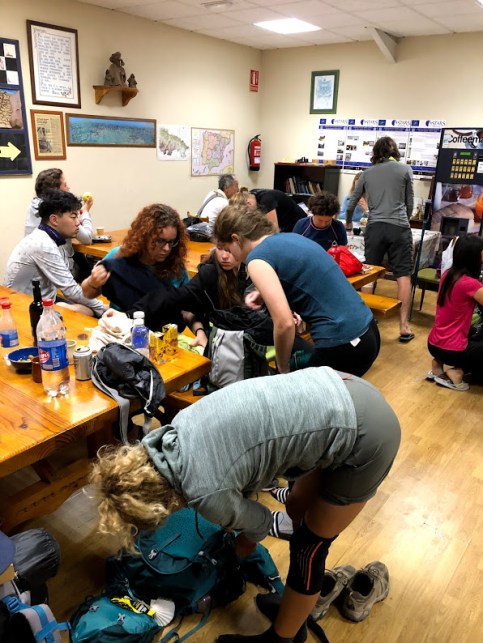
Sharing a meal in an Albergue is one of the joys of the day on the Camino 

But why go through the discomfort of sharing a stuffy dormitory with up to 90 other pilgrims, where some individuals ride roughshod over the sleeping needs of everyone else in setting their alarm clocks at 3.30 a.m and then noisily go about packing their backpack. Inevitably, there are two or three loud snorers who would keep everyone awake.

Popular Camino makes staying in an Albergue the only alternative

Sometimes there is no other choice. With more than 300,000 people now walking the Camino annually, the municipal Albergues are often the only places with beds available. Towns have had to open sports halls in the summer months to cater for the influx of pilgrims.

Such situations are real testing times for humility. What you make out of the situation in an Albergue is always a reflection of where you are at mentally.  I recall meeting a very moody and sleepy-eyed pilgrim in an Albergue last year who threatened all sorts of “warning letters to the authorities” about conditions in the Albergue. Then I noticed that her general negativity was creating an invisible wall between her and everyone else in the room.

Nothing beats the bonding spirit in an Albergue

Some pilgrims, who could easily afford better accommodation, make it a point to choose an Albergue. For, nothing beats the bonding spirit between pilgrims in an Albergue on the Camino. Meals are shared, over sometimes very intimate and emotional conversations. Blisters need to be attended to, and sometimes a doctors’ appointment has to be arranged. Impromptu singing and prayer are common on such evenings.

For low-budget pilgrims and also for those coming from countries with a poor exchange rate to the euro, the Camino would not be possible without the municipal Albergues.  The Camino is becoming more international from year to year with more South Americans and people from far-flung eastern European countries on the Path.

And, it is a joy to watch the Camino uniting people of very diverse national and cultural backgrounds. It is one of the many reasons why the Camino becomes addictive and some people walk it dozens of times.

Reino Gevers – Author, Mentor, and Consultant

https://www.reinogevers.com

                                             applepodcast         

2 Comments

Filed under Camino de Santiago, lifestyle management, Pilgrimage, psychology, spirituality, Uncategorized

Mindful walking

Najera, northwestern Spain – Preparation for a lengthy pilgrimage walk is essential.  After eight days of walking many pilgrims are arriving at the Municipal Albergue in Najera with badly blistered feet and hurting knees.


bunkbeds

Bunk beds for 90 pilgrims in the Municipal Albergue in Najera 

Most people, who walk the Camino Frances to Santiago de Compostela, start in the French town of Saint-Jean-Pied-de-Port.  It takes the hiker up a steep climb of the Pyrenees mountains to the Spanish town of Roncesvalles.  It is a good 24 kilometer or seven to nine-hour walk. Even for trained hikers, this is no mean feat.


However, if you are wearing new boots and carrying a backpack full of unnecessary clutter, your walk will soon become a chore. The Camino is not only a physical challenge but even more so an emotional challenge. Much of the first few days of walking can rekindle old stuff you thought you had dealt with years ago. It is then comforting to know that there will always be other pilgrims walking with you, going through much of the same process.

bunkbeds.2

Getting ready for the day’s walk. The hostel has to be empty by 7.30 am latest

Three parts of the Camino

Some hikers describe the first stage of the Camino as the “path of crucifixion”, the second as the transition or the walk through the “valley of death” in the heat and dust of the Meseta between Burgos and Leon.  Several guide books describe this section as boring and recommend that the hiker skip the section by taking a bus. Most people who have walked it, however, describe it as a crucial part of the Camino that they would want to have missed. A absolutely agree.

A path of rebirth

I would describe the first two sections as the mindful preparation for the last section-the “path of rebirth or resurrection”.  It is when the pilgrim has moments of absolute euphoria, gratitude, and joy. It is the feeling of accomplishment after transmuting the old stuff into revived energy.  The three parts of the Camino however, can be experienced in some form or other each day. Getting up early in the morning after a bad night’s sleep in a crowded Albergue is a challenge where the mood can be at rock bottom.  This could all change an hour later when experiencing a beautiful sunrise on a mountain top with a bird of prey circling overhead.

Having walked the Camino more than a dozen times, I decided this year to give something back in serving as a volunteer in an Albergue or pilgrims’ hostel for two weeks.  There are between 50-70 pilgrims arriving here each day. It is an enormous privilege to hear the stories of why and how they are doing the Camino. Some are doing the path the third, fourth or fifth time. Most are walking the Camino for the first time.

It is a joy to observe people from many different nationalities and cultural backgrounds bond in this shared experience of the Camino. They mostly don’t understand each other’s language. But the language of shared experience shared meals, and shared emotional ups-and-downs are universal.

Reino Gevers – Author, Mentor, and Consultant

https://www.reinogevers.com

                                             applepodcast         

Leave a comment

Filed under Camino de Santiago, lifestyle management, meditation, Pilgrimage, psychology, Uncategorized

Spiritual hot spots

Najera, Spain – The pilgrimage path or Camino de Santiago in northwestern Spain is dotted with “spiritual hot spots” where man has worshipped different deities since the earliest of times.

Different religions worshipped at the same sites

Romans built mausoleums on Celtic sites. Early Christians turned these temples into churches or chapels. According to legend, the Celts had already performed walking pilgrimages on the Camino in following the Milky Way northward. Names and religions change over time but the geographical pull of a place remains.

img_2487

The Sta. Maria de Arcos chapel near Najera, a Paleo Christian Basilica built upon a Roman mausoleum between the 5th and 6th centuries.

When the Moslems occupied most of the Iberian Peninsular they converted the churches into mosques. Later the Christians again turned the mosques into churches.

However, as humanity moves toward higher consciousness, religious belief in the form of intolerant dogma is being replaced by mystical experience. It is what many of the folk from numerous nationalities, and cultural background are seeking in the modern-day pilgrimage.

Spiritual experience versus religious dogma

Spiritual experience can only be felt. The universal intelligence or God speaks through symbols, sometimes in a message from people, we coincidentally meet.

On the Camino, wonderful sites of worship can be found in the small towns and villages. Pilgrims complain that these are often closed. There is a reason. Art thieves have in the past stolen valuable artifacts, notably „The Lamentation“ in Najera in 1913.  The 15th century was sold by Sotheby‘s for 1.46 million euros in 2008. Spanish authorities were unable to halt the auction because it was sold several times during the past century.

We only become aware of this mystical language when we remove ourselves from the bombardment of daily distractions and allow our senses to open to the magic.

Some on the Camino come just for the adventure but most of the people I’ve been talking to on the Camino during the past few days have a story. One woman told me she had come to the conclusion that there was so much more to discover than a life of silent misery.

Today I met a Paris fashion photographer who is taking a lengthy mental time-out in walking “only” a slow 10-15 km a day. In a village chapel along the way, he said he had an “experience” that could not be explained.

Reino Gevers – Author, Mentor, and Consultant

https://www.reinogevers.com

                                             applepodcast         

Leave a comment

Filed under Camino de Santiago, lifestyle management, raised consciousness, self-development, Uncategorized

Tales from a pilgrims’ hostel

An 85-year old Dutch guy arrived here at the pilgrims’ hostel in Najera, northwestern Spain, pulling a 100-kilogram cart. While all the other arriving pilgrims were walking toward Santiago, Johannes van der Pas was going the other direction back home.

Johannes celebrated his 100th day on the Camino and has become quite a celebrity. Passing motorists have been seen waving to him. Strangers are inviting him to stay overnight after he was featured on Portuguese television while on his way to the famous pilgrimage town of Fatima.

He started walking from Eindhoven, Netherlands, then stopped in Lourdes and from there walked via Santiago to Fatima.

Pilgrim-najera1

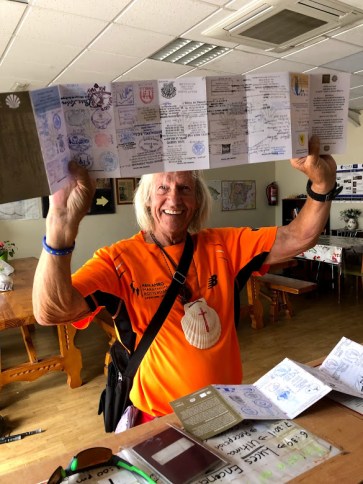
Johannes van der Pas with his credential or pilgrim’s pass displaying all the stamps from the towns he has visited along the way.

It’s a remarkable achievement for any person, but this guy is not letting the old man in and is in better physical shape than most men half his age. He has according to my calculation, so far walked 3,340 kilometers, averaging 33.4 kilometers a day.

On occasions, he has walked all night in the rain in the remote areas of France where, in contrast to Spain, there are hardly any pilgrims hostels.

Johannes is living proof that it’s possible to remain mentally and physically active up to a high age. His recipe is simply doing a good walk every day, and shakes his head at the many people starting their walk on the Camino with little training and then complaining about sore knees and feet.

It’s my fourth day serving as a voluntary hospitalero in this town. The hostel is run by the local municipality and pilgrims are just asked to provide a donation to offset electricity and water costs. Locals living along the Camino have for centuries been generous hosts to pilgrims walking to Santiago de Compostela. The marker stones with yellow arrows on the path are almost entirely put up by local volunteers, paying for them with their own money. It is therefore sad to see that some of these markers are defaced by “Killroy was bere”  ego-minded “bypassing tourists.”

We voluntary hospitaleros are being greeted here with exceptional kindness. Restaurants have refused taking money for meals. Entry to the local museum and monastery is free of charge.

On the third day, we registered 58 pilgrims including seven from South Korea, one from Taiwan, two from South Africa, two from Bulgaria, one from Hungary, one from Venezuela, three from Japan and six from the United States and Canada. Most people are from Spain, Italy, and France as this is the main vacation period in these countries.

And, just as I’m finishing the Blog for the day two women from Greenland arrive at the door, saying that they will stay for the night as they are not used to the warm temperatures.
Reino Gevers – Author, Mentor, and Consultant

https://www.reinogevers.com

                                             applepodcast         

Leave a comment

Filed under Camino de Santiago, lifestyle management, longevity, psychology, self-development, spirituality, Uncategorized

Lessons from the Camino: Winding down

Many a pilgrim doing a walk for the first time on the Camino in northwestern Spain underestimates the physical and emotional challenges.

Most hikers start on the French Route, or Camino Frances, from Saint Jean Pied Le Port, the small French town straddling the Spanish border.  It’s a steep walk up the Pyrenees mountains. For the inexperienced hiker, this in itself can be challenging.

pilgrim_najeriaBut in the last few days, summer temperatures were touching 40 degrees Celcius in much of southwestern Europe.  A walk in the midday sun can be life-threatening and some albergues, or pilgrims’ hostels, have put up signboards, warning pilgrims not to walk between 11.00 and 3 p.m.

A path of crucifixtion?

A few pilgrims in the Albergue of Najera, where I’m serving as a volunteer for the next two weeks, are arriving with blistered feet, swollen knees and other body ailments. I always tell them that this is not a path of the crucifixion and that nobody will chop their head off if they take a break, a taxi or a bus to the next destination if their body is clearly telling them: “Slow down, take a rest, go easy.”

Subtle whispers from the universe

The Camino has so many life lessons to tell the pilgrim. Walking is an ideal way of reconnecting with body, mind, and soul. In the rat-race of day-to-day distractions, we often ignore the body’s subtle whispers telling us to slow down, to recuperate and take a time-out. If we fail to listen, these whispers will get louder, and if we still fail to heed that inner voice, the body will at some point force you to stop. It’s very much the same when we reach a deadlock during a particular life situation when the universe is telling us with obstacle after obstacle to change something.

The higher perspective

Reaching a destination should not be the objective. The real miracles happen in opening the senses to the here and now while walking. This morning I took a walk with two of my fellow volunteers, Ebi from Argentina and Carmen from Spain to the next village, Azofra.

A beautiful bird of prey took flight from a tree in the vineyard nearby, circling overhead. This animal messenger from the spirit world appeared to tell us to remain focused on the task at hand and to keep the higher perspective in mind.

Reino Gevers – Author, Mentor, and Consultant

https://www.reinogevers.com

                                             applepodcast         

Leave a comment

Filed under Camino de Santiago, lifestyle management, spirituality, Uncategorized

Yielding to Nature

Our ancestors and the ancient tribes were firmly entrenched in the philosophy of the yielding to the forces of nature as opposed to the modern mindset of conquering and extracting from the earth.

img_1685

On some of my lengthy hikes on the Camino in Spain, the routes inevitably take you along busy country roads. Tons of rubbish including plastic bags, tin cans, plastic bottles and cigarette butts are carelessly thrown out of car windows by passing motorists.

It has a devastating effect on other living beings. I’ve seen cows and goats munch plastic bags and hedgehogs trapped in rubbish. More disturbingly sacred crosses and way markers are defaced by graffiti.

Much can be attributed to the disconnect of modern man to his natural surroundings. Nature is a manifestation of God and not without reason have the wise teachers of old described time spent in nature as our best healer.

Any person who has spent alone time in the African bush or hiked alone for hours in pristine nature will soon become aware of the awesome marvel of creation and the inter-connectedness of all living beings. God can be seen live working in slow motion.

Humanity will only survive when we recognize that the sacred within is also the sacred without.

For centuries Christianity has had a false understanding of man’s role in nature based on misinterpretation of the old testament of the bible in Genesis 1:28 in which man is given the cultural mandate to subdue and rule over the earth:

“And God blessed them, and God said unto them, be fruitful, and multiply, and replenish the earth, and subdue it: and have dominion over the fish of the sea, and over the fowl of the air, and over every living thing that (Heb. creepeth)  moveth upon the earth.”

Especially the translations of “subdue” and “dominion” from the Hebrew have different meanings. Rather than exploitation and domination the call to humanity by God is like that to a king to take care of the weak and poor in his kingdom. Man is called to preserve the natural beauty of the environment entrusted to him and to restore those places that have been harshly affected by force and hardness of rule.

The lost gospel of St. Thomas, that was discovered in Egypt in the 1940s, has a far more mystical interpretation of many of the biblical interpretations. Rather waiting for the Second Coming of the Christ, the lesson espoused here is all about nurturing and discovering the Christ Within−closely resembling what is described in Buddhism as discovering the Buddha Nature.

The Medieval interpretation of Nature was that of a harsh alien environment, that needed to be conquered. Paradise and a life of bliss could only be expected after death and resurrection.

In contrast the eastern Daoist tradition is all about the yielding to the laws of nature. The philosophy of the Five Elements in essence is about the right timing in accordance with the laws of nature. The harmony of objects and things in Feng Shui, the cultivation of the life-force energy of Chi in the body with nutrition, Qi Gong and Tai Chi and the ancient Book of Wisdom, the I Qing, all are built on the foundations of the Elements.

Likewise the Greek, Roman and Medieval cultures placed great emphasis on building their temples and cities in harmony with the natural environment. These cultures were still steeped in myth and legend while the modern world is dominated by the economic.

Modern man’s environment−often in an urban concrete jungle, is very much a contributing factor to the alienation from nature and the loss of soul purpose. It is beginning to change. As humanity moves to a raised consciousness we rediscover old teachings that were anything but primitive.

Reino Gevers – Author, Mentor and Consultant

https://www.reinogevers.com

      Yield_and_Overcome_Cover_for_Kindle (2)


Leave a comment

Filed under Camino de Santiago, environment, happiness, lifestyle management, plastic, psychology, raised consciousness, Uncategorized

Who are you?

Emotional and physical exhaustion is one of the scourges of the modern era. Depression is reaching almost epidemic proportions. You could very well say that the Western mind has lost its soul that has been entrapped by the temptations of immediate gratification.

We are bombarded constantly with subliminal messages that tell you: Buy this and you will be happy. Do this and you will get rich. Do this to live like a super star. Dress like this and act like that to be loved and validated by the crowd.

Along the way one of our most valuable assets – the time to be fully aware of the  moment – is getting lost. The mind is constantly occupied with either the past or the fears of the future.  In the process you forget soul purpose and who you are!

IMG_1429

I have found that walking alone in nature is a magnificent way of detoxing and training the mind by re-calibrating the senses to the world around us.  I truly believe that nature is a manifestation of God. The whisper of creation can be sensed by a bird song, the rustling of leaves in an ancient tree, or the clouds enveloping a mountain top.

Most people in today’s world however are forced to live in crowded cities that are dehumanizing in their detachment from nature. They cloud the senses with a high level of noise, pollution and bombardment of the senses. The modern human being has become so detached from his natural environment, that its causing havoc to emotional stability.

I think this is one of the reasons for the great attraction of the ancient pilgrimage route in Spain.  More and more people are becoming spiritually conscious and seeking answers. Spending weeks alone by simply walking in nature without distraction is like a detox in peeling away the layers to the heart of the true self. But it doesn’t only have to be walking.  New retreats and centers of meditation are opening everywhere as human consciousness is rising to a new level.

Old school religion has taught us to believe and to follow a certain doctrine and behavior. The new consciousness is very much an experiental spirituality in a “becoming” of the real self.

Reino Gevers – Author, Mentor and Consultant 

https://www.reinogevers.com


Leave a comment

Filed under Camino de Santiago, exercise mental health, happiness, healing nature, lifestyle management, spirituality, Uncategorized

Reconnecting with ancestral roots

Our ancestors from centuries ago might be influencing our lives in more ways than we might be aware of.

Cultures steeped in tradition and ritual, place great value on their history and ancestral roots. Much of this has been lost in the modern materialist world−which then finds an unhealthy avenue in extreme nationalism.

IMG_0757

There is a long tradition on the Camino in Spain that reminded me a lot of the Zulu culture in South Africa.

The Zulu greeting “sawbona” means “I see you” to which the fellow being greeted responds with “yebo”, or yes and I see you too.

In the rural Zululand of my childhood the conversation would then continue with strangers exchanging their names and asking each other the names of their parents and grandparents and from what village they came from so that the ancestral tree to the tribe or clan could be recognized.

The Zulus journeyed mostly on foot, and would pile stone cairns at key junctions as a mark of respect to the ancestors and asking them for a safe journey. In the Umfolozi Game Reserve in KwaZulu-Natal there is a massive stone cairn that dates back to the stone ages.

I was surprised to find this tradition also on the Camino and learned that similar rituals also exist in other cultures such as the Inuit, American Indians and Celts from which the practice probably came in Spain.

In medieval times it was common for one member of a family to walk the Camino to atone for the sins of the entire clan. The family would in return collect funds to finance the pilgrimage.

The pilgrimage began after crossing the threshold of his front door, and after being granted permission to leave by his local religious authorities. Before leaving he had attended mass where his staff and scrip were blessed by the priest.

It would be months, sometimes more than a year before he returned−if he was lucky. Many pilgrims did not survive the journey, making the ultimate sacrifice.

Along the Camino, the pilgrim would add a rock to the cairns at the wayside, saying a prayer for a member of the family going down the line of the family tree, starting with the parents, siblings, grandparents, great-grandparents, and all the other members of the clan.

Today the tradition continues and many of the cairns have rocks with prayer inscriptions for a deceased loved one, someone going through a serious illness or a special wish.

Genetic research is still a young science but some scientists believe that some of our habits, traumas, memories and survival instincts are imprinted in our genes from our ancestors. An ancestor born centuries ago could still be impacting your life. Ancestral memories could be passed on for 14 generations, according to one body of research.

We are who we are not only because of the influences from our immediate friends and the environment in which we live but it also appears, that some of our habits, fears and talents are inherited from our ancestors.

Reino Gevers – Author, Mentor and Consultant 

https://www.reinogevers.com


Leave a comment

Filed under Camino de Santiago, happiness, humanity, mental-health, psychology, raised consciousness, spirituality, Uncategorized

Go Slow To Go Far

One of the  many lessons learned walking the Camino in Spain is that you have to go slow to get far.  I must admit that I too get infected at times by the “bug” that bites many hikers on the Camino: Getting up in the early hours of the morning and racing ahead to the next town to avoid the hassle of finding no accommodation.

IMG_1014

In some of the remote towns albergues or hostels for pilgrims are rare. But on all my ten walks on the Camino, I have always found a place to stay for the night. The Spanish people are incredibly hospitable and friendly toward pilgrims walking the Camino. If worse comes to worse a sports hall or school classrooms is opened with mattresses on the floor. Villagers in the towns have even been seen offering their private bedrooms to tired pilgrims.

But the Camino is in many ways an analogy of life and you inevitably take yourself with you on a journey.  Many pilgrims take a time out from their stressed-out lives at home, and have difficulty switching to a calm, slowed-down rhythm.

And, under stress or in a hurry, you make mistakes. You go into tunnel vision and start missing way markers, making your walk that much longer than planned. You miss out seeing many of the small miracles or the messages sent by the universe on your way. You fail to pace your energy, ending up with blisters on your feet, hurt knees and back problems.

Sometimes a small talk with a villager or a word from a fellow pilgrim along the way can be an immense eye opener and blessing. I have walked several of the Camino routes more than twice and have been amazed at how much I didn’t see the first time around, and how different each Camino walk was.

Staying in the moment is one of the most difficult exercises in the hurried life of the Western mind which is preoccupied with all the fears of tomorrow and the events of the past. Will I have to sleep under the bridge? Will I be safe?  I have seen pilgrims literally fall into panic upon hearing that there was no accommodation left in the town. It is an innate fear to be in a foreign place and having no place to stay.  Others stay completely calm, trusting in the universe that a solution will always be found, laughing it off as part of the Camino experience.

I have taken this Camino experience to heart. A day can be ruined by a stressed-out, hurried mindset where one little catastrophe follows the next.  Or, you can just take one step back, concentrating on the breathing, deliberately slowing your walk by a pace or two, and then just taking it as it comes.

Reino Gevers – Author, Mentor and Consultant 

https://www.reinogevers.com


Leave a comment

Filed under Camino de Santiago, life vision, lifestyle management, Pilgrimage, spirituality, Uncategorized

Walk your path

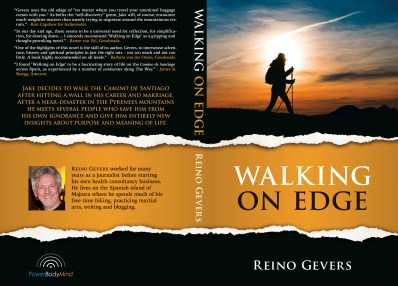
I’ve just released the second edition of my book “Walking on Edge: A Pilgrimage to Santiago”  – a novel based on firsthand conversations and insights with many fellow hikers on the Camino. For some people the Camino can be a life-changing experience – for others it is disappointing.

IMG_0156

What Camino you walk depends very much on your expectations and your frame of mind.  After months, sometimes even years, of preparation and planning, and reading some of the many books on the Camino, you are finally on the road.

If you start your walk in Saint-Jean-Pied-de-Port, in southwestern France, in the summer months from June to August you will be disappointed by the masses of people walking the Camino Frances – the most common route.

You will be staying in crowded hostels and sleeping on bunk beds. You might have to stand in a long line for a shower and have to cope with blisters and other aches and pains in your body.  You will be frightened by cyclists coming from behind you at breakneck speed, and sometimes even pushing you off the road.

The first days of walking on the Camino are a real test of mind and body. It is also called the path of crucifixion. A fellow pilgrim once said to me: “Be humble on the path, or the path with humble you.”

On one of my walks I met a very frustrated pilgrim, who had refused advice from fellow walkers, to take it slow during the first days. He was going on and on about his disappointment, criticizing the “boring” landscape of the Camino and lamenting why he had not chosen a holiday on the Canary islands instead.  A lot of people are obviously walking the same route and coming home with very different perceptions and experiences, judging by the comments in many of the social media forums.

My advice is: Don’t be duped by other people’s opinions and what you read. If you liberate your mind from preconceived images and expectations, you will have your very own Camino experience – that can be magical in many ways.

Call it the the Universe, God or just the “magic of the path” has been life-transforming for me and so many people I’ve met on the Camino.  If you walk alone and confront those emotional demons along the way, you will make extraordinary discoveries both within and without. The Camino is certainly not everyone’s cup-of-tea. It can be a hard, uncomfortable, excruciating slog in mud, rain and heat.

At the same time the Camino is exceptionally rewarding on many subtle levels that sometimes only make themselves felt, months after the pilgrimage. The walk is an analogy of life as you deal with the daily ups-and-downs.

Reino Gevers – Mentor and Author – Your Health Matters

 “Walking on Edge – A Pilgrimage to Santiago” available both in Kindle and paperback.

http://www.reinogevers.com


Leave a comment

Filed under Camino de Santiago, spirituality, Uncategorized