Tag Archives: reading

How We Stopped Reading and Started Believing Slogans

With each passing year, fewer people finish reading a book, with public discourse getting s a little dumber. This is not a coincidence. The two trends are moving in lockstep because they’re the same trend. Thinking in complexities comes from sustained reading. What’s replacing it is faster, louder, and easier to produce than to challenge. The decline of reading appears to be ushering in a less rational, less analytical, less sophisticated mode of thought, and it’s threatening democracy.

Reading long-form prose trains the mind to hold several ideas in tension at once, to follow an argument through its qualifications and counterpoints, to sit with ambiguity rather than resolve it prematurely. A dense paragraph forces you to track a claim across several clauses, weigh a caveat against the point it qualifies, and keep revising your understanding as new information arrives.

Take that engagement away, and the muscle in the brain doesn’t just go unused. It starts working against you. Attention spans shorten. Patience for a slow-building argument gives way to a need for the payoff up front. Ambiguity starts to register as failure rather than as a feature of anything worth understanding properly. And because nuanced thinking is effortful, its absence leaves a preference for whatever requires the least effort. It is the argument that confirms what you already believed, the explanation that fits in a headline. The mind doesn’t stay idle in the space reading used to occupy. It fills that space with something more crude.

Simplicity and emotional charge are rewarded

Algorithms accelerate the drift, rewarding simplicity, outrage, and emotional charge over complexity, nuance, and rigour. Ideas that fit folk theories of politics — all leaders are equally corrupt, immigrants steal jobs, every policy problem has an easy, commonsense fix — spread further than the findings of subject-matter experts ever will.

Joshua Meyrowitz explored this territory in No Sense of Place, predicting that the decline of print and the rise of electronic media would eventually push people toward populist leaders. “You name an enemy and you polarize the public,” he said. “You don’t allow for nuance, because nuance is just a confusion when you’re in a power struggle.”

That power struggle is where the erosion stops being an abstract concern about attention spans and becomes a question about how democracy functions. Elections depend on voters weighing trade-offs. A policy might help one group while burdening another, that a leader’s strengths come bundled with real weaknesses, and that most hard problems don’t have a clean fix.

Surrendering the mind to sloganeering

Slogans work by stripping all of that away. “Drain the swamp” or “take back control” asks nothing of the listener except agreement. A white paper on institutional reform asks for time, patience, and tolerance for uncertainty, which most people no longer have. When the electorate’s capacity for the second kind of thinking shrinks, the first kind isn’t just more appealing — it becomes the only kind that can win.

The result is a selection pressure on political leadership itself. Candidates who traffic in complexity and qualification lose ground to those who traffic in certainty and enemies, not because voters are unintelligent, but because the cognitive infrastructure of nuance has been allowed to run down. Over enough election cycles, that pressure doesn’t just change who wins. It changes what kind of person even attempts to run, and what kind of promises get made. A politics built on slogans breeds politicians who speak only in them.

Reino Gevers – Host of the LivingToBe podcast

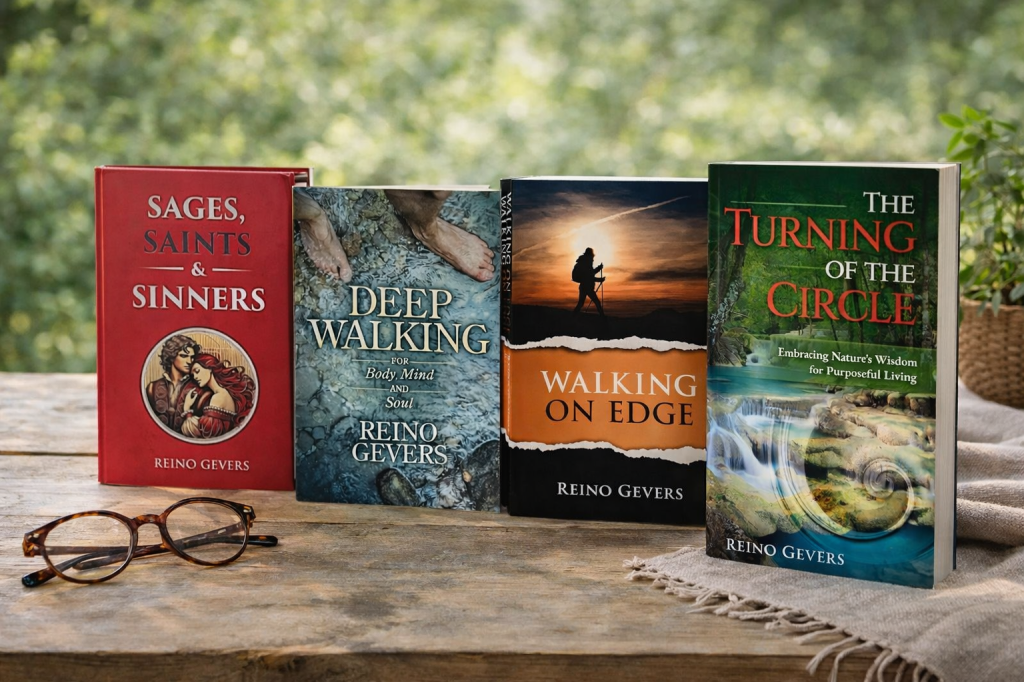
P.S: If you enjoyed this article, you might be interested in reading one of my four books, available where all good books are sold.

Leave a comment

Filed under happiness, meditation, mental health

What We Lose When We Stop Reading

I recently came across a thought-provoking article in The Atlantic that stopped me in my tracks. It reported that, in 2022, fewer than half of all adults in the United States read a single book of any kind. Even more striking, the proportion of Americans who read for pleasure on any given day has fallen dramatically—from 28 per cent in 2004 to just 16 per cent in 2023.

These figures tell a story that extends far beyond changing reading habits. It invites the question: What happens to a society when it loses the habit of sustained attention, deep reflection, and the companionship of books?

The decline in reading cuts across every age group, gender, and education level. The result: basic reading skills are eroding. In an era of information overload, short text messages and textual fragments, our capacity for sustained attention — the kind longer, complex works demand — is shrinking.

The article quotes Maryanne Wolf, a cognitive neuroscientist at UCLA, who argues that people aren’t forgetting how to decode words. What they’re losing are the higher-order skills of comprehension and synthesis — the ability to hold a complicated argument in mind long enough to weigh it.

Why reading matters

This isn’t just about nostalgia. Deep reading trains a particular kind of mind. Following an argument across three hundred pages — tracking its turns, holding contradictions in tension, revising your judgement as new evidence appears — is a rehearsal for democratic life itself. It’s the same muscle you need to weigh competing claims in an election, or sit with a problem that has no easy answer. Skimming a headline or a ten-second video trains the opposite reflex: snap judgement, then move on. A society that reads less doesn’t just know less. It loses practice in the patient, the uncomfortable work of changing its mind.

Reading also builds something harder to measure: the habit of inhabiting another consciousness. A good novel forces you to live inside a character’s way of thinking for hours at a stretch — to feel why they act as they do, even when you’d choose differently. That’s a rehearsal for empathy that no summary or excerpt can substitute for. Lose the habit, and you don’t just lose stories. You lose the practice in imagining anyone unlike yourself.

Are we, then, entering a post-literate society — one growing less able to grasp complex issues, and, in plain language, more susceptible to loud, brash voices peddling simple answers to complicated problems?

Is a free, democratic society itself at risk when a growing number of people become functionally illiterate, or simply hand the work of thinking in complexity over to someone else?

Photo by Nitin Arya on Pexels.com

Literacy forms the foundation of a free society

For most of human history, literacy belonged to a small educated elite that ruled over the masses. The ability to read and write opened up a whole world to millions and became the foundation of a free society. It changed consciousness. It changed the political order.

“More than any other single invention, writing has transformed human consciousness,” wrote Walter J. Ong, the historian and Jesuit priest. Neil Postman went further, arguing that reading and writing were the preconditions for philosophy, modern science, history, and academic life as we know them.

I’ve been fascinated by books since childhood. I grew up in South Africa in the early 1960s, in a country without television, where a trip to the cinema was a rare event. In that rigid, joyless world inhabited by Calvinist doctrine, I found refuge in books.

They became my escape, carrying me far beyond the streets of my hometown in rural KwaZulu-Natal. I must have read King Solomon’s Mines half a dozen times, wandering in imagination through the vast African interior.

Later, it was the classics that held me — thanks to our English teacher, Andy Towert. He had a gift for breathing life into prescribed texts and for setting essay questions that were anything but safe. His entrance into the classroom was a performance in itself: he’d toss his bag into the air, sending it into a perfect somersault before it landed square on the desk. From that moment, he had our full attention.

Towert didn’t just teach literature — he ignited it. He made us believe that books weren’t relics of the past but living voices, speaking directly into our own lives. Those hours were never mere diversions. They were seeds of a lifelong calling, planted quietly within the narrow conformities of a small-town childhood.

Some books have changed my life outright. Paulo Coelho’s The Pilgrimage sent me on my first walk to Santiago and more than a dozen pilgrimages since. Eckhart Tolle’s A New Earth and John O’Donohue’s Anam Cara reshaped how I think about lived, experiential spirituality.

Early reading and teachers like Andy Towert planted the seeds of my own writing life. Having just finished the manuscript of my fifth book, I can’t imagine stopping. While writing my novel Sages, Saints and Sinners, I became so immersed in the two central characters and their love story that I fell for them myself — and was almost sorry to have to bring their story to an end.

So pick up a book. I did, once, in a small town with nothing else to offer — and it changed everything.

Reino Gevers – Host of the LivingToBe podcast

P.S: If you enjoyed this article you might be interested in reading one of my four books, available where all good books are sold.

Leave a comment

Filed under happiness, humanity, mental health, psychology, purpose

Sages, Saints and Sinners

In a life-threatening global crisis, individuals are compelled to either dig deep into their inner light or succumb to their darkest shadows. This is the central theme of my upcoming book, “Sages, Saints, and Sinners,” set against the harrowing backdrop of the Black Plague, which nearly decimated the entire population of Europe in the 14th century.

Here are two contrasting excerpts:

“Amidst the stark contrast of tragedy, mortality, and chaos, beauty revealed itself in heightened clarity and depth.

A keen awareness of life’s fleeting nature permeated his being, igniting an inner yearning to embrace existence with unwavering intensity.

 He savored the earth’s pulsating rhythm beneath his feet, marveling at the majestic dance of birds of prey overhead, the delicate shimmer of sunlight on swaying blades of grass, and the harmonious symphony of nature’s myriad voices. The beauty of creation eluded possession, transcending mere ownership to encompass a profound perspective that infused every facet of existence.”

Photo by Samrat Maharjan on Pexels.com

…”Nuns and monks offered simple herbal remedies and prayers, reading from the sacraments or taking confessions from the dying.

Simple pallets with straw served as beds with local volunteers supplying food and taking away the bodies of the dead in donkey carts to be buried in a cemetery nearby.

Isabel frequently conferred with Brother Thomas on researching the possible cause of the pestilence, refusing to believe that it was an act of God.

What better place to be than the monastery where some of Europe’s best theologians, astronomers, mathematicians, and doctors were at work.

“God has blessed us with intellect and a mind to ponder. Do we not ascend through every trial, gathering wisdom along the journey?” remarked Brother Thomas.

I’ve been working on this book project for the past two years and I’m now working on the final draft. The message I want to put out there with this novel is that even in dire situations of hopelessness, life is transitory.

It is in times of difficulty, in the pain, in the suffering that consciousness can either be elevated to its highest levels or succumb to the lowest vibrational levels of toxic emotions marked by procrastination, fear, and rage.

Reino Gevers – Author – Mentor – Speaker

P.S. I’m excited to announce the release of my latest book, “The Turning of the Circle: Embracing Nature’s Wisdom for Purposeful Living.” If you enjoy it, you might also be interested in my previous works, “Deep Walking for Body, Mind and Soul” and “Walking on Edge: A Pilgrimage to Santiago.” You can find all of these titles at reputable bookstores near you.

Leave a comment

Filed under spirituality