In a recent conversation, someone asked about the essence of “living your authenticity,” the central theme of my podcast and YouTube channel. While it typically entails remaining faithful to one’s core values and identity, its scope is more intricate.
How can you discern when you’re not living authentically?
Embarking on the journey of fulfilling your destiny and purpose tends to engender a sense of natural alignment, accompanied by feelings of flow, joy, and passion. You will be operating on a higher vibrational frequency, naturally radiating an allure in your relationships and interactions.
Choosing happiness and masterminding your thoughts is a conscious choice.
In a conversation with the Pharisees, the Jewish clergymen of the time, Jesus admonishes them for seeking the kingdom of heaven in the external world, telling them: “Neither shall they say, Lo here! or, lo there! for, behold, the kingdom of God is within you.” (Luke 17:21)
Living your authenticity is not a destination or procrastinating in some utopia.
The whole purpose of life is to keep on growing and elevating your consciousness. The activities that you pursue with a passion and where you stay in the flow will ultimately shape you into the person you are destined to be.
Living authentically does not mean you won’t have setbacks but how fast you can bounce back into the flow after the experience of loss, pain, or shame. It is the courage to stand up for what you believe in and to pursue your goals, even in the face of adversity especially if it gets difficult or you are unpopular.
You might lose friends, family members, and what you believed was your support network. But very often those people closest to you are those that pull you back to their low vibrational field because they can’t bear one of their “tribal members” pursuing their dream. It would, in their mind, expose them as weak and a failure.
Most unhappiness and much of the depression epidemic we are seeing is when there is addiction to a false identity that feeds on external validation.
Especially the passive consumption of mass media is designed to make you unhappy. Their whole purpose is to generate profit for someone else, and they can literally suck out your lifeblood if you allow their messaging to shape an identity that is far removed from authentic soul purpose. You become a mere consumer instead of a creative shaper of your destiny.
If you are addicted to a mindset that is fixated on external gratification and where you are dependent on flaunting your status and possessions you will fall into a spiral of unhappiness. For there will always be someone more successful, younger, more beautiful, more famous, and happier than you are.
It is the reason why lottery winners end up bankrupt or commit suicide. Or film or sports stars at the height of their success fall prey to substance abuse, as they desperately try to avoid an underlying emptiness.
Cultivating a sense of self-love, gratitude, and awareness is key.
Your body will at an early stage send warning signals if you need to change something, like feeling stress, anxiety, and sleeplessness. Your gut feeling will tell you that something needs to change. The high-value man or woman you meet might show all the right credentials for a good partnership but something inside tells you that he/she is just not the right fit or that something is wrong.
You might be doing something where you consistently have to compromise your core values, beliefs, and feelings. When external voices have led you astray on the wrong path you will consistently face obstacles, setbacks, and disappointment. When you are on the right path you feel instinctively that wind in the sails where the universe has your back, and everything falls into place like meeting the right people at the right time.
You might just be going through the motions without feeling any sense of passion or purpose. You feel like you’re wearing a mask and pretending to be someone you are not. You might want to drown that underlying growing feeling of unhappiness by accumulating more and more things with the novelty wearing off after only a few minutes.
Experiencing a profound “flat-on-the-ground” moment can often serve as the catalyst for seeking a deeper reconnection with the essence of existence. Authenticity and true meaning come into focus when you realize that your purpose is intertwined with the universal fabric of life and its inherent wholeness.
Following the estrangement from nature, humanity faces the formidable task of recognizing this avenue of reconnection through an experiential spirituality that transcends the confines of religious dogma, belief systems, and political or ideological barriers.
Reino Gevers – Author – Mentor – Speaker
P.S. I’m excited to announce the release of my latest book, “The Turning of the Circle: Embracing Nature’s Wisdom for Purposeful Living.” If you enjoy it, you might also be interested in my previous works, “Deep Walking for Body, Mind and Soul” and “Walking on Edge: A Pilgrimage to Santiago.” You can find all of these titles at reputable bookstores near you.
“Democracy is not a spectator sport, it’s a participatory event. If we don’t participate in it, it ceases to be a democracy.” – Michael Moore
Envision yourself living in a country where even the mildest critique of the ruler could land you behind bars or strip you of your livelihood. The airwaves echo incessant hymns of praise for the leader, while simultaneously stoking hate towards both real and imagined adversaries. Meanwhile, your son lives in constant fear, knowing he could be conscripted at any moment into a futile war.
This is a grim reality in Russia and a growing number of countries, casting a shadow over the lives of its citizens. Alarmingly, this pattern could potentially spread to numerous democratic nations where generations have relished unparalleled freedoms, blissfully unaware of the true implications of authoritarian rule and its pervasive influence on society.
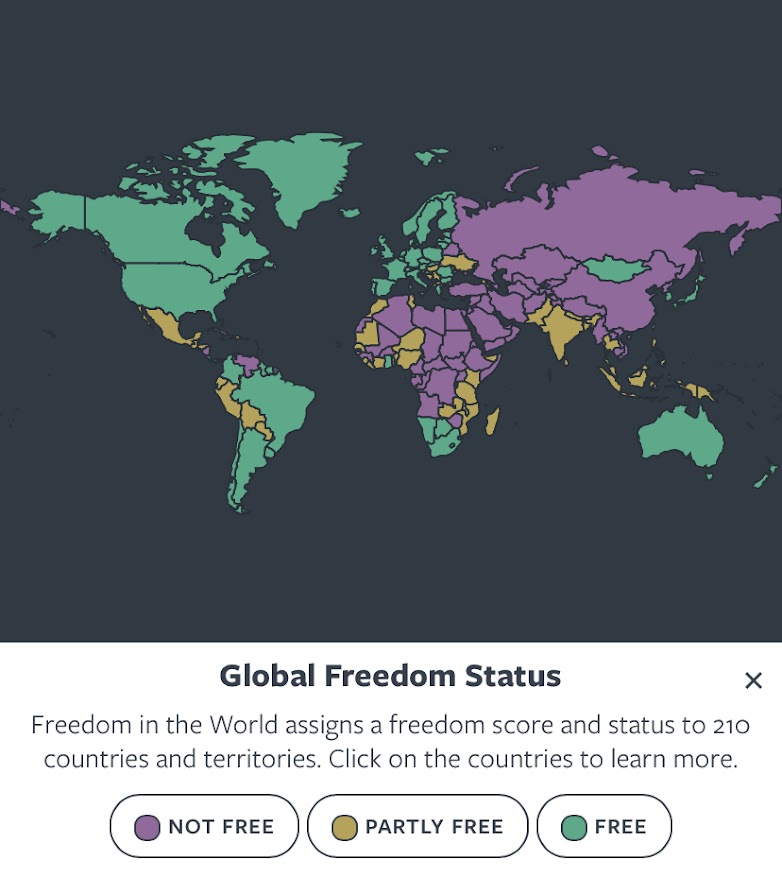
Across the globe, we witness a gradual erosion of fundamental liberties and democratic principles. Even within Western democracies long considered bastions of stability, nefarious political factions are becoming mainstream, posing a major threat to the established order
Democratic backsliding across the globe
The Democracy Index for 2019 found that democratic backsliding across the world has led to the worst score since the index was first produced in 2006, with only 5.7 percent of the global population living in what could be considered a “full democracy.”
Far-right parties bent on eroding democratic checks and balances
A Berlin-based leading Civil liberties network has warned that the rule of law is declining across the European Union as far-right parties continue to weaken legal and democratic checks and balances. Liberties in entrenched democracies such as Sweden and Italy are in a gradual process of retreat and risk becoming systematic, according to the 2024 Liberties Rule of Law Report.
The U.S. presidential elections this year are bearing up to become a real test in democracy with a significant portion of election denialism having taken hold among a large section of voters. Donald Trump’s claim that the last election was stolen has led to a wholesale attack on the entire democratic election process.
In the past, the United States has relied on state and local election officials, regardless of party, to count votes fairly and to accurately report results—but that can no longer be taken for granted, according to a detailed report in The Atlantic.
The rightwing Heritage Foundation has drawn up detailed plans to purge government agencies and to replace non-partisan civil servants with Trump loyalists if they win the 2024 election. Agencies and offices responsible for enforcing civil rights laws are to be replaced with right-wing ideologues throughout the federal government, making their agenda on women’s and LGBQT rights permanent.
Democracy and civil liberties take many decades to be entrenched in society while it takes only one government to dismantle everything. Freedom of the press can be stifled overnight, opposition parties banned or intimidated, and judges and civil service members replaced with regime-friendly acolytes.
The frightening scenario is that the process takes place gradually and incrementally with an electorate sleepwalking into authoritarianism.
Recent examples where this has happened are Turkey, Russia, Hungary, and Poland with ominous signs that things might be going the same way in the United States. In Poland, the tide was turned with the election of a new coalition government.
However, it might take a generation to rebuild the Polish judiciary and civil service into neutral bodies after the previous right-wing government had reshaped them into partisan instruments over eight years. The first priority was “to turn off the factory of hate,” said the new head of Poland’s highly influential public television network TVP, Tomasz Sygut, replacing party political propagandists with real journalists. Two of the main TVP channels were abruptly taken off the air by new managers. The channels had openly campaigned for the previous right-wing government and churned out hate toward migrants, the European Union, Germany, political opponents, LGBTQ people, and minorities.
We need only to look at history to understand how quickly basic freedoms can be usurped when a society fails to heed the warning signs. Adolf Hitler’s ultimate plan to extinguish the Jewish population with a German Reich controlling all of Europe was clearly outlined in his 1925 autobiographical manifesto “Mein Kampf”, compounding existing beliefs, fears, and xenophobia.
When opinion becomes an entrenched belief when the mind refuses to accept an alternative idea or reality, and people with other viewpoints are dehumanized it is but a short road to authoritarianism.
Hitler’s explicit racial theories were openly portrayed in “Mein Kampf” and in his speeches before coming to power: Jews, Slavs, and other non-Aryan groups were described as subhuman and deserving of extermination or subjugation. His vision for a racially pure society involved the systematic elimination of “undesirable” populations that eventually culminated in the Holocaust. People in the mid-1920s failed to fully comprehend Hitler’s intentions for territorial expansion (Lebensraum) and the establishment of a racially pure Aryan state.
The suppression of dissent, the elimination of political opposition, and the manipulation of propaganda to indoctrinate the German population with Nazi ideology was introduced gradually. The policy of appeasement with influential groups of Nazi sympathizers in the United States, Britain, and other countries, eventually paved the way for one of the darkest periods in human history.
Currently, the global battle between authoritarian dictatorship and democracy is symbolized by Ukraine defending itself against Russia determined to destroy the country as a nation-state and to integrate it into a new authoritarian Russian empire with “Tsar” Vladimir Putin having complete control.
The Russian narrative is revealing itself as very effective in falsifying history by arguing that Ukraine was always part of Russia. Ukraine has a long cultural history and was forcibly integrated into the Soviet Union by Stalin. Russia’s distortion of history is finding track, especially among right-wing parties who see the dictator Putin as a defender against the “immorality” of Western liberalism.
Authoritarianism goes against all human dignity and essentially gives power to a single ruler or small clique that inevitably ends up enriching itself at a terrible cost to the majority of the population. It is a one-way street where everyone loses.
Democracy and basic freedom are by far the best instruments for human creativity and innovation. It is not something you believe or accept unconditionally. It demands constant action, participation, innovation, and adaptation to changing circumstances.
“The only sure bulwark of continuing liberty is a government strong enough to protect the interests of the people, and a people strong enough and well enough informed to maintain its sovereign control over the government.” – Franklin D. Roosevelt
Reino Gevers – Author – Mentor – Speaker
P.S. I’m excited to announce the release of my latest book, “The Turning of the Circle: Embracing Nature’s Wisdom for Purposeful Living.” If you enjoy it, you might also be interested in my previous works, “Deep Walking for Body, Mind and Soul” and “Walking on Edge: A Pilgrimage to Santiago.” You can find all of these titles at reputable bookstores near you.
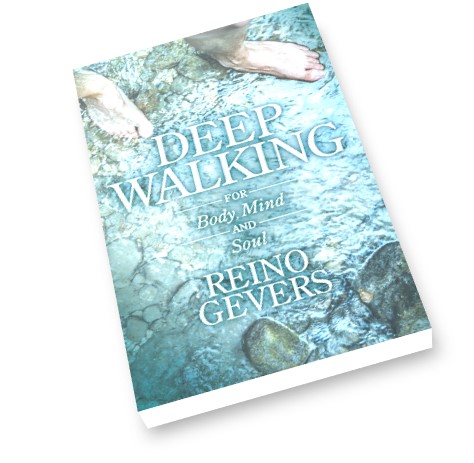
“Listen to the wind, it talks. Listen to the silence, it speaks. Listen to your heart, it knows.” – Ojibwe Prayer
Acquired knowledge and intelligence are often confused with wisdom in our digital age where we have a world of information at our fingertips while the deeper understanding and insight into life’s mysteries appears to be on the wane.
The ancient Mystics, notably the 13th-century Dominican monk Meister Eckart, understood true wisdom as the intimate connection and surrender to the divine will.
Eckart’s idea was that of a “divine birth” within the soul, where a transformative experience leads to a profound shift in consciousness.
“In this divine birth, I find that God and I are the same: I am what I am and what I shall remain, now and forever. I am carried above was the highest angels. I neither increase nor decrease, for in this birth I have become the motionless cause of all that moves. I have won back what has always been mine. Here, in my own soul, the greatest of all miracles has taken place-God has returned to God!
The sages and Mystics were well aware of the limitations of intellectual thought and knowledge. The accumulation of information, facts, theories, and concepts on the cognitive level were deemed worthless if they were not connected to wise decision-making.
Intelligence, especially on the part of egocentric politicians, scientists, and business leaders, has in the past caused havoc to humanity and become even more topical in an age where spreading falsehoods and toxic emotions to millions on a global level has become the norm.
Millions of people are being spoonfed with external beliefs, concepts, and ideas that ultimately are far removed from authentic soul purpose, finding themselves digging deeper and deeper into the rabbit hole of falsehoods and illusion.
Wisdom meanwhile encompasses a broader understanding of human nature, ethics, and the interconnectedness of the world by letting go of “ego” desires and attachments, especially of fixed beliefs and concepts that are closely intertwined with personality and ego.
The misunderstanding of Karma
Wisdom is an alignment with the cosmic laws and a greater whole that governs all existence. In this context the concept of karma or the law of attraction is often misunderstood as a predestined inevitability, yet with the growth of wisdom comes the growth of awareness.
It is inseparable from such values as compassion, empathy, and unconditional love. Mystic teachers emphasize the importance of cultivating these qualities as essential aspects of spiritual growth, enlightenment, and ultimately fulfilling life’s purpose.
Karma is the result of habits, actions, and choices made. We have been given the power of choice by the divine. If you extract yourself from the addiction of blaming external circumstances you become the creator and master of your destiny.
“Life is a meteor Let your eyes roam Heaven is beautiful It’s almost like home Children! get ready It’s time to come home”
(Paul Simon Track Seven on Seven Psalms)
Reino Gevers – Author – Mentor – Speaker
P.S. I’m excited to announce the release of my latest book, “The Turning of the Circle: Embracing Nature’s Wisdom for Purposeful Living.” If you enjoy it, you might also be interested in my previous works, “Deep Walking for Body, Mind and Soul” and “Walking on Edge: A Pilgrimage to Santiago.” You can find all of these titles at reputable bookstores near you.
The average person spends a large portion of their life daydreaming, problem-solving, planning, worrying, and mulling over the past and the future, caught in the maelstrom of between 50,000 and 70,000 thoughts per day.
A large part of these thoughts would be influenced by a spectrum of emotions that have a major impact on your physical and mental well-being.
Numerous studies reveal that positive emotions such as happiness, gratitude, and love have been associated with a stronger immune system, while negative emotions like sadness or loneliness may weaken it, making you more susceptible to infections and illnesses.
Emotions impact your physical and mental well-being
Toxic emotions such as anger, anxiety, and fear are known to trigger stress hormones responsible for the fight, flight, and freeze response in the body. Prolonged stress can cause problems such as cardiovascular issues, a weakened immune system, digestive problems, muscle tension, and metabolic diseases.
Your business success, your relationships, your partnership, and basically your happiness are linked by how well you have your emotions under control, and how well you understand your own emotional response mechanism.
Doing the self-work and understanding your own emotions is key
Developing emotional awareness, and understanding your emotions is therefore key to leading a beautiful life.
This week I interviewed on my podcast Living to BE , a Sensory Perception Analyst and Expert in her field, Kim Korte. I would highly recommend you listen to the valuable advice she gives on finding a good emotional balance. You can also watch it on my youtube channel. Some of the highlights of our conversation:
Finding the right balance in your emotional response
Training your mind for greater emotional resilience
Self-awareness on the different emotional nuances
Reino Gevers – Author – Mentor – Speaker
P.S. I’m excited to announce the release of my latest book, “The Turning of the Circle: Embracing Nature’s Wisdom for Purposeful Living.” If you enjoy it, you might also be interested in my previous works, “Deep Walking for Body, Mind and Soul” and “Walking on Edge: A Pilgrimage to Santiago.” You can find all of these titles at reputable bookstores near you.
“Pity the nation whose people are sheep, and whose shepherds mislead them. Pity the nation whose leaders are liars, whose sages are silenced, and whose bigots haunt the airwaves…” – Lawrence Ferlinghetti –
Voters in more than 60 countries are going to the polls this year, as the ominous tide of extremism gains momentum globally, fostering a toxic atmosphere of xenophobia, fear, and division, and undermining basic democratic principles.
The central African country of Rwanda serves as an extreme example of what is possible when extremism captures the minds of an entire nation. About one million people of the Tutsi minority and Hutu moderates were slaughtered in the genocide in April 1994.
In an unprecedented wild frenzy of killings, people grabbed machetes, clubs, firearms, and other crude weapons turning on neighbors, colleagues, and even family members. Many of the key perpetrators were well-educated, having studied at elite Western universities.
The role of mass media in a genocide
Weeks before the genocide radio stations and media outlets stepped up their hate speech and then turned to incitement of direct violence against the Tutsi population, encouraging ordinary citizens to take up arms and participate in the killings.
If you think this is not possible in modern Western societies, think again. Germany was a democratic country in the 1920s with a well-educated middle class until the Nazis seized control. Yugoslavia descended into a genocidal civil war in the 1990s.
When the dark shadows of the collective subconscious are captured, anything is possible. The Swiss psychiatrist Carl Gustav Jung warned that nothing is more dangerous than a psychic epidemic fanned by toxic emotions.
A simple but effective message of hate and fear
We are seeing much of the same narrative toward immigrants and refugees in the United States, Europe, and other countries. The message is simple but highly effective: Illegal immigrants are swamping our society, coming to take your job, and ramping up crime. Dysfunctional behavior by an individual or a crime committed by an individual is boxed into a behavior pattern of a certain group or minority.
Extremist fringe groups riding the wave of xenophobia, fear, and anxiety have become mainstream in formerly tolerant countries such as the Netherlands, Italy, Sweden, Britain, and Germany. The conservative Republican party in the United States has basically been hijacked by MAGA Trump extremists.
The real facts on immigration
Few media outlets take the trouble to look at the real facts in the hysterical debate on immigration, refugees, and undocumented immigrants and to expose the lies of the demagogues.
Despite the media and political narrative in the United States crime among undocumented immigrants is much lower than in the native population, according to several studies, notably in the U.S. state of Texas.
What is true in the United States also applies to many European countries. Crime among foreign immigrants or refugees is much lower than in the native population. This is because the consequences such as deportation are much harsher and immigrant communities normally have a healthy community network.
A study published in the Journal of Ethnicity in Criminal Justice in 2018 even found that undocumented immigration was associated with decreased violent crime rates.
The mortal fear that societies will be swamped by foreigners also needs to be put into perspective. As of 2021, the 10.5 million unauthorized immigrants in the United States represented only about three percent of the total U.S. population and 22 percent of the foreign-born population. These percentages were among the lowest since the 1990s, according to the Pew Research Center.
In Europe, the estimates indicate that there were around 3.9 to 4.8 million irregular migrants living in the European Union as of 2017 with a total population of around 512 million. This equals only about 0.76 to 0.94 percent of the total population.
If we compare Jordan’s population of around ten million people the proportion of Syrian refugees alone is about 6.5 per cent. Lebanon’s population of around six million people hosts over 1.5 million Syrian refugees.
Despite language and cultural differences more than half of the Syrian refugees who came to Germany six years ago have a job, two-thirds of them work full-time and 70 percent of them have a qualified job.
Nearly half of the people currently receiving social welfare are foreigners in Germany but this has to be put into perspective when you consider that most of them are people who fled Ukraine. It is much the same in the UK and other Western European countries bearing the brunt of providing food and shelter for people who fled Ukraine after the Russian invasion in 2022.
Why are people migrating from their home countries?
The debate on immigration is missing the key aspects of why people are leaving their home countries. If you or your family are threatened with persecution by an authoritarian regime, or your children have no food to eat, you will do everything to save them from starvation or death.
Millions of people will continue to leave their home countries if the socio-economic conditions in these countries are not addressed, especially if a growing number of autocrats and dictators in these countries live in luxury while their populations starve. With the impact of climate change, especially affecting poorer countries severe droughts, floods, and other extreme weather events are exacerbating the situation.
On the positive side migrants often bring valuable skills, talents, and expertise that benefit the economy, leading to higher productivity and competitiveness. Cultural exchange also fosters creativity, cross-cultural understanding, tolerance, and appreciation of diversity as a principle of creation.
Racism, hate and xenophobia goes against the very principle of creation based on diversity, adaptation to change, creativity and evolution of conciousness. It is the very opposite of our ultimate purpose on earth – spreading kindness, love and compassion.
Immigrants are often highly motivated and entrepreneurial, leading to the creation of new businesses, industries, and jobs. Several studies currently point to the generally growth-promoting effects of migration on international trade and investment.
As Lawrence Ferlinghetti so succinctly puts it: “Pity the nation that knows no other language but its own and no other culture but its own. Pity the nation whose breath is money and sleeps the sleep of the too-well-fed. Pity the nation – oh, pity the people who allow their rights to erode.”
Reino Gevers – Author – Mentor – Speaker
P.S. I’m excited to announce the release of my latest book, “The Turning of the Circle: Embracing Nature’s Wisdom for Purposeful Living.” If you enjoy it, you might also be interested in my previous works, “Deep Walking for Body, Mind and Soul” and “Walking on Edge: A Pilgrimage to Santiago.” You can find all of these titles at reputable bookstores near you.
Humans thrive on social connections, as evidenced by research from the American Medical Association (AMA), which underscores the profound impact that a healthy community has on both physical and mental well-being.
Loneliness and isolation have reached epidemic levels in most Western countries, emerging as significant public health issues. Highlighting the severity of this problem, a U.S. Surgeon General advisory equates social connection with fundamental necessities like food and water in terms of its importance for long-term survival.
“We all need our time away for rejuvenation and reflection,” says Dr. Frank Clark, an associate clinical professor at the University of South Carolina School of Medicine-Greenville, “but social isolation is a form of solitude that is unhealthy and can occur due to multitude of reasons.”
Causes of social isolation could be the loss of friends or a partner due to death, divorce, or separation. An illness could make social connections difficult to maintain, but other factors such as a caregiver’s responsibility, a traumatic event, or life changes such as the loss of a job or retirement could all play a role.
Researchers who examined longevity in the Five Blue zones that included Sardinia, Italy; the Greek island of Ikaria; Loma Linda, California; Nicoya Peninsula, Costa Rica and Okinawa, Japan, found that social interconnectedness played a key role in a healthy lifestyle. It can literally add decades to your life.
Social connections slow cognitive decline
Keeping up social connections as people get older helps to maintain thinking skills and slow cognitive decline. “It’s not uncommon for our social networks to shrink as we get older,” says Marilyn Albert, chairwoman of the Global Council on Brain Health.
Maintaining social bonds and having a sense of purpose have been identified by researchers in the Blue Zones Project as a critical element for longevity.
Here are some common practices observed in Blue Zones that help strengthen social ties:
Strong family bonds: Families tend to stay close-knit across generations. Elders are respected and often live with or near their extended family members. Regular family gatherings and celebrations are common, fostering a sense of belonging and support.
Active social lives: People in Blue Zones often engage in regular social activities with friends and neighbors. This can include communal meals, gatherings, festivals, and religious or cultural events.
Collaborative work and projects: Communities in Blue Zones often come together to work on shared projects or goals. Whether it’s farming cooperatives, community gardens, or other collaborative efforts.
Cultural traditions: Many Blue Zones have strong cultural traditions that emphasize social connections. This can include practices like storytelling, music, dance, and rituals that bring people together and reinforce community ties.
Support networks: Blue Zones tend to have strong support networks built on reciprocity and mutual assistance. People help each other in times of need, whether it’s through informal networks of friends and neighbors or more formal community organizations.
While rural settings often have characteristics conducive to strong community ties, the lifestyle factors observed in Blue Zone were not exclusively rural. The key lies in the cultural and social practices that promote longevity and well-being, regardless of whether they’re found in rural or urban environments.
Reconnecting with others after a period of social isolation can be challenging but is certainly possible. Start by reaching out to a close friend or family member for example with a simple text or phone call to catch up.
Consider joining groups, a religious community, or clubs that align with your interests or hobbies. This could be a book club, hiking group, cooking class, or volunteer organization.
Keep an eye out for local community events such as festivals, workshops, or meetups. These events offer opportunities to meet new people and engage with your community.
If you’re struggling with specific challenges such as mental health issues, addiction, or grief, consider attending support groups where you can connect with others who are going through similar experiences.
When interacting with others, practice active listening by showing genuine interest in what they have to say. Ask questions, offer support, and show empathy to deepen connections.
Cultivating a sincere interest in others not only enriches your relationships but also enhances your own appeal and magnetism. Developing and honing your social skills is essential for experiencing a fulfilling and rewarding life.
Reino Gevers – Author – Mentor – Speaker
P.S. I recently had a great chat on the fitforjoy podcast with Valeria Koopman on Living a Beautiful Life. If you found this Blog an interesting read you might also enjoy my latest book, “The Turning of the Circle: Embracing Nature’s Wisdom for Purposeful Living.” My previous titles, “Deep Walking for Body, Mind and Soul” and “Walking on Edge: A Pilgrimage to Santiago,” can also be ordered from all reputable bookstores near you.
“Silence in the face of evil is itself evil: God will not hold us guiltless. Not to speak is to speak. Not to act is to act.” – Dietrich Boenhoeffer (German theologian killed by the Nazis)
A couple of days back, a startling headline lit up my screen: Russian dissident Alexei Navalny had been assassinated. The news shook me to my core, leaving me appalled at the apparent depths to which Russian leader Vladimir Putin would stoop, fully aware of the shockwaves it would send worldwide.
Navalny’s murder snuffed out a beacon of hope in the oppressive landscape of Putin’s Russia. When a leader turns to such brutal tactics, it reveals not strength but profound weakness. Navalny epitomized everything the autocrat in the Kremlin was not.
It is the nature of dictatorial regimes that they bring forth the best and the worst extremes in mankind. South Africa’s apartheid regime had shining examples of courage and humanity in Nelson Mandela, Archbishop Desmond Tutu, Steve Biko, and many others. Nazi Germany had Dietrich Boenhoeffer and dissidents such as Sophie Scholl. Czechoslovakia had Vaclav Havel and Poland Lech Walesa.
Navalny’s assassination, probably directly ordered by Putin, is one of many in today’s Russia including opposition politicians, journalists, businessmen, and academics who dared speak out about the corruption, cruelty, and nepotism.
We discover who we are in confronting evil and at the same time the darkness and the light within. The external is a reflection of that which is within. Evil manifests itself where there is a complete absence of what is good and pure.
Failure to engage in self-reflection, transmuting one’s own shadows, and speaking out against evil renders one vulnerable to the influence of evil. This truth was starkly realized by figures such as Dietrich Bonhoeffer and Winston Churchill during World War II. Attempting to placate, appease, or negotiate with evil proves futile, as it perceives such actions as weaknesses, stemming from a consciousness devoid of moral values.
In Greek mythology, the evil Goddess Eris has the only purpose of sowing discord. She causes a conflict among the Goddesses Athena, Hera, and Aphrodite by throwing a golden apple among them with the words: “to the fairest”.
No other God wanted to be put on the receiving end of the wrath of the three Goddesses by choosing one of them as the fairest. The Goddesses then ask the mortal prince of Troy Paris to do it for them. Each tries to bribe him by pledging great gifts, and Paris then gives the apple to Aphrodite who had promised to make the most beautiful woman on earth fall in love with him.
The woman chosen was Helen, the queen of Sparta and wife to Menelaus. When Paris eloped off with her, Menelaus declared war on Troy, rallying all the Greek kings, and triggering the Trojan War.
Another Greek Goddess, Enyo, delighted in war and destruction, bloodshed, and the ransacking of cities.
The fallen angel and the lure of power
Christianity describes the devil, Satan, as a fallen angel and the very personification of evil. He was expelled from Heaven at the beginning of time after attempting to become equal to God.
The archetypal motif of the fallen angel or Lucifer is found in Summerian folklore, Roman mythology, Germanic tribes, and the Vedas.
In popular culture, we find Darth Vader, a fictional character in the Star Wars series. He is the dark father and the personification of evil in popular culture, serving the empire as its chief enforcer.
The windows to the soul
Eyes are said to be the windows to the soul with the bible quoting several passages in this vein. “The eye is the lamp of the body. So, if your eye is healthy, your whole body will be full of light,” (Matthew 6:22). “But if your eye is bad, your whole body will be full of darkness. If then the light in you is darkness, how great is the darkness!” (Matthew 6:23).
I remember very well when my elderly German neighbor, who had experienced the horrors of World War II, remarked on Vladimir Putin’s ascension to power in 1999. “You can’t trust him. His eyes are cold like those of a wolf.”
U.S. President Joe Biden told Putin during a closed-door meeting in 2011: “I looked in your eyes and I don’t think you have a soul,’ and [he] looked back at me, he said, ‘We understand each other.'”
For all those millions of people in the West who blindly follow the Russian narrative of lies, deception and fake news, I highly recommend the book: “The Killer in the Kremlin”, an explosive account and exposure of Putin’s tyranny and sinister ambitions by award-winning journalist John Sweeney.
Often evil disguises its real intentions behind a smokescreen of lies, disinformation, and false flag operations. It is the playbook of such Lords of Evil as Adolf Hitler, Slobodan Milosevic, Joseph Stalin, and Mao Zedong. In our lifetime we have to face the truth. We have another Lord of Evil in Vladimir Putin. Over decades he has not only duped western politicians but much of the rest of the world. Let’s connect the dots just to illustrate how much this Lord of Evil has sown destruction and discord.
Under Putin, Soviet-era repression has given way to a marriage between kleptocracy and organized crime, turning Russia into a “Mafia state”.. Organized crime has become an outgrowth of the political machine. Mafia cells have undertaken assassinations, facilitated coercion, and extortion. Outspoken Putin critics such as Garry Kasparov have all the while warned and revealed the true nature of the monster.
During a closed-door meeting in the year 2000, Putin is said to have offered the wealthiest Russian oligarchs a deal: Surrender to my authority, and you can keep your mansions, and multibillion-dollar corporations. Those oligarchs who reneged on this deal and undermined Putin were thrown into prison or died under mysterious circumstances. Putin’s wealth is a secret but it can be safely assumed that he has used the oligarchs as a major source of his hidden assets.
Turning Russia into a Mafia-type state has given Putin huge resources to weaken Western democracies. Putin has repeatedly voiced his disgust for the multi-culturalism, sexual diversity, and free speech which he sees as a direct threat to his authoritarian and 19th-century imperialist dreams. Over the years he has funneled huge resources to rightwing and extremist groups in western countries, spreading lies and disinformation on social media through Russian state-funded bots.
And then the Lord of Evil decides to invade Ukraine, the world’s breadbasket, triggering the largest refugee crisis in Europe since World War II and possibly the deaths of millions of people in Third World countries due to famine. Meanwhile, we have become almost emotionally immune to the daily bombardment of playgrounds, hospitals, and residential buildings in Ukraine as Putin wages a war against innocent civilians.
What does humanity have to learn from all this?
We need the enemy, and the opposite perspective to gain clarity on our own core values and choices. Often the question is asked: “If there is a God, why does he allow evil?”
But we have been given the power of choice. We cannot blame dysfunctional human actions on the Creator. God has often been seen as a strict father figure punishing his flock for sinful or bad behavior. The Mystics in contrast view God, the universal creator or the divine as “a state of Being” – the connection to pure love, kindness, and compassion. The manifestation of evil would therefore be the opposite condition – the state of complete absence of God.
Napoleon Hill once said that every evil carries within it the flames of self-destruction. It was a warning by the famous mentor to his students, political and business leaders to reflect carefully on their actions and goals. When they are not in sync with the universe and designed for the benefit of all, those flames will come back to burn you.
Sometimes those flames can come in the form of such deep disgust and regret with the “Self” that it manifests in self-destructive behavior such as addiction or serious illness.
The tragedy is that the character once held by the stranglehold of the shadow demons finds himself incapable of self-reflection.
Most suffering that we experience in our personal lives or that we witness in the external world is a result of bad human choices and actions carried out from a low level of spiritual disconnect.
The word “evil” is often used in a confusing context to blame, vilify or distract.
The wisdom of the ancient Mystics can be a good guideline. Basic human nature has not changed much over the centuries. There will always be a segment of people who don’t give any regard to the outcome of their actions. Meister Eckhart, the great Dominican friar of the early fourteenth century, warned against those whose “sole concern is how to gain honors, wealth, and pleasure.”
These people, according to Eckart, are those who lack all sense of humility by “running in front of God.” Inevitably their lives will be haunted by what they call bad luck or a bad hand. They will be blaming God, fate, people different from themselves, and basically everyone for what has gone wrong in their lives. They are filled with hate, resentment, and anger. They are the malignant narcissists of our age who seek only personal validation and glory.
As the Lord of Evil and his followers spin the narrative of hate, division, and destruction some comfort can be taken from the fact that evil ultimately destroys itself because it is out of sync with the laws of the universe. The thoughts, actions, and energy you send out inevitably come back to you.
In the same way, the path of light which is that of kindness, unconditional love, compassion, unity, tolerance, gratitude, and acceptance will bless you in a multitude of ways. You will be living a happy and blissful life if you make yourself an instrument of divine purpose.
Reino Gevers – Author – Mentor – Speaker
P.S. I’m excited to announce the release of my latest book, “The Turning of the Circle: Embracing Nature’s Wisdom for Purposeful Living.” If you enjoy it, you might also be interested in my previous works, “Deep Walking for Body, Mind and Soul” and “Walking on Edge: A Pilgrimage to Santiago.” You can find all of these titles at reputable bookstores near you.
“Three things cannot be long hidden: the sun, the moon, and the truth.” – Buddha
In my early days as a news reporter covering the ‘court beat’ and witnessing some of humanity’s worst crimes, it was disheartening to see how many criminals, even when faced with undeniable evidence, would contort the truth, painting their victims as the villains.”
In the tumultuous public information space, truth finds itself relegated to the backseat, drowned out by a cacophony of lies, deception, and hate speech. The manipulation of truth isn’t solely the domain of petty criminals; it’s a tool wielded with equal fervor by autocrats, dictators, and cult leaders.
I’ve often pondered how individuals can fabricate and obscure with such unwavering conviction that one might almost be inclined to believe them. It dawned on me that evil, or Satan isn’t merely a religious concept but a stark reality, inhabited by individuals devoid of a moral compass and exhibiting behavior far removed from what society deems normal and ethical.
In the increasingly muddied water of social media, we need to call out the purveyors of evil messaging. They are easily identifiable:
They lack complete empathy and have no qualms in causing harm and suffering to others.
They are masters at manipulating words. Their tools are deception and gaslighting. Their lies and twisting of the truth will make you doubt your own sanity.
They seek complete control. They will pressure, intimidate, and coerce. They demean, humiliate, or degrade others as a means of asserting power and dominance.
Charisma. Externally they are sometimes charismatic, outgoing, and charming personalities. But they have an agenda. They are trying to gain your trust while secretly pursuing their own selfish agenda – typical among religious and political cult leaders.
Emotional manipulation. If you have not transmuted your own dark emotions of fear, anxiety, hate, and shame you are easy prey. They will tell you that all your “bad feelings” have been caused by “others” – people of other faiths, cultural origins, and political beliefs. By this stage, you will be willing to follow them unconditionally all the way into the darkest of dungeons.
The good news is that God has given us the power of choice. Our primary purpose on earth is to elevate consciousness. You ultimately have the power to transcend limited perspectives, biases, and conditioned beliefs, gaining greater clarity, empathy, and interconnectedness with the broader world of existence.
By engaging in simple acts of service, kindness, and altruism you will cultivate a sense of purpose, fulfillment, and connection to something greater than yourself.
By learning to love yourself you will cultivate empathy and compassion towards others, fostering a greater sense of connection and understanding of the human experience.
Explore and study spiritual and philosophical traditions that promote personal growth, self-discovery, and a sense of interconnectedness with higher consciousness.
To quote Robert Frost: “Two roads diverged in a wood, and I took the one less traveled by, and that has made all the difference.”
Reino Gevers – Author – Mentor – Speaker
P.S. I’m excited to announce the release of my latest book, “The Turning of the Circle: Embracing Nature’s Wisdom for Purposeful Living.” If you enjoy it, you might also be interested in my previous works, “Deep Walking for Body, Mind and Soul” and “Walking on Edge: A Pilgrimage to Santiago.” You can find all of these titles at reputable bookstores near you.
“You must never think of the whole street at once, understand? You must only concentrate on the next step, the next breath, the next stroke of the broom, and the next, and the next. Nothing else.”
– Michael Ende, Momo
Are you finding yourself on a frustrating treadmill of doing a job that you hate and counting the years until retirement? There are millions of people out there wasting the most precious years of their lives for all the wrong reasons.
On average about half of your lifetime will be spent working, assuming you retire in your mid-60s and have a typical lifespan between 70 and 80. It therefore makes sense that you spend your best years doing what you love and what you are passionate about.
If you are stuck in grievance culture, unhappy in your job, or your relationship, and have problems with your self-esteem the universe will be sending you many signs that you need to change direction.
A job environment with constant high-stress levels will not only cause mental and physical exhaustion but eventually lead to a host of other health problems that will severely impact your lifespan and quality of life. Some typical red flags:
Your personal values are no longer in alignment with the values of the organization
All your efforts go unnoticed or unappreciated
You feel undervalued and underpaid for what you are doing
You have reached a dead end in personal growth. The job lacks growth opportunity, meaning, and purpose.
You might have started a particular career or job with a passion, but it has meanwhile outlived its purpose. It has become a grinding chore and is exhausting you physically and mentally. That might be the time for you to move on. One path is often the stepping stone or learning curve for you to move on to another path.
In doing what you love, you will discover that the true richness of life is not just in the paycheck, but in the fulfillment of your soul. When you are doing what you are passionate about your higher vibrational frequency will automatically attract all the abundance and the money you need.
Even in carrying out the most mundane tasks your mindset and perspective are key, according to the 13th-century Mystic Meister Eckhart. Being in alignment is the discovery of mysticism in all of your activities in a “joyful experiential presence”.
Eckart’s formula for happiness was liberation from attachment and complete surrender to “dedication” in giving yourself wholeheartedly to a cause, person, or activity. This, he argues, is only possible if you create space for contemplative “emptiness”.
The more in alignment “the more powerful, dignified, useful, commendable, and perfect is the prayer and the work,” Eckart writes in one of his sermons.
Similarly, Zen Buddhism encourages practitioners to cultivate mindfulness, which involves paying full attention to each moment, fully immersing yourself in the present experience, and extending to all activities whether it’s walking, eating, working, or any other daily task.
Mindful activity involves being fully present in the current moment, paying attention to thoughts, feelings, and sensations without becoming entangled by attachment or judgment. Developing a kind and compassionate attitude is integral to the spiritual path.
In a busy world, you are constantly being pulled into a thousand different directions, becoming a playball for social media and the “glitter of the shiny things.” Distraction and addiction are trying to stifle the voice of your soul yearning to accomplish that which it was destined to bring forth and create from the day you were born.
Reino Gevers – Author – Mentor – Speaker
P.S. I’m excited to announce the release of my latest book, “The Turning of the Circle: Embracing Nature’s Wisdom for Purposeful Living.” If you enjoy it, you might also be interested in my previous works, “Deep Walking for Body, Mind and Soul” and “Walking on Edge: A Pilgrimage to Santiago.” You can find all of these titles at reputable bookstores near you.
Crazy politics is infiltrating the minds of millions of people in key European countries and the United States, with the views of extremist fringe groups becoming mainstream as they cleverly manipulate powerful communication instruments.
Politics is a reflection of massive changes in social norms and values as a growing number of people feel they are being left behind by a technological revolution that benefits a tech-savvy elite to the detriment of industries that have formed the lifeblood of regions and communities for centuries.
Rational thought and logic are being undermined by manipulators
The ancient Greeks and Romans were well aware of how rational thought and logic could be undermined by manipulators feeding on fear, anger and desire. The Stoics therefore advocated logic and reason as an antidote in understanding and navigating the world.
The Stoics categorized emotions into two types: “eupatheiai” or good feelings and “apatheia” – a state of tranquility or freedom from disturbing emotions. They accepted emotions as being part of the human condition and they could not be suppressed. Rather a healthy emotional state should be aligned with reason.
External events are beyond our control but Stoicism teaches us that we should focus on what we can control such as our own thoughts and actions. The concept is encapsulated in the Stoic maxim: “Epictetus’ Dichotomy of Control,” which encourages individuals to distinguish between what is within their control such as their own thoughts and actions, and what is not such as external events.
During these times it is more important than ever to stand guard at the guardrails of the mind. We are seriously lacking in leaders of wisdom who are aware that their actions, words, norms, and values have a huge impact on society. Words and slogans that stir division, and belittle and disparage people with opposing views rip apart the very fabric of what holds a society together.
If emotions overpower logical thought, entire economies and the nation state are at risk. An example is the current political narrative in Germany. A fringe rightwing party called the Afd (Alternative for Germany) was largely ridiculed by the mainstream because of its extremist ideas. But steadily over the past few years it has gathered more support with simplistic xenophobic messaging to the point where it has become the second-most popular party in current opinion polls.
The silent majority was finally stirred into action with hundreds of thousands of moderate Germans taking to the streets during the past few days horrified at the news that Afd party leaders met secretly drafting a master plan on how to deport millions of people both citizens and non-citizens with an immigrant background. The Afd’s economic policies would in reality devastate the German economy as most factories, hospitals, and service industries are totally dependent on foreign labor because of an ever growing older population.
In the same vein the Brexit campaign in the United Kingdom was fixated on the idea that leaving the European Union would save the country billions of pounds that would then be spent on the country’s National Health Service (NHS). In reality economists have calculated that the UK’s GDP is currently about five per cent lower than it would have been had it not voted to leave.
Emotions unfortunately are more powerful than rational tnought and logic. It explains why those politicians arguing on the benefits of remaining in the European Union lost the argument. They provided statistics and economic data whilst the Brexiteers emotionalized the debate with the vision of reborn “Great Britain” freed from the constraints of Brussels bureaucrats.
Most people outside the United States are horrified at the prospect of the world’s most powerful nation being led by a president with obvious mental health issues. Psychologists and sociologists will for many decades be analyzing the “Trump phenomenon.” Part of the explanation could be that he has become the voice for grievance culture – for the large numbers of people suffering from frustration, dissatisfaction, stress, anxiety, anger and compulsive behavior.
Our core values, norms and beliefs are shaped by those people we idolize as leaders. We should choose wisely using the Stoic method of logic and rationality: What is external and beyond my control and what is intrinsically part of my thought process and perspective that I can change?
Are my values of an empathic nature in service of universal rights, liberty, kindness, tolerance, protective of other people and the natural world or are my values motivated by dominance, exploitation, aggressiveness, and retribution that ultimately lead to a world the worse for everyone.
Reino Gevers – Author – Mentor – Speaker
P.S. I’m excited to announce the release of my latest book, “The Turning of the Circle: Embracing Nature’s Wisdom for Purposeful Living.” If you enjoy it, you might also be interested in my previous works, “Deep Walking for Body, Mind and Soul” and “Walking on Edge: A Pilgrimage to Santiago.” You can find all of these titles at reputable bookstores near you.