
Category Archives: spirituality

Can religion be an addiction?

Times of uncertainty and rapid social and economic change provide fertile ground for a proliferation of religious and political cults offering „easy solutions“ for deeper underlying issues.

In a positive sense religion can offer sanctuary for like-minded people providing a framework of meaning in a chaotic world. Codes of behavior are offered as a means of salvation from an often unbearable life in the here and now.

It becomes unhealthy where it turns into an addiction characterized by compulsive behaviors and the inability to perceive or discuss any other perspective or alternative.

Adherents might engage in activities to the point where it disrupts their daily life, relationships, work and responsibilities – common to all addictions.

It becomes a coping mechanism, deflecting an underlying past trauma, loss or hurt. Sect and cult leaders are particularly successful in recruiting individuals going through a particularly vulnerable period in their life.

Control and Isolation

The control mechanisms of a cult can be on a very subtle emotional level. Once the member has gone all-in by severing long-term relationships, it becomes very difficult to return to the old life. Few people will admit to having made a mistake or having made the wrong decision after sacrificing the best years of their life and donated all their money to the “movement” or “cause.” We are hard-wired as social beings and it gets very difficult to leave “the cult family”. Those who leave are vilified as traitors to the cause, threatened and in extreme cases harmed physically and mentally.

Group-Think, Lies and Deception

Once in the cult or religious movement you are part of the „group-think bubble“ . Members expressing the faintest doubts or engaging in a critical discourse about the objectives of the movement or the leader are shamed, coerced and brought into line. They will be told that they are “in their ego”, have sinned or strayed from the path. They will be playing on a core fear of most humans – the fear of being excommunicated from the safety of the tribe.

Financial Exploitation

A common denominator of all cults is the financial exploitation of their members. They will be asked to contribute membership fees, provide funds for a new temple, pay for the private jet or the legal fees of the cult leader. At times members would have to donate all their assets to the movement for “the common good” as a sign of their commitment and loyalty. A small portion might be channeled to real charities as a marketing ploy while the major portion will be kept by the cult leader for his personal needs.

Exploitation of vulnerabilities

The political cult and charismatic leader at its head will ensnare you if you haven’t dealt with your shadows such as anger and fear or transmuted a traumatic experience.

Addiction to a belief has to be treated like any other addiction. First and forement there is the need for an honest recognition and acceptance of the problem. What lifestyle changes, support groups and therapy are necessary? What would my life look like without the addiction? What freedoms would I be enjoying? How can I prevent relapse and find supportive friends with a higher vibrational energy?

If you are drawn to a charismatic leader with a hate-filled, and vindictive messaging, ask yourself: “What anger within me is he tapping into? What can I positively change in my life now, instead of placing my hopes in the “political messiah.”?

Walking the path of your highest calling in personal freedom and liberty is foundational to fulfilling your soul destiny and living a life of bliss. You can pick and learn from the gems and wisdom of many teachers past and present. But if you should run into that religion, sect or cult offering the one and only perfect solution, it might just sound too good to be true.

Experiential spirituality

While experiential spirituality can exist within the context of organized religions, it transcends traditional religious boundaries of what to believe, and how to behave. There is a direct personal experience of the divine, through a sacred, or transcendent state of consciousness, and cannot be defined.

Practices closely associated with experiential spirituality include meditation, prayer, music, contemplating sacred art, and deepwalking pilgrimages.

On the path of experiential spirituality, you are never truly done. You continuously grow, make mistakes, learn, and discover along the way. Rather than adhering to a fixed moral code, you develop an intuitive situational awareness that guides you toward higher or lower vibrational paths.

Once on the journey, it fosters a profound sense of connection with the cosmic order and the essence of life, kindling a deeper feeling of peace, love, and interconnectedness that transcend doctrine or belief.

In the words of 13th-century Mystic Meister Eckart:

“The knower and the known are one. Simple people imagine that they should see God as if he stood there and they here. This is not so. God and I, we are one in knowledge.”

Reino Gevers – Author – Mentor – Speaker

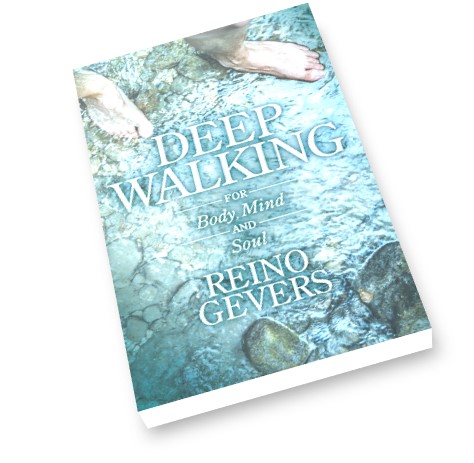
P.S. I’m excited to announce the release of my latest book, “The Turning of the Circle: Embracing Nature’s Wisdom for Purposeful Living.” If you enjoy it, you might also be interested in my previous works, “Deep Walking for Body, Mind and Soul” and “Walking on Edge: A Pilgrimage to Santiago.” You can find all of these titles at reputable bookstores near you.

Leave a comment

Filed under deep walking, meditation, mental health, nature, religion, spirituality

Truth of the Heart

Just having completed the Camino Aragonese pilgrimage route in northwestern Spain, I was deeply inspired by the diverse landscapes, rich vegetation, and the symphony of nature that emerges when human noise recedes.

Immersing oneself in nature reveals the interconnectedness of all living beings. Nature is an expression of the divine, with diversity as a fundamental principle of creation.

In times when external voices grow increasingly loud with hate-filled tribalism and ethnocentricity, the truth of the heart becomes paramount.

Monoculture is lifeless

Compare a lifeless monoculture with a meadow buzzing with the sound of birds, insects and the aroma of wild herbs and a multitude of flowers.

Thoughts and beliefs – religious, philosophical or political – have become so much part of tribalist identity that some people would rather die than admit that they have all along placed the ladder against the wrong wall.

Attachment to fanaticism in all shape and form hardens mind and body, and is one of the biggest obstacles to personal growth and elevation of consciousness.

One humanity or chaotic tribalism

Currently humanity is at the cusp of an elevation of consciousness of a one humanity or regressing into another chaotic age of divisive tribalism, nationalism, and intolerance.

There have been brief periods of enlightenment in the past when faith was more experiential in nature, with individuals gaining higher insight through contemplation, art and music.

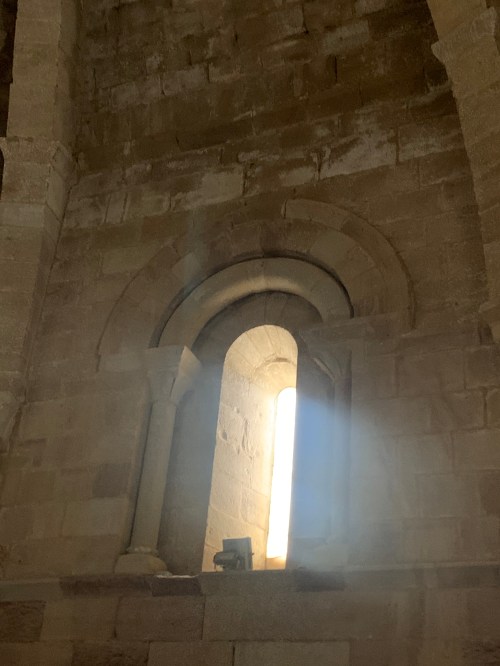
Beautifully restored Romanesque cathedrals, especially in Jaca and Sanguesa, on the Aragonese route provided sanctuary in medieval times for quiet contemplation and inspiration from sculpture at a time when most people were illiterate.

Divinely inspired music and art

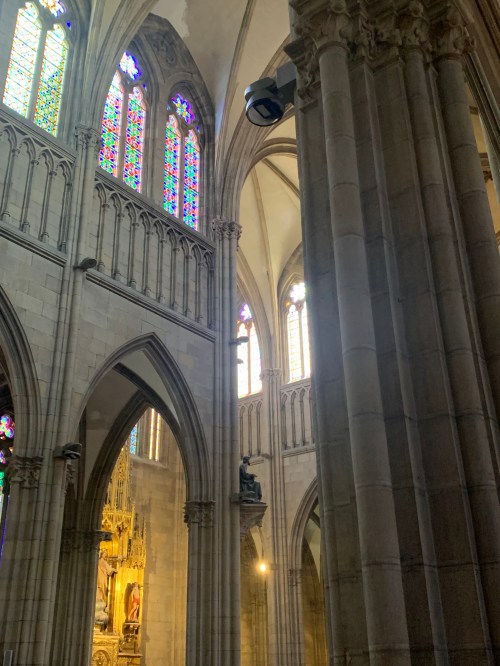
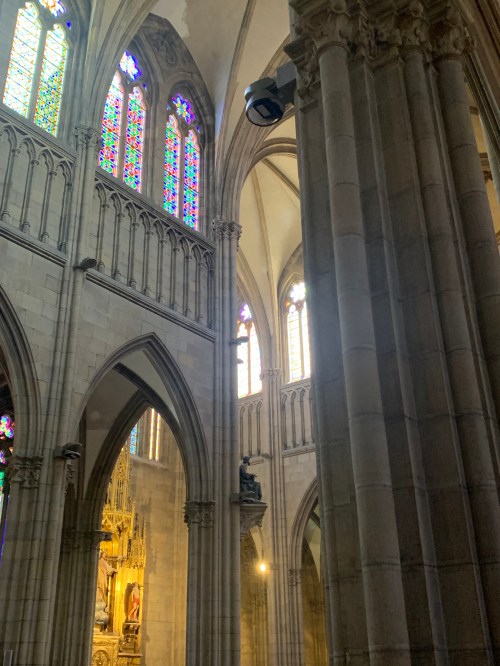
Later construction of the grand cathedrals such as Notre-Dame in Paris and Chartres, with their stunning stained glass windows inspired awe and devotion.

During the Renaissance era religious art with masterpieces by artists such as Michelangelo, Leonardo da Vinci, and Raphael communicated complex theological ideas through visual means.

Sacred music by composers such as Johann Sebastian Bach, and Beethoven created elaborate musical compositions elevating the liturgical experience and deepening the spiritual experience, connecting with the divine in profound sensory-rich ways.

When a religion degenerates into claiming the ultimate truth, subjugating its members into what to believe and how to behave, there is empty ritual and stagnation. The head-mind closes the door to the heart-mind and the whispers to the soul.

Reino Gevers – Author – Mentor – Speaker

P.S. I’m excited to announce the release of my latest book, “The Turning of the Circle: Embracing Nature’s Wisdom for Purposeful Living.” If you enjoy it, you might also be interested in my previous works, “Deep Walking for Body, Mind and Soul” and “Walking on Edge: A Pilgrimage to Santiago.” You can find all of these titles at reputable bookstores near you.

Leave a comment

Filed under deep walking, Pilgrimage, spirituality, Uncategorized

Manifesting into misery

Creating a vision board with images of a beautiful seaside home, luxury cars, and a substantial bank balance might seem like an easy path to a blissful life. However, for most people, this remains a distant dream, while they continue living in quiet misery and desperation.

Books on personal wealth and fulfillment like „Think and Grow Rich“ by Napolean Hill reached a cult-like status in the 1960s-1970s and were followed in recent times by bestsellers such as „The Secret“ by Rhonda Byrne.

Some people do in fact win the lottery, inherit a fortune, or become rich and famous overnight. Yet, many of these individuals end up losing their wealth or attempt to drown their profound unhappiness with substance abuse and escape into constant external distractions. Multiple studies reveal that lottery winners are twice as likely to file for bankruptcy than the general population.

If you haven‘t done the inner work by questioning your real motivation and are primarily focused on the HAVING rather than the BEING you will remain on a low unhappy vibrational level despite living a life of exceptional material abundance.

Visualizing and manifesting is only one part of the work. You will be severely disappointed if you don‘t follow through with a realistic plan of action and do the inner work on the vibrational frequency that you emanate.

How are you talking to yourself?

Are you at peace with yourself and your darker side? Can you accept and love yourself the way you are or is talking to the self dominated by feelings of regret, shame, or guilt?

Are your thoughts dominated by negativity?

Your first thought when you awake in the morning is your compass for the day. Can you transmute low-energy such as anger, sadness, and fear into kindness, positivity, and courage? Be authentic by accepting how you feel without blaming yourself and others. Do external circumstances out of your control dominate your thoughts?

Why do you want certain things?

Do you want that nice house, car, or kitchen to compete with the Joneses to boost your low self-esteem by wanting to impress the people you most dislike?

What happens if?

Ever thought about what happens when you actually achieve your goal? Super achievers often describe an empty feeling almost like a hangover. After winning the 1997 World Golf Championship in Spain, Australian golfer Greg Norman left his trophy in the locker room, saying the memories were more important than the trophy itself. Sometimes we need that challenge, that obstacle and that long road to elevate consciousness.

You need to be clear on whether your wish is embedded in an ego-mind or driven by an inner passion, and joy where you deeply feel a connection to inner purpose and ultimately divine will of service to a greater whole.

Your eyes will light up when you tell people about your dream. You will feel a surge of energy in your body, and your spirit is lifted.

If your path is cluttered with obstacles, disappointment, and setbacks it could mean two things: You either still have to learn something or you have mindlessly careened off on the wrong track, needing to press the reset button.

Be careful what you wish for

It could turn into a horrible nightmare if it is not aligned with your divine purpose to become who you really are. Fame and wealth doesn’t mean your life is without problems. You will still have to deal with health, personal grief, and external circumstances out of your control like all other people.

When you start building a high vibrational level you will automatically attract circumstances and people on the same frequency. You will develop greater situational awareness of what information, people, foods, and surroundings boost your energy levels. 

When things start falling into place almost effortlessly you are on the right path. You can start enjoying the gifts bestowed to you by the universe in humble gratitude. The universe in essence has your back.

Reino Gevers – Author – Mentor – Speaker

P.S. I’m excited to announce the release of my latest book, “The Turning of the Circle: Embracing Nature’s Wisdom for Purposeful Living.” If you enjoy it, you might also be interested in my previous works, “Deep Walking for Body, Mind and Soul” and “Walking on Edge: A Pilgrimage to Santiago.” You can find all of these titles at reputable bookstores near you.

Leave a comment

Filed under mental health, mental-health, self-development, spirituality

Sages, Saints and Sinners

In a life-threatening global crisis, individuals are compelled to either dig deep into their inner light or succumb to their darkest shadows. This is the central theme of my upcoming book, “Sages, Saints, and Sinners,” set against the harrowing backdrop of the Black Plague, which nearly decimated the entire population of Europe in the 14th century.

Here are two contrasting excerpts:

“Amidst the stark contrast of tragedy, mortality, and chaos, beauty revealed itself in heightened clarity and depth.

A keen awareness of life’s fleeting nature permeated his being, igniting an inner yearning to embrace existence with unwavering intensity.

 He savored the earth’s pulsating rhythm beneath his feet, marveling at the majestic dance of birds of prey overhead, the delicate shimmer of sunlight on swaying blades of grass, and the harmonious symphony of nature’s myriad voices. The beauty of creation eluded possession, transcending mere ownership to encompass a profound perspective that infused every facet of existence.”

Photo by Samrat Maharjan on Pexels.com

…”Nuns and monks offered simple herbal remedies and prayers, reading from the sacraments or taking confessions from the dying.

Simple pallets with straw served as beds with local volunteers supplying food and taking away the bodies of the dead in donkey carts to be buried in a cemetery nearby.

Isabel frequently conferred with Brother Thomas on researching the possible cause of the pestilence, refusing to believe that it was an act of God.

What better place to be than the monastery where some of Europe’s best theologians, astronomers, mathematicians, and doctors were at work.

“God has blessed us with intellect and a mind to ponder. Do we not ascend through every trial, gathering wisdom along the journey?” remarked Brother Thomas.

I’ve been working on this book project for the past two years and I’m now working on the final draft. The message I want to put out there with this novel is that even in dire situations of hopelessness, life is transitory.

It is in times of difficulty, in the pain, in the suffering that consciousness can either be elevated to its highest levels or succumb to the lowest vibrational levels of toxic emotions marked by procrastination, fear, and rage.

Reino Gevers – Author – Mentor – Speaker

P.S. I’m excited to announce the release of my latest book, “The Turning of the Circle: Embracing Nature’s Wisdom for Purposeful Living.” If you enjoy it, you might also be interested in my previous works, “Deep Walking for Body, Mind and Soul” and “Walking on Edge: A Pilgrimage to Santiago.” You can find all of these titles at reputable bookstores near you.

Leave a comment

Filed under spirituality

Is religion stifling spiritual growth?

During my childhood in South Africa, I started having my first doubts about religion when clergy defended from the pulpit the abhorrent policy of apartheid and prevented a devout black priest from attending a church ceremony.

The message of salvation failed to resonate in the obligatory Sunday services which I found to be extraordinarily melancholy and joyless occasions, steeped in empty ritual. It did however serve the purpose of sending me onto a path of intensive ongoing spiritual exploration.

If you are one of those people who left the church in frustration after being shamed for thinking differently or questioning doctrine, then welcome to the club.

For centuries religious institutions have stifled spiritual growth and prevented people from living their divine purpose by telling them how to behave, what to believe, and even what politicians to vote for. This, for me at least, is the ultimate sin for which the church needs to take responsibility.

Spiritual but not religious

Especially younger people in Western countries are seeing through the hypocrisy and leaving the church in droves. But does that mean that more people are becoming agnostic, atheist, or have lost their belief in the divine?

Seven out of ten Americans describe themselves as spiritual in some way including 22 percent who say they are spiritual but not religious.

Even the first Christian communities were often divided between legalistic interpretations of the Gospel and experiential spirituality. There is a lovely passage in Galatians 5 of the New Testament of the Bible where St. Paul criticizes an early church in today’s Turkey.

Paul underscores the centrality of the Gospel, calling on the faithful to practice love, joy, peace, patience, kindness, goodness, faithfulness, gentleness, and self-control as opposed to the legalism of what foods to eat and what could and could not be done on a Sabbath.

Jesus, the ultimate revolutionary

Some 2,000 years ago Jesus broke all religious conventions by healing the sick on the Sabbath. He was eventually crucified when openly exposing the hypocrisy of the clergy, by dining with sinners, tax collectors, prostitutes, and other outcasts – who were excluded from the Temple.

Jesus never had plans to establish an institution or a church and would probably be horrified by what people are saying and practicing in his name today. When someone starts confronting me with the words: “Have you found the real Jesus?” it is for me a signal to run.

Temples, churches, and places of worship could be turned into sanctuaries of peace by opening their doors to people of all faiths. Many Christian churches however are stuck in tribalistic doctrine, especially when it comes to who is entitled to holy communion, abortion, or whether women can be ordained as priests.

Thriving churches, however, are vibrant meeting places for people joyfully dancing, singing, praying, and sharing meals together. In a positive sense, they can cement the community spirit, especially in urban environments where we have an epidemic of isolation and loneliness. These church members practice a living faith by visiting the aged, providing comfort to prison inmates, and refugees, and establishing food banks for the hungry.

Spiritual growth comes from a place of brokenness

There is a saying that religion is for those who fear hell while spirituality is for those who have been there. The seeds of spiritual growth come from a place of brokenness.

On my more than a dozen walks on the Camino in Spain I have met countless people who have gone through the hell of losing loved ones, confronted life-threatening illnesses, the dark holes of depression, financial ruin, and relationship breakdown. What I can say about all these people I’ve met on the Camino is that such life-changing events made them come out stronger, forcing them into deep introspection on the purpose and meaning of life.

A cosmic religion of the future

Experiential spirituality is a process whereby the shutters of the soul window are opened. It is a feeling of connection with the divine, and the mystery of creation. The great scientist Albert Einstein once said that the religion of the future will be cosmic in nature. 

“The most beautiful and deepest experience a man can have is the sense of the mysterious. It is the underlying principle of religion as well as all serious endeavors in art and science. He who never had this experience seems to me, if not dead, then at least blind,” Einstein is quoted as saying.

The Dalai Lama, the spiritual leader of Tibetan Buddhism, encourages individuals to go beyond the superficial differences among religions and recognize the deeper essence of spirituality and morality that can be found in all faith traditions. 

The fundamental principles of compassion, love, and ethics are not limited to any particular religious tradition or belief system. These principles, the Dalai Lama believes, are universal.

Already early into this year, a record number of pilgrims are walking the Camino. All share the common quest that has resonated through the ages:

“From whence do I hail? Whither do I journey? What purpose guides my days ahead?”

In echoing the ancient Sages and Mystics, emphasizing the innate spirit of man: Where there is a lighthearted spirit of joy, peace, positivity, and kindness, negativity and darkness recede.

Reino Gevers – Author – Mentor – Speaker

P.S. I’m excited to announce the release of my latest book, “The Turning of the Circle: Embracing Nature’s Wisdom for Purposeful Living.” If you enjoy it, you might also be interested in my previous works, “Deep Walking for Body, Mind and Soul” and “Walking on Edge: A Pilgrimage to Santiago.” You can find all of these titles at reputable bookstores near you.
Leave a comment

Filed under Camino de Santiago, happiness, humanity, meditation, mental health, psychology, self-development, spirituality

Evil is created, not born

Russian President Vladimir Putin’s unprovoked invasion of Ukraine has inflicted devastation upon millions of lives and dramatically altered geopolitical realities. Analysts speculate that Putin’s actions may be rooted in a traumatic childhood, a common denominator of some of the world’s most brutal dictators.

Adverse childhood experiences and trauma are sometimes passed on for generations, and if not transmuted can create particularly destructive adults who are incapable of showing compassion, empathy, or love.

Putin himself is probably unaware that his behavior is driven by unresolved “inner childhood” trauma but his convoluted argument on national television that the invasion of Ukraine was justified to fight “Nazis” offer some clues to his actions.

Ukraine is led by a Jewish leader and Putin’s argument that the country’s government is led by Nazis is absurd. Lately, the argument of fighting “Nazis” in Ukraine has been changed into a fight against the West as a whole “intent on destroying Russia.”

Putin, judging from his many unhinged statements in state-controlled media, obviously feels threatened and considers himself the victim seemingly oblivious to the suffering he has unleashed.

A former profiler from the U.S. Central Intelligence Agency (CIA), Dr. Jerrold Post, who later became a professor of psychiatry has suggested that Putin’s anxieties possibly stemmed from his early experiences in life.

Putin grew up as a street kid in a rough neighborhood of Leningrad, a city devastated by the Nazis during World War II. Most of the population died in the war and Putin’s father was badly injured, inheriting from his parents their wartime trauma. Growing up without any loving adults around him, Putin was forced to fend for himself on the streets and was badly bullied by other children.

It produced a macho personality, deep distrust of others, unpredictability, and a man willing to advance his own power agenda walking over killing fields in the process. Putin has had his most vocal opponents assassinated or imprisoned, started wars in several neighboring countries, and is sowing division and hate with an information war of fake news on a global level. We are seeing evil at play on multiple levels.

Photo by Keira Burton on Pexels.com

Dr. Post explained in an essay that Putin’s steely surface is directly linked to being bullied as a child which led him to take up martial arts.

“He (Putin) took up martial arts so as not to be pushed around by other kids. We are seeing the same behavior in his leadership,” Post wrote.

The psychologist Alice Miller writes that there “is no confirmation of the widespread assertion that there are people who are born evil. On the contrary. The deciding factor is the reception they were given when they came into the world and the way they were treated later.”

Her summary of how evil is created and what she learned from the common denominator of childhoods from dictators is particularly poignant:

“These children will tend to glorify the violence inflicted upon them and later take advantage of every possible opportunity to exercise such violence, possibly on a gigantic scale. Hitler, Stalin, and Mao all had particularly traumatic childhoods during which they were repeatedly beaten and shamed by adults.

“Children learn by imitation. Their bodies do not learn what we try to instill in them through words but what they have experienced physically. Battered, injured children will learn to batter and injure others; sheltered, respected children will learn to respect and protect those weaker than themselves. Children have nothing else to go on but their own experiences.”

Our responsibility as a society therefore is to instill in children from an early childhood love, respect, understanding, kindness, and warmth.

The healthier a child’s relationships are at a later stage in life, the higher the possibility of recovery and resilience from trauma.

When a childhood trauma can be resolved at an early stage, there is a greater chance of healing and less risk that a destructive behavior pattern is repeated in adult life.

Related articles:

Reino Gevers – Author – Mentor – Speaker

P.S. I’m excited to announce the release of my latest book, “The Turning of the Circle: Embracing Nature’s Wisdom for Purposeful Living.” If you enjoy it, you might also be interested in my previous works, “Deep Walking for Body, Mind and Soul” and “Walking on Edge: A Pilgrimage to Santiago.” You can find all of these titles at reputable bookstores near you.
Leave a comment

Filed under psychology, self-development, spirituality, Uncategorized

Wisdom is drowning in the flood of information

“Listen to the wind, it talks. Listen to the silence, it speaks. Listen to your heart, it knows.”
– Ojibwe Prayer

Acquired knowledge and intelligence are often confused with wisdom in our digital age where we have a world of information at our fingertips while the deeper understanding and insight into life’s mysteries appears to be on the wane.

The ancient Mystics, notably the 13th-century Dominican monk Meister Eckart, understood true wisdom as the intimate connection and surrender to the divine will.

Eckart’s idea was that of a “divine birth” within the soul, where a transformative experience leads to a profound shift in consciousness.

“In this divine birth, I find that God and I are the same: I am what I am and what I shall remain, now and forever. I am carried above was the highest angels. I neither increase nor decrease, for in this birth I have become the motionless cause of all that moves. I have won back what has always been mine. Here, in my own soul, the greatest of all miracles has taken place-God has returned to God!

(quote 3086  |   Meister Eckhart).

Knowledge is worthless without wisdom

The sages and Mystics were well aware of the limitations of intellectual thought and knowledge. The accumulation of information, facts, theories, and concepts on the cognitive level were deemed worthless if they were not connected to wise decision-making.

Intelligence, especially on the part of egocentric politicians, scientists, and business leaders, has in the past caused havoc to humanity and become even more topical in an age where spreading falsehoods and toxic emotions to millions on a global level has become the norm.

Millions of people are being spoonfed with external beliefs, concepts, and ideas that ultimately are far removed from authentic soul purpose, finding themselves digging deeper and deeper into the rabbit hole of falsehoods and illusion.

Wisdom meanwhile encompasses a broader understanding of human nature, ethics, and the interconnectedness of the world by letting go of “ego” desires and attachments, especially of fixed beliefs and concepts that are closely intertwined with personality and ego.

The misunderstanding of Karma

Wisdom is an alignment with the cosmic laws and a greater whole that governs all existence. In this context the concept of karma or the law of attraction is often misunderstood as a predestined inevitability, yet with the growth of wisdom comes the growth of awareness.

It is inseparable from such values as compassion, empathy, and unconditional love. Mystic teachers emphasize the importance of cultivating these qualities as essential aspects of spiritual growth, enlightenment, and ultimately fulfilling life’s purpose.

Karma is the result of habits, actions, and choices made. We have been given the power of choice by the divine. If you extract yourself from the addiction of blaming external circumstances you become the creator and master of your destiny.

“Life is a meteor
Let your eyes roam
Heaven is beautiful
It’s almost like home
Children! get ready
It’s time to come home”

(Paul Simon Track Seven on Seven Psalms)

Reino Gevers – Author – Mentor – Speaker

P.S. I’m excited to announce the release of my latest book, “The Turning of the Circle: Embracing Nature’s Wisdom for Purposeful Living.” If you enjoy it, you might also be interested in my previous works, “Deep Walking for Body, Mind and Soul” and “Walking on Edge: A Pilgrimage to Santiago.” You can find all of these titles at reputable bookstores near you.
Leave a comment

Filed under mental health, spirituality

The Killer in the Kremlin

“Silence in the face of evil is itself evil: God will not hold us guiltless. Not to speak is to speak. Not to act is to act.” – Dietrich Boenhoeffer (German theologian killed by the Nazis)

A couple of days back, a startling headline lit up my screen: Russian dissident Alexei Navalny had been assassinated. The news shook me to my core, leaving me appalled at the apparent depths to which Russian leader Vladimir Putin would stoop, fully aware of the shockwaves it would send worldwide.

Navalny’s murder snuffed out a beacon of hope in the oppressive landscape of Putin’s Russia. When a leader turns to such brutal tactics, it reveals not strength but profound weakness. Navalny epitomized everything the autocrat in the Kremlin was not.

It is the nature of dictatorial regimes that they bring forth the best and the worst extremes in mankind. South Africa’s apartheid regime had shining examples of courage and humanity in Nelson Mandela, Archbishop Desmond Tutu, Steve Biko, and many others. Nazi Germany had Dietrich Boenhoeffer and dissidents such as Sophie Scholl. Czechoslovakia had Vaclav Havel and Poland Lech Walesa.

Navalny’s assassination, probably directly ordered by Putin, is one of many in today’s Russia including opposition politicians, journalists, businessmen, and academics who dared speak out about the corruption, cruelty, and nepotism.

We discover who we are in confronting evil and at the same time the darkness and the light within. The external is a reflection of that which is within. Evil manifests itself where there is a complete absence of what is good and pure.

Failure to engage in self-reflection, transmuting one’s own shadows, and speaking out against evil renders one vulnerable to the influence of evil. This truth was starkly realized by figures such as Dietrich Bonhoeffer and Winston Churchill during World War II. Attempting to placate, appease, or negotiate with evil proves futile, as it perceives such actions as weaknesses, stemming from a consciousness devoid of moral values.

In Greek mythology, the evil Goddess Eris has the only purpose of sowing discord. She causes a conflict among the Goddesses Athena, Hera, and Aphrodite by throwing a golden apple among them with the words: “to the fairest”.

No other God wanted to be put on the receiving end of the wrath of the three Goddesses by choosing one of them as the fairest. The Goddesses then ask the mortal prince of Troy Paris to do it for them. Each tries to bribe him by pledging great gifts, and Paris then gives the apple to Aphrodite who had promised to make the most beautiful woman on earth fall in love with him.

The woman chosen was Helen, the queen of Sparta and wife to Menelaus. When Paris eloped off with her, Menelaus declared war on Troy, rallying all the Greek kings, and triggering the Trojan War.

Another Greek Goddess, Enyo, delighted in war and destruction, bloodshed, and the ransacking of cities.

The fallen angel and the lure of power

Christianity describes the devil, Satan, as a fallen angel and the very personification of evil. He was expelled from Heaven at the beginning of time after attempting to become equal to God.

The archetypal motif of the fallen angel or Lucifer is found in Summerian folklore, Roman mythology, Germanic tribes, and the Vedas.

In popular culture, we find Darth Vader, a fictional character in the Star Wars series. He is the dark father and the personification of evil in popular culture, serving the empire as its chief enforcer.

The windows to the soul

Eyes are said to be the windows to the soul with the bible quoting several passages in this vein. “The eye is the lamp of the body. So, if your eye is healthy, your whole body will be full of light,” (Matthew 6:22). “But if your eye is bad, your whole body will be full of darkness. If then the light in you is darkness, how great is the darkness!” (Matthew 6:23).

Photo by wendel moretti on Pexels.com

I remember very well when my elderly German neighbor, who had experienced the horrors of World War II, remarked on Vladimir Putin’s ascension to power in 1999. “You can’t trust him. His eyes are cold like those of a wolf.”

U.S. President Joe Biden told Putin during a closed-door meeting in 2011: “I looked in your eyes and I don’t think you have a soul,’ and [he] looked back at me, he said, ‘We understand each other.'”

For all those millions of people in the West who blindly follow the Russian narrative of lies, deception and fake news, I highly recommend the book: “The Killer in the Kremlin”, an explosive account and exposure of Putin’s tyranny and sinister ambitions by award-winning journalist John Sweeney.

Often evil disguises its real intentions behind a smokescreen of lies, disinformation, and false flag operations. It is the playbook of such Lords of Evil as Adolf Hitler, Slobodan Milosevic, Joseph Stalin, and Mao Zedong. In our lifetime we have to face the truth. We have another Lord of Evil in Vladimir Putin. Over decades he has not only duped western politicians but much of the rest of the world. Let’s connect the dots just to illustrate how much this Lord of Evil has sown destruction and discord.

  • Under Putin, Soviet-era repression has given way to a marriage between kleptocracy and organized crime, turning Russia into a “Mafia state”.. Organized crime has become an outgrowth of the political machine. Mafia cells have undertaken assassinations, facilitated coercion, and extortion. Outspoken Putin critics such as Garry Kasparov have all the while warned and revealed the true nature of the monster.
  • During a closed-door meeting in the year 2000, Putin is said to have offered the wealthiest Russian oligarchs a deal: Surrender to my authority, and you can keep your mansions, and multibillion-dollar corporations. Those oligarchs who reneged on this deal and undermined Putin were thrown into prison or died under mysterious circumstances. Putin’s wealth is a secret but it can be safely assumed that he has used the oligarchs as a major source of his hidden assets.
  • Turning Russia into a Mafia-type state has given Putin huge resources to weaken Western democracies. Putin has repeatedly voiced his disgust for the multi-culturalism, sexual diversity, and free speech which he sees as a direct threat to his authoritarian and 19th-century imperialist dreams. Over the years he has funneled huge resources to rightwing and extremist groups in western countries, spreading lies and disinformation on social media through Russian state-funded bots.
  • And then the Lord of Evil decides to invade Ukraine, the world’s breadbasket, triggering the largest refugee crisis in Europe since World War II and possibly the deaths of millions of people in Third World countries due to famine. Meanwhile, we have become almost emotionally immune to the daily bombardment of playgrounds, hospitals, and residential buildings in Ukraine as Putin wages a war against innocent civilians.

What does humanity have to learn from all this?

We need the enemy, and the opposite perspective to gain clarity on our own core values and choices. Often the question is asked: “If there is a God, why does he allow evil?”

But we have been given the power of choice. We cannot blame dysfunctional human actions on the Creator. God has often been seen as a strict father figure punishing his flock for sinful or bad behavior. The Mystics in contrast view God, the universal creator or the divine as “a state of Being” – the connection to pure love, kindness, and compassion. The manifestation of evil would therefore be the opposite condition – the state of complete absence of God.

Napoleon Hill once said that every evil carries within it the flames of self-destruction. It was a warning by the famous mentor to his students, political and business leaders to reflect carefully on their actions and goals. When they are not in sync with the universe and designed for the benefit of all, those flames will come back to burn you.

Sometimes those flames can come in the form of such deep disgust and regret with the “Self” that it manifests in self-destructive behavior such as addiction or serious illness.

The tragedy is that the character once held by the stranglehold of the shadow demons finds himself incapable of self-reflection.

Most suffering that we experience in our personal lives or that we witness in the external world is a result of bad human choices and actions carried out from a low level of spiritual disconnect.

The word “evil” is often used in a confusing context to blame, vilify or distract.

The wisdom of the ancient Mystics can be a good guideline. Basic human nature has not changed much over the centuries. There will always be a segment of people who don’t give any regard to the outcome of their actions. Meister Eckhart, the great Dominican friar of the early fourteenth century, warned against those whose “sole concern is how to gain honors, wealth, and pleasure.”

These people, according to Eckart, are those who lack all sense of humility by “running in front of God.” Inevitably their lives will be haunted by what they call bad luck or a bad hand. They will be blaming God, fate, people different from themselves, and basically everyone for what has gone wrong in their lives. They are filled with hate, resentment, and anger. They are the malignant narcissists of our age who seek only personal validation and glory.

As the Lord of Evil and his followers spin the narrative of hate, division, and destruction some comfort can be taken from the fact that evil ultimately destroys itself because it is out of sync with the laws of the universe. The thoughts, actions, and energy you send out inevitably come back to you.

In the same way, the path of light which is that of kindness, unconditional love, compassion, unity, tolerance, gratitude, and acceptance will bless you in a multitude of ways. You will be living a happy and blissful life if you make yourself an instrument of divine purpose.

Reino Gevers – Author – Mentor – Speaker

P.S. I’m excited to announce the release of my latest book, “The Turning of the Circle: Embracing Nature’s Wisdom for Purposeful Living.” If you enjoy it, you might also be interested in my previous works, “Deep Walking for Body, Mind and Soul” and “Walking on Edge: A Pilgrimage to Santiago.” You can find all of these titles at reputable bookstores near you.
Leave a comment

Filed under humanity, spirituality, Uncategorized

The truth be told

“Three things cannot be long hidden: the sun, the moon, and the truth.” – Buddha

In my early days as a news reporter covering the ‘court beat’ and witnessing some of humanity’s worst crimes, it was disheartening to see how many criminals, even when faced with undeniable evidence, would contort the truth, painting their victims as the villains.”

In the tumultuous public information space, truth finds itself relegated to the backseat, drowned out by a cacophony of lies, deception, and hate speech. The manipulation of truth isn’t solely the domain of petty criminals; it’s a tool wielded with equal fervor by autocrats, dictators, and cult leaders.

I’ve often pondered how individuals can fabricate and obscure with such unwavering conviction that one might almost be inclined to believe them. It dawned on me that evil, or Satan isn’t merely a religious concept but a stark reality, inhabited by individuals devoid of a moral compass and exhibiting behavior far removed from what society deems normal and ethical.

In the increasingly muddied water of social media, we need to call out the purveyors of evil messaging. They are easily identifiable:

  • They lack complete empathy and have no qualms in causing harm and suffering to others.
  • They are masters at manipulating words. Their tools are deception and gaslighting. Their lies and twisting of the truth will make you doubt your own sanity.
  • They seek complete control. They will pressure, intimidate, and coerce. They demean, humiliate, or degrade others as a means of asserting power and dominance.
  • Charisma. Externally they are sometimes charismatic, outgoing, and charming personalities. But they have an agenda. They are trying to gain your trust while secretly pursuing their own selfish agenda – typical among religious and political cult leaders.
  • Emotional manipulation. If you have not transmuted your own dark emotions of fear, anxiety, hate, and shame you are easy prey. They will tell you that all your “bad feelings” have been caused by “others” – people of other faiths, cultural origins, and political beliefs. By this stage, you will be willing to follow them unconditionally all the way into the darkest of dungeons.

The good news is that God has given us the power of choice. Our primary purpose on earth is to elevate consciousness. You ultimately have the power to transcend limited perspectives, biases, and conditioned beliefs, gaining greater clarity, empathy, and interconnectedness with the broader world of existence.

By engaging in simple acts of service, kindness, and altruism you will cultivate a sense of purpose, fulfillment, and connection to something greater than yourself.

By learning to love yourself you will cultivate empathy and compassion towards others, fostering a greater sense of connection and understanding of the human experience.

Explore and study spiritual and philosophical traditions that promote personal growth, self-discovery, and a sense of interconnectedness with higher consciousness.

To quote Robert Frost: “Two roads diverged in a wood, and I took the one less traveled by, and that has made all the difference.”

Reino Gevers – Author – Mentor – Speaker

P.S. I’m excited to announce the release of my latest book, “The Turning of the Circle: Embracing Nature’s Wisdom for Purposeful Living.” If you enjoy it, you might also be interested in my previous works, “Deep Walking for Body, Mind and Soul” and “Walking on Edge: A Pilgrimage to Santiago.” You can find all of these titles at reputable bookstores near you.

1 Comment

Filed under raised consciousness, self-development, spirituality, Uncategorized

Do what you love

You must never think of the whole street at once, understand? You must only concentrate on the next step, the next breath, the next stroke of the broom, and the next, and the next. Nothing else.”

– Michael Ende, Momo

Are you finding yourself on a frustrating treadmill of doing a job that you hate and counting the years until retirement? There are millions of people out there wasting the most precious years of their lives for all the wrong reasons.

On average about half of your lifetime will be spent working, assuming you retire in your mid-60s and have a typical lifespan between 70 and 80. It therefore makes sense that you spend your best years doing what you love and what you are passionate about.

If you are stuck in grievance culture, unhappy in your job, or your relationship, and have problems with your self-esteem the universe will be sending you many signs that you need to change direction.

A job environment with constant high-stress levels will not only cause mental and physical exhaustion but eventually lead to a host of other health problems that will severely impact your lifespan and quality of life. Some typical red flags:

  • Your personal values are no longer in alignment with the values of the organization
  • All your efforts go unnoticed or unappreciated
  • You feel undervalued and underpaid for what you are doing
  • You have reached a dead end in personal growth. The job lacks growth opportunity, meaning, and purpose.

You might have started a particular career or job with a passion, but it has meanwhile outlived its purpose. It has become a grinding chore and is exhausting you physically and mentally. That might be the time for you to move on. One path is often the stepping stone or learning curve for you to move on to another path.

In doing what you love, you will discover that the true richness of life is not just in the paycheck, but in the fulfillment of your soul. When you are doing what you are passionate about your higher vibrational frequency will automatically attract all the abundance and the money you need.

Photo by Riya Kumari on Pexels.com

Even in carrying out the most mundane tasks your mindset and perspective are key, according to the 13th-century Mystic Meister Eckhart. Being in alignment is the discovery of mysticism in all of your activities in a “joyful experiential presence”.

Eckart’s formula for happiness was liberation from attachment and complete surrender to “dedication” in giving yourself wholeheartedly to a cause, person, or activity. This, he argues, is only possible if you create space for contemplative “emptiness”.

The more in alignment “the more powerful, dignified, useful, commendable, and perfect is the prayer and the work,” Eckart writes in one of his sermons.

Similarly, Zen Buddhism encourages practitioners to cultivate mindfulness, which involves paying full attention to each moment, fully immersing yourself in the present experience, and extending to all activities whether it’s walking, eating, working, or any other daily task.

Mindful activity involves being fully present in the current moment, paying attention to thoughts, feelings, and sensations without becoming entangled by attachment or judgment. Developing a kind and compassionate attitude is integral to the spiritual path.

In a busy world, you are constantly being pulled into a thousand different directions, becoming a playball for social media and the “glitter of the shiny things.” Distraction and addiction are trying to stifle the voice of your soul yearning to accomplish that which it was destined to bring forth and create from the day you were born.

Reino Gevers – Author – Mentor – Speaker

P.S. I’m excited to announce the release of my latest book, “The Turning of the Circle: Embracing Nature’s Wisdom for Purposeful Living.” If you enjoy it, you might also be interested in my previous works, “Deep Walking for Body, Mind and Soul” and “Walking on Edge: A Pilgrimage to Santiago.” You can find all of these titles at reputable bookstores near you.

2 Comments

Filed under psychology, self-development, spirituality, Uncategorized