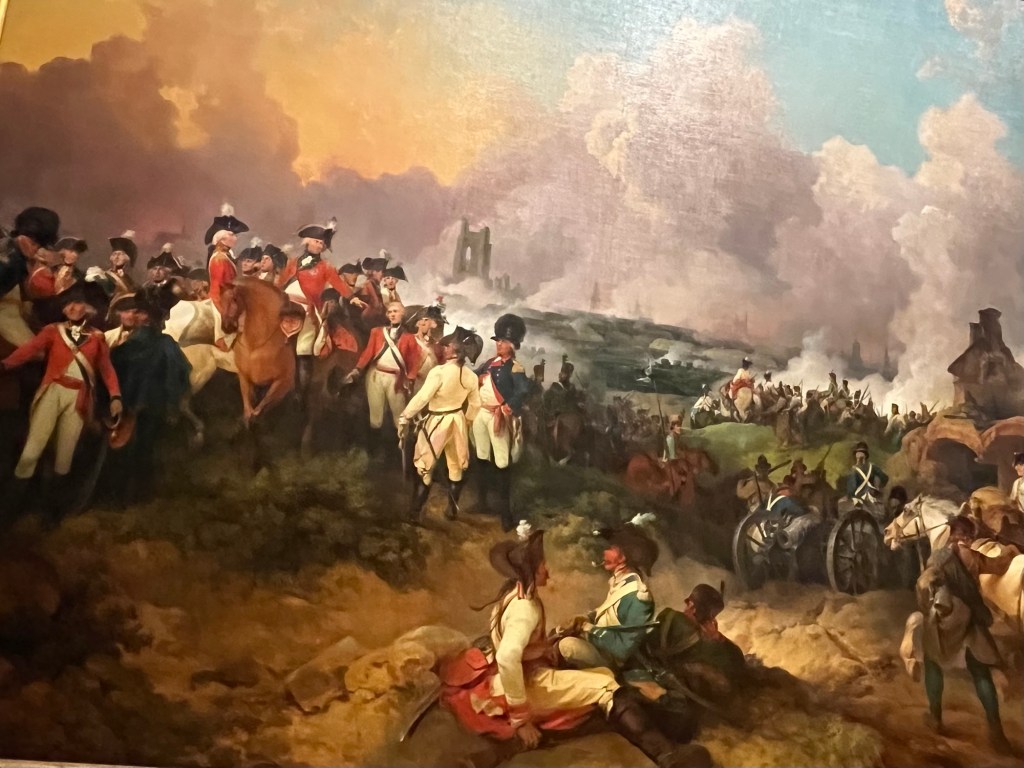
Great artists possess the rare ability to pierce through the veil of the ordinary, revealing the deeper truths that lie beneath life’s surface. In times when power distorts reality and fear stifles truth, their work becomes a courageous act of revelation.
A few days ago, I was vividly reminded of this while visiting the Tate Britain gallery in London. Entrance to most of London’s famous galleries is free, and it’s a great way to spend a few quiet hours in a big city.
I was particularly struck by the works of the late 17th and 18th centuries. The expanding British Empire was marked by conflict, built by the sacrifices of soldiers and the toil of slaves and factory workers. Child labour was common, and women were condemned to giving birth and running the household.
Subtle hints beneath the surface
Artists were often commissioned to glorify the king and the empire, yet beneath the surface of landscape paintings, market scenes, and depictions of mixed-status couples, subtle traces of class divisions and social tensions quietly emerge.
The tumultuous times of the late 18th and 19th centuries, along with global wars, came at a huge cost, marked by massive taxation for ordinary people, widening wealth gaps, poverty, and unemployment. Artists responded by painting dramatic battle scenes or images that either evoke a Romantic past or feelings of awe and terror.
Art and spirituality
Much of religious art was commissioned by monasteries in medieval times to convey the gospel because most people were illiterate. In contemplation of the art, the individual had a unique gateway to experiential spirituality.
Apocalyptic imagery from the Book of Revelation reflects the deep anxieties of a time when rapid technological and social upheaval left many feeling unmoored. Long-held certainties, norms, and values were beginning to crumble. In many ways, these ancient fears echo our own and mirror the disruptions in today’s world.
Artists sensing underlying tensions
Major social and political shifts are often preceded by conflict and upheaval. Artists sense these underlying tensions long before they burst into the open ,but also give some cues to a brighter future.
Art offers us a unique lens through which to view the past, revealing not just historical waymarkers but the deeper rhythms of human experience.
History moves in cycles. Out of hardship and resilience emerges renewal and growth, only to give way once more to seasons of disruption and decline. Yet, from each winter of decay, a new spring is born, reminding us that regeneration is woven into the very fabric of life.
Authoritarian movements are not historical accidents. They are the outcome of a long, steady erosion of the moral and spiritual foundations that once underpinned Western societies. The Judaic-Christian values that emphasized community, compassion, and responsibility have weakened, leaving a vacuum filled by grievance culture and divisive tribalism.
A growing number of people feel frustrated, aggrieved, and desperate as societies fracture between the privileged and the left-behind. Rapid technological disruption and sweeping social changes have upended long-held certainties. Entire communities have been dislocated, and the Covid-19 pandemic only deepened the sense of instability and loss.
Traditional institutions in education, religion, media, and politics have not addressed the alienation felt by millions. Students of history will recognize these conditions. Today’s authoritarian movements bear an uncanny resemblance to the turmoil and mass manipulation of the late 1920s and 1930s.
In A Preface to Morals (1929), Walter Lippmann foresaw the dangers of moral relativism and cultural drift:
“When men can no longer be the slaves of tradition, they must be the slaves of reason. If they will not be slaves of reason, they must be the slaves of their passions… And if each man is to judge for himself what is true and false, right and wrong, then we are already at the end of civilization.”
Authoritarian movements offer the illusion of safety and belonging. But instead, they further tear apart the fabric of civil society. Families, communities, and congregations fracture into warring factions, each loyal to its own tribe, and its own version of truth.
The Role of Media
Traditional media once acted as a civic compass, a watchdog of power. But in the digital age, social media algorithms amplify the most extreme, emotional, and divisive content. Outrage sells; nuance does not. Facts struggle to compete with feelings. In this climate, truth is no longer a shared destination but a weapon of personal or political gain.
The Sacrifice of Traditional Values
This is fertile ground for demagogues who distort Judaic-Christian values beyond recognition. Empathy is rebranded as a fatal flaw. Power is idolized; the weak and vulnerable are mocked as “parasites.” Even the medieval theology of ordo amoris—originally a call to rightly ordered love—is weaponized to justify a hierarchy of compassion: prioritize citizens over foreigners, neighbors over strangers. In this logic, cutting humanitarian aid for millions of people becomes not just acceptable, but righteous.
Yet most theologians, including Pope Francis, have challenged this interpretation. He reminds us that unconditional love lies at the heart of the Christian faith, and that true morality cannot be confined to borders or tribal interests. The parable of the Good Samaritan teaches that love recognizes no boundary.
As former U.S. President Jimmy Carter once put it:
“It is the weak nation that must behave with bluster, boasting, rashness, and other signs of insecurity.” Strong societies practice humility. They uphold compassion, generosity, and justice—especially toward the most vulnerable.
The Choice Before Us
With traditional norms under siege and authoritarianism corroding democratic institutions, the burden of responsibility falls on we the people, every one of us. Troubled times, however grim, present a profound opportunity for reflection and moral clarity. There will come the realization that there is no hero coming and no savior on the horizon.
Change begins within—when individuals reclaim their agency, resist distraction, and choose courage over comfort. But it cannot end there. Lasting transformation happens when people come together, organize with purpose, and hold power to account.
For democracy to endure, it must do more than preserve procedures. It must recover its soul and the shared commitment to truth, moral responsibility, and compassion.
A democracy worthy of its name serves all people, not just the powerful elite. It confronts inequality, ensures access to healthcare, housing, and education, and defends the dignity of every human being. It protects the environment not as an afterthought, but as a sacred trust, recognizing that the future of life itself depends on how we care for the Earth today.
Democracy ultimately is not merely a system of governance. It is an expression of our collective values. And its survival depends on whether we are willing to live them.
Reino Gevers – Author – Mentor –Speaker
P.S: If you enjoyed this article you might be interested in my very latest book: Sages, Saints and Sinners Get it today on Amazon, Barnes & Noble and where all good books are sold.
Throughout history, one of the most potent catalysts of conflict and war has been humanity’s deep-seated addiction to rigid concepts and beliefs, particularly those rooted in religion, ideology, and political affiliation. These mental fixations often block the path to growth, empathy, and the elevation of consciousness.
While society rightly highlights the dangers of substance addictions like alcohol and drugs, we often overlook an equally destructive force: the psychological and emotional dependence on fixed worldviews. This addiction becomes especially visible during periods of rapid social upheaval and crisis. In such times, people often cling even more tightly to their beliefs, seeking certainty in a world that feels uncertain.
At the heart of these belief systems lies a refusal to entertain alternative perspectives. Even when faced with overwhelming evidence or scientific data, those entrenched in ideological thinking will often reject reason itself. For many, admitting they might be wrong is more terrifying than death. They become prisoners of their own convictions.
Scapegoating and misinformation
The COVID-19 pandemic offered a sobering modern example. As the virus swept across the globe, so too did a parallel wave of conspiracy theories, scapegoating, and misinformation. Rational discourse was drowned out by fanaticism. In many places, especially the United States, this led to deepening political polarization and extremism. Civil debate between differing political camps has become virtually impossible.
During the lockdown, I delved into the social consequences of previous pandemics. One of the most harrowing was the Black Plague of the 14th century, which devastated Europe and left cities and countrysides empty for decades. Faced with unimaginable death, people sought easy answers. In Strasbourg, a vicious rumor claimed Jews had poisoned the water wells, leading to the massacre of the city’s Jewish population. Those who were different—whether in religion, race, or opinion—were blamed.
In my latest book,Sages, Saints and Sinners, I explore how two central characters respond to such a crisis. While some individuals rise to the occasion with compassion and courage, others descend into violence and hatred. This story, rooted in historical truth, offers a mirror to our turbulent times. I encourage you to read it as a call to self-reflection.
Just like substance addiction, ideological addiction often stems from unresolved trauma and fear. In times of economic uncertainty or personal crisis, people gravitate toward simple answers to complex problems. This is the moment when deceivers step in, offering an easy scapegoat: You are not the problem—it’s “them.” The others. The outsiders. Those who think, look, or believe differently from you.
This narrative is tragically familiar. It has fueled genocides, invasions, land thefts, torture, witch hunts, and pogroms. History is littered with the consequences of belief systems weaponized against fellow human beings.
Healing begins within
Ideological fixation poisons the mind. The path to healing begins with honest inner reflection. We must each ask:
What lies beneath my anger, my sadness, my resentment? How can I transmute these emotions into love, compassion, and understanding?
The responsibility rests with each of us. Our highest calling and our divine purpose is to cultivate and spread love. Love that transcends division. Love that sees the humanity in all beings. Love that embraces life in its fullness.
This is the true revolution. And it begins within.
Reino Gevers – Author – Mentor –Speaker
P.S: If you enjoyed this article you might be interested in my very latest book: Sages, Saints and Sinners Get it today on Amazon, Barnes & Noble and where all good books are sold.
There’s a bird that has fascinated me since childhood—the hoopoe.
With its elegant crown, zebra-striped wings, and quiet mystery, it’s always felt like more than just a bird. Here in Mallorca, a whole family of them lives in my garden, and I often watch them flit from tree to ground, moving with purpose and poise. But just the other day, one came unusually close—right up to my window.
We looked at each other for a moment. Still. Silent.
There was a sense that something was being exchanged without words. A subtle pause in time.
Was it a blessing? A message?
The Hoopoe as Spiritual Guide
In ancient literature and spiritual tradition, the hoopoe is no ordinary bird. It is said to move between the seen and unseen realms—a spiritual guide and messenger of deeper truths.
In the Persian classic The Conference of the Birds, the hoopoe leads a group of birds on a perilous inner journey, urging them to face their fears and seek union with the Divine. It doesn’t offer easy answers—it calls them to transformation.
That moment at the window made me wonder: What is the hoopoe inviting me to see? What fear am I being called to face? What truth am I being asked to follow?
The Noise of the World and the Power of Whispers
We live in a world where the loudest voices often get the most attention. Where urgency, anxiety, and constant stimulation pull us in every direction. It’s so easy to be swept into the maelstrom of noise, to live in reaction rather than reflection.
And yet, life doesn’t always speak in volume.
Sometimes, the most important messages come not with noise—but with presence. Not in shouting—but in whispers.
These whispers can take many forms. They are gentle nudges that awaken something within us and guide us back to our soul’s purpose:
A sudden encounter with an animal or bird rich in symbolic meaning
A word, song, or conversation that strikes a deep, unexpected chord
A chance meeting with a stranger who feels like a messenger
A chapter in a book that completely shifts your path
A Whisper That Changed Everything
That last one happened to me.
Years ago, I picked up The Pilgrimage by Paulo Coelho. I read it in one night. And something inside me stirred awake. That book became a whisper—a gentle push that led me to walk the Camino de Santiago for the first time in 2006.
At the time, I was living in a dysfunctional marriage, navigating a stressful job, and anchored in a place that never truly felt like home. But that quiet invitation—a story—shifted the course of my life.
Becoming Who We Truly Are
I’ve come to believe, deeply and wholeheartedly, that every soul is born with a purpose.
Life is not about becoming someone new. It is about remembering who we truly are. We are sculpted by experience, softened through struggle, awakened by beauty. The adventure of life is the gradual unfolding of the self.
As Carl Gustav Jung once wrote:
“The privilege of a lifetime is to become who you truly are.”
But this becoming doesn’t happen in the noise. It happens in stillness—in the quiet space where truth can finally reach us.
An Invitation to Pause
So, today I invite you: Step away from the noise.
Take a walk in nature. Open your senses to the miracle of sight, smell, and touch. Breathe deeply. Sit in stillness. Offer gratitude—for your breath, your being, and the mystery of your life.
You are not random. You are not alone. You are part of something vast and sacred—a web of meaning, love, and purpose.
And sometimes, all it takes to remember that… is a whisper.
Reino Gevers – Author – Mentor –Speaker
P.S: If you enjoyed this article you might be interested in my very latest book: Sages, Saints and Sinners Get it today on Amazon, Barnes & Noble and where all good books are sold.
In times of crisis, prayer can become a sacred act of surrender and spiritual growth. When we release the need to control, prayer opens a quiet space where the soul can rest, realign, and remember its connection to the greater Oneness.
Regardless of religious background, contemplative prayer can serve as a lifeline, anchoring the soul in resilience and peace. By turning inward and detaching from external distractions, we remember who we truly are.
The great 13th-century Mystic Meister Eckart describes his concept of prayer as one of “Gebet aus ledigem Gemüt”, which translates from the German as a prayer detached from the conceptual mind – a turning inward to the heart-mind.
The two eyes of the soul
Eckart describes the soul as having two eyes. The soul’s inner eye is that which sees into being, and derives its being without any mediation from God.
The soul’s outer eye is turned toward all creatures, observing them as images and through the ‘powers.’
“Any man who is turned in on himself, so as to know God by His own taste and in His own ground, that man is made free of all created things, and is enclosed in himself in a very castle of truth.
As I once said, our Lord came to his disciples on Easter day behind closed doors.
So it is with this man who is freed from all otherness and all createdness: God does not come into this man – He is essentially within him.” (Meister Eckhart, The Complete Works of Meister Eckhart, Sermon 66, Page 336)
For Eckhart, prayer “aus ledigem Gemüt” was a contemplative state of inner stillness with the soul liberated from all egoic desire and becoming receptive to the Divine presence, driven not by need but by love and union.
What we ask for may not serve our highest good
According to Meister Eckhart, God cannot always grant our requests, for we may still be in a state of unpreparedness. What we ask for may not serve our highest good, or it may simply not be the right time.
Like the soil that must first be tilled, the soul requires a practiced detachment. A receptiveness to divine gifts can only come by letting go of ego and desires. When we are prepared we receive not only what we ask for, but perceive the miracles of the very presence of God within all things. Without such preparation, we risk spoiling both the gift and the giver.
There appears to be a growing fascination with the “Elon Musk” style of forceful leadership glorifying a macho bravado over emotional intelligence. But behind the tough talk lies a troubling truth: Such an approach quietly erodes the foundations of a business. After 15 years in the consultancy field, I’ve seen it firsthand. If you want to damage a company from the inside out, lead with ego and ignore the human element.
My work facilitating countless in-house workshops in a wide variety of business sectors is backed by research. Leadership matters. How managers and supervisors engage with their teams directly influences motivation, performance, absenteeism, customer satisfaction, innovation, and long-term loyalty. The impact is immediate and often irreversible.
A significant share of workplace-related mental health issues such as burnout and depression, can often be traced back to organizational dysfunction, and how supervisors and managers treat their teams. When disengaged or unhappy employees are asked to evaluate their leaders, they frequently highlight a lack of core social and emotional skills.
Common complaints include:
Inability to address or resolve conflicts
Reluctance to acknowledge or validate good work
Micromanagement and controlling behavior
Excessive focus on minor mistakes or faults
In some cases, managers transferred to new departments quickly saw the same pattern emerge—high absenteeism, low morale, and disengagement—indicating that leadership style, not just environment, was the root cause.
On the other end of the spectrum, passive or absent leadership is equally damaging. Teams want leadership—but they want it from someone who leads with integrity, consistency, and emotional intelligence. The most respected leaders don’t shy away from accountability. They address underperformance, but they do so with what can best be described as tough love—firm yet fair, grounded in mutual respect.
People who feel dehumanized, disconnect
Constructive feedback uplifts and encourages growth. In contrast, harsh, demeaning, or fear-based criticism—what some might call the “kick-arse” style—erodes trust, silences initiative, and ultimately dehumanizes. And when people feel dehumanized, they disconnect. That’s how organizations slowly begin to lose their heart—and their talent.
Sport teams offer a great example of leadership style in action. Authoritarian coaches often bring short-term success but fail in the long-term.
Clear expectations, discipline, and structure can boost performance, especially in high-pressure or high-stakes environments like playoffs or elite competition.
Reduced Player Autonomy, Creativity Over time, however, athletes under this style of leadership show reduced motivation, creativity, and autonomy. A lack of personal agency can stifle adaptive thinking on the field, a key to navigating unpredictable situations.
While some authoritarian leaders succeed in rallying teams through sheer force of will, they often fail to build trust or psychological safety. When things go wrong, blame replaces support, and that kills morale and camaraderie.
My experience is that companies grossly underestimate the cost of bad leadership. Costs can be prohibitive when highly-skilled staff leave, absenteeism rises, and new staff have to be recruited and trained. This comes in addition to the costs caused by demotivated staff in a culture of fear and negativity.
Authoritarian leadership fails over time
Authoritarian leaders in business often deliver quick results. They take control, issue orders, and expect compliance. In moments of crisis or chaos, that decisiveness can seem like strength. But over time, the cracks start to show—both on the field and in the office.
Great teams thrive on trust, mutual respect, and shared purpose. Authoritarian leaders undermine that by silencing voices and centralizing power. Over time, teams stop collaborating and start competing—for attention, approval, or simply survival.
Leaders who foster inclusion, creativity, and emotional intelligence over time are more successful. Satya Nadella, revitalized Microsoft with his emphasis on shifting from a know-it-all culture to a learn-it-all culture, emphasizing emotional intelligence and humility.
Ed Catmull, co-founder of Pixar, and author of Creativity, Inc., a go-to book on healthy leadership. is quoted as saying: “Give a good idea to a mediocre team, and they will screw it up. Give a mediocre idea to a great team, and they will either fix it or come up with something better.”
Success and happiness at the workplace is increasingly dependent on how we communicate and interact with others. At the workplace people operate either as takes, matches, or givers without expecting anything in return, according to famous Organizational psychologist Adam Grant.
Takers are those who almost exclusively act in ways that advance their own personal agendas. In their interactions with others, they are internally asking the question, “What can you do for me?” Matchers operate on a quid pro quo basis, giving in equal measure as others have given to them. Matchers’ interactions are based on fairness, with interactions based on the idea that “If you do something for me, I’ll do something for you.” The third group, the givers, is made up of people who are characterized by serving those around them. The interaction of givers is based on the question, “What can I do for you?”
Grant’s research, based on interviews with 30,000 people across a variety of industries and cultures, reveals that although some givers get exploited and burn out, the rest achieve extraordinary results across a wide range of industries.
Reino Gevers – Author – Mentor –Speaker
If you enjoyed this article you might be interested in my latest book: Sages, Saints and Sinners and “The Turning of the Circle” on how the underlying the laws of nature, give an invaluable insight into life’s evolutionary cycle.
„False words are not only evil in themselves, but they infect the soul with evil „ – Socrates
Socrates’ timeless warning about the power of words feels more urgent than ever in a world flooded with information overload much of it crafted to mislead and deceive.
When those in power use language to distort reality, the ability to discern truth from illusion becomes not just a skill, but a necessity.
Choosing your words wisely
The way we speak and the choice of words matter, revealing our true character with language a key tool in preparing the soul for truth.
Multiple studies confirm what the Ancient Greek sages knew all along: The words we speak and internalize can significantly impact our emotions, stress levels and body metabolism.
Neuroscientist Dr. Andrew Newberg and communications expert Mark Robert Waldman found that even a single negative word can stimulate the brain‘s fear center, or amygdala.
Conversely, positive words stimulate the prefrontal cortex associated with logic and emotional balance.
Words that heal
Hearing or uttering positive words such as love, gratitude, support, strong, capable, resilient, brave, happy, vibrant, cheerful or warmth activates reward centers in the brain, leading to increased dopamine and serotonin levels.
Using positive affirmations or mantras have an even more powerful impact. Some examples:
– I am surrounded by kindness, compassion and love.
– My life is filled with gratitude, radiance and happiness.
– I am a magnet of abundance and prosperity.
– I am resilient, strong and full of courage
Mantras and prayers have been used for centuries to cultivate inner peace and spiritual strength.
Om Mani Padme Hung, with its emphasis on resonant vowels, carries a unique vibrational quality that makes its repetitive intonation especially powerful for cultivating inner peace and facilitating emotional healing. Its rhythmic chanting not only calms the mind but also helps release stress, fostering a deep sense of balance and spiritual well-being.
The Ave Maria whether sung or recited in prayer enhances comfort and protection, particularly during challenging times. It deepens feelings to the divine, reinforcing trust and surrender.
A 2001 study published in the British Medical Journal found that recitation of the Rosary including the Ave Maria synchronized breathing to about six breaths per minute, a rhythm particularly effective in reducing anxiety and enhancing emotional well-being.
Words and language fulfill their highest purpose when they uplift the soul and foster spiritual growth—when they seek truth through song, poetry, or storytelling, resonating with the deeper essence of human experience.
Powerfully chosen words illuminate the path to truth and freedom. Writers select them with care and intention. Storytellers and poets devote a lifetime to refining their craft. But when language is twisted for ulterior motives, it does more than deceive—it corrupts the soul, as Socrates warned.
Reino Gevers – Author – Mentor –Speaker
If you enjoyed this article you will be interested in my books available where all good books are sold.
“Like river tides and autumn leaves, All things must drift, all things must weave. No hand can hold the fleeting dawn, For what is here will soon be gone.” — Unknown
External events, such as elections and economic cycles, can easily consume all your attention, pulling you away from your true purpose and inner joy. You may perceive the world as chaotic, making it harder to focus on the person you are meant to become.
If recent political events have left you feeling disheartened, powerless, or overwhelmed, know that you are not alone. Take comfort in the timeless wisdom: “This too shall pass.” Challenges are temporary, and no moment—good or bad—lasts forever. Stay grounded, keep perspective, and trust in your resilience.
The origins of the expression are unclear. According to Jewish folklore, King Solomon is said to have asked his advisors for something that would keep him grounded. They presented him with a ring inscribed with “Gam zeh ya’avor” (גם זה יעבור), which translates as “This too shall pass.”
The phrase has also been linked to several other traditions and later gained popularity in Western culture, and was famously quoted by Abraham Lincoln in a speech in 1859.
Lincoln made his remarks at the Wisconsin State Fair in Milwaukee, at a time of looming civil war, and rising political divisions over the slavery issue. He referenced an Eastern monarch who sought a phrase from advisors that would always be true in both good and bad times.
The answer he received was “This too shall pass away.” Lincoln used this phrase to highlight the idea that all circumstances—whether good or bad—are temporary.
The phrase serves as a powerful reminder to the wealthy, the powerful, and the arrogant that humility is essential, and success can be fleeting.
Just as nature moves through its cycles, life is impermanent, with good and bad times constantly shifting. Those who remain attached to power and wealth are especially vulnerable to these unpredictable forces, much like the changing seasons. They cannot be controlled.
Seizing back control when life becomes challenging
In the winter season of life, external events can at times be very challenging. But there are ways of how you can seize back control by focusing on those things that you can control:
Accepting a reality does not mean that you approve of it
You can control your response and your emotions to external events
Remind yourself that nothing lasts forever including challenging times
You can reframe your perspective into a question:
What can I learn from this and what opportunity may arise from this situation?
This is a time to build resilience by strengthening body, mind, and spirit. Falling into despondency and negativity will not serve you well. Try limiting your exposure to negativity such as negative social media and news events. Surround yourself with positive people and do things that boost your vibrational energy.
Practicing Gratitude
Being grateful for those things that are going well in your life can be a powerful tool of reframing emotions and feelings. Write down every day three things you can be truly grateful for.
Letting go of attachments to beliefs, perspectives, and emotions is a journey. Realigning with the rhythms of nature—listening to the wind, the rustling leaves, birds singing or the gentle flow of water—can be profoundly healing.
A deep walking meditation in nature allows for a reset, grounding yourself in the present moment. Whenever you feel weighed down, shift your focus to your breath. With each inhale, reconnect to your true self; with each exhale, release what no longer serves you.
Reino Gevers – Author – Mentor – Speaker
P.S. If you enjoyed this article you will be interested in my books available where all good books are sold.
“The weak can never forgive. Forgiveness is the attribute of the strong.“
– Mahatma Gandhi-
Many misconceptions surround the act of forgiveness, especially when it involves those who have caused you the most pain. However, when practiced with true intention, forgiveness is not about excusing harm but about freeing yourself from the emotional weight of resentment and anger. By embracing forgiveness the right way, you elevate your vibrational energy, fostering inner peace, and a greater sense of emotional and spiritual well-being.
Holding onto a grudge, hate or resentment creates stress while forgiveness creates inner peace and restores the trust in human connections.
Most spiritual traditions emphasize forgiveness as a path to enlightenment, inner peace, and a sense of purpose but there are many misconceptions about forgiveness, often amplified by religious doctrine.
Studies show that forgiveness can lower blood pressure, improve heart health, and reduce chronic stress. The body and mind are deeply connected, and forgiveness can lead to measurable health improvements.
It does not mean that you have to restore a relationship with the person who has caused you much pain but releasing yourself from the toxic emotions related to that incident.
Common misconceptions about forgiveness are that you are excusing the behavior of the person who has hurt you or that you must reconcile with the offender. Forgiveness is not weakness but takes takes strength and courage in facing your own shadow.
In a recent conversation on my Living to BE podcast with forgiveness expert Katharine Giovanni we delved into the typical misconceptions about forgiveness, many of them stemming from early childhood patterns. The key takeaways from her new book “The Ultimate Path to Forgiveness”:
Emotional freedom and harmony is a long-term process
Forgiveness is a step-by-step process that can transform the soul
You can practice forgiveness without physically meeting the person who has caused you pain and even with those who have long passed.
Reino Gevers – Author – Mentor – Speaker
P.S. If you enjoyed this article you will be interested in my books available where all good books are sold.
You can watch the podcast interview with Katharine Giovanni here and also on the Youtube channel Living to BE
Throughout my life, I have grappled with the tension between religion and spirituality. Organized belief systems can so easily devolve into intolerance, hypocrisy, and hatred of those who look, think, or act differently. Ideology in all its forms fractures societies, breeding division and animosity.
Yet, creation thrives in diversity. God’s garden is a vibrant spectrum of colors and forms, each plant and flower enhancing the other in a harmonious beauty that can only be fully appreciated when seen in its entirety.
At its best, religion provides meaning and purpose to life. It offers solace and sanctuary during life’s most challenging moments—times of grief, loss, despair, and seemingly insurmountable obstacles.
Religion at its best and at its worst
Religion can unify communities, fostering a spirit of collective goodwill that transcends individual needs. Throughout history, faith-based inspiration has unleashed humanity’s most profound creativity in art, music, philosophy, and architecture. The masterpieces of Michelangelo, the compositions of Bach and Beethoven, and the enduring grandeur of centuries-old cathedrals and temples stand as testaments to the power of faith to inspire and elevate. At their core, all major religions share a universal message of love, compassion, kindness, and peace.
Yet, at its worst, religion has been wielded as a tool for manipulation and abuse. It has perpetuated discrimination, financial exploitation, fraud, and instilled fear and shame in innocent victims, leaving lifelong scars.
Over centuries, countless lives have been lost in wars waged over dogma, with individuals persecuted or executed for deviating from “the true gospel.” Such hypocrisy has driven millions to turn away from institutionalized and denominational religion, creating a vacuum often filled by a trash culture of alternate ideologies, political extremism, or addictions to external gratification. The consequences of this disconnection are evident in the growing epidemic of depression and spiritual emptiness.
How spirituality creates resilience against life’s challenges
Recent research highlights a significant link between spiritual belief and resilience to depression. Those who believe in a higher power are often better equipped to navigate life’s challenges, finding balance and purpose more easily than those disconnected from spiritual practice.
Experiential spirituality, unlike externally imposed beliefs, emerges as a deeply personal “knowing.” As Carl Gustav Jung famously stated when asked if he believed in God: “I don’t believe. I know.” This kind of spirituality arises intuitively, often in moments of awe—walking in nature, contemplating a masterpiece, listening to music, or engaging in creative flow.
This prompts profound questions: Is religion merely a pathway to spirituality, or is it an end in itself? Are we transitioning into a post-religious era? How can we bridge the divide between organized religion and personal spirituality to cultivate deeper, more authentic connections with the divine?
Reino Gevers – Author – Mentor – Speaker
P.S. If you enjoyed this article you will be interested in my books available where all good books are sold.